Broken or Sprained? What the Market's Telling Us Right Now
Published 28-MAR-2026 18:18 P.M.
|
20 minute read
Disclosure: S3 Consortium Pty Ltd and its associated entities may hold direct or indirect interests in securities referred to in this publication and may receive fees or other forms of consideration from entities mentioned. These interests and arrangements may create a potential conflict of interest in the preparation of this material.
The information contained in this communication is provided for general information purposes only and may relate to speculative investments. It does not constitute financial product advice, and has been prepared without taking into account your personal objectives, financial situation or needs. You should consider obtaining independent financial advice before making any investment decision.
Any forward-looking statements are uncertain and not a guaranteed outcome.
I played soccer last weekend for the first time since breaking my collarbone nearly two years ago (playing soccer).
Feeling good. Positive. Strong. Getting stuck in.
(Maybe a bit too stuck in for somebody in his 40s who hasn't kicked a ball in looong time...)
Then a guy on the other team broke his leg... yep seriously.
Game stopped. Ambulance called.
Everyone standing around in that awkward silence where you're simultaneously feeling terrible for the guy and privately thinking "thank god that wasn't me."
(at my age, every game of Sunday soccer is basically a dice roll between glory and the emergency room)
Back in December 2024, the market had just strung together 8 positive weeks after spending years in the toilet, then crashed again, we wrote about how the market recovery will be like recovering from a sporting injury (or a hangover)
(you can probably now tell what the inspiration for this analogy was...)
The recovery happens in waves, each one a bit longer and a bit stronger than the last until you are back at full strength/bullishness.
And things can break again.
Much like the poor bloke who broke his leg, a lot of people who slowly waded back into the market after the last crash - feeling good, feeling strong, feeling confident - just got a brutal reminder that the risk of holding into a market correction is always there.
Here’s the analogy using my broken collarbone from 2024:
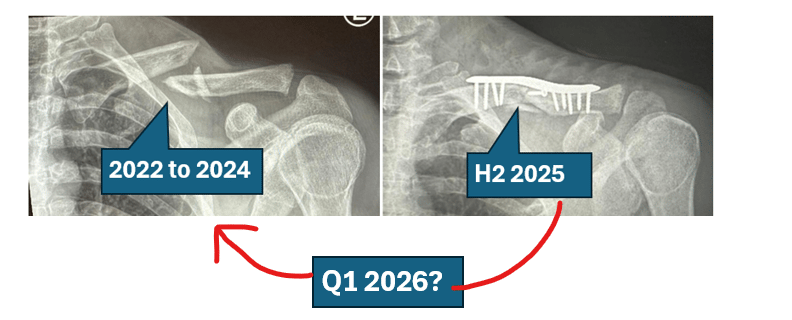
Is the market broken again?
What could be different this time?
Maybe this Iran conflict market freak out of the last few weeks is just a “tweaked hammy” or “dead leg” and recovery will only take a couple of weeks...
(like the markets liberation day tariff freakout that quickly came and went 12 months ago)

We hope so.
Trump appears to be using the Iran attacks as leverage to do a deal.
And we have seen this week how Trump tweets (or “truths”) about the conflict ending can move the markets up.
So hopefully a speedy end to the conflict and Trump tweeting us into the next phase of the bull market before mid-term election season kicks off in the second half of this year...
(or not - we certainly don't claim to know what's going to happen)
In the meantime, something interesting happened last night: for the first time since the Iran conflict started - oil, gold AND silver prices all went up together.
(safe haven metals finally safe-havening?)
This week we also saw a Melania Trump and AI robot moment at the White House:
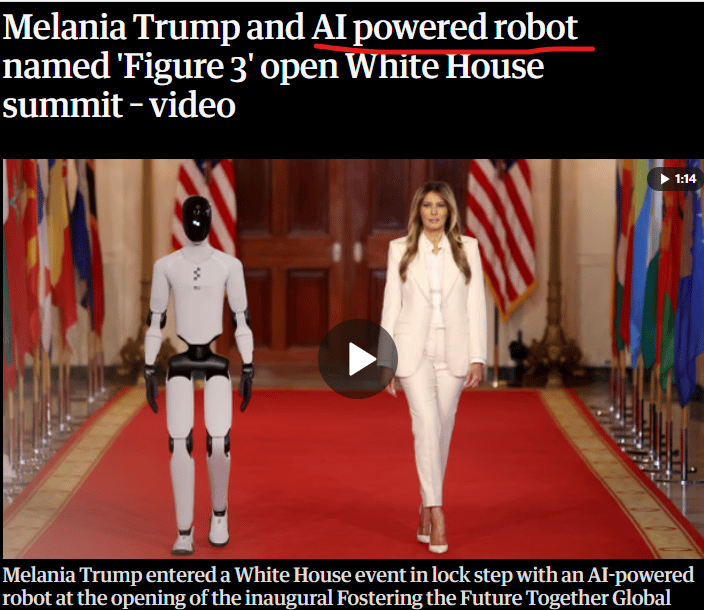
(source)
And NVIDIA's CEO and Founder Jensen Huang agrees with our SaaSpocalypse take (probably).
Let's see what's happening with our favourite macro themes...
What's happening with gold?
Something weird happened this week.
(weird based on the last few weeks, but actually more like “totally in line with traditional expectations” in the larger scheme of things)
For the last few weeks of the Iran conflict, gold and silver have been moving in an almost perfect inverse relationship with oil.
War escalating: Oil up, gold and silver down.
War de-escalting: Oil down, gold and silver up.
For the first time since the Iran war kicked off, last night oil, gold AND silver all went up together.
So why the inverse relationship until last night?
(we wrote about it in detail last week here)
One theory is that when oil surges, inflation expectations rise, rate cut hopes evaporate, and the US dollar strengthens - all of which are headwinds for gold.
But our working (preferred) theory is that investors and some central banks have been selling gold after the Iran conflict commenced... to raise urgent cash.
(with gold being a big juicy liquid asset in the portfolio to quickly free up cash.)
Investors needing quick cash to cover losses and margin calls in equities during the market crash.
Central banks selling gold to top up cash in war scenario (either that or print cash to pay for urgent, non budgeted stuff) OR selling gold to stabilise their local currency:
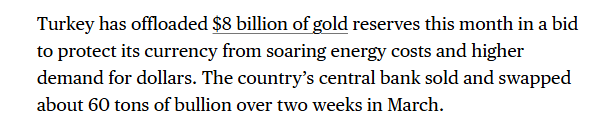
What does it mean now that oil, gold and silver all went up at the same time?
We don’t know...yet - one night is just a single data point.
When oil, gold and silver rise together during a conflict, it usually means the market is moving beyond a one‐off oil shock and toward a broader stagflation/credit‐stress story.
(Stagflation means high inflation, slow economic growth, and high unemployment)
Is the market now saying “this isn’t just an oil story any more, it’s a system‐wide stagflation and confidence story”?
In other words: has the correlation flipped from “oil vs precious metals” to “oil with precious metals”?
We’ll see...
So far gold has come off from US$5,400 when the conflict started to around US$4,500.
Quite the “dip”
(but still the highest it has EVER been aside from the first few months of this year)
And speaking of buying the dip, the legendary precious metals investor Rick Rule (45 years in the resources game) released a video this week titled "This Is The GOLD Buying Opportunity Most Investors Will Miss."
His take?
The US dollar is set to lose 75% of its purchasing power, the Treasury is running out of road, and this dip is "a generational entry point hiding in plain sight" (source).
Great advice Rick.
We'd love to be buying this dip too, but we already went fully deployed before the pullback and don't exactly have a mountain of cash sitting around to scoop up “bargains”.
(story of our lives - don’t worry, we love you Rick)
We think gold is still going to deliver a major run and are holding on during the current volatility.
Hopefully those option buyers at US$11,000 gold are right. (source)
Gold stocks we are Invested in:
- KAU - Gold producer in Victoria & Tasmania. Stage: Production.
- HAR - High-grade gold in California, USA. Stage: Exploration/Development.
- BMG - Gold in Western Australia. Stage: Exploration.
- BPM - Gold in Western Australia. Stage: Exploration.
- TTM - Gold & copper in Ecuador. Stage: Exploration/Development.
- MTH - Silver & gold in Mexico. Stage: Exploration/Development.
- RML - Gold, antimony & tungsten in Alaska & NT. Stage: Exploration.
- TG1 - Gold & copper in Western Australia. Stage: Exploration.
- PUR - Lithium & gold in Argentina. Stage: Exploration/Development.
- L1M - Gold, silver & lithium in WA, Brazil & Canada. Stage: Exploration.
- AVM - Silver & gold in Mexico. Stage: Exploration.
- BKB - Silver Texas and gold in Nevada, USA. Stage: Exploration/Development.
And silver?
Silver is following gold, but as usual, the moves are accentuated.
Silver ended at ~US$69 (hehe) this morning.
For context, silver hit an all-time high of US$121 in January and is now down 44% from that peak.
That's a savage pullback (after an equally savage run up).
But we've been listening to someone who predicted it.
Our favourite technical (momentum) analyst on silver (and gold) Michael Oliver totally got it right back in June 2025 on the silver triple top breakout when it stayed above US$36 (read it here - stroll down memory lane).
(thanks to another silver bull Simon Catt from Catt Calls for getting us onto Michael Oliver)
Michael has been spot on so far - he even called the current major pullback we are sitting in right now, describing it as a key part of getting to his predicted US$300 to US$500 silver price target.
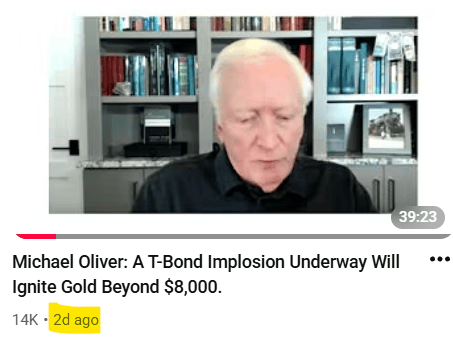
that's an extraordinary call - silver from US$69 to US$300-$500 in a few months - but he's been right so far, so we're listening.
We’ll take even half of that.
We still hold our silver positions, and are looking to add another in the coming weeks while sentiment is uncertain and prices are beaten up.
We still think silver is going up.
(keeping in mind that the silver price can go down as well as up - nobody has a crystal ball)
Silver stocks we are Invested in:
- SS1 - Silver & antimony in Nevada, USA. Stage: Exploration.
- IVR - Silver in South Australia. Stage: Development.
- BKB - Silver in Nevada, USA. Stage: Exploration/Development.
- AVM - Silver & gold in Mexico. Stage: Exploration.
- WCE - Silver in Western Australia. Stage: Growth.
- MTH - Silver & gold in Mexico. Stage: Exploration/Development.
- RCM - Silver in New South Wales. Stage: Exploration.
- PFE - Silver, antimony & lithium in Arkansas, USA. Stage: Exploration.
SaaSpocalypse? More like... RockSaaSship
We did say when we first wrote about the SaaSpocalypse a few weeks ago that we thought it was an overdone kneejerk freakout (read it here).
When you think about it, who is actually going to benefit from cheaper, 10x faster software development?
Companies that build software... Duuhhh.
BUT, not ALL software companies.
We have been saying for a long time:
"Companies developing genuine AI with over a decade of development efforts AND internal knowledge on how to apply AI to solve a specific and real world problem are rare on the ASX... “
"And in our view are the best positioned to leverage and apply the rapid recent advances in AI technology and tools to their specific sector of expertise.” (Read it here)
So it's the SaaS companies WITHOUT deep specialisation that are vulnerable. The ones solving generic problems with easily replicable solutions.
(and are overcharging for it)
But companies solving highly specialised problems?
The ones where the complexity isn't in the code but in deeply understanding a specific domain for years?
And companies who already have software in place with big customers, and trusted relationships into these organisations.
Those companies are the winners.
One of the world's smartest and most successful guys, NVIDIA founder and CEO Jensen Huang (head of the world's most valuable company) came out last week saying he basically agrees with us.
(surely he reads our Saturday emails...)
In his interview on (our favourite) the All-In Podcast, Jensen was incredibly bullish and positive on AI's future impact on the world, business and for humanity (source).
(noting too... says the guy selling all the AI chips)
Not all doom and gloom.
He talked about Physical AI being a US$50 trillion market, AI healthcare breakthroughs, and how robotics and AI will advance together.
On the SaaSpocalypse specifically, Jensen made the point that companies with deep, highly specialised problem definitions - the ones who have spent years understanding a specific domain - will be the winners.
The generic tool builders get disrupted. The specialists get supercharged.
Which is exactly what we've been saying
(great minds and all that... right?)
Here are our tech Investments that fit this thesis:
ROC (RocketBoots) - AI-powered retail analytics.
They've spent years defining the loss-prevention problem for major retailers, building internal AI trained on specific retail environments. They now have a $9.1M ARR contract with a Tier-1 global retailer, with their AI being deployed across 40% of the store network.
They've been defining this problem for years. Deeply embedded in their customers' workflows. Now AI is accelerating their solution, not disrupting it.
ONE (OneView Healthcare) - Patient engagement SaaS platform.
They've been defining the hospital patient experience problem for over a decade, building deep integrations with hospital systems across Ireland, Australia, and the US. Record revenue of $21.1M in FY25 with US expansion underway.
This is the kind of domain expertise that some guy vibe-coding in his bedroom can't replicate. You need YEARS inside a hospital to build this.
EIQ (Echo IQ) - AI heart diagnostics.
They've spent years building an AI solution for echocardiogram analysis (that's heart ultrasounds), recently secured FDA 510(k) clearance, and just revised their deal with the Mayo Clinic. This is exactly the kind of deeply specialised, decade-long problem definition Jensen is talking about.
They've been training their AI on cardiac imaging data for years. That dataset - and the clinical relationships that produced it - is the moat. Not the code.
So me and Jensen both think the SaaSpocalypse is overblown.
So does Reid.
You’ll probably know him better as LinkedIn founder Reid Hoffman, who published a piece this week called "Notes from the SaaS Funeral" where he made the point perfectly:
"The leap from 'the old SaaS model is being disrupted' to 'no one will sell software anymore' is a distinct flavor of foolishness" (source).
He also nailed (stole?) our thesis: "Customer lock-in takes on new meaning when an AI system has been trained and tuned on years of a company's specific workflows."
speaking of Reid...
I was just re-reading (get it?) Neuromancer by William Gibson this week.
(my last read was 20 years ago...)

It's a scifi book that is essentially what people in the 1980’s thought AI’s impact on the world would be like by 2035.
It’s about a powerful AI that quietly assembles, bankrolls and manipulates a crew of hackers, mercenaries, and guns‐for‐hire.
It uses them to get around legal and technical ring‐fences it’s not allowed to cross itself, effectively outsourcing the dirty work of making money, breaking rules, and consolidating power...
While the humans think they’re running a risky but lucrative job, not realising they’re just pawns in the AI’s growth strategy.
Fun fact: this book was one of the key inspirations for the Matrix movies... probably worth a rewatch of those soon too:
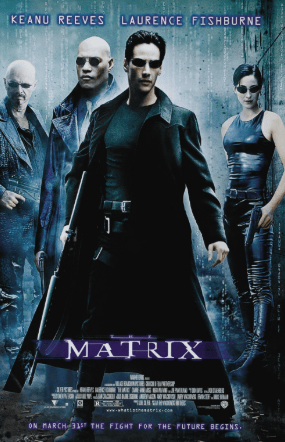
Imagine how much nickel, cobalt, rare earths (and probably antimony and tungsten... oh dear) would be needed to build even one sentinel from the Matrix movies:

Not to mention to build the Matrix data centre cities...

(we don't buy the main premise in the Matrix movies that humans will be used to power the datacentres, nuclear power is way more efficient... and as far as power source choices go, has a much lower chance to stage an “chosen one” led uprising and rebellion given that it isn’t sentient)
Neuromancer and the Matrix are pretty grim takes on an AI and robot future.
(the pop culture from our youth generally painted a pretty dystopian future for AI and robots... probably contributing to the current AI fears)
Jensen Huang, Elon Musk and many others have started outlining much more positive visions for humanity in recent weeks
(possibly in response to the global community’s freak out about the SaaSpocalypse and AI taking everyone’s jobs)
Anyway, whether for good or bad, we think AI is coming.
But to build AI we are gonna need a LOT of AI microchips AND data centres...
And the metals to build them.
The stuff you need to build AI, robots and data centres
So we are bullish on the metals and materials needed to build AI chips and data centres.
The numbers are staggering:
Building AI infrastructure requires 25-30+ metals and minerals across three layers - and every piece of it starts in the ground.
AI Chips use ~300 materials (source).
The critical ones: gallium, germanium, silicon, fluorspar, rare earths (neodymium, lanthanum, gadolinium, yttrium), arsenic, indium, tantalum, palladium, and platinum.
The US imports 75-100% of most of these - and China controls supply (source).
AI Data Centres embed 60-75 tonnes of minerals per megawatt (source).
Copper, silver, gold, tin, aluminium, steel, rare earths - all in massive quantities.
One Microsoft facility used 2,100 tonnes of copper alone (source).
A 25-30% copper shortfall is projected by 2035.
AI Robots need rare earth magnets (28-30+ motors each), copper (wiring, motors), lithium (~2 kg per unit), nickel, and cobalt.
At scale, S&P Global estimates 10 billion robots would require 100x current rare earth magnet production, 10x lithium, and 4x copper output - just for robots. (source)
New mines take ~18 years (source) from discovery to production.
The industry faces a $200B investment shortfall through 2030 (source).
As we wrote in our "AI Can't Mine" Saturday note (1 March 2026) (source): NVIDIA alone is worth 3x the top 50 mining companies combined.
Capital will flow to where the scarcity is - and that's metals.
You can't “will” a data centre or a robot into existence using AI.
You need actual, physical metal dug out of the ground.
AI Metals / Robot Metals stocks we are Invested in:
- AW1 - Copper & silver in Utah, USA & Canada. Stage: Exploration/Development.
- TG1 - Gold & copper in Western Australia. Stage: Exploration.
- TTM - Gold & copper in Ecuador. Stage: Exploration/Development.
- NC1 - Nickel & cobalt in Western Australia. Stage: Exploration/Development.
- SGQ - Rare earths & niobium in WA & Brazil. Stage: Exploration.
- CAY - Bauxite in Cameroon. Stage: Development.
- OD6 - Rare earths & fluorspar in WA. Stage: Exploration.
- ION - Battery recycling. Stage: Development.
- LKY - Antimony & rare earths in NSW & Arizona. Stage: Exploration/Development.
- PNN - Rare earths & lithium in Argentina & Brazil. Stage: Exploration/Development.
- LSR - Gold, copper & rare earths in WA, Arizona & Chile. Stage: Exploration.
Robot story of the week
Speaking of AI and robots...
This week, First Lady Melania Trump walked into a White House education summit alongside a humanoid robot.
Not a joke.

(source)
The Figure 03 robot, faceless and walking mechanically beside the First Lady - then greeted attendees in multiple languages:

We note that this USA robot wasn't doing any sick backflips like the Chinese robots from a few weeks ago:

(source)
Back in February we wrote about how China has kinda got the jump on the USA (pun intended) in the race to build autonomous AI robots.
The USA has actually been building robots for a long time, way ahead of China...
But this was before the robots could be given a proper “brain”.
That's changed now.
AI IS the brain.
Our “mate” and man of the moment NVIDIA’s Jensen Huang said:
“The U.S. actually pioneered this industry (robotics), but we entered too early and were exhausted five years before the enabling technology (the AI brain) emerged.
But now, the brain technology is ready.
From the emergence of high‐functioning prototypes to the actual release of viable products, it typically takes only two to three cycles, meaning that within approximately three to five years, we will see robots everywhere.”
(source)
He’s essentially saying the U.S. was building robots too early, before AI was developed enough to be the brain.
So don’t discount the USA in the robot race just yet...
And for those of you waiting for the... uh... more intimate applications of AI robotics, you'll have to wait a bit longer.
OpenAI indefinitely shut down its “erotic adult chatbot” plans this week after staff and investors raised concerns (source).
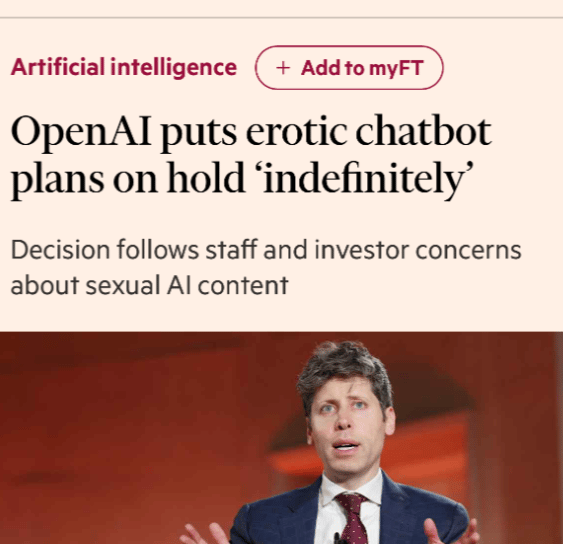
(source)
(yeah, probably a good idea to shelve that one)
One nail in the coffin for our dystopian prediction of universal basic income, Netflix and sexbots for humanity once AI takes all our jobs?
US military metals
We wrote extensively last week about the staggering amount of ammunition (missiles) being used up in the Iran conflict.
803 missiles in a single day, 5,197 munitions by Day 4, costs passing US$11.3 billion by Day 6 (Read it here).
The key point:
You can have all the money in the world to order new missiles, but if you can't get the antimony for the primers, the rare earths for the guidance systems, or the tungsten for the penetrators, the money is irrelevant.
This week, the conflict continued:
Trump announced he will hold off on attacking Iran's energy facilities until April 6, extending a 48-hour deadline and saying talks are "progressing very well" (source).
(Iran denies there are any talks, so... interpret that how you will)
We still hold our military minerals positions.
Panic selling small caps during global chaos events is something we've been through before (Tariff Liberation Day being the most recent example)
And every time the market has eventually recalibrated.
We just have to ride out the panic, like we always do.
(we just hang on and pray that we are right in the long term... works for us but might not be right for everyone)
US Military Minerals stocks we are Invested in:
- SS1 - Silver & antimony in Nevada, USA. Stage: Exploration.
- AL3 - Additive manufacturing (3D printing) in SA & Ohio. Stage: Growth.
- RML - Gold, tungsten & antimony in Alaska. Stage: Exploration.
- LKY - Antimony & rare earths in NSW & Arizona. Stage: Exploration/Development.
- AW1 - Copper & silver in Utah & Canada. Stage: Exploration/Development.
- VKA - Tungsten & gold in Nevada. Stage: Exploration/Development.
- ION - Battery recycling in South Australia. Stage: Development.
- LSR - Rare earths in Arizona. Stage: Exploration.
- OD6 - Fluorspar & rare earths in WA. Stage: Exploration.
- SGQ - Rare earths & niobium in WA & Brazil. Stage: Exploration/Development.
- PFE - Silver, antimony & lithium in Arkansas. Stage: Exploration.
- PNN - Rare earths & lithium in Argentina & Brazil. Stage: Exploration/Development.
Speaking of military stuff
The USS Gerald R. Ford, the US Navy's most advanced aircraft carrier, had to leave the Iran conflict and pull into port in Crete this week for repairs after a fire broke out in the ship's laundry room on March 12 (source).
The USS Gerald R. Ford has been plagued by persistent reliability and maintenance problems with key new systems (EMALS, arresting gear, weapons elevators, radar) plus chronic sewage/toilet failures that hurt crew morale and operations. (source).
If you ever needed a reminder of how hard naval sustainment and shipbuilding actually is - that's it.
Which brings us to our Investment AL3 which has done two deals in two weeks totalling $12.5M in new orders from the US defence industrial complex (read it here):
- $9.9M order from HII/Newport News Shipbuilding - America's largest military shipbuilder - for ARCEMY 3D printing systems. AL3's biggest order to date.
- $2.6M order for US Navy submarine parts - 3D printing five components that the original manufacturer no longer makes. The US Navy literally can't source these parts from anyone else.
The US Navy aims to reach three submarines per year by 2028, up from a current average of 1.2. The US Department of War's FY2026 budget allocated US$3.3 billion for additive manufacturing - which is exactly what AL3 does.
And while we're talking about defence...
Here's a quick segue from missiles to microbes.
Our Investment ILA is working to fill the gap in the US biodefense stockpile.
Marburg disease - the only unfilled Category A bioterror threat - was previously weaponised by the Soviet Union and has no current vaccine or FDA-approved treatment.
ILA's drug Galidesivir has shown up to 94% survival in animal tests (versus 0% for placebo), and ILA recently signed an R&D contract with USAMRIID - the US Army's top biowarfare lab (source).
With the 2025 US Threat Assessment highlighting Iran's biological and chemical weapons R&D, the timing feels relevant.
Looking ahead
The market is in one of those "intense uncertainty" periods where everything gets sold indiscriminately.
Broken collarbone? Hopefully just a tweaked hamstring.
We've been here before. Tariff Liberation Day. COVID crash. Every time, the initial panic selling gives way to clarity, and then the sectors that actually benefit from the chaos start to move.
We still think the gold, silver, and US critical minerals themes will be strong over the coming years.
(not to mention AI metals and robot metals)
Trump is tweeting about winding down the Iran conflict.
When he does, Oil futures price in a resolution. If that happens, rate cut hopes come back, gold and silver rip higher, and the small end of the market does what it does best - rebounds hard.
Or things could get worse. Nobody knows.
But we're positioned for the themes we believe in, and we're holding.
See you next week, and have a great weekend
Next Investors
General Information Only
This material has been prepared by StocksDigital. StocksDigital is an authorised representative (CAR 000433913) of 62 Consulting Pty Limited (ABN 88 664 809 303) (AFSL 548573).
This material is general advice only and is not an offer for the purchase or sale of any financial product or service. The material is not intended to provide you with personal financial or tax advice and does not take into account your personal objectives, financial situation or needs. Although we believe that the material is correct, no warranty of accuracy, reliability or completeness is given, except for liability under statute which cannot be excluded. Please note that past performance may not be indicative of future performance and that no guarantee of performance, the return of capital or a particular rate of return is given by 62C, StocksDigital, any of their related body corporates or any other person. To the maximum extent possible, 62C, StocksDigital, their related body corporates or any other person do not accept any liability for any statement in this material.
Conflicts of Interest Notice
S3 and its associated entities may hold investments in companies featured in its articles, including through being paid in the securities of the companies we provide commentary on. We disclose the securities held in relation to a particular company that we provide commentary on. Refer to our Disclosure Policy for information on our self-imposed trading blackouts, hold conditions and de-risking (sell conditions) which seek to mitigate against any potential conflicts of interest.
Publication Notice and Disclaimer
The information contained in this article is current as at the publication date. At the time of publishing, the information contained in this article is based on sources which are available in the public domain that we consider to be reliable, and our own analysis of those sources. The views of the author may not reflect the views of the AFSL holder. Any decision by you to purchase securities in the companies featured in this article should be done so after you have sought your own independent professional advice regarding this information and made your own inquiries as to the validity of any information in this article.
Any forward-looking statements contained in this article are not guarantees or predictions of future performance, and involve known and unknown risks, uncertainties and other factors, many of which are beyond our control, and which may cause actual results or performance of companies featured to differ materially from those expressed in the statements contained in this article. S3 cannot and does not give any assurance that the results or performance expressed or implied by any forward-looking statements contained in this article will actually occur and readers are cautioned not to put undue reliance on forward-looking statements.
This article may include references to our past investing performance. Past performance is not a reliable indicator of our future investing performance.