Power Minerals (ASX:PNN) owns 100% of advanced stage rare earths project in Brazil. The project sits on a "Manifesto de Mina" mining title which has no expiry date and requires only environmental permits to put into production. The project has some of the highest grade rare earth drill intercepts we have seen of any company listed on the ASX.
What is the macro theme?
China controls ~90% of the world's rare earth magnet supply chain and has placed the most valuable magnet rare earths behind export restrictions.
Especially - neodymium, praseodymium, dysprosium and terbium.
The four magnet rare earths that make up >80% of the market value of all rare earths used in magnets for EVs, robots, drones, defence systems and AI data centre hardware.
Brazil is home to the world's second largest rare earth reserves - we think the US will lean into Brazilian rare earth project to secure its own supply chains.
Our Big Bet for PNN
“PNN makes an economic discovery on either of its US or Brazilian rare earths projects and re-rates 1,000% from our Initial Entry Price”
NOTE: our “Big Bet” is what we HOPE the ultimate success scenario looks like for this particular Investment over the long term (3+ years). There is no guarantee that our Big Bet will ever come true. There is a lot of work to be done, many risks involved, including development risk, country risk and commodity price risk - just some of which we list in our PNN Investment Memo.
Success will require a significant amount of luck. Past performance is not an indicator of future performance.
Why did we invest in PNN?
Rare earths as an exposure to AI and Robotics
Rare earths are a group of 17 metals, a small group of them - neodymium, praseodymium, dysprosium and terbium - are used to make the strongest permanent magnets on earth.
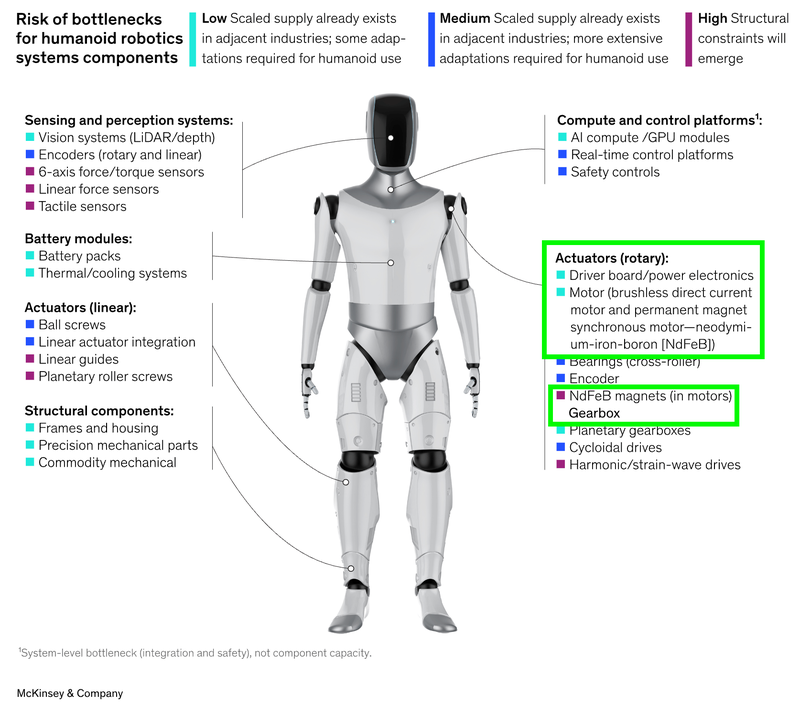
Those magnets are in EV motors, wind turbines, robots, drones, fighter jets, guided missiles, smartphones and the cooling systems of AI data centres.
There are no commercial substitutes.
An F-35 contains ~400kg of rare earth materials. A single EV uses 1-2kg of rare earth magnets. A humanoid robot is expected to use more.
PNN's project is advanced stage (an existing discovery)
PNN’s project has passed the exploration stage with ~156 holes drilled into it.
It has already had 50 drill holes for a total of over 4,000m of diamond core drilling AND 106 holes for a total of 846.5m of auger drilling.
The existing discovery de-risks the asset from an exploration perspective and gives PNN something to expand.
PNN’s project has some of the highest rare earth grades we have seen on the ASX
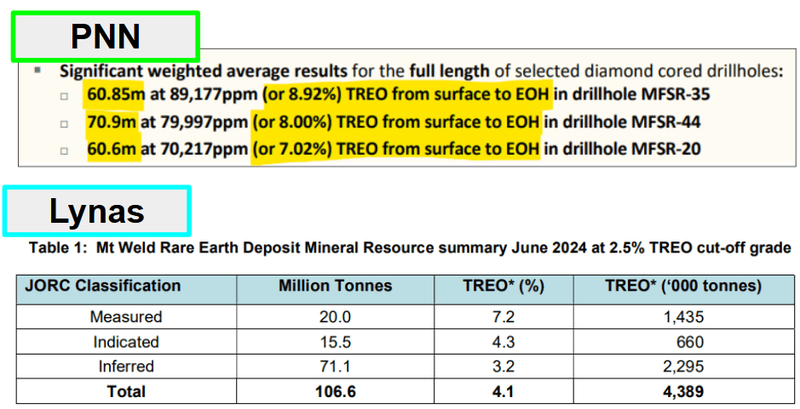
Historic drilling at Morro do Ferro returned 60.85m at 8.92% TREO, 70.9m at 8.00% TREO and 100.44m at 4.99% TREO - all from surface to the end of the hole.
For context $18BN Lynas Rare Earths project (which is the highest grade on the ASX) has a resource with an average grade around ~4.1% TREO.
The grades are rich in the rare earths that actually matter
PNN’s due diligence confirmed MREO values up to 3.53% of whole rock - and one hole averaged 1.47% MREO over its entire 60.85m length, a higher magnet rare earth grade than the total rare earth grade of many deposits globally.
The four magnet rare earths (MREO) - Nd, Pr, Dy, Tb - account for more than 80% of the market value of all rare earths.
They are the ones that go into humanoid robots, drones, jet fighters, missile guidance systems, naval propulsion, next-gen submarine sonar, AI data storage & displays.
PNN’s project has a special type of mining title - “Manifesto de Mina"
A "Manifesto de Mina" is a legacy Brazilian mining title with no expiry date that already grants the right to mine, with only environmental permitting required to move to production. (source)
PNN also owns the freehold land above the deposit, so there are no third-party landholders to negotiate with.
We think the special type of license means IF PNN can define a large enough resource to put the project into production it can get to a decision point a lot quicker than other rare earths projects globally.
Geology analogous to the world’s highest grade operating rare earths mine
PNN says that its project's mineralisation is hosted in bastnäsite - the same well-understood mineral processed for decades at MP Materials' ~A$14BN Mountain Pass operation in California.
That gives the metallurgical workstream a meaningfully better starting point than most early-stage rare earths projects.
Brazil has an established mining industry - Minas Gerais (the state where PNN’s project sits in) literally translates to "General Mines" - the state was founded on mining and has hosted it for over 300 years.
This is not a frontier jurisdiction. The workforce, the drilling contractors, the labs, the infrastructure and the regulator all exist at scale.
Some of our biggest wins have come from companies with projects in Brazil (both of them also being in Minas Gerais):
Latin Resources - which made a lithium discovery in Brazil and went from ~3c to a high of ~45c per share - at its peak LRS returned 2332% for us. Eventually the company was taken over by Pilbara Minerals in a deal worth ~$560M.
St George Mining (ASX: SGQ) - We Invested in SGQ at 2.5c when it first acquired its rare earths project in Brazil. At its peak SGQ was up 620% for us - now it trades at 11c per share - still 340% above our Initial Entry Price.
Brazil matters for US critical minerals independence
China still controls ~90% of the world's rare earth magnet supply chain.
For the heaviest, most valuable rare earths like dysprosium and terbium, China controls ~98-99% of refined supply.
The US is pouring capital into Brazil to try and solve its domestic rare earth supply chain dependency issue.
Brazil is home to the world's second biggest rare earth reserves (behind only China).
So far committed more than US$565M to Brazilian critical minerals projects and just last month US listed USA Rare Earths agreed to a US$2.8BN takeover of a producing rare earths mine in Brazil. (source)
Both of PNN's Brazilian projects sit in states (Minas Gerais and Goiás) that have been in talks to sign critical minerals cooperation agreements with the US. (source)
We think more of these type deals between the US and Brazil are possible for rare earths assets.
The "SGQ 2.0" set-up
PNN's deal has a lot of similarities to the deal our Investment SGQ did for its asset in 2024.
SGQ paid a similar amount for its project AND the same corporate advisor behind SGQ is behind PNN.
SGQ re-rated from ~2.5c to a high of 18c and is now capped at ~$435M.
We are hoping some of the capital from people who had a winner with SGQ finds its way into PNN as it proves out its asset.
PNN’s project also has Ionic clay optionality
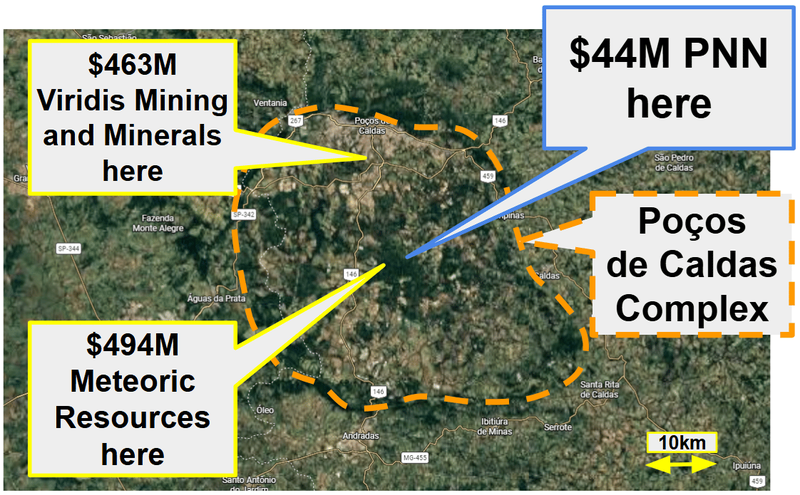
Parts of PNN's ground trend toward its neighbours' ionic clay deposits - the style of rare earths mineralisation the ASX understands well with PNN’s two neighbours - $463M Viridis and $494M Meteoric.
IF PNN defines an ionic clay resource on top of its existing discovery then it could all of a sudden draw comparisons to its project and that of Viridis and Meteoric.
What do we expect PNN to deliver?
Objective #1: Objective #1: Drilling at rare earths project (Morro do Ferro)
We want to see PNN drill out its project and extend its deposit at depth and along strike.
Milestones
Acquisition completed
Drilling started
First assay results
Objective #2: Objective #2: JORC resource for rare earths project (Morro do Ferro)
We want to see PNN define a maiden JORC resource estimate for its project in Brazil.
Milestones
PNN to test the ionic clay potential of the project
Metallurgical testwork results
Resource drilling completed
Maiden JORC Mineral Resource Estimate
Objective #3: Objective #3: Permitting and development progress (Morro do Ferro)
We want to see PNN complete environmental permitting and move the project closer to development.
We are also hoping to see the project attract corporate/strategic or offtake interest either from inside the US or internationally.
Milestones
Environmental permitting
Economic/development studies
Corporate/strategic/offtake interest
Objective #4: Objective #4: Progress at PNN’s other Brazilian rare earths/niobium project (Santa Anna)
We want to see PNN spend most of its time/capital on its main asset (Morro De Ferro) but would also like to see its other asset move to at least a maiden JORC resource.
Milestones
Maiden resource estimate preparation
What could go wrong?
Exploration risk
All of Morro do Ferro's headline grades were drilled by previous owners, mostly in shallow holes. The project has no JORC resource yet. IF PNN's drilling fails to confirm the historic grades, or the deposit doesn't extend, the investment thesis takes a direct hit and we would expect the share price to re-rate lower.
Metallurgical risk
High grades mean nothing if the rare earths can't be economically extracted. Bastnäsite is well understood, but every deposit's metallurgy is unique - recoveries, impurities and processing costs could be a lot higher than other well understood deposits making it challenging to develop the asset.
Funding & dilution risk
PNN has staged acquisition payments of up to ~$25.4M ahead of it, plus drill programs across multiple projects. As a pre-revenue explorer, future raises are likely - potentially at a discount, diluting existing shareholders.
Commodity price / macro risk
Rare earths equities are running on geopolitics. A durable US-China trade detente, or a public failure of US-Brazil minerals cooperation, could pull sentiment (and capital) out of the sector quickly - hitting early-stage explorers hardest.
Permitting & jurisdiction risk
The Manifesto title removes mining-licence risk, but environmental permitting is still required to develop the project. Regulatory changes, permitting delays or political shifts in Brazil could slow the path from drilling to development.
Market risk
Broader market sentiment could deteriorate, and shares as an investment class trade lower, taking PNN's share price with it. Junior explorers typically fall harder than the broader market in risk-off periods.
What is our investment plan?
We are Invested in PNN to see it progress its project toward development.
PNN sits in our Catalyst Hunter Portfolio.
Our plan is to hold PNN in line with our Trading Blackout and hold conditions for the Catalyst Hunter Portfolio - which we hope is enough time to see PNN to move towards either development, strategic investment or acquisition (see “our long term bet” above).
After 12 months we will apply our standard de-risking strategy.
We may also look to sell up to 20% of our holding if the company delivers on one or more of our Investment Memo objectives and/or the share price materially re-rates.
Any sell downs will be in accordance with our trading and hold policy disclosure.
Check out the detailed hold conditions for our Catalyst Hunter Portfolio here.
Disclosure: Disclosure: S3 Consortium Pty Ltd (the Company) and Associated Entities own 7,338,223 PNN Shares and 4,399,786 PNN Options at the time of publishing this article. The Company has been engaged by PNN to share our commentary on the progress of our Investment in PNN over time. This information is general in nature about a speculative investment and does not constitute personal advice. It does not consider your objectives, financial situation, or needs. Any forward-looking statements are uncertain and not a guaranteed outcome.
Investment Memo:
Power Minerals Ltd
(ASX:PNN)
-
LIVE
Opened: 08-Oct-2025
Shares Held at Open: 7,186,000
Options Held at Open: 3,675,500
What does PNN do?
Power Minerals (ASX:PNN) owns a portfolio of exploration projects including:
Rare earths in California, USA - early stage project where PNN is exploring for light and heavy rare earths in California 195km away from America’s only rare earths producing mine Mountain Pass owned by MP Materials.
Rare earths in Brazil - PNN is aiming to unlock a hard rock carbonatite hosted rare earths discovery similar to two of the biggest operating rare earth deposits in the world owned by Lynas Rare Earths and MP Materials projects.
Lithium in Argentina - PNN’s most advanced assets with a combined 714,864kt LCE JORC resource estimate across three projects.
What is the macro theme?
Critical minerals and US-based projects are attracting attention and capital.
Trump is now looking to adopt pandemic-era level urgency to boost critical minerals production in the US.
With Trump signing Executive Orders to encourage US domestic critical metals production, fast track permitting and providing funding for mining projects private interest and capital has followed into the sector.
PNN has exposure to:
Rare earths - a set of niche minerals used in the production of magnets for various military applications and AI.
Lithium - a critical component for lithium-ion batteries, leveraged to electrification, energy storage and electric vehicle update.
Our Big Bet for PNN
“PNN makes an economic discovery on either of its US or Brazilian rare earths projects and re-rates 1,000% from our Initial Entry Price”
NOTE: our “Big Bet” is what we HOPE the ultimate success scenario looks like for this particular Investment over the long term (3+ years). There is no guarantee that our Big Bet will ever come true. There is a lot of work to be done, many risks involved, including development risk, country risk and commodity price risk - just some of which we list in our PNN Investment Memo.
Success will require a significant amount of luck. Past performance is not an indicator of future performance.
Why did we invest in PNN?
PNN has a US critical minerals project
PNN’s US project is 195km away from A$20BN MP Materials. More importantly, it's got heavy rare earth exploration potential (the less common and more valuable type of the rare earth materials). Both types of rare earth are needed for advanced magnet production the USA is seeking to onshore.
Strong macro theme #1: Capital is flowing into US critical metals macro thematic
We think PNN’s US rare earths project could attract increased capital flows into PNN.
We have seen this play out in other stocks where they list on the OTC, attract US attention and eventually capital.
PNN has a REE project in Brazil
PNN also has a rare earths asset in Brazil that we think could mirror a project that the market is really liking right now (SGQ’s project)
Strong macro theme #2: Capital is flowing into Brazilian rare earths projects looking for “the next SGQ”
We have had success with Brazilian rare earths assets before with SGQ which is up 500% in the last 9 months, and there will be investors who have made cash (and ones who missed SGQ) looking for “the next SGQ”. We think some of this cash could come into PNN.
(the past performance is not an indicator of future performance)
IF PNN attracts capital and re-rates to a valuation high enough it could acquire more advanced assets
IF PNN can attract enough capital with its current portfolio of assets, it can use its re-rated valuation to acquire more advanced assets.
We are Investing alongside Tribeca Investment Partners
Tribeca has come into three of our recent Investments - LKY (up 626% at its peak), AVM (up 250% at its peak) and RCM (up 151% at its peak).
We like their approach to resources investing and they have deep pockets.
The past performance is not an indicator of future performance.
We think it's the right time in the bull market cycle to get some exposure to exploration stocks
We think it's the right time to get set in junior explorers with new assets.
We think the next 6-9 months will see institutional capital finally coming back into the exploration sector after years of a capital drought.
We expect those capital inflows to increase the valuation of explorers with projects in the right commodities and the right parts of the world (like rare earths in the US or Brazil).
PNN also has advanced assets in an out of favour sector
PNN has advanced lithium projects in Argentina with one of them even having a Preliminary Economic Assessment done that shows an after-tax Net Present Value of US$308.8M.
We think that IF sentiment improves in the lithium sector these assets could justify PNN’s current valuation.
Uranium free kick on the new US project
All of the old exploration was focused on uranium - mind you that old drilling found uranium over at least 2km with grades as high as 1.3% in drilling and 1.786% in rock chips.
Gold free kick on the new US project
PNN’s new US asset was initially explored for gold. We could see PNN go back and look at the gold potential of the project.
What do we expect PNN to deliver?
Objective #1: Target Generation on US rare earths project
We want to see PNN sample, map and run geophysics on its US asset to identify priority drill targets.
Milestones
Mapping and sampling (soil and rock chips)
Geophysics
Drill targets confirmed
Objective #2: Drilling on PNN’s US rare earths project
After PNN has identified priority drill targets, we want to see the company drill the project.
Milestones
Drill permitting
Drilling
Objective #3: Macro objectives
We want to see PNN go after fast tracked permitting and non-dilutive funding opportunities that are available for US critical minerals projects.
Milestones
Fast-tracking permitting
Non-dilutive US critical minerals funding opportunity applications
Objective #4: Drilling at Brazilian rare earths project
We want to see PNN drill out and define a maiden JORC resource estimate in Brazil to enable comparison to peers.
Milestones
Geophysics/Geochemistry work
Drilling starts
Drilling results
Maiden JORC resource estimate
Objective #5: (Bonus): PNN uses its market cap to acquire more advanced assets
This one would be an unexpected surprise to the upside (depending on what assets PNN can acquire).
What could go wrong?
Commodity price risk
The performance of commodity stocks are often closely linked to the value of the underlying commodities they are seeking to extract. Should rare earths prices fall, this could hurt the PNN share price.
Permitting Risk
PNN will need to get permitting in order for its rare earths project in the US. If this permit is delayed or rejected it may be a drag on the PNN share price.
Funding risk/dilution risk
As a pre-revenue small cap company, PNN is reliant on capital markets to advance its projects. If something negative happens at a macro or company level, PNN could struggle to access capital on favourable terms.
These capital raises may take place at a discount, and result in the issuance of new shares which incur dilution to existing shareholders.
Market risk
Broader market sentiment could deteriorate, and shares as an investment class trade lower, taking PNN’s share price with it. Alternatively, there could be further sector specific pain ahead where junior explorers suffer a lot more than the broader market.
PNN is an early-stage explorer with projects in the USA, Brazil, and Argentina. None are producing, and there is no certainty exploration will lead to an economic discovery.
The company’s value is highly exposed to sentiment in the rare earths and lithium markets. Prolonged weakness in these commodities could affect funding access and share price performance.
As a pre-revenue small cap, PNN depends on capital raisings to advance its projects. Any new equity issues may dilute existing shareholders, and financing may not always be available on favourable terms.
Multi-jurisdiction operations bring permitting and regulatory risks, including possible delays or policy changes that could affect project timelines.
Finally, general market or sector downturns could impact PNN’s share price regardless of company progress.
Investors should consider these risks carefully and seek professional advice before investing.
What is our investment plan?
We are adding PNN to our Catalyst Hunter Portfolio.
PNN is an early stage, small cap, high risk, high reward Investment.
In 12 months, a discovery on either of two rare earths projects OR a bull market in the lithium space will mean our Investment in PNN pays off.
There is no guarantee PNN finds anything of value, but if they do then we would hope to see its share price re-rate to a level multiples of our Initial Entry Price.
If none of the three scenarios happen, then we fully acknowledge that we may be down on our Investment.
Check out the detailed hold conditions for our Catalyst Hunter Portfolio here.
Disclosure: Disclosure: S3 Consortium Pty Ltd (the Company) and Associated Entities own 7,186,000 PNN Shares and 3,675,500 PNN Options at the time of publishing this Investment Memo. Some shares and options are subject to shareholder approval. The Company has been engaged by PNN to share our commentary on the progress of our Investment in PNN over time. This information is general in nature about a speculative investment and does not constitute personal advice. It does not consider your objectives, financial situation, or needs.




 Acquisition completed
 First assay results
 Maiden resource estimate preparation