PNN: How’s this hit...
Disclosure: S3 Consortium Pty Ltd (the Company) and Associated Entities own 7,338,223 PNN Shares and 4,399,786 PNN Options at the time of publishing this article. The Company has been engaged by PNN to share our commentary on the progress of our Investment in PNN over time. This information is general in nature about a speculative investment and does not constitute personal advice. It does not consider your objectives, financial situation, or needs. Any forward-looking statements are uncertain and not a guaranteed outcome.
The biggest rare earths mines outside of China are owned by Lynas Rare Earths and MP Materials.
These companies are the West’s only option to buy the rare earths needed to build robotics, AI and advanced military weapons whenever China decides to withhold rare earth supply....
One is owned by the ~$15BN ASX listed Lynas Rare Earths.
The other is owned by the ~$10BN NYSE listed MP Materials.
Lynas’ mine averages grades of ~4.1%, MP’s mine averages ~8%.
So when it comes to rare earth grades, 4% is very very good.
8% is incredible, and anything above that is almost exclusive to MP’s mine in California.
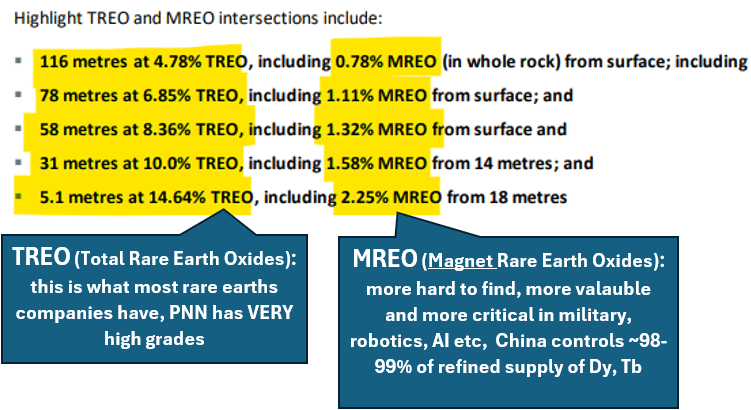
Well, this morning, $46M capped Power Minerals (ASX:PNN) just hit the following from its advanced stage project in Brazil:
(source)
Excellent over 116m... and a ~31m intercept sitting in that elite level basket.
One of the strongest single intercepts we have seen from a rare earths project on the ASX before.
One hole does not make a mine, but this is an excellent start, plus PNN has some high grade historical hits too.
Those billion dollar rare earths producers have been able to define resources at those 4.1% and 8% grades and get into production.
PNN still has another two holes in the lab for assays, a second rig on site and more drilling to come.
With a maiden JORC resource estimate targeted by the end of the year.
As expected from historic drill cores, the Magnet Rare Earth Oxide (MREO) grades on this hole also came in strong.
PNN's first hole returned up to 3.66% MREO over a 2m sample - and 31m at 1.58% MREO.
The four magnet rare earths (ie MREO) account for more than 80% of the market value of all rare earths. (source)
Magnet rare earths are the valuable ones that go into humanoid robots, drones, jet fighters, missile guidance systems, AI data storage and quantum computing.

PNN’s 31m drill intercept has a MAGNET rare earth grade higher than the TOTAL rare earth grade of many deposits globally.
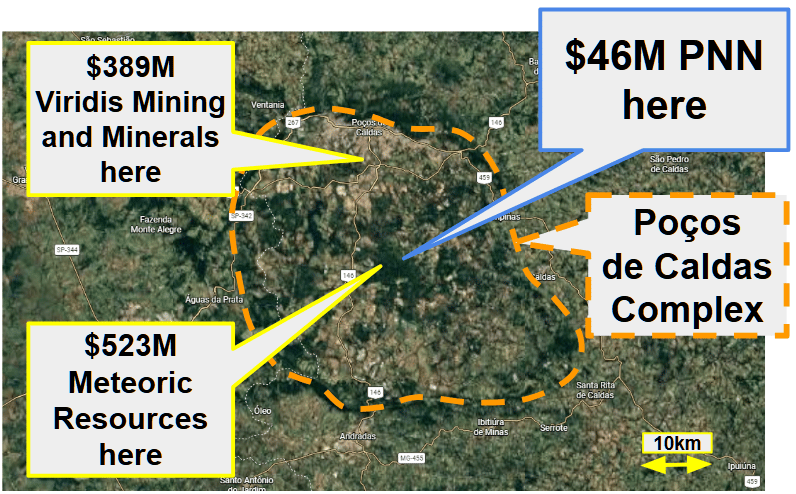
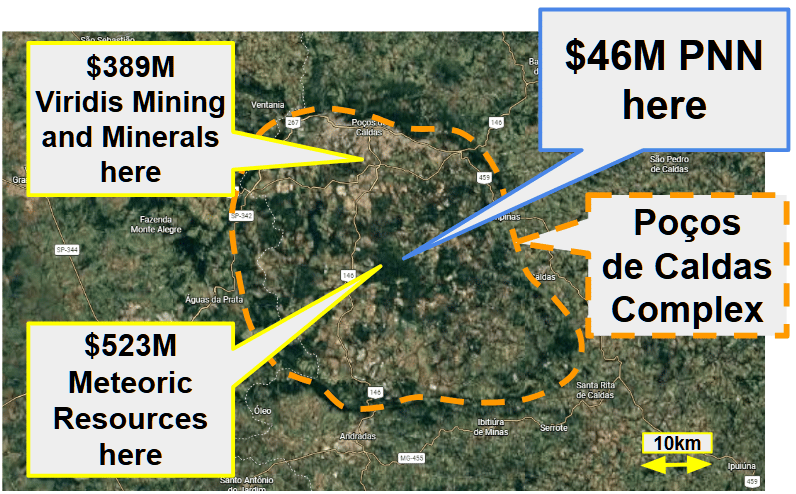
For context - PNN’s two neighbours $523M Meteoric and $389M Viridis’ projects have average TREO grades of 0.23% and 0.25% respectively. (source)(source)
Here is where PNN sits relative to $523M Meteoric and $389M Viridis:
(source)
PNN’s MREO grades are ~5x higher than those numbers and PNN’s TREOs are almost 20x bigger.
Unexpectedly... PNN also got a surprise win at the bottom of its first hole.
Historical drilling never drilled as deep as PNN did - so the gallium hits are completely new data...
Gallium is another critical mineral used in semiconductors and military radar which China banned exports of back in December 2024.
The gallium started toward the end of hole and grades were really starting to pick up right at the end averaging 51.7g/t:
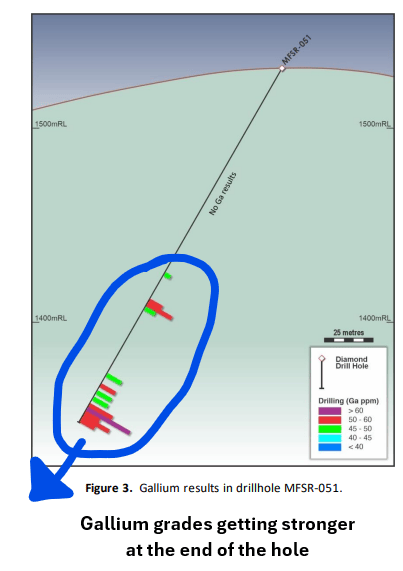
Early days here on the gallium, and again, it's only one hole, but we’ll take a high grade gallium hits sitting above some of the highest rare earth grades we have ever seen.
Especially with MAGNET rare earths - these are generally the harder to find.
High grades... MREO’s... strongest on the ASX... similar to $14BN Lynas and $10BN MP... a lot of positives from the first hole.
But why should we care about PNN’s result right now?
Because in ~100 days, on the 10th of November 2026 China’s rare earth export bans come into play.
Remember last year when the USA agreed to a 12 month tariff truce with China because they threatened to withhold rare earths supply? That “pause” ends in 4 months.
And because China still controls ~90% of the world's rare earth magnet supply chain. (source)
For the heaviest, most valuable rare earths like dysprosium and terbium, China controls ~98-99% of refined supply. (source)
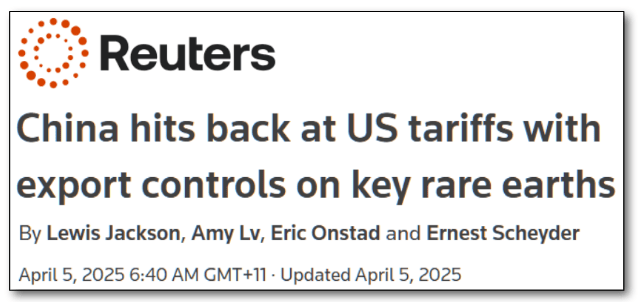
China announced these export restrictions in April 2025 (in response to Trump’s tariff threats):
(source)
Those bans were put on PAUSE as part of the US-China trade truce in November 2025.
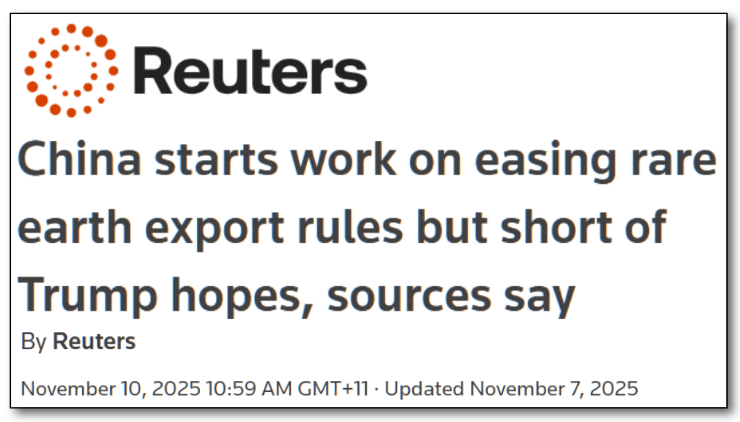
(source)
And that pause ends on the 10th of November this year.
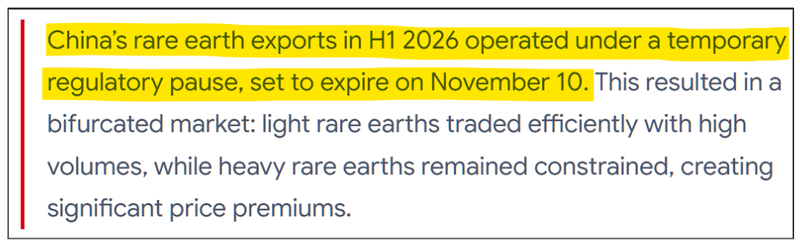
(source)
Right now dysprosium and terbium (two of PNN's four magnet metals) still need case-by-case export licences out of China.
And just a few weeks ago, effective immediately, China banned exports of “dual-use items” to US defence contractors including two US rare earths companies:


(source)
Rare earths are considered “dual-use” items:
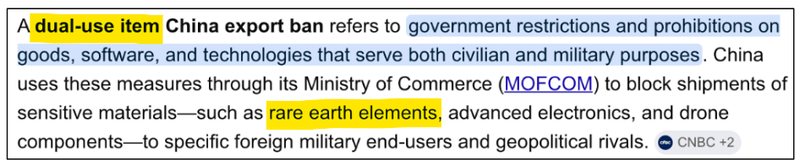
(source - we google’d dual-use item China ban)
We think PNN’s got the right asset, at the right time, in the right place
A very high grade, advanced rare earths asset, sitting on a fully permitted special mining license in Brazil’s “Poços de Caldas”.
Brazil is home of the world's second biggest rare earth reserves (behind only China). (source)
And the region PNN’s project sits in is a rare earth hotspot inside Brazil - it even featured in this Wall Street Journal article which called it the "new front" for rare earths:

(source)
There is also corporate precedent for interest in Brazilian assets:
- The US$2.8BN USA Rare Earth's takeover of Serra Verde - the only large-scale producer outside Asia producing rare earths from ionic clays. The deal comes with a 15-year US government supply agreement including a price floor. (source)
- A US$250M letter of interest from the Export-Import Bank of the United States (EXIM) to PNN's next door neighbour Meteoric Resources for its Caldeira project. (source)
$14BN Lynas Rare Earths CEO has publicly said they are looking at Brazil for rare earths assets.
Here is what former Lynas CEO Amanda Lacaze said when asked about Brazilian deposits:
"Yes there are deposits there, yes there are deposits in Brazil. Yes we are looking at them." (source)
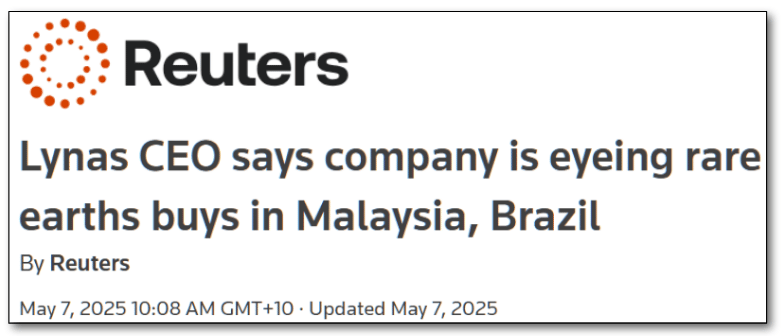
(source)
Even the EU is looking to do a Brazil minerals deal:

(source)
So there is definitely a group of important global capital allocators that are open to cutting cheques for Brazilian assets.
Which could mean they see PNN’s announcement today...
Maybe a few of them sit forward in their chairs to read the announcement and even go onto watchlist PNN - we will take that.
IF PNN’s next few holes show more of the same, then that interest could grow too.
Especially given those grades are right up there with two of the west’s only operating rare earths mines.
PNN’s grades rank with $10BN MP and $14BN Lynas’ assets
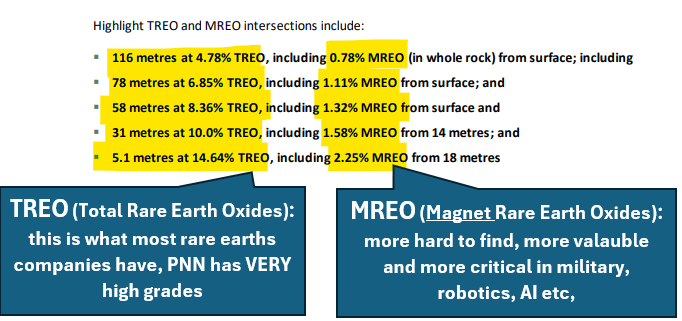
We mentioned it right at the start of today’s note, but here they are again:
(source)
PNN's first hole averaged 4.78% TREO over 116 metres (including a high grade 31m section averaging 10%.
$14BN Lynas' Mount Weld in WA is the highest grade rare earths mine on the ASX, with a resource grade of ~4.1% TREO. (source)
~$10BN MP Materials' Mountain Pass in California - the only operating rare earths mine in the USA - has an average resource grade of 4.65% TREO at 2.15% cutoff. (source)
PNN’s project also has a geological link to MP’s asset.
PNN's acquisition announcement said the mineralisation is "comparable to the producing Mountain Pass Mine (USA)" because it is hosted in bastnäsite, the same rare earths mineral that MP Materials has processed for decades.
Of course - PNN is at a lot earlier stage than MP and Lynas, but you get the point in terms of grades.
We think that the major catalyst for PNN will be a maiden JORC resource estimate which allows for the market to compare PNN’s assets to MP, Lynas and even our other Brazilian rare earths Investment - St George Mining (ASX: SGQ).
PNN expects to have a maiden JORC resource estimate before the end of the year.
PNN is starting to remind us of St George Mining (ASX:SGQ)
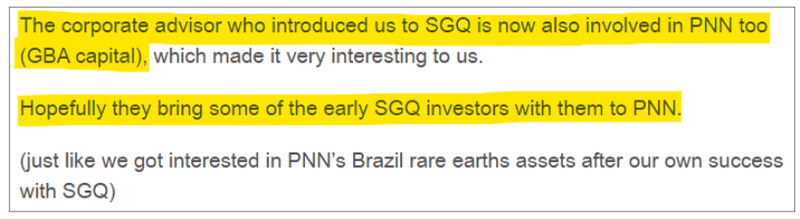
We first Invested in PNN following the corporate advisor who got us into SGQ that was up almost 7x from our Initial Entry Point at one stage (thanks Flynn).
Here is what we said when we first Invested in PNN:
(source)
Now that SGQ has become the $343M capped beast that it is today and is trading millions of dollars in volume a day, we are hoping that some of the winners from SGQ go out looking for “SGQ 2.0”.
Which we hope leads them to PNN.
Of course the past performance of SGQ is not an indicator of the future performance of PNN.
A big reason why we think PNN could become SGQ 2.0 for us is because of the way PNN has structured its deal.
PNN’s acquisition will end up costing a total of ~$25.4M (a mix of cash, milestone payments and shares, and there is ~$19.4M remaining).
Which sounds like a big chunk of cash when you consider PNN’s current market cap is ~$46M (fully diluted).
But that was very similar to how SGQ structured its deal.
When SGQ initially acquired its asset, the market was somewhat taken aback by the price it was paying for the asset.
There was even a period of suspension where the company had to iron out the initial funding to pay for the asset.
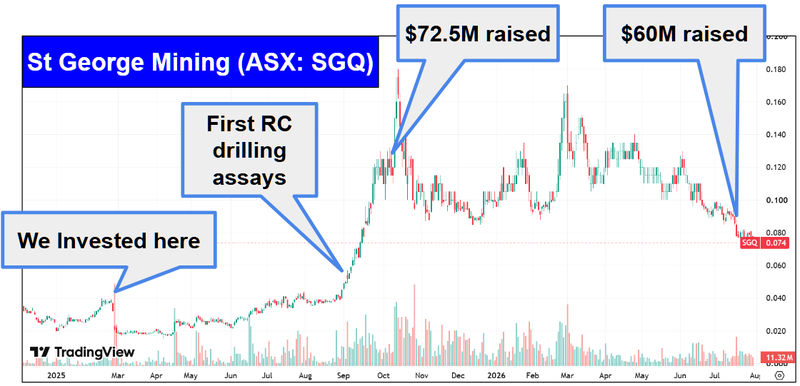
14 months later, SGQ rallied from ~2.5c to a high of 18c and the company pulled off a $72.5M mega raise, cornerstoned by one of Australia’s richest people, mining magnate Gina Rinehart's private investment vehicle Hancock Prospecting.
Gina followed her money in again with $20M of a $60M capital raise SGQ closed in June. (source)
Gina is a substantial shareholder now in MP Materials, Lynas Rare Earths and our Investment St George Mining.
SGQ was one of our best performers in 2025 - sitting at a peak share price rise of 620% for us at one point:
(source)
The past performance is not and should not be taken as an indication of future performance. Caution should be exercised in assessing past performance. This product, like all other financial products, is subject to market forces and unpredictable events that may adversely affect future performance.
We continue to be big holders of SGQ.
There was a lesson we took away from that SGQ deal - sometimes the more expensive acquisitions are expensive for a reason.
Especially when the project being acquired justifies the acquisition price...
Like SGQ’s project, PNN’s is also relatively advanced - an existing discovery sitting on a "Manifesto de Mina" - a legacy title from the 1930s that functions as a full, granted mining licence - with no expiry date. (source)
From a regulatory standpoint, the main thing PNN needs to take its project into production will be environmental approvals.
PNN also owns the freehold farmland above the deposit - so there are no third party landholders to negotiate with either.
IF PNN can define an economic resource, this is the kind of project that can move to a development decision a lot faster (relatively) than most rare earths projects globally.
Anyway - the point is, paying up for an asset makes sense if you are getting a lot back in return.
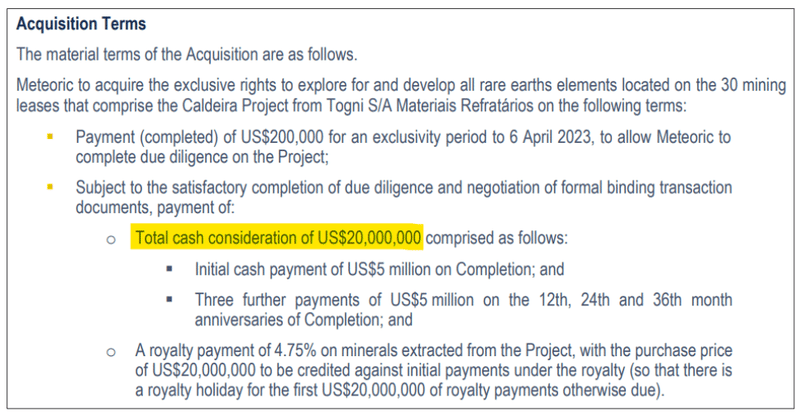
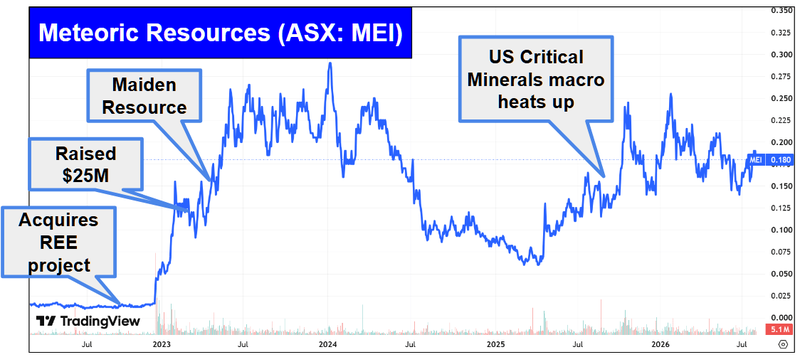
Another example is PNN’s neighbour - Meteoric Resources which paid $20M cash in total for their asset:
(source)
Only 12 months after acquiring the asset Meteoric’s share price was up 1,837%.
Now, 3 years later the company has defined a large ionic clay rare earth system and trades at a market cap of $389M.
(source)
The past performance is not and should not be taken as an indication of future performance. Caution should be exercised in assessing past performance. This product, like all other financial products, is subject to market forces and unpredictable events that may adversely affect future performance.
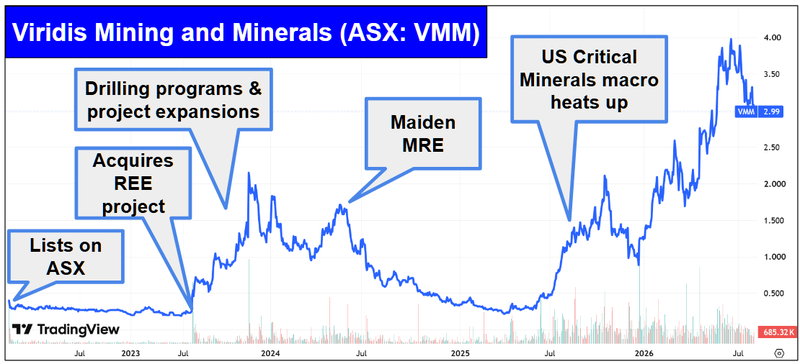
The other one in the sam region to PNN is Viridis Mining & Minerals which IPO’d at 20c and ran all the way as high as $4.03 per share (up 1,915% at its peak).
Today Viridis is capped at $389M.
(source)
The past performance is not and should not be taken as an indication of future performance. Caution should be exercised in assessing past performance. This product, like all other financial products, is subject to market forces and unpredictable events that may adversely affect future performance.
Here is where $46M PNN sits relative to $523M Meteoric and $389M Viridis:
(source)
The difference between those two regional peers is that PNN’s asset (for now) has a different mineralisation style. (source)
Viridis and Meteoric’s projects are both considered “ionic clay” deposits.
So the hard rock mineralisation is the primary target for PNN and we essentially get the ionic clay upside for free.
PNN has explicitly said it would “prioritise the examination of this potential” at some point.

(source)
Very early days for PNN on the ionic clay potential.
But we like that the project has this exploration optionality - especially for discovering two types of deposits the ASX understand well and knows how to value:
- Hard rock mineralisation similar to $10BN MP Materials and $14BN Lynas, and
- Ionic clay mineralisation similar to ~$389M Viridis and ~$523M Meteoric.
Ultimately, with PNN’s market cap where it is today at ~$46M, we think a resource (hard rock or ionic clays) could be enough to re-rate it from here.
No guarantees of course, this is small cap investing, things can and do go wrong.
Our PNN Big Bet:
"PNN proves up a major high-grade rare earths resource in Brazil and re-rates 1,000% from our Initial Entry Price - via development, strategic investment or acquisition"
NOTE: our "Big Bet" is what we HOPE the ultimate success scenario looks like for this particular Investment over the long term (3+ years). There is no guarantee that our Big Bet will ever come true. There is a lot of work to be done, many risks involved, including development risk, country risk and commodity price risk - just some of which we list in our PNN Investment Memo.
Success will require a significant amount of luck. Past performance is not an indicator of future performance.
What's next for PNN?
🔄 Maiden drill program at Morro do Ferro (MDF)
Here are the milestones we are tracking:
- ✅ First hole assays
- 🔄 Assays for holes 2 and 3 (at the lab now)
- 🔄 Hole 4 (being drilled)
- 🔲 Second rig starts (arrived on site, starting imminently)
- 🔲 Metallurgical test work drilling
- 🔲 Gallium follow up results
🔲 Maiden JORC resource estimate at Morro do Ferro (MDF)
Expected before the end of the year - this is the big one for us.
🔲 Ionic clay potential tested at Morro do Ferro (MDF)
The "free shot" at the style of deposit that made PNN's neighbours worth a combined ~$1BN.
What could go wrong?
One of the biggest risks right now is “exploration risk”.
Today's result is a strong start but it's only one hole.
There is always a risk that the remaining holes in PNN’s drill program disappoint.
Exploration risk
All of Morro do Ferro's headline grades were drilled by previous owners, mostly in shallow holes. The project has no JORC resource yet. IF PNN's drilling fails to confirm the historic grades, or the deposit doesn't extend, the investment thesis takes a direct hit and we would expect the share price to re-rate lower.
Source: “What could go wrong” - PNN Investment Memo 15 June 2026
Other Risks
Like any early-stage exploration company, PNN carries significant risk, here we aim to identify a few more risks.
PNN still owes ~$19.4M in remaining acquisition and milestone payments against a ~$46M market cap. The company will likely need to raise capital to fund these commitments and ongoing drilling, which could result in shareholder dilution.
While early drill grades are exceptionally high, hard-rock rare earth deposits often face complex metallurgical processing challenges. If upcoming test work shows low recovery rates or high processing costs, the economic viability of the project could be impacted.
The broader investment thesis relies heavily on geopolitical tensions and global rare earth prices. Any shifts in market sentiment, changes to Chinese export policies, or drops in rare earth prices could negatively affect PNN’s valuation.
Although the project sits on a granted legacy mining license, PNN still requires environmental approvals to progress toward development. Unforeseen delays or strict regulatory conditions in Brazil could stall project timelines and increase overall costs.
Investors should consider these risks carefully and seek professional advice tailored to their personal circumstances before investing.
Our PNN Investment Memo
You can read our PNN Investment Memo in the link below.
We use this memo to track the progress of all our Investments over time.
Our PNN Investment Memo covers:
- What does PNN do?
- The macro theme for PNN
- Our PNN Big Bet
- What we want to see PNN achieve
- Why we are Invested in PNN
- The key risks to our Investment Thesis
- Our Investment Plan
General Information Only
This material has been prepared by StocksDigital. StocksDigital is an authorised representative (CAR 000433913) of 62 Consulting Pty Limited (ABN 88 664 809 303) (AFSL 548573).
This material is general advice only and is not an offer for the purchase or sale of any financial product or service. The material is not intended to provide you with personal financial or tax advice and does not take into account your personal objectives, financial situation or needs. Although we believe that the material is correct, no warranty of accuracy, reliability or completeness is given, except for liability under statute which cannot be excluded. Please note that past performance may not be indicative of future performance and that no guarantee of performance, the return of capital or a particular rate of return is given by 62C, StocksDigital, any of their related body corporates or any other person. To the maximum extent possible, 62C, StocksDigital, their related body corporates or any other person do not accept any liability for any statement in this material.
Conflicts of Interest Notice
S3 and its associated entities may hold investments in companies featured in its articles, including through being paid in the securities of the companies we provide commentary on. We disclose the securities held in relation to a particular company that we provide commentary on. Refer to our Disclosure Policy for information on our self-imposed trading blackouts, hold conditions and de-risking (sell conditions) which seek to mitigate against any potential conflicts of interest.
Publication Notice and Disclaimer
The information contained in this article is current as at the publication date. At the time of publishing, the information contained in this article is based on sources which are available in the public domain that we consider to be reliable, and our own analysis of those sources. The views of the author may not reflect the views of the AFSL holder. Any decision by you to purchase securities in the companies featured in this article should be done so after you have sought your own independent professional advice regarding this information and made your own inquiries as to the validity of any information in this article.
Any forward-looking statements contained in this article are not guarantees or predictions of future performance, and involve known and unknown risks, uncertainties and other factors, many of which are beyond our control, and which may cause actual results or performance of companies featured to differ materially from those expressed in the statements contained in this article. S3 cannot and does not give any assurance that the results or performance expressed or implied by any forward-looking statements contained in this article will actually occur and readers are cautioned not to put undue reliance on forward-looking statements.
This article may include references to our past investing performance. Past performance is not a reliable indicator of our future investing performance.