372 Pages of Confirmation Bias (Thanks IEA)
Published 18-JUL-2026 13:14 P.M.
|
17 minute read
Disclosure: S3 Consortium Pty Ltd and its associated entities may hold direct or indirect interests in securities referred to in this publication and may receive fees or other forms of consideration from entities mentioned. These interests and arrangements may create a potential conflict of interest in the preparation of this material.
The information contained in this communication is provided for general information purposes only and may relate to speculative investments. It does not constitute financial product advice, and has been prepared without taking into account your personal objectives, financial situation or needs. You should consider obtaining independent financial advice before making any investment decision.
Any forward-looking statements are uncertain and not a guaranteed outcome.
We now enter week #2 of being wrong about the small end of the ASX roaring back in July.
Blaming Australian school holidays again this week?
Nope.
Choose a negative global media headline from the week and blame the negative global sentiment flowing down into the ASX small end?
Nah... well kind of.
Nothing was wrong with the small end of the ASX specifically.
Everyone just suddenly remembered that “risk exists”... at the same time.
The real reason the market was generally red this week?
Because more people wanted to sell, than wanted to buy.
Binge drinking on negative news headlines from SpaceX, IBM, chip selloffs, Iran conflict etc converged to make people sad and scared for the current news cycle.
Seeking the warm embrace of a previously unthinkable, but increasingly charming and sexy looking sell button - at market closing time after 8 pints of negative financial news headlines...
Will they regret it when they wake up in the morning and the news headlines in their head have cleared?
Maybe.
Point is the news of the week created certain emotions conducive to sell button mashing - until the next set of headlines rolls in.
Underlying macro themes take a longer time to play out than headline driven short term moves that really just reveal the average weight of the collective emotional states of the market’s participants that day.
Let’s see if FOMO takes over next week.
Speaking of FOMO...
We bid on the Minbos Resources (ASX:MNB) share placement this week - a big $ swing for us (by our standards).
Here’s why:
Long time readers will know we have been holding MNB for 6 years now.
MNB has been saying for a while that it can build a phosphate (fertiliser) plant for ~US$30M-US$40M that will generate US$55M EBITDA per year (base case, on average) over a 20 year mine life.
(at last trade MNB is capped at ~$25M)
We were convinced MNB was going to get it built in 2022, then 2023 and then 2024.
(We didn't make a “we think they are going to build it this year!” call in 2025)
The market punished MNB’s share price for years of delays in securing the full funding package to build the plant and get the mine into production.
Here’s where our FOMO comes in...
Over the last 12 months, MNB has finally got all the funding secured and is now in a position to actually finish the build - which is already well underway.
With build financing now secured...
(Here it goes...)
It looks like they are actually going to build it and start producing.
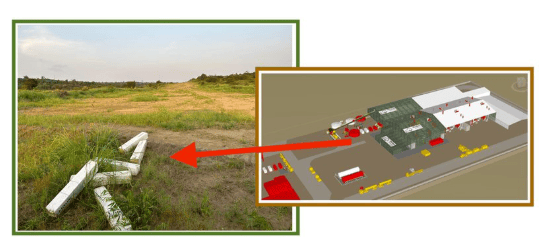
Here is what the plant site looked like when we visited the MNB site back in 2024 - our photo of an empty, grassy field with a 3D model design of what could be one day...
Here’s what the MNB site looks like as of a couple of weeks ago:
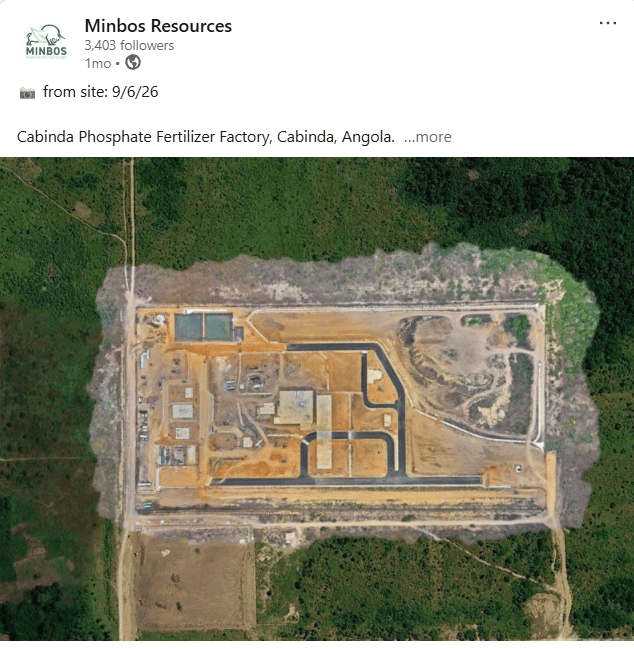
(source)
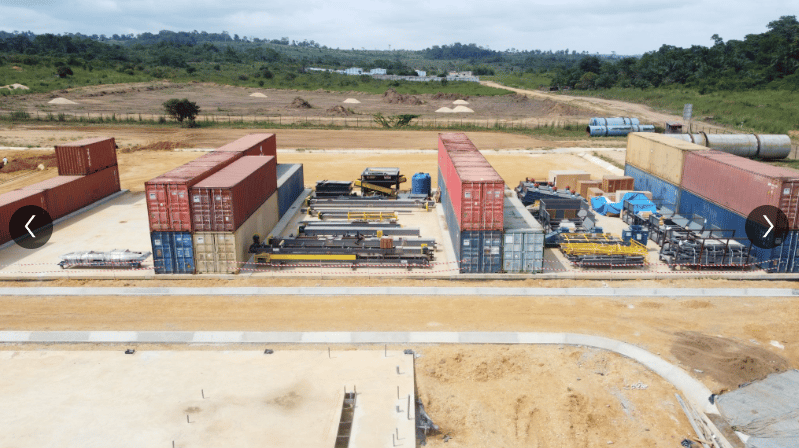
(source)
MNB expects to come out of its trading halt following the capital raise and trade again on Monday.
And with all the financing in place (finally, after so many years of waiting), the next thing we will be watching for is lots of photos of the plant construction progressing...
And eventually...
Our long mooted ceremonial photo of Angolan politicians and MNB management showcasing the first Angolan phosphate sack produced from this project.
In the meantime, have a read of what we saw on MNB’s phosphate project in our MNB site visit write up here.
Speaking of going to places...
A slightly shorter trip than that to Angola...
A few of us went to Sydney on Thursday to watch Spacetalk (ASX:SPA) host a first look at its “household graph” platform for telcos.
SPA is already a leading provider of family and child safety tech in Australia (kids safety watches).
~$19M capped SPA generated ~$10.9M in Annual Recurring Revenues (ARR) inside the last nine months.
A few years ago SPA commenced a strategy to add a full family safety software platform and mobile app.
To emulate ~$6.2BN Life360’s family safety app success.
(ie we already know there is mega demand out there for family safety apps)
Instead of selling directly to customers (parents), SPA came up with a clever model...
To partner with telcos and have them distribute SPA’s app to their billions of customers.
- Families get peace of mind from family safety tech.
- Telcos get better client engagement embedding family safety, engagement and insight directly into the telco customer experience for their billions of customers.
- SPA gets access to revenue and rapid customer growth.
SPA has purpose built its family safety app and platform to solve problems for families AND telcos.
(and all it asks for in return is for direct access to billions of telco customers around the world).
And we got a first look at what the interface looks like for telcos:
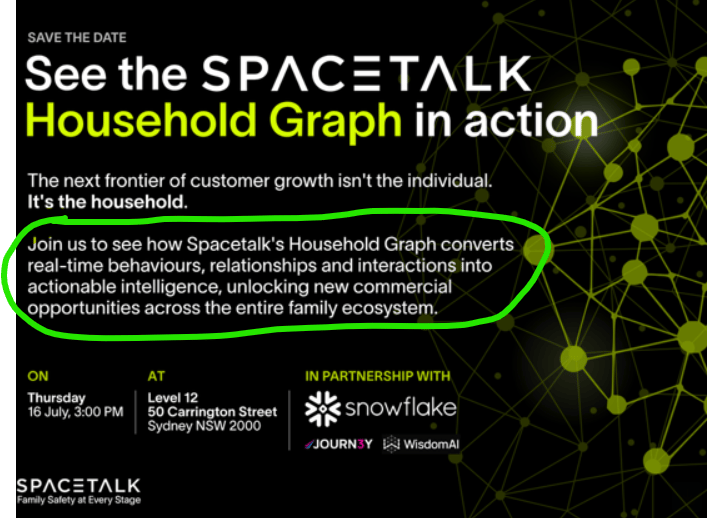
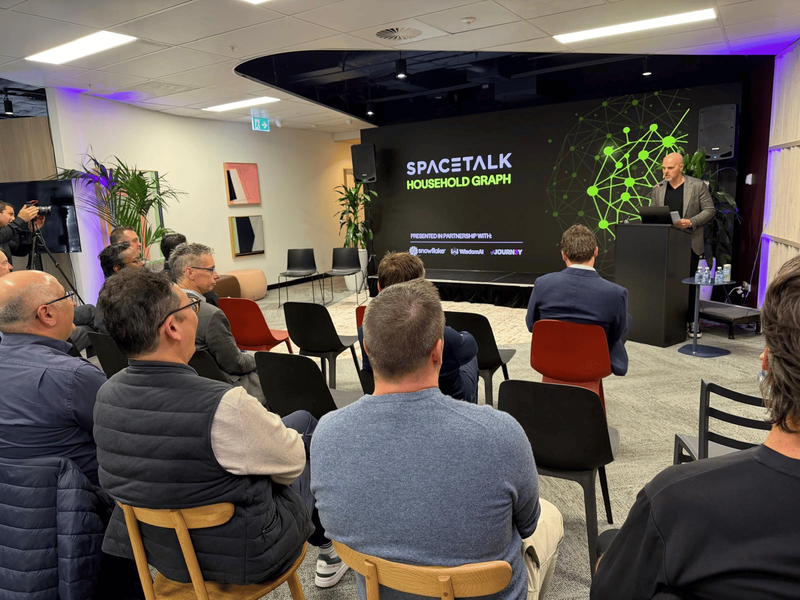
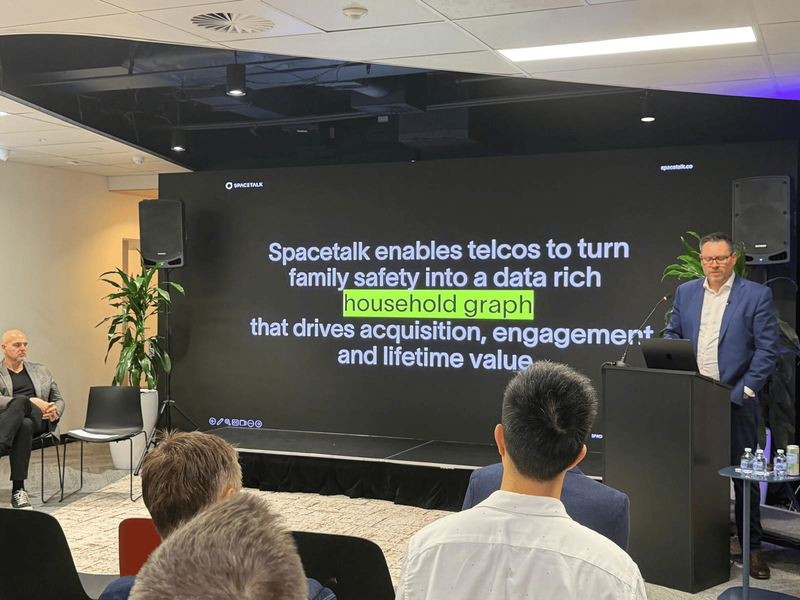
One of the big takeaways here is that telcos don't actually have a way to get insights on how you use your phone.
(when was the last time you opened the Telstra, Optus or Vodafone app? Never, right?)
By partnering with telcos to provide a family safety app to their mobile plan customers, the telcos can use the insights generated from usage of the family safety app to engage with their customers and offer them additional value.
(ie sell them more stuff that they are more likely to buy based on data generated by the family safety app)
Here’s a sample of what the SPA household graph looks like for a telco:
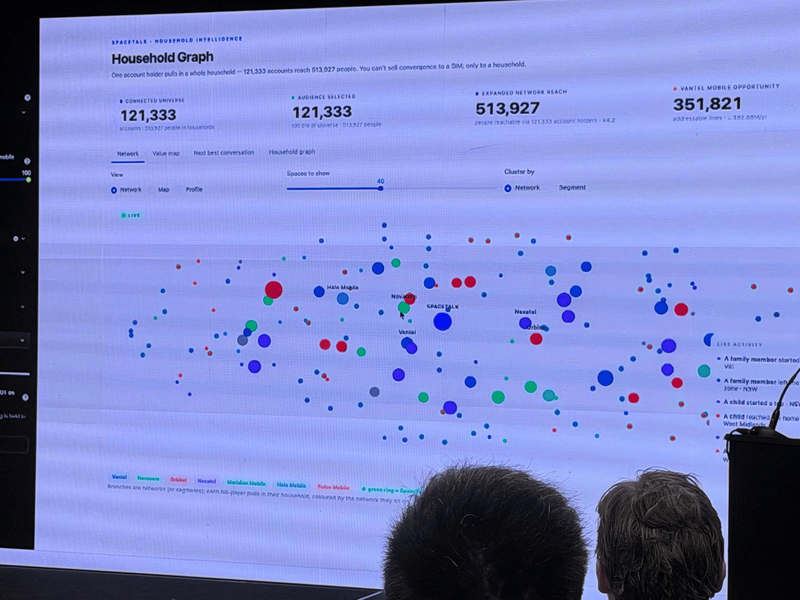
We saw how a telco marketing team can ask it a question to build a subset of users that fit a certain criteria, and send those users an appropriate offer they will likely engage with:
Show me all family members with an old phone model and send an offer of a new phone deal
OR
Show me all members in a household using a different mobile plan provider and send them an offer to switch to OUR mobile phone plan... with free double data usage for the first 6 months.
All using SPA’s platform and insights from its family safety app.
(As we mentioned above, telcos provide mobile phone plans but have literally no way of gaining deep insights into phone users and their households, which requires an app on their phone that they regularly engage with)
After 3+ years in the works on this telco platform, two weeks ago SPA signed on its first telco partner - $7.1BN TPG Telecom (Vodafone Australia) in Australia
(A major, commercially material, proof point of this model working.)
SPA now has access to millions of Vodafone Australia’s mobile customers:
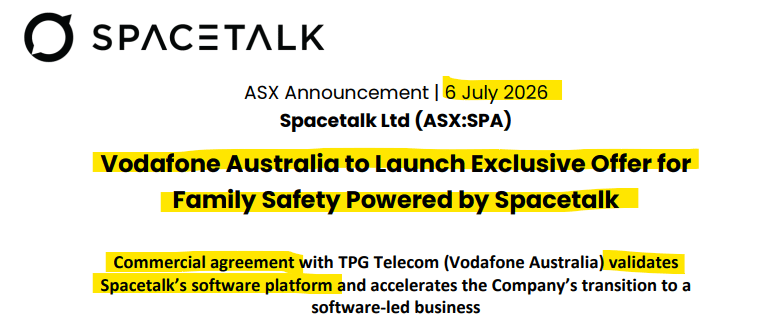
(read our full update on this news here)
While we were at the SPA event, we had a good chat with the TPG Telecom guys who were in the room, who were pretty excited about the potential of the SPA tech.
Next proof point we are watching for from SPA is more telco partnership sign ups.
This week we also caught up with our other recent tech Investment Harvest Technology Group (ASX:HTG).
We Invested in HTG because it is pivoting its commercially tried, tested and revenue generating “communications link resilience” tech to an urgent new defence problem:
“Communications link resilience” in the battlefield for remote operated drones, robots, boats and vehicles.

12 months ago, another ASX company Elsight pivoted its own commercially proven “comms resilience tech” into defence and went from 30c to (now) over $6.50.
The past performance of Elsight is not and should not be taken as an indication of future performance of HTG.
HTG and their new CEO tasked with executing this move into the defence space, gave a webinar last week updating the market on what they’ve been cooking up.
The key thing the market (and us) are watching for is acceleration of new deals.
Here is a quick fire summary of the update provided on HTG’s sales pipeline:
- Europe: at least two partnerships "quite close" on scope/terms that would scale existing procurement. Dr Oleksandra Molloy (counter-UAV specialist) engaged to lead Ukrainian efforts; early-stage negotiations to grow footprint there.
- Middle East: two opportunities progressing through the existing reseller agreement, hoping to announce "in the near future."
- APAC: new reseller-style arrangement set up; discussions with large drone manufacturers on collaborative/MOU arrangements, plus an unnamed government entity project spanning drone ops, crowd control and disaster response.
- Australia: active work on how to engage the ADF directly.
- USA: called it their most important market, US trip departing Saturday (today), split between Colorado Springs (defence-funded accelerator programs open to non-US companies, described as "low-hanging fruit". Plus Space Command connections) and Washington DC, including a Pentagon meeting "in two weeks' time" and deputy-secretary-level engagements.
Also meeting major defence tech players (Anduril and Shield AI). Chairman Jeff Sengelman said that morning he'd spoken to two California-based CEOs, one of the world's largest private defence companies.
Next thing we are watching for from HTG is some of these pipeline deals to convert into contracts.
Read our HTG launch note here
A quick update on critical minerals - the IEA released its 2026 analysis doc two days ago
If you are into the critical minerals theme (like we are), buckle up...
The International Energy Agency (IEA) put out its 2026 critical minerals outlook piece two days ago (read it here).
It's a great (and very long - 372 pages) read... one that you come back to, not sit down and read in one go.
Some was read on the flight back from Sydney, some before bed, and then the rest in the last 24 hours.
For us, it was a good, unbiased reality check on the hard facts behind what we "feel” is happening in the space.
Right now, in ASX small cap land it feels a bit like the enthusiasm (at least amongst the investors) has come out of the critical minerals sector (after a big H2 2025).
BUT the facts tell a different story.
According to the report, the only place where the US (and the rest of the west) have been able to mobilise enough capital allocation to make a dent in the China dominance is... rare earths.
The US megapush was in rare earths so that makes sense...
The IEA actually singles out rare earths as THE exception - the only mineral where refining concentration went DOWN in 2025, thanks to new US projects and Malaysian production.
AND the IEA made a point of underlining that - Targeted policy + Capital = works.
The job isn’t done on rare earths though, the IEA report has “diversified refining capacity” (basically refining capacity in the West) only covering 2/3rds of ex-China mined supply and ~1/3rd of magnet production by 2035.
So the upstream’s been fixed somewhat, the midstream will be next...
BUT across everything else nothing has really changed YET...
Excluding rare earths, the average share of the top refining country actually went UP - from 70% in 2023 to 72% in 2025.
Which to us means targeted policy (some sort of US mega push) + capital (funding/investments) will need to be deployed across all of the other critical minerals at some point.
We came away from this one a lot more bullish on the whole critical minerals thematic (thank you IEA for the confirmation bias).
Here are some of the key charts/images we saw in there:
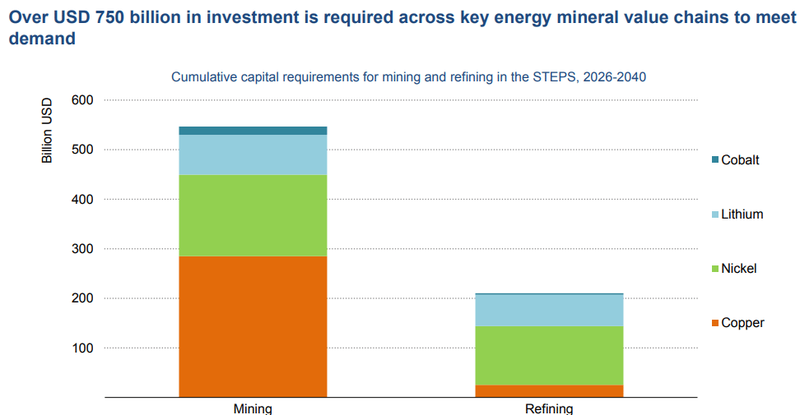
First the big one... over US$750BN in investment is required across mining and refining to meet demand between 2026-2040.
But global spend on exploration FELL in 2025 to ~US$6BN and capital expenditures on “non-ferrous metal production by major mining companies” FELL in 2025 to US$50BN.
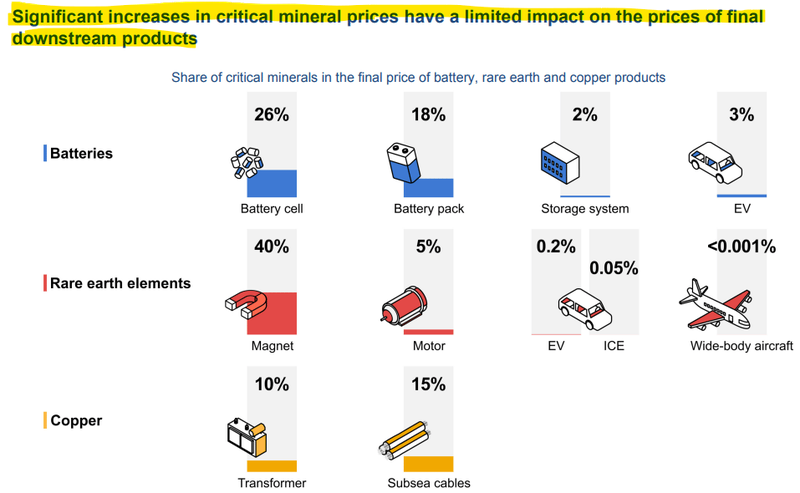
Second, another big one which answers how and why we think the critical minerals problem can be solved.
How critical minerals prices make up a tiny % of end product values.
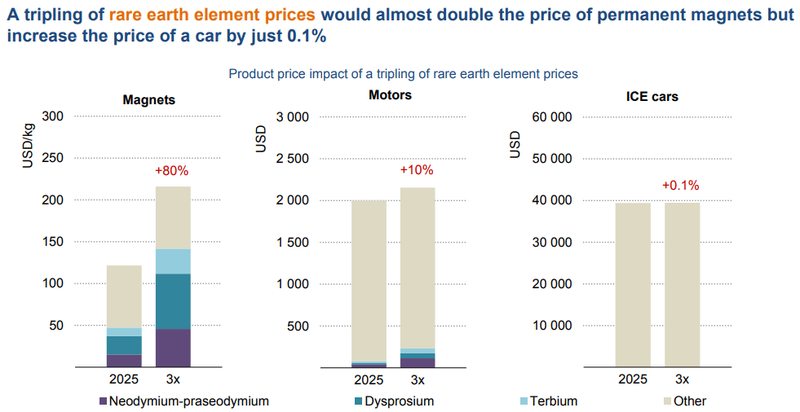
Check out the rare earths one below - tripling prices impacts 0.1% of the value of the end product.
So if the trade off is 10x rare earths prices and the government needs to pay 0.3% more for its F-35 fighter jets... the question really does answer itself.
The IEA even gave this idea a name: the "mineral security premium" - paying a bit more for supply as insurance.
It also costed strategic stockpiles of the 11 highest-risk minerals at under US$900M a year - a rounding error against the US$6.5 TRILLION of downstream production the IEA says full rare earth export controls would put at risk...
(check out Page 249 of the report for this bit)
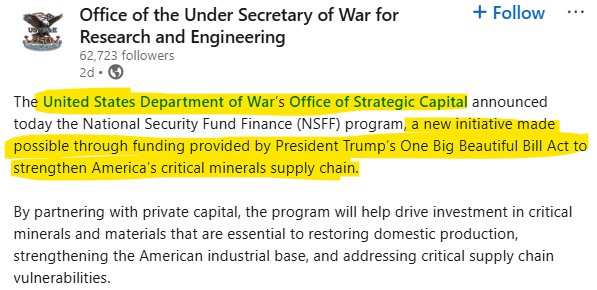
We expect price-floors, government offtakes above spot prices and more announcements like this across the world over the next few years:
(source)
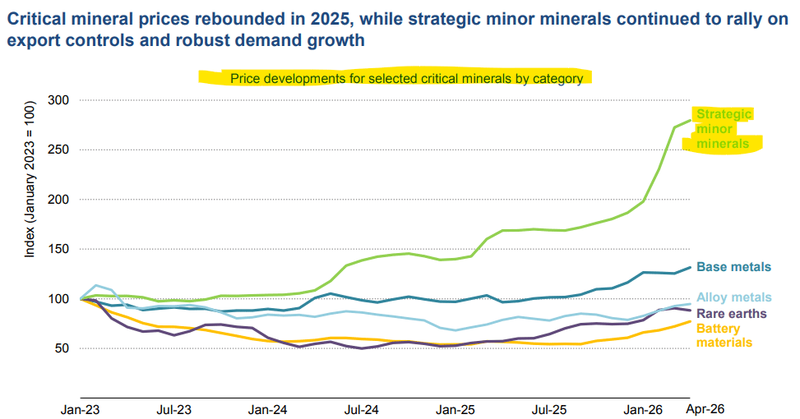
On the massive rally in “strategic minor minerals” like germanium, antimony, indium and tungsten.
Prices for these more than doubled as a group... and tungsten went up SIX FOLD.
We think the ASX has barely responded to the juniors working with these minerals - most of the ASX interest has been the top single production exposures to date...
Like for tungsten, EQ Resources and Almonty have rallied hard... we think the juniors come next...
Our “strategic minor minerals” Investments are:
- VKA - Tungsten in Nevada, USA - about to drill its project for the first time any day now.
- RML - Antimony, tungsten AND gold right next door to $3BN+ Perpetua Resources.
- SS1 - The biggest pre-production silver resource estimate in the USA (~539M oz silver equivalent) - with antimony upside inside it.
- OD6 - Fluorspar in Nevada, USA + rare earths in WA.
- AW1 - The biggest JORC indium resource estimate (with gallium and germanium) in the USA.
- LKY - Antimony + rare earths ~1.4km from $12BN MP Materials.
- RCM - Gallium and germanium in Canada. (RCM also has Silver in NSW)
- PFE - Antimony (and silver) in Arkansas, USA.

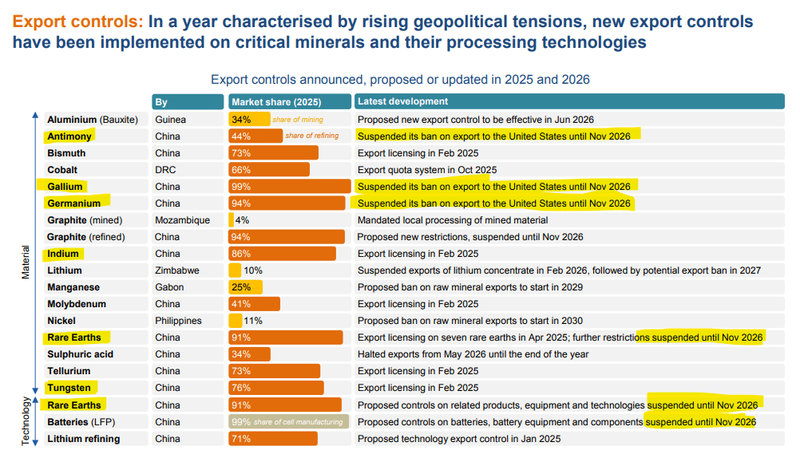
Export controls are getting worse... AND a lot of them are suspended from the United States until NOV-2026...
IF the suspension gets lifted and export controls remain, we think the urgency to fix the China dependence problem will increase significantly.
Here are our exposures to export-controlled minerals:
- RML - Antimony, tungsten AND gold right next door to $3BN+ Perpetua Resources.
- LKY - Antimony + rare earths ~1.4km from $12BN MP Materials.
- VKA - Tungsten in Nevada, USA - about to drill its project for the first time any day now.
- SGQ - The biggest hard rock rare earth deposit in South America.
- PNN - One of the highest grade discovery hits on a rare earths project we have ever seen in Brazil.
- SS1 - The biggest pre-production silver resource estimate in the USA (~539M oz silver equivalent) - targeting a maiden antimony resource inside it.
- RCM - Gallium and germanium in Canada. (RCM also has Silver in NSW)
- AW1 - The biggest JORC indium resource estimate (with gallium and germanium) in the USA.
- LSR - Heavy rare earths project in Arizona that’s shown all 12 heavy rare earths with the restrictions.
- PFE - Antimony (and silver) in Arkansas, USA.
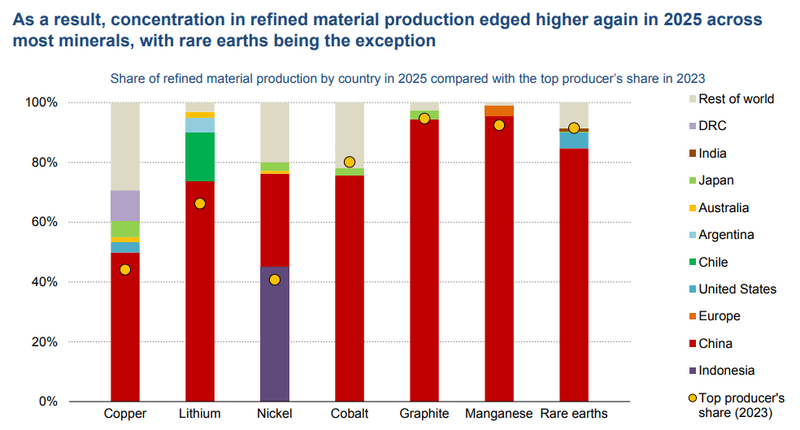
China's dominance in the processing/refining space actually went UP across a lot of critical minerals.
(this is the chart that kills the "problem solved" narrative - the top refiner's share rose again in 2025 for almost everything except rare earths)
Here are our exposures to the "ex-China midstream" build-out:
- SGQ - The largest, highest-grade carbonatite rare earths deposit in South America - same geology the $13BN+ majors process today.
- ION - Battery recycling tech, in a world where China owns ~85% of pre-treatment and ~90% of material recovery capacity.
- LKY - Already making 99.5% purity antimony trioxide - actual midstream product, not just rocks.
- OD6 - Rare earths + fluorspar, two feedstocks the West doesn't process at scale.
- PNN - Brazilian rare earths for the non-China supply chain.
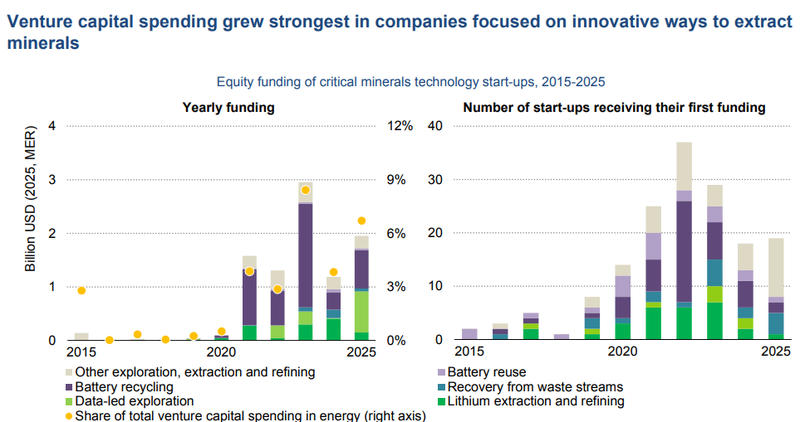
Next, where venture capital is most interested = companies trying to extract minerals from stuff.
(Like our Investment ION - building out a rare earths recycling business in the USA)
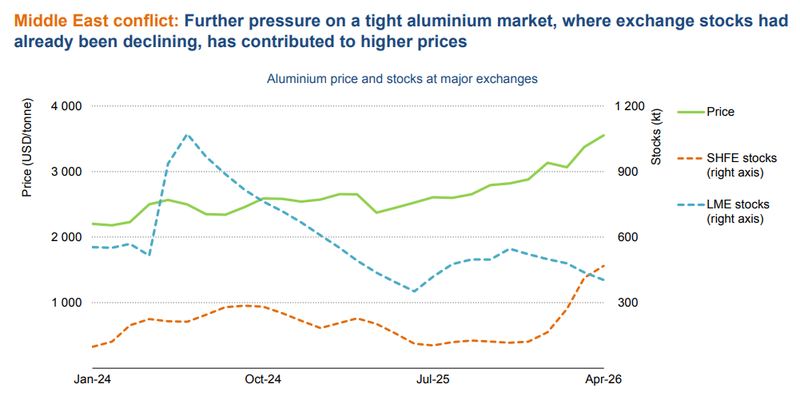
On bauxite and aluminium - the export controls table from earlier had Guinea (34% market share of world bauxite mining) proposing export controls starting in June 2026.
At the same time ~8% of the world's aluminium is made in the Middle East and has been impacted by the war in Iran.
Our Investment CAY is bringing on one of the biggest new bauxite mines in the world in Cameroon - on track for its first shipment in late September.
(Guinea restricting supply while Cameroon brings new supply on... CAY's timing might end up looking very good.)
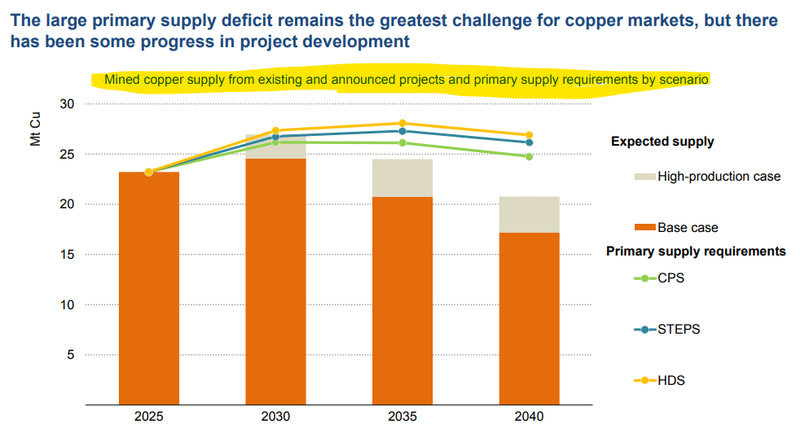
On copper - a false sense of confidence from "committed developments" that could see the market supplied well into 2030...
BUT the big challenge is supply out into 2035 and 2040...
Here are our copper exposures:
- AW1 - Advanced stage copper project in Canada
- TG1 - Two giant, undrilled copper targets in WA - drilling soon.
- PAT - A new copper discovery just made in Zambia ~18km from $10BN Sinomine's copper project.
- TTM - 3.1M oz gold + 22M oz silver in Ecuador, with a copper project joint ventured with Gina Rinehart’s Hancock prospecting.
- AVM - Could be a dark horse copper exposure in our Portfolio, AVM just hit 54.6m of copper mineralisation at its silver project in Mexico.
- LSR - Copper project in Chile with historic hits of 136m @ 0.2% copper.
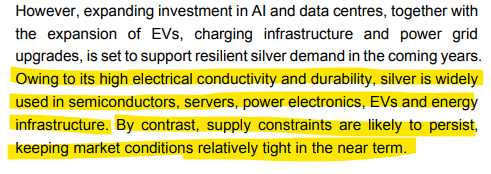
Nice to see silver pop up in a critical minerals focused 372 page analysis doc...
It was comforting reading this while watching the silver price on Friday - we are still very bullish, but have to admit the close for silver this week was painful.
Here are our silver Investments:
- SS1 - The biggest pre-production silver asset in the USA - ~539M silver equivalent ounces.
- PAT - 31.4M ounce silver equivalent JORC resource in Peru sitting inside a giant JORC exploration target of between 559 Million ounces to 774 Million ounces silver equivalent.
- BKB - A 17.6M ounce silver foreign resource estimate with ~US$150M of infrastructure already sitting on site in Texas, USA.
- IVR - ~57M oz of silver in South Australia with a DFS showing a pre-tax NPV of $1.15BN using a US$80 silver price.
- AVM - ~116M oz silver equivalent resource estimates across three Mexican silver projects.
- MTH - High-grade silver-gold in Mexico (373k Oz gold, 11 million Oz silver JORC resource estimate)
- WCE - Looking to bring back into production the highest-grade silver mine operated in Australian history.
- RCM - 67M ounces silver equivalent in resource estimates in NSW. Currently drilling to expand those numbers.
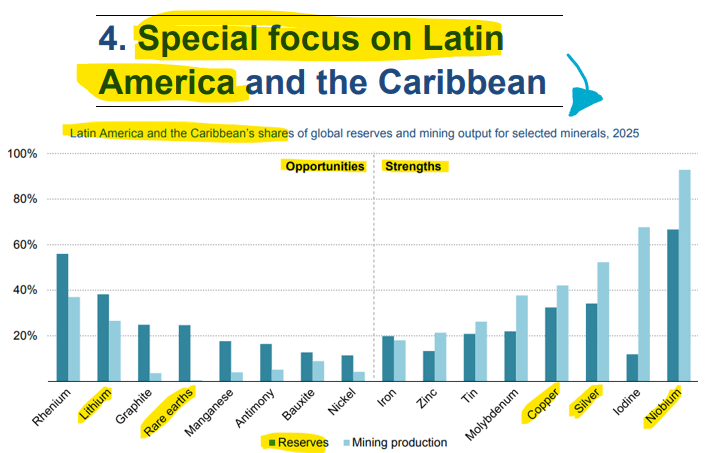
The IEA report also gave a special shout-out to Latin America and the Caribbean as regions to help solve the critical minerals problem...
Here are our Investments in those regions:
- PAT - in Peru - 31.4M ounce silver equivalent JORC resource sitting inside a giant JORC exploration target of 559M ounces to 774M ounces silver equivalent.
- SGQ - in Brazil - the biggest hard rock rare earth resource: 70.9Mt @ 4.06% TREO + a 95.5Mt niobium resource next door to the world’s biggest niobium mine.
- PNN - A very high grade rare earths project in Brazil (one of the highest we have ever seen) + lithium brines in Argentina.
- AVM - ~116M oz silver equivalent resource estimates across three Mexican silver projects. (now also potentially copper)
- MTH - High-grade silver-gold in Mexico (373k Oz gold, 11 million Oz silver JORC resource estimate)
- TTM - 3.1M oz gold + 22M oz silver resource estimate in Ecuador, with a copper project joint ventured with Gina Rinehart’s Hancock prospecting.
- PUR - In Argentina a 1.26Mt Lithium Carbonate Equivalent (LCE) JORC resource estimate with a Pre-Feasibility Study (PFS) showing a US$364M Net Present Value (NPV).
- LSR - Copper project in Chile with historic hits of 136m @ 0.2% copper.
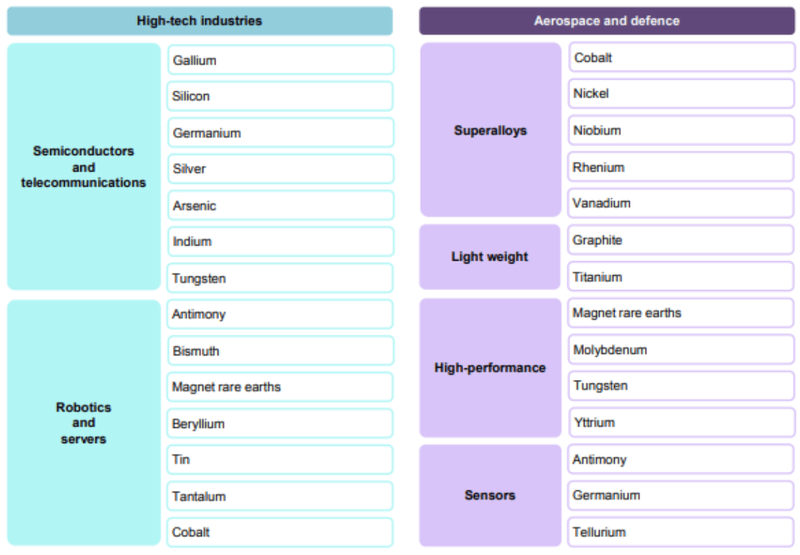
And finally, just a nice reminder of all the critical minerals grouped across high-tech industries, Aerospace and Defence:
Anyway, got a bit carried away... it's a great read for anyone with Investments in the minerals above - check it out here.
Have a great weekend.
Next Investors
General Information Only
This material has been prepared by StocksDigital. StocksDigital is an authorised representative (CAR 000433913) of 62 Consulting Pty Limited (ABN 88 664 809 303) (AFSL 548573).
This material is general advice only and is not an offer for the purchase or sale of any financial product or service. The material is not intended to provide you with personal financial or tax advice and does not take into account your personal objectives, financial situation or needs. Although we believe that the material is correct, no warranty of accuracy, reliability or completeness is given, except for liability under statute which cannot be excluded. Please note that past performance may not be indicative of future performance and that no guarantee of performance, the return of capital or a particular rate of return is given by 62C, StocksDigital, any of their related body corporates or any other person. To the maximum extent possible, 62C, StocksDigital, their related body corporates or any other person do not accept any liability for any statement in this material.
Conflicts of Interest Notice
S3 and its associated entities may hold investments in companies featured in its articles, including through being paid in the securities of the companies we provide commentary on. We disclose the securities held in relation to a particular company that we provide commentary on. Refer to our Disclosure Policy for information on our self-imposed trading blackouts, hold conditions and de-risking (sell conditions) which seek to mitigate against any potential conflicts of interest.
Publication Notice and Disclaimer
The information contained in this article is current as at the publication date. At the time of publishing, the information contained in this article is based on sources which are available in the public domain that we consider to be reliable, and our own analysis of those sources. The views of the author may not reflect the views of the AFSL holder. Any decision by you to purchase securities in the companies featured in this article should be done so after you have sought your own independent professional advice regarding this information and made your own inquiries as to the validity of any information in this article.
Any forward-looking statements contained in this article are not guarantees or predictions of future performance, and involve known and unknown risks, uncertainties and other factors, many of which are beyond our control, and which may cause actual results or performance of companies featured to differ materially from those expressed in the statements contained in this article. S3 cannot and does not give any assurance that the results or performance expressed or implied by any forward-looking statements contained in this article will actually occur and readers are cautioned not to put undue reliance on forward-looking statements.
This article may include references to our past investing performance. Past performance is not a reliable indicator of our future investing performance.