Small caps just had their Red Wedding (Jim Chalmers sends his regards)
Published 24-OCT-2026 17:07 P.M.
|
12 minute read
Disclosure: S3 Consortium Pty Ltd and its associated entities may hold direct or indirect interests in securities referred to in this publication and may receive fees or other forms of consideration from entities mentioned. These interests and arrangements may create a potential conflict of interest in the preparation of this material.
The information contained in this communication is provided for general information purposes only and may relate to speculative investments. It does not constitute financial product advice, and has been prepared without taking into account your personal objectives, financial situation or needs. You should consider obtaining independent financial advice before making any investment decision.
Any forward-looking statements are uncertain and not a guaranteed outcome.
How's your small cap Portfolio looking at the moment?
Ours is a bloodbath.
Looking at my Portfolio this week reminds me of watching the Red Wedding scene in Game of Thrones.
(spoiler alert below if you haven't seen it yet)
The Red Wedding is a notorious massacre in Game of Thrones taking place during a wedding feast intended to cement an alliance, the hosts violate the sacred laws of hospitality by turning on their guests.
Robb Stark, his pregnant wife Talisa, his mother Catelyn Stark, and the vast majority of the Northern army leadership are brutally ambushed and slaughtered at the wedding by the hosts, effectively destroying the Northern rebellion and securing a devastating political victory for House Lannister.
Sudden, unexpected, brutal, shocking... and very hard to watch.
Like opening the Portfolio screen this week...
Favourite characters you have grown to love over the last year or two - struck down in an instant.
(I was making an animated image where I put a bunch of stock market words over various Stark family members getting killed... but it’s just too gory to share, and we are all already depressed enough as it is)
At the end, once most of the murders are completed, instead of saying “the Lannisters send their regards” to Robb Stark...
It should be “Jim Chalmers sends his regards”?
Don’t worry - it’s not just you and me.
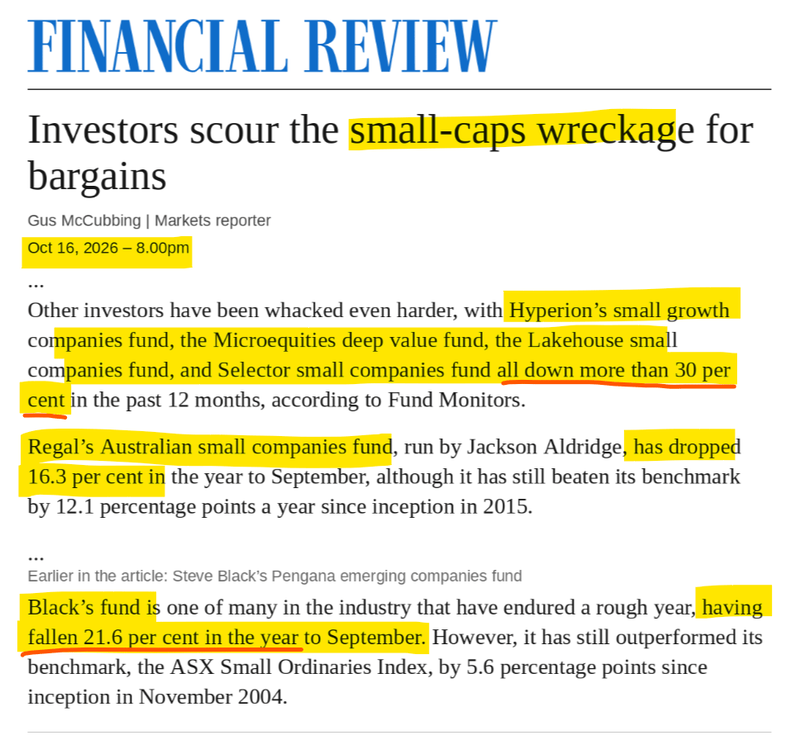
It seems almost everyone in the small end of the ASX is having a shocker:
(source)
This article is from 8 days ago, and since then things on the market have gotten even worse.
So even the “experts” are getting smoked on paper, it's an indiscriminate sector wide sell off in small ASX stocks.
Thankfully, unlike the GoT Red Wedding murder-fest, our Portfolio characters aren't dead.
The share prices just went down (a lot)... for the moment.
And the trading that is pushing down the share prices has been on relatively low volumes.
(I’ll show data to support this in a second).
Currently there are investors who want to sell - that's fine, it's their choice and yes the fear is currently out there.
And when there is fear out there, not many people really want to buy stocks until things get better.
Even bargain hunters generally wait until things stabilise a little.
What does it mean when a stock goes down a lot on low trading volume (ie not many shares traded)?
A couple of people decided to exchange shares with each other at a much lower share price.
So does multiplying that low share price by the number of shares on issue really reflect the value of the company?
Does that mean the company is now worth a lot less?
Just because a couple of desperate sellers matched with some low ball bargain hunters?
(and YES - the same applies to when a stock goes up a lot on tiny volumes too)
If the trading volumes are huge then yes, it probably means that enough people have exchanged shares at the lower (or higher) price that it is a good indicator of that company's value.
But on tiny or small volumes - all it means is that your paper portfolio value looks terrible based on just a few trades.
Have you ever had a stock with a buy-sell spread with buyers at 0.001 and sellers at 0.002?
And if somebody buys $500 of stock, your trading platform shows the share price is up 100%.
“Woohoo! I’m up 100% on this one!”
And the company went from a $5M market cap to a $10M market cap in one $500 trade?
Not real, right?
Think of that time you got a really good bargain on something.
Like a 70% discounted fridge because a shop was having a closing down sale and had to move all stock that week.
OR you bought a near-new shiny Haro BMX bike at half its bike shop price from your mate because he desperately needed the cash for something.
OR you found a cheap 1oz silver coin at Cash Converters in 2021 during the reddit driven “almost silver squeeze” after the silver price popped and Cashies staff hadn't caught up to the silver spot price popping yet.
OR during COVID when we shut down our office and it was easier to put an advert on the internet for somebody to come and take a few chairs, desks and computer monitors FOR FREE - rather than messing around with the selling and moving it ourselves - great for them.
We’ve all had a story of a great one-off bargain we got from a unique situation we have found ourselves in.
BUT...
Just because me and a few other people bought a fridge for 70% off when our local electronics goods store went out of business DOES NOT suddenly mean every fridge in the world is 70% less valuable.
Just because my mate needed money and sold me his BMX bike for half price DOES NOT mean every BMX bike in the world is suddenly worth half the price.
Just because I bought a 1oz silver coin for 30% less than spot price, DOES NOT mean every silver coin in the world is suddenly worth 30% less.
And just because we gave away some office furniture during COVID does not mean all office furniture is worthless.
And finally, just because a few people got spooked into selling a few small cap ASX shares at a time when there are almost no buyers DOES NOT mean that the company's true value is suddenly that much lower.
Now the important thing is, this applies to share prices going up too.
Just because I wildly overpaid for a room service coffee that I was desperate for in a hotel room in Vegas doesn't mean that all coffee is suddenly worth more.
A share price fall or rise should be taken seriously when it is on relatively high volumes over a long time - when more and more people agree that this is the real price they are willing to pay.
If you take a long term view when Investing (like we do), there are quite a few small companies out there where a big share price drop on low volumes doesn't really matter that much.
Imagine if a BMX bike shop owner heard that I bought that Haro BMX bike for 50% less than his shop's price...
Would he suddenly write down the value of the 150 BMX bikes he has in stock and shut down his business - nope.
If he was using Commsec, CMC or most other trading platforms he might be a bit more depressed.
Those platforms show that the value of every share of a company as being whatever the last traded share price on the open market is...
Even if it was just one desperate dude offloading his $500 position into some lowball bids to pay for his night out that weekend.
(so it would show the bike shop owners 150 BMX bikes are now worth half as much)
Which makes for some grim viewing in the “your current Portfolio value” - especially this month.
The moral of the story is - your Portfolio value on screen is never really as high OR as low as the number you are looking at on your trading platform.
Here is that data I promised earlier showing the lower $ volumes traded this month (across our stocks):
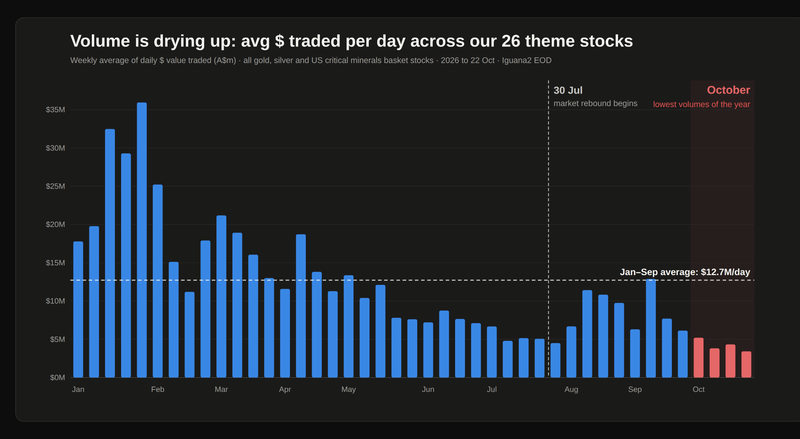
The good news is while the drops are still on relatively low volumes, the bouncebacks can be swift and big.
The bad news is that while the drops are still on relatively low volumes, things can always get worse, and it could drop even more AND on higher volumes.
Everytime the market is terrible like this, I dust off my Grandads favourite saying:
“Always remember that things are never so bad... that they couldn’t get even worse”
While he used it mostly to fend off any whingers he encountered while living in the grim times of post-WW2 Eastern Europe, the saying also has some utility in the small end of the market.
The other bad news is that my “the market will bounce back from July” prediction is about as alive as Robb Stark at the end of the GoT Red Wedding.
Speaking of other depressing stories and wartime Europe, I remember reading and watching Animal Farm when I was a kid.
Animal Farm is a story of the Russian Revolution and the rise of Stalinism, told through the story of a group of farm animals who rebel against their human owner.
A group of farm animals overthrow their human master only to fall under the tyranny of a ruthless pig named Napoleon, who turns their society into a brutal dictatorship where:
"some animals are more equal than others."
The point being, while nearly every small ASX stock is equally down a lot, a smacked down share price is more of a problem for some than it is for others.
(I bet you thought I was about to go on a rant defending capitalism then, huh?)
So which stocks find themselves in the most OR least trouble when all share prices are down? Even on just low volumes?
It's most problematic for exploration companies or pre-revenue companies that are almost broke.
Companies that need to raise money to do stuff, then for the market to care when they announce said stuff, so they can raise at higher prices.
Whether it’s thin volume share price drops or not, capital raises are broadly determined at whatever the last traded price was - doesn’t matter if it’s 3 people panic selling into low ball bids because they have some bills due that week.
Not good because raising money at a lower share price means less money AND more dilution of existing shareholders.
(so actually it really just sucks for shareholders, the companies can usually raise money to keep going by making the raise terms extremely attractive for new money in, and terrible for existing holders)
Less affected by lower share prices are companies with a decent amount of cash in the bank.
Anyone lucky (smart?) enough to have raised decent money before market sentiment went bad, and share prices cratered and can “weather the storm” until things get better.
A couple of examples:
IVR is going to build a silver mine in South Australia and raised $55M back in March and can happily wait it out until silver rises again and market sentiment improves. (read our latest IVR article here)
MNB is building their phosphate plant in Angola - MNB raised $4M then upsized it to $6M back in August... just before the market tanked.
MNB also has a US$16M IDC loan facility, which it has already started drawing down to start building.
The next key funding hurdle is getting the guarantee needed to unlock its BFA financing. (read our latest MNB article here)
SGQ is developing a rare earths and niobium project in Brazil - they raised $60M in June and have almost $100M in the bank to continue on their merry way until market sentiment returns.(read our latest SGQ article here)
Better still, companies with decent cash in the bank AND are already selling stuff (making revenue) - maybe even being close to break even.
Some examples:
EIQ makes AI that helps doctors spot heart diseases from heart ultrasound measurements - they are already selling a product.
EIQ raised around $110M in July to push into the USA, then FDA didn’t clear their next product and share price got smacked.
Then smacked again when the rest of the market tanked.
They are appealing the FDA decision... and they still have the $110M. (read our latest EIQ article here)
ROC makes AI that watches shop camera footage to help banks and retailers spot theft and checkout losses, and work out where staff are needed
ROC raised $7M in January AND they signed a giant up to $9.1M annual recurring revenue deal which they are executing on.
Raising money AND making money. (read our latest ROC article here)
EMD runs mental health treatment services, including psychedelic-assisted therapy under medical supervision.
EMD raised $8M last November and still had $7.29M cash at the end of June.
They are already treating patients and getting paid for it, with A$4.05M in service revenue last financial year.
Cash in the bank AND an operating treatment business (read our latest EMD article here)
ONE makes hospital bedside software that helps patients access services and connect with their care team - hospitals pay to use it.
They raised $19M ($7M T2 still to come) from their March placement and reported €7.19M cash at the end of June, alongside €5.48M in first-half revenue.
Already selling into hospitals, with more beds to win... (read our latest ONE article here)
And the best in a bad share price situation, companies with cash in bank AND selling stuff AND in a sector that gets good during global chaos:
The small end of the markets are rough, and the geopolitical scene is getting rough too - most countries are ramping up military spending and military tech revamps.
A good time to be selling technology into the defence sector.
AL3 makes industrial metal 3D printers that build big parts layer by layer, including for suppliers to the US Navy.
They raised A$30M back in late 2024 and still had A$24.42M cash at the end of September.
AND they recorded A$12.5M in revenue including lease income last financial year.
Cash in the bank, selling real equipment, and helping make the parts defence customers need. (read our latest AL3 article here)
NS1 makes technology that gets video and data through poor connections on the battlefield - useful when you need to see what a drone or remote machine is seeing.
They completed a A$6.5M share placement in July.
Their share price has been very smashed (and they have some convertible notes coming due in 12 months)
NS1 have money in the bank giving them time to try and make some big military sales - lets see if they can do it. (read our latest NS1 article here)
So there are a couple of examples in each category.
Anyone following small oil & gas stocks will probably have noticed most of them are tracking along sideways, while everything else is getting hammered down.
When everything else is cratering - sideways is as good as going up!
See you next week - hopefully things start turning around.
Have a great weekend.
Next Investors
General Information Only
This material has been prepared by StocksDigital. StocksDigital is an authorised representative (CAR 000433913) of 62 Consulting Pty Limited (ABN 88 664 809 303) (AFSL 548573).
This material is general advice only and is not an offer for the purchase or sale of any financial product or service. The material is not intended to provide you with personal financial or tax advice and does not take into account your personal objectives, financial situation or needs. Although we believe that the material is correct, no warranty of accuracy, reliability or completeness is given, except for liability under statute which cannot be excluded. Please note that past performance may not be indicative of future performance and that no guarantee of performance, the return of capital or a particular rate of return is given by 62C, StocksDigital, any of their related body corporates or any other person. To the maximum extent possible, 62C, StocksDigital, their related body corporates or any other person do not accept any liability for any statement in this material.
Conflicts of Interest Notice
S3 and its associated entities may hold investments in companies featured in its articles, including through being paid in the securities of the companies we provide commentary on. We disclose the securities held in relation to a particular company that we provide commentary on. Refer to our Disclosure Policy for information on our self-imposed trading blackouts, hold conditions and de-risking (sell conditions) which seek to mitigate against any potential conflicts of interest.
Publication Notice and Disclaimer
The information contained in this article is current as at the publication date. At the time of publishing, the information contained in this article is based on sources which are available in the public domain that we consider to be reliable, and our own analysis of those sources. The views of the author may not reflect the views of the AFSL holder. Any decision by you to purchase securities in the companies featured in this article should be done so after you have sought your own independent professional advice regarding this information and made your own inquiries as to the validity of any information in this article.
Any forward-looking statements contained in this article are not guarantees or predictions of future performance, and involve known and unknown risks, uncertainties and other factors, many of which are beyond our control, and which may cause actual results or performance of companies featured to differ materially from those expressed in the statements contained in this article. S3 cannot and does not give any assurance that the results or performance expressed or implied by any forward-looking statements contained in this article will actually occur and readers are cautioned not to put undue reliance on forward-looking statements.
This article may include references to our past investing performance. Past performance is not a reliable indicator of our future investing performance.