AL3: Record $12.5M revenue, $78M in sales pipeline, US Navy keen and entry in UK/EU defence space.
Disclosure: S3 Consortium Pty Ltd (the Company) and Associated Entities own 8,110,529 AL3 Shares and the company’s staff own 128,000 AL3 Shares at the time of publishing this article. The Company has been engaged by AL3 to share our commentary on the progress of our Investment in AL3 over time. This information is general in nature about a speculative investment and does not constitute personal advice. It does not consider your objectives, financial situation, or needs. Any forward-looking statements are uncertain and not a guaranteed outcome.
10 days ago, one of AML3D (ASX:AL3)'s robot 3D metal printers featured on the US Navy's website.
In the US Navy's announcement that it will start to deploy 3D metal printing "at unprecedented speeds"...
starting from 10 days ago.
Seriously, here it is again:
(AL3’s 3D metal printers help print complex metal parts for shipbuilding, aerospace and defence - harder, better, faster, stronger than traditional casting or forging)
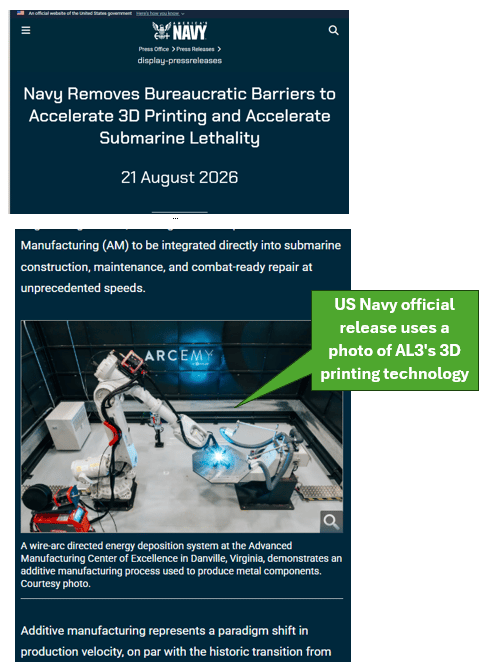
(source) and (we covered that news in Monday's note)
At last traded price of 13.5c, AL3 is has a market cap of ~$76M... with $26.7M in the bank
Meaning AL3’s enterprise value is currently ~$50M.
Today AL3 announced:
- Record FY26 revenue of $12.5M - up 70% on last year.
- $78M in sales pipeline (near-term order opportunities), AND
- $16.8M in orders carried over to FY27 - so next year should be another record year for AL3).
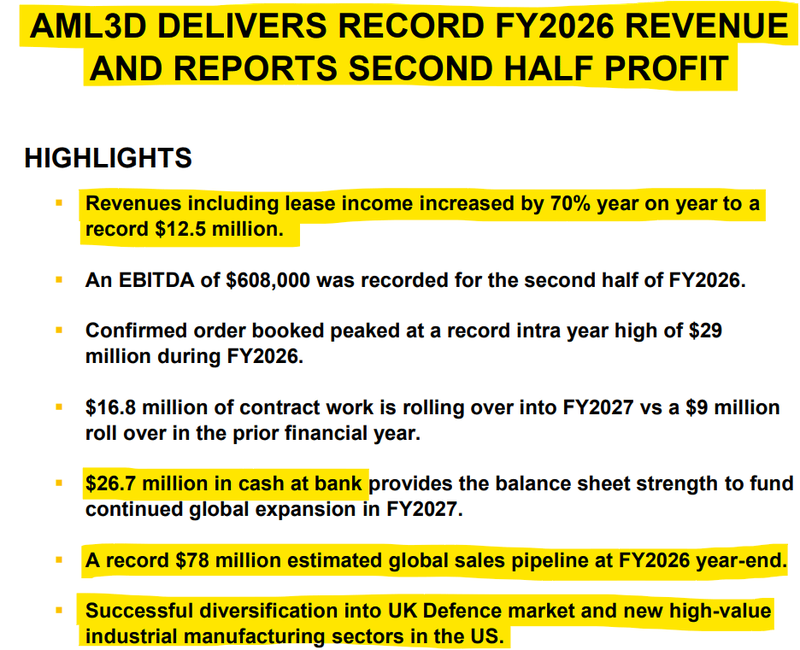
(source)
We first Invested in AL3 back in June 2024, just after it pivoted its business to selling 3D printing systems, printed parts AND charging buyers recurring software license fees.
(Instead of the previous business model of just selling 3D printed metal parts)
From a standing start in 2023, AL3 has signed contracts for 16 of its (ARCEMY) 3D printing systems in the US.
14 of those are inside the US Navy’s supply chain.
AL3 now counts Huntington Ingalls (builder of 70% of the current US fleet), $1.7BN Austal, and the US Navy's own Additive Manufacturing Centre of Excellence as customers.
AL3 has also received a letter from the US Navy forecasting demand for 100 additive manufacturing (metal 3D printing) systems across the Marine Industrial Base and telling AL3 it would play a "pivotal role" in meeting these needs.
Here is that letter addressed to AL3 again:
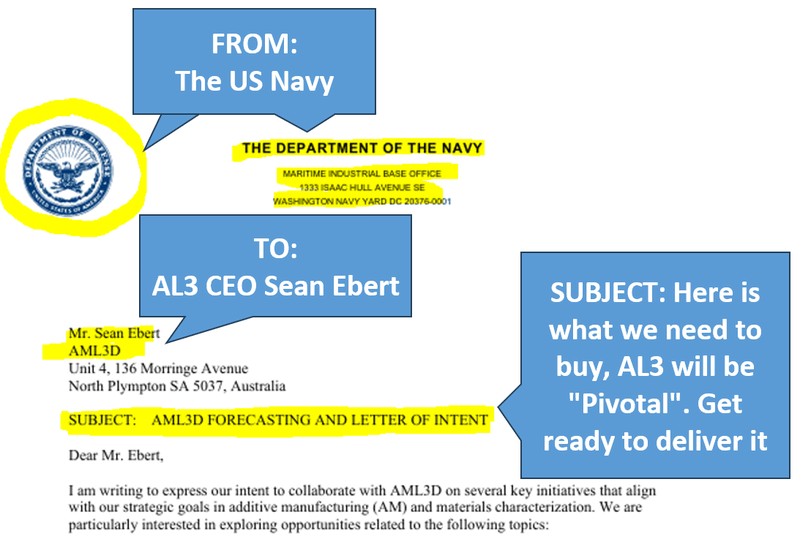
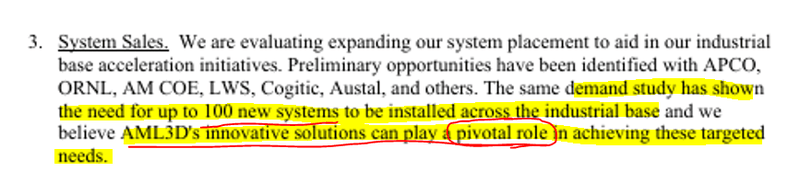
(Source: US Navy Letter of Intent to AL3)
Quick back of napkin calcs on that US Navy LOI:
AL3’s systems have sold for between ~$1M and ~$2.5M each - so 100 systems is somewhere between ~$100M and ~$250M in gross revenue.
No guarantee AL3 captures anywhere near all of that, these are just back of napkin calcs based on a number of assumptions we could have gotten wrong.
But it's no secret that the USA is aiming to turbo charge the speed at which it build ships - and its coming straight from the very top:

(source)
AL3 ended FY26 with $26.7M cash in the bank, $16.8M in its order book (the order book alone is more than the record revenues AL3 did in FY26), AND...
A record $78M sales pipeline (opportunities AL3 could convert into orders in the near term).
With that order book, cash position and sales pipe - AL3 is capped at ~$71M, trading with an enterprise value of ~$44.3M (held $26.7M cash as at June 30).
Another key takeaway from today's annual results:
AL3 has also entered the UK defence market
AL3's material feasibility program with ~A$125BN BAE Systems in the UK is progressing - and distribution deals are now done in BOTH the UK and Europe.
BAE systems is the biggest defence contractor in Europe and one of the biggest in the world.
We think the market is completely missing the UK/EU opportunity for AL3.
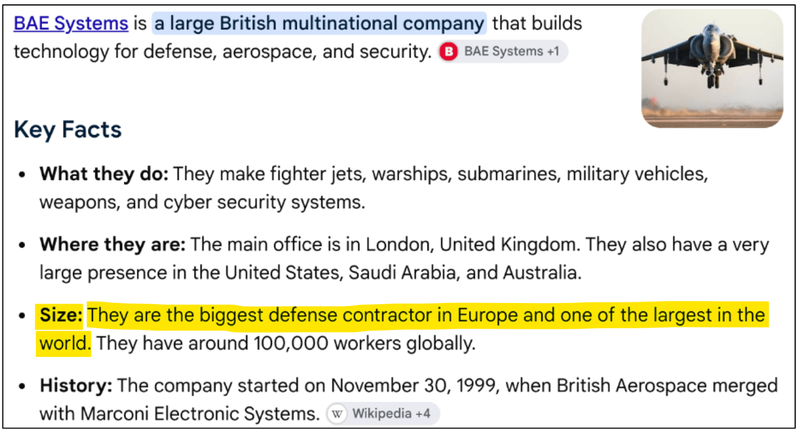
(source - we googled “who is BAE systems”)
Entry into the UK defence market means AL3 now has defence relationships in Australia, the UK and the USA.
Maybe AL3 now goes and executes an expansion into the UK/EU the same way it has in the US...
Can AL3 run its US playbook again in the UK/EU?
AL3 went from materials qualification work and zero systems installed in 2023.
To three years later having 14 systems contracted into the US Navy's supply chain, record revenue, and a $78M sales pipeline.
We think AL3 in the UK/EU is where it was in the US back in 2023.
- AL3 is running materials feasibility work with BAE Systems right now
- Has UK/EU distribution deals signed, AND
- AL3 says it is in "advanced negotiations" for its first European ARCEMY system order. (source)
That first order would trigger AL3 building a $5M European Technology Centre - exactly the same way AL3 launched into the US.
Here is what AL3 had in its deck today:
"European Defense demand and pipeline mirror trends that underpinned successful entry into the US Defence market."
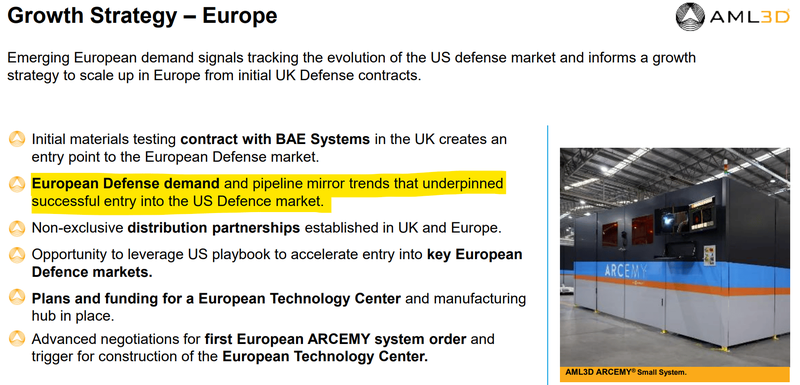
(source)
We think the macro is relatively strong for AL3 too.
Europe at the 2025 NATO summit agreed to lift defence spending to 5% of GDP by 2035.

(source)
The UK/EU has also been the reason for so many ASX defence stocks re-rating.
DroneShield’s run to a ~$2.8BN market cap was off the back of deals in the EU defence space.
And the same is true for ~$1.3BN Elsight.
We think that if a few of those familiar names (to ASX punters) start announcing deals with AL3, the market could start to price the EU/UK expansion into AL3’s share price.
The past performance is not and should not be taken as an indication of future performance for this or any stock. Caution should be exercised in assessing past performance. This product, like all other financial products, is subject to market forces and unpredictable events that may adversely affect future performance.
For now though, the main game is still the US
AL3 makes 3D printing systems that produce complex parts using metals.
Faster, stronger and cheaper than traditional casting and forging.
AL3 also owns and operates its own fleet of printers - to print parts for customers on demand (customers like the US Navy, defence, shipbuilding, oil and gas, aerospace and utilities).
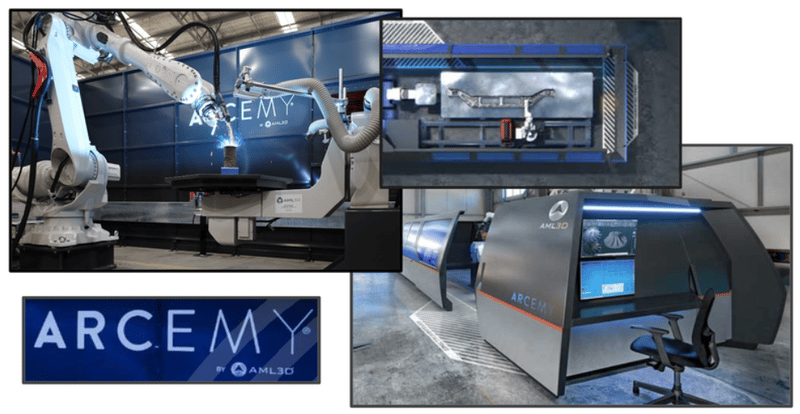
Here is one of AL3’s robots, “additive manufacturing” in action:
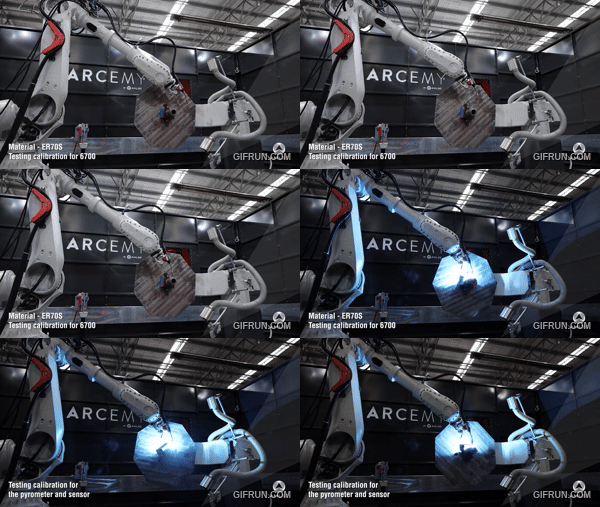
(source)
Until the news from two weeks ago, every 3D printed part needed to pass engineering sign-offs and different testing programs based on each use case the parts were made for.
Huge friction for any technology to get off the ground.
Imagine having to walk to your local post office and verify your ID every time you wanted to log in to Netflix... usage would be near zero.
Now, the US Navy can procure 3D-metal printed parts for its submarines a lot simpler AND a lot faster than before.
We think that the rollout of the 3D-metal printing (additive manufacturing) systems will really start to ramp up after Friday’s announcement.
Hopefully meaning the Letter of Intent AL3 received from the US Navy last year starts to play out.
For ~100 x 3D printing systems and up to 1,600 x 3D printed parts per year by 2030 across the US submarine and shipbuilding industrial base.
Basically giving AL3 a heads up to get ready, because AL3 would play (in the US Navy's own words) a "pivotal role in achieving these targeted needs".
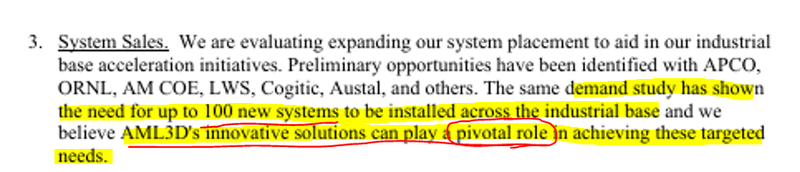
(Source: US Navy Letter of Intent to AL3)
Since that letter, AL3 has landed:
- A $4.5M order (two systems) from a subsidiary of ~US$12BN Huntington Ingalls Industries (HII), the largest military shipbuilder in the USA (source)
- A $9.9M follow-up order (four more systems) from the same customer - AL3's biggest ever order, taking their installations to six systems in under six months (source)
- A $2.6M order to 3D print five submarine parts the US Navy can no longer source anywhere else. (the original manufacturers stopped making them) (source)
- A $1.7M system sale to a US Navy component supplier (source), And
- AL3's first portable, containerised 3D printing system went live at the US Navy's Additive Manufacturing Centre of Excellence in May. (source)
We said this in our last AL3 note back in March:

Source: AL3: New $2.6M US Navy submarine parts order... A week after $9.9M military shipbuilding order.
We have seen a few deals get signed between now and then - but we are hoping last week's news really gets things going over in the US.
Especially with AL3 basically ready to ramp up operations over there.
So how does AL3 actually sell into all this and who is buying from AL3 already?
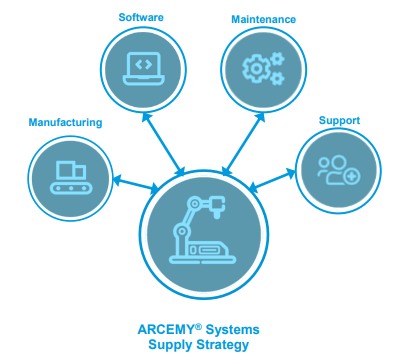
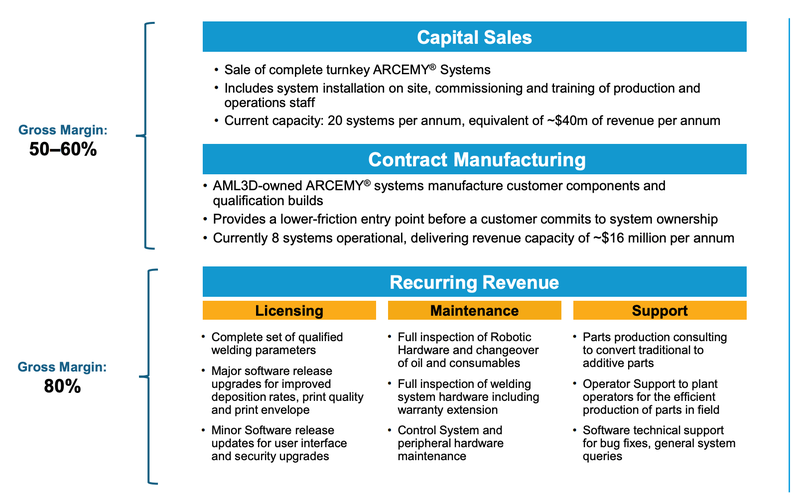
AL3 makes money in three ways:
- Selling its 3D printing (ARCEMY) systems (for ~$1-2.5M),
- Recurring software/services fees on every installed system (~$250K per system per year), and
- Contract manufacturing of parts (like the $2.6M submarine parts order). (source)
(source)
Here is a great slide from today’s investor presentation summarising the model:
(source)
AL3 currently has a “Master Licensing Agreement” with BlueForge which was given a US$951M budget from the Department of War to deploy into the US submarine supply chain.
A Master Licensing Agreement is basically AL3 being plugged into the parts database that the BlueForge Alliance covers.
(Sort of like the Uber Eats for parts the US military industrial complex needs)
That $2.6M submarine parts order we mentioned earlier was through BlueForge.
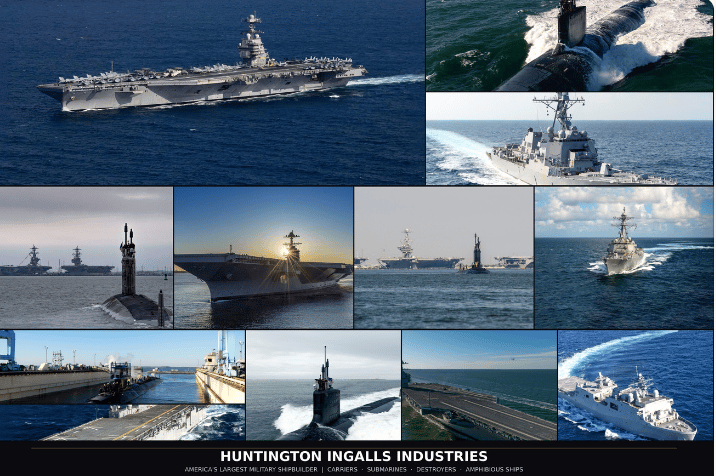
AL3 also sells its systems to a division of Huntington Ingalls Industries (HII) - the biggest military shipbuilder in the USA.
Over 70% of the current US Navy fleet was built by Huntington Ingalls Industries. (source)
HII has ordered a total of six of AL3’s custom systems - two are now live, the remaining four are being built in Ohio for delivery in early 2027.
(source)
AL3 also has systems installed with $1.7BN Austal in the US Navy's Additive Manufacturing Centre of Excellence.
That US Navy ‘Centre of Excellence’ is the US Navy's flagship additive manufacturing facility, where there are three AL3 systems installed, including AL3's first portable, containerised ARCEMY (nice to show off the system that can be installed in 1-2 days).
The portable unit is a new product line - and a preview of "forward deployed" manufacturing for multiple branches of the US military. (source)
We think the “forward deployment opportunity” hasn’t really been tested by AL3 yet.
We think we could start to see a lot more news on that front over the coming months.
Where else could more AL3 contracts come from?
Everything mentioned above is just related to the US Navy.
We think the biggest opportunity for AL3 will come after embedding itself within the Navy supply chain.
Starting with submarines, we think AL3 can treat that as a proof of concept - showing the US Navy that its tech works and can be relied upon.
The reality is that a lot of the companies that are doing the submarine building also happen to build other important stuff for the US government.
Like Huntington Ingalls, which as we mentioned earlier (who has six of AL3’s systems installed/on order).
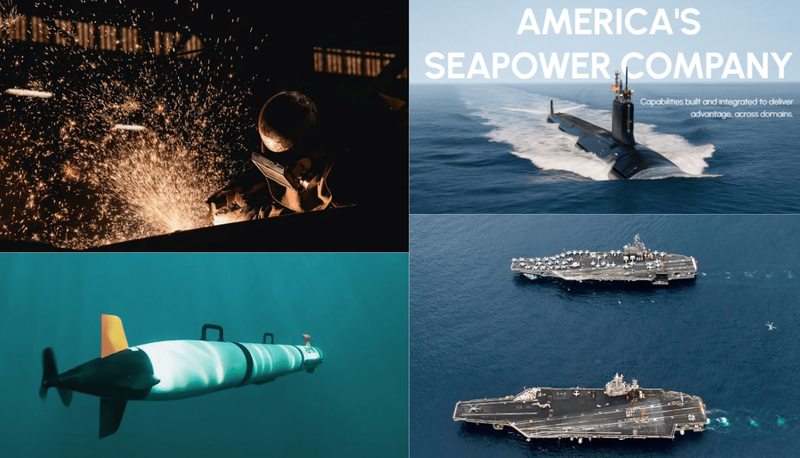
That large company also produces aircraft carriers AND destroyers AND unmanned systems for the wider US military:
(source)
Assuming AL3 can show customers like Huntington the reliability of its tech, we think there could be more orders to come.
AL3 could expand into the US Army and Air Force - where the US is likely having the same manufacturing challenges it is having with the submarine programs (speed/flexibility).
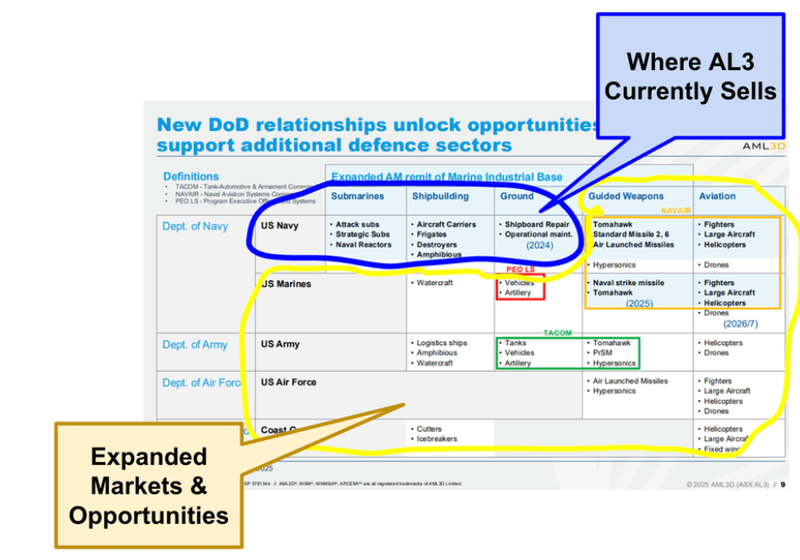
(source)
Outside the US government, AL3 already sells systems and parts to customers like:
- ~US$170BN Boeing through a “Defence Manufacturing License Agreement”
- Tennessee Valley Authority - the largest public utility in the USA ($2.27M system)
- Chevron and ExxonMobil - selling mostly parts.
So we think there could also be demand from the oil & gas, utilities and aerospace industries.
Aerospace especially.
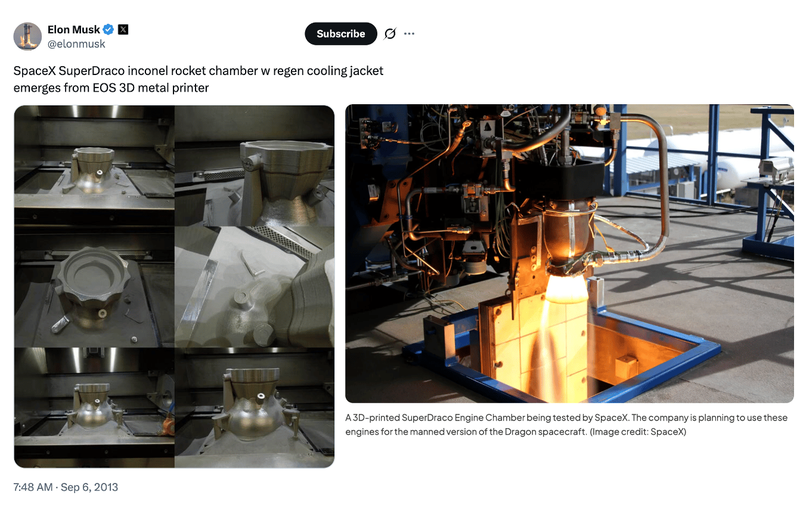
Fun Fact: Elon Musk’s SpaceX builds its rocket engines using metal 3D printing.
The day SpaceX IPO’ed this year, there were news articles which called SpaceX "one of the world's most significant users of additive manufacturing".
Here is Musk sharing a 3D metal printer back in 2013:
Then there is the potential EU/UK growth story
At the 2025 NATO summit an agreement was made to increase defence spending to 5% of GDP by 2035 - with a specific commitment to "innovate, and strengthen the defence industrial base". (source)
Right now ~A$125BN BAE Systems (a major EU/UK defence contractor) is completing a $1.2M alloy testing and materials feasibility program with AL3.
We think that program (if successful) COULD be the precursor to AL3's UK/European expansion.
AL3 also says it is in “advanced negotiations for first European ARCEMY system order and trigger for construction of the European Technology Center”. (source)
So we could see a similar growth story in the UK/EU to the one we have seen in the US.
Ultimately, we are Invested in AL3 to see it grow its business in the US and/or the EU/UK:
Our AL3 'Big Bet':
"AL3 re-rates to a $500M market cap on achieving significant sales growth across an expanding range of industries and jurisdictions"
NOTE: our “Big Bet” is what we HOPE the ultimate success scenario looks like for this particular Investment over the long term (3+ years). There is no guarantee that our Big Bet will ever come true. There is a lot of work to be done, many risks involved, including development risk, country risk and regulatory risk - just some of which we list in our AL3 Investment Memo.
Success will require a significant amount of luck. Past performance is not an indicator of future performance.
Why AL3 now?
The reason why we are bullish AL3 from a macro perspective right now goes back ~200 years...
Bear with us on this one.
Why is the US moving so fast on 3D printing?
Because for the last ~200 years, global superpower status has tracked one metric: shipbuilding capacity.
The last global superpower before the US was Britain.
At its peak in the 1890s, Britain built ~80% of the world's shipping tonnage. (source)
Then came the World Wars and at the peak of the war, the US was delivering ~800,000 tons of new ships every month - roughly 70 times its pre-war rate.
One California shipyard got so fast it built an entire ship in 7 days.
By 1945, the US had the largest navy ever assembled, the world's reserve currency... and the superpower title.
Britain's shipbuilding share never recovered - it slid from 57% in 1947 to 17% a decade later, and today the UK builds essentially no commercial ships at all. (source)
Now the same thing is happening between China and the USA.
China now builds more than 50% of the world's commercial ships.
The USA builds 0.1%. (source)
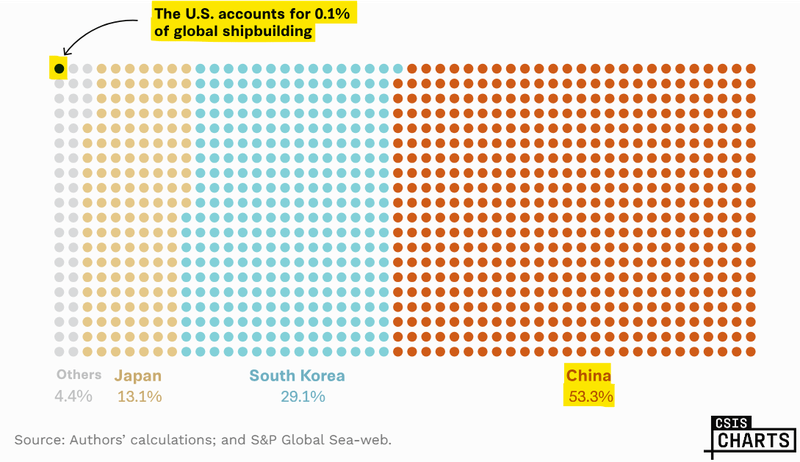
(source)
One single Chinese state-owned shipbuilder (CSSC) built more commercial tonnage in 2024 alone than the entire US shipbuilding industry has built since World War II. (source)
US Naval Intelligence estimates China's shipbuilding capacity at ~23.2 million tons per year versus less than 100,000 tons for the USA.
That is 232 times more capacity. (source)
So it makes sense that shipbuilding capacity has become one of the few genuinely bipartisan priorities in Washington.
US President Donald Trump: "We used to make so many ships. We don't make them anymore very much, but we're going to make them very fast, very soon. It will have a huge impact."

(source)
If the future is going to be robots working with software to build stuff, that’s where additive manufacturing comes in - and why the US Navy has been throwing money and urgency at it:
- The BlueForge Alliance was allocated US$951M specifically to rebuild the US submarine industrial base (source)
- The "Big Beautiful Bill" earmarked US$450M for additive manufacturing in shipbuilding. (source - page 110)
- The US Department of War's FY2026 budget allocated US$3.3BN for additive manufacturing (source)
- The Navy's FY27 budget request asks for US$65.8BN for shipbuilding. (source)
The US Navy has called metallic additive manufacturing its "Manhattan Project" - and told parts suppliers to either adopt 3D printing or get left behind.
Here's that quote from Matt Sermon, Executive Director of PEO-Strategic Submarine (linked to NAVSEA):

(source)
NAVSEA is responsible for the acquisition, development and maintenance of US Navy submarine systems and programs - and is directly linked to Huntington Ingalls, AL3's biggest customer.
This is the same Matt Sermon who featured in AL3’s latest Investor presentation on slide 17:
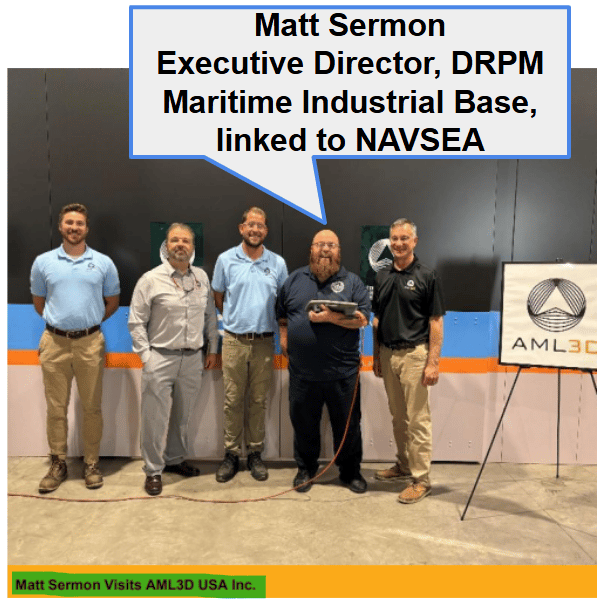
(source)
We have been to AL3’s facilities, here is what we saw
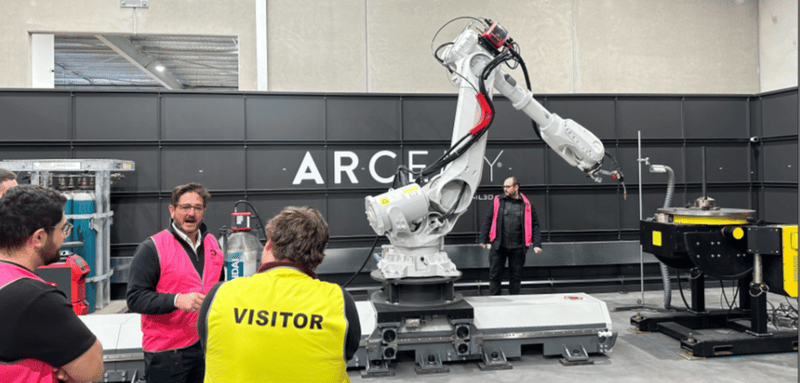
We have been to AL3's Australian facility in Adelaide a few times to check the systems out and it's pretty cool to see these things in operation.
We saw the largest ever custom AL3 ARCEMY 3D printing system ever built, before it was to be shipped off to the USA:
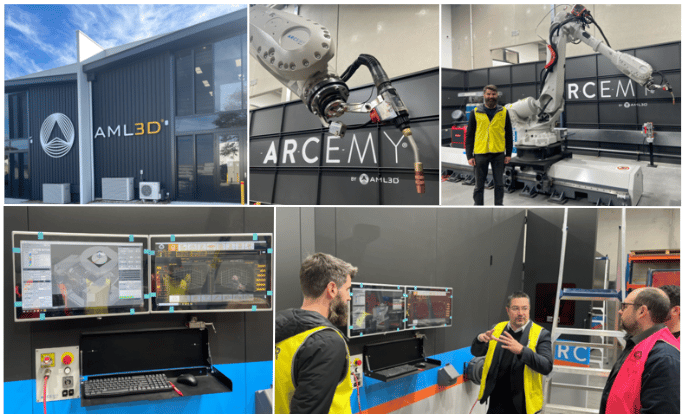
As well as some of what the product software looks like:
To see our full site visit write up read: Our AL3 site visit and what we learnt.
What's next for AL3?
🔄More system sales into the US market
We want to see more orders from the six US naval base companies named in the Navy's LOI.
And hopefully new channels after last week's US Navy announcement.
🔄US facility expansion
AL3 has flagged that it will be doubling the capacity of its Ohio facility.
AL3 plans to invest $12M to expand production capabilities.
We don't expect things to suddenly take off but a few system sales every few weeks/months would be a great outcome here.
🔄UK and European market entry
AL3 has appointed distributors in the UK and Germany, and is running alloy testing with BAE Systems.
We think the alloy testing contracts are precursors for system sales/manufacturing deals - these testing contracts are where the bigger guys test AL3’s tech before buying.
Sales into Europe or the UK could change the way the market sees AL3’s future growth potential.
AL3 explicitly said in today’s announcement that it “has the cash reserves to fund a $5 million investment in a UK Technology Centre to support UK and European demand” (source)
What could go wrong?
The single biggest risk right now is without a doubt order conversion risk.
The US Navy's Letter of Intent is a demand forecast, not a contract - it's non-binding, contains no guaranteed dollar value, and the Navy named other companies alongside AL3 that could help meet its targets.
Sales risk
There is always the possibility that AL3 does not close more sales, and its financial performance suffers as a result.
Source: "What could go wrong" section - AL3 Investment Memo 27 June 2024
Other Risks
Like any small-cap industrial technology company, AL3 carries significant risk, here we aim to identify a few more risks.
AL3's heavy reliance on the US Navy and defense supply chain leaves it vulnerable to shifts in government policy, defense budget reallocations, or procurement delays.
Any changes to military spending priorities could directly impact expected system deployments.
While the US Navy's Letter of Intent forecasts demand for 100 systems, it remains non-binding and carries no guaranteed revenue or purchase commitments.
Failure to convert this pipeline into firm, binding contracts would significantly impair projected financial growth.
Expanding the Ohio facility with a planned $12M investment introduces operational execution risks and potential cost overruns.
Scaling operations across both the US and UK/Europe could also strain management bandwidth and capital resources.
AL3's European entry is at an early stage - the BAE program is a feasibility study, the distribution deals are non-exclusive, and no European system sale has been signed yet.
Additive manufacturing remains a highly competitive and rapidly evolving space, exposing AL3 to competition from alternative technologies or well-funded market entrants.
Slower-than-expected industry adoption or technical qualification delays could slow revenue realization.
Investors should consider these risks carefully and seek professional advice tailored to their personal circumstances before investing.
Our AL3 Investment Memo
You can read our AL3 Investment Memo in the link below. We use this memo to track the progress of all our Investments over time.
In our AL3 Investment Memo, you can find the following:
- What does AL3 do?
- The macro theme for AL3
- Our AL3 Big Bet
- What we want to see AL3 achieve
- Why we are Invested in AL3
- The key risks to our Investment Thesis
- Our Investment Plan
General Information Only
This material has been prepared by StocksDigital. StocksDigital is an authorised representative (CAR 000433913) of 62 Consulting Pty Limited (ABN 88 664 809 303) (AFSL 548573).
This material is general advice only and is not an offer for the purchase or sale of any financial product or service. The material is not intended to provide you with personal financial or tax advice and does not take into account your personal objectives, financial situation or needs. Although we believe that the material is correct, no warranty of accuracy, reliability or completeness is given, except for liability under statute which cannot be excluded. Please note that past performance may not be indicative of future performance and that no guarantee of performance, the return of capital or a particular rate of return is given by 62C, StocksDigital, any of their related body corporates or any other person. To the maximum extent possible, 62C, StocksDigital, their related body corporates or any other person do not accept any liability for any statement in this material.
Conflicts of Interest Notice
S3 and its associated entities may hold investments in companies featured in its articles, including through being paid in the securities of the companies we provide commentary on. We disclose the securities held in relation to a particular company that we provide commentary on. Refer to our Disclosure Policy for information on our self-imposed trading blackouts, hold conditions and de-risking (sell conditions) which seek to mitigate against any potential conflicts of interest.
Publication Notice and Disclaimer
The information contained in this article is current as at the publication date. At the time of publishing, the information contained in this article is based on sources which are available in the public domain that we consider to be reliable, and our own analysis of those sources. The views of the author may not reflect the views of the AFSL holder. Any decision by you to purchase securities in the companies featured in this article should be done so after you have sought your own independent professional advice regarding this information and made your own inquiries as to the validity of any information in this article.
Any forward-looking statements contained in this article are not guarantees or predictions of future performance, and involve known and unknown risks, uncertainties and other factors, many of which are beyond our control, and which may cause actual results or performance of companies featured to differ materially from those expressed in the statements contained in this article. S3 cannot and does not give any assurance that the results or performance expressed or implied by any forward-looking statements contained in this article will actually occur and readers are cautioned not to put undue reliance on forward-looking statements.
This article may include references to our past investing performance. Past performance is not a reliable indicator of our future investing performance.