$44M capped ROC has started the roll out of its $9.1M Annual Recurring Revenue (ARR) contract. First store installations have begun.
Disclosure: S3 Consortium Pty Ltd (the Company) and Associated Entities own 6,584,069 ROC Shares at the time of publishing this article. The Company has been engaged by ROC to share our commentary on the progress of our Investment in ROC over time. This information is general in nature about a speculative investment and does not constitute personal advice. It does not consider your objectives, financial situation, or needs. Any forward-looking statements are uncertain and not a guaranteed outcome.
What does the AI boom and the railroad buildout of the 1840s have in common?
In the 1840s, during the big railroad buildout, a bubble formed around railway stocks.
(like we are seeing now with the AI models - OpenAI (ChatGPT) & Anthropic (Claude))
But, in the long run the big winners weren't the railway stocks themselves.
It was actually the retail, manufacturing and logistics businesses built on transporting stuff around faster.
The same thing happened with electricity, the internet and even smartphones.
Our view is that every technology boom follows the same pattern.
And the businesses that survive (and dominate) are the ones that find the best ways to build a business using that new tech infrastructure.
Which is one of the big reasons we made RocketBoots (ASX:ROC) our 2025 Tech Pick of the Year.
ROC was "doing AI" way before ChatGPT was released - back in 2022. (source)
Taking in-store video and catching theft + optimising staff productivity for giant retailers and banks.
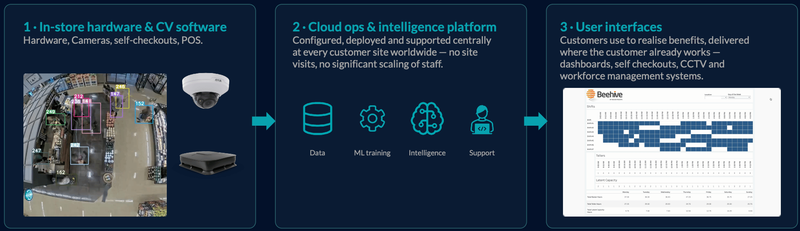
ROC is already servicing customers across retail grocery and banking - including two ASX 20 companies.
More on what ROC does (and why its customers pay for it) later in today's note.
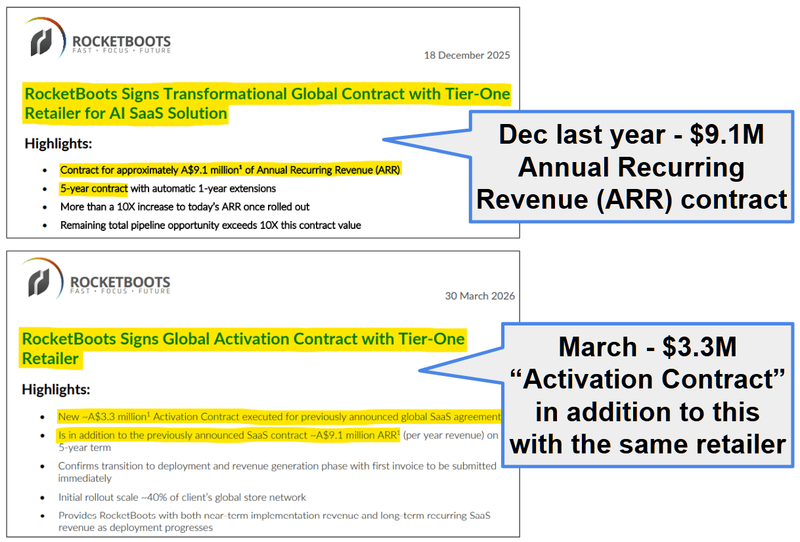
The big company making deal for ROC came in December last year and then March this year when ROC announced these two:
- ~$9.1M PER YEAR in Annual Recurring Revenue, for at least 5 years, with a "tier-one multinational retailer" (source);
- PLUS a $3.3M one-off "activation contract" from the same customer - ROC gets paid to switch the tech on (source).
ROC's total revenue for FY26 was ~$725k.
So this one deal with a Tier 1 global retailer can more than 12x the entire company's last-year revenue - on a recurring annual basis - once fully rolled out.
And the first contract is only for about 40% of their stores - perhaps we can expect more stores in the future?
Seriously one of the best deals we have ever seen from any small ASX listed tech company.
At the same time, there’s activation risk still at play, timing of full roll outs is unclear, and things can and will change (especially in small cap stocks).
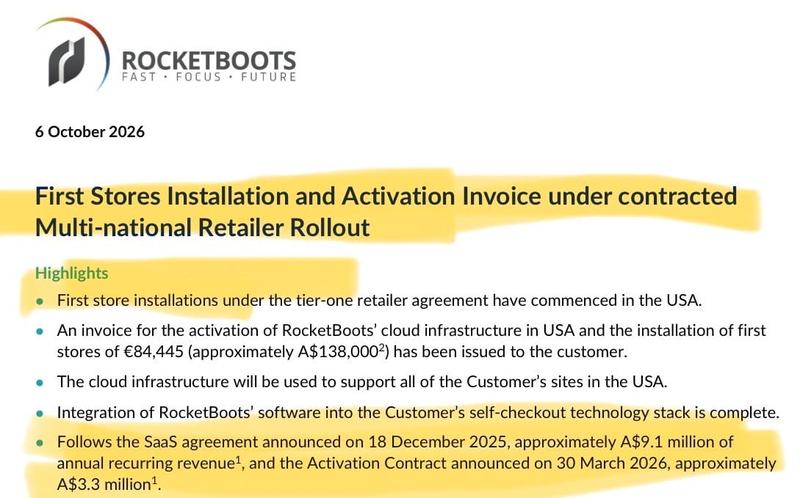
TODAY ROC confirmed the first store installations under that deal have started - in the USA.
(source)
(This is in the US, back in Q1 ROC’s team had also “spent significant time in Europe advancing activation readiness” source)
Now, ROC has invoiced its customer the first (~A$138,000) of its ~$3.3M activation contract.
Here is everything ROC’s done since signing that activation contract in March:
- ✅ ROC's software is now integrated into the customer's self-checkout tech.
- ✅ New camera and self-checkout hardware types integrated
- ✅ Software/hardware connection is now hooked up to ROC’s cloud platform
- ✅ Architecture and security decisions locked with the customer
- ✅ Project teams, steering committees and third-party suppliers for the rollout in place
- ✅ New engineering and operations staff hired for the life of the contract
All of the background technical work that is hard to communicate to the stock market - but has to happen to get a deal off the ground.
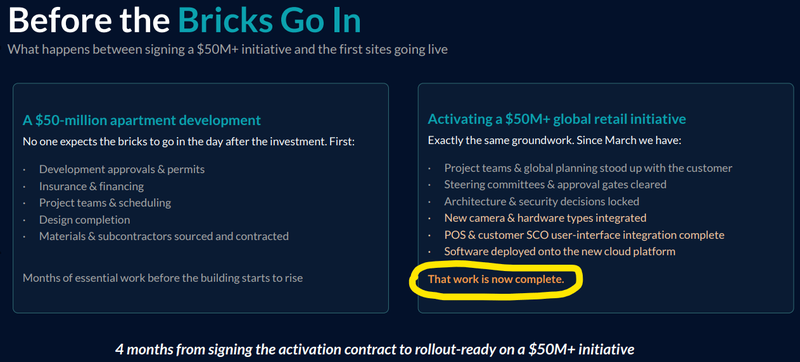
ROC used a property development example in its most recent investor presentation (here) saying how it takes years for an apartment building to be built after financing is locked in:
(source)
First come approvals, the insurance, the project teams, the subcontractors... and then a finished product.
ROC went from signing the activation contract to "rollout-ready" in ~4 months - pretty quick when the deal is genuinely company making.
Over the next 24 months, ROC will get paid the ~$3.3M activation contract to roll its tech out. (source)
And when all is said and done ROC should be generating ~$9.1M in Annual Recurring Revenue from this ONE customer.
(no guarantees of course - enterprise rollouts can always be delayed)
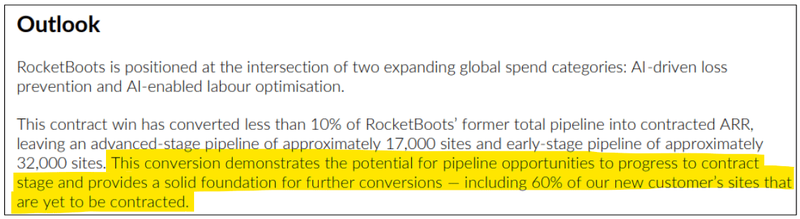
And as we mentioned above, this is just for ~40% of this one customer's store network.
So IF the customer likes what it sees from the first US stores, there is still the other 60% of its global network that could be signed up to use ROC’s tech.
If ROC's tech goes into the other 60% of its stores, the look through Annual Recurring Revenue to ROC could be somewhere around ~$22.5M.
That is $22.5M in recurring revenue for $45M capped ROC.
From just ONE customer.
This is a ‘back of napkin’ calculation of course - no guarantee ROC can sign up 100% of stores and its a big assumption the pricing will stay the same - so big speculation on our part here.
(source)
This is all before we get to the rest of ROC's sales pipeline of other customers.
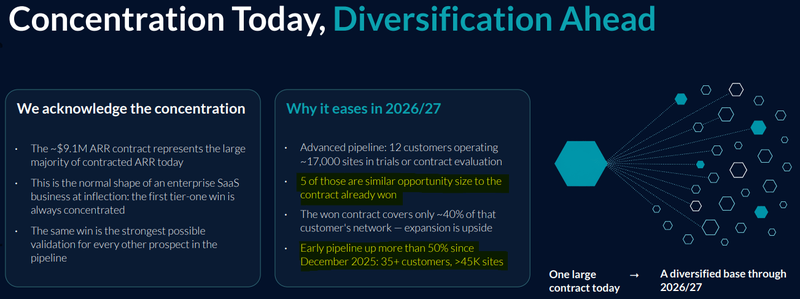
ROC's "advanced stage pipeline" is big & has five more deals of a similar size
ROC's advanced sales pipeline currently sits at 12 customer opportunities operating ~17,000 sites (source).
FIVE of those are of a similar size to the transformational contract ROC won in December last year.
So again, pulling out our napkin and scrawling some rough numbers on it - 5 x $9.1M = $45.5M in potential Annual Recurring Revenue sitting in ROC's advanced pipeline from just those five potential deals.
Again - napkin calcs are crude numbers with a lot of assumptions involved, a lot of which may not eventuate - it's way too early to speculate on future revenue to ROC, this is merely a guide of what the pipeline looks like.
(source)
ROC's "advanced" pipeline means customers that are at the Trial, UAT (user acceptance testing) or Negotiation stage. (source)
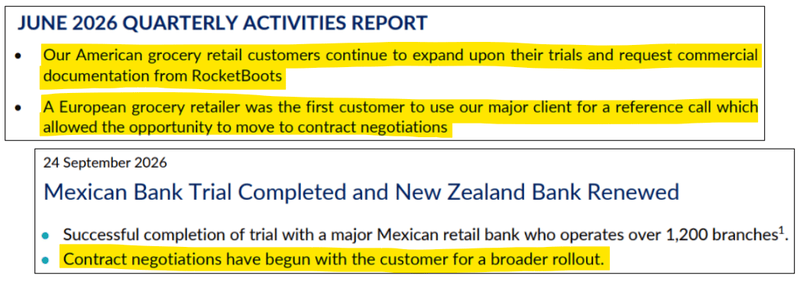
In the most recent quarterly we saw:
- ROC's American grocery retail customers "continue to expand upon their trials and request commercial documentation",
- A European grocery retailer used ROC's major client for a reference call - which moved the opportunity to contract negotiations.
And just last week, ROC announced its trial with one of Mexico's largest retail banks (1,200+ branches) was successful - with contract negotiations now underway for a broader rollout:
Maybe one of those above is one of the five that are of similar size to ROC’s (potential) $9.1M ARR contract - and all very close to that ‘contract negotiation’ stage.
That's just the "advanced stage" pipeline.
Across its ENTIRE sales pipeline, ROC has over 35 customer opportunities operating over 45,000 sites in the early stage pipeline, on top of the 12 customers / 17,000 sites in the advanced stage pipeline (source).
And it looks like that big company making contract signed in December is opening ROC up to new opportunities.
ROC’s early-stage pipeline has grown more than 50% since December (when the $9.1M ARR contract was signed). (source)
Exactly what we hoped would happen - a “tier-one global retailer” signing up ROC as a client, and all of a sudden ROC becoming a credible tech partner for other potential customers.
The entire sales pipe could be worth ~$109M in ARR (which the ASX loves)
OK we are going to need another napkin...
Bear with us here - again the below numbers are very forward looking and should not be relied upon, we are merely demonstrating potential which may not translate into reality.
Treat all our and ROC’s napkin calcs with extreme caution.
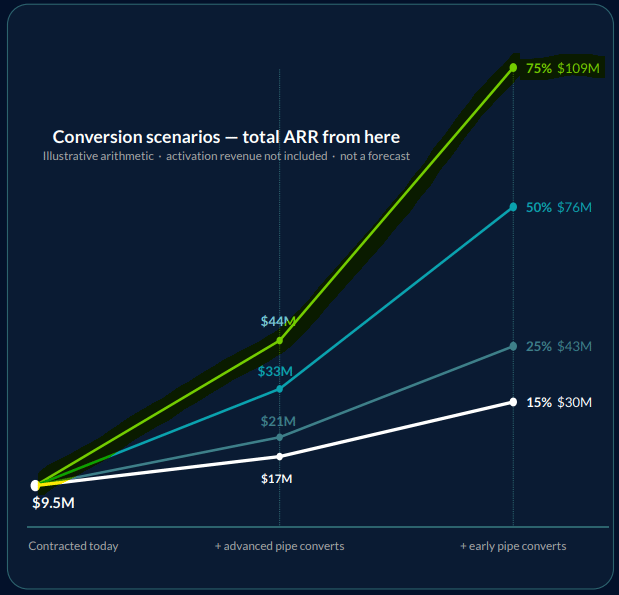
In its August Investor Presentation, ROC lays out its own sales conversion scenarios using ROC's ~$9.5M of contracted ARR as the base.
Here is what ROC thinks could happen depending on how much of its pipeline can be converted into ARR:
- 15% conversion of the pipeline = ~$30M total ARR
- 25% conversion = ~$43M total ARR
- 50% conversion = ~$76M total ARR
- 75% conversion = ~$109M total ARR
Very high level numbers here and a lot of things are assumed and need to right to turn those scenarios into actual revenue.
(source)
So what is Annual Recurring Revenue (ARR) worth?
Annual Recurring Revenue (ARR) is the holy grail revenue type for any tech company - tech investors love recurring revenue.
When the ASX starts to see a line of sight to rapid ARR growth it starts to value those companies at ridiculous multiples - generally ~6x to 15x their Annual Recurring Revenue (ARR).
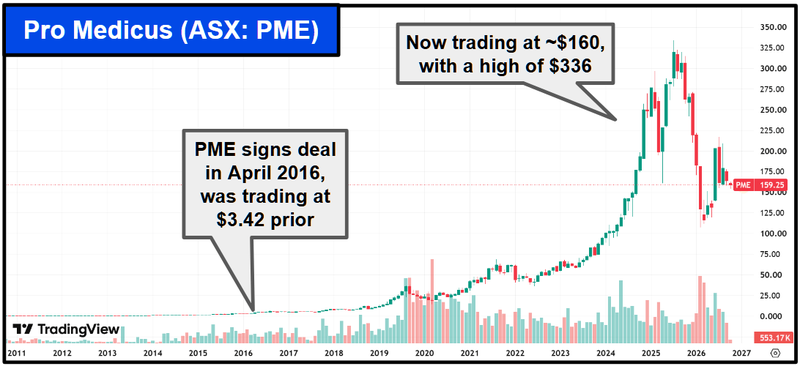
In some rare scenarios the market pushes that to 60x+ like market darling Pro Medicus, which reported FY26 revenue of ~A$262M...
... and its market cap is ~$17.1BN.
Fun fact - Pro Medicus’ first big deal came back in April 2016 - a 7 year, A$21M deal. (source)
That was the one that snowballed the business to where it is today:
(source)
The past performance is not and should not be taken as an indication of future performance. Caution should be exercised in assessing past performance. This product, like all other financial products, is subject to market forces and unpredictable events that may adversely affect future performance.
Pro Medicus is definitely an incredible outlier (a great business with an even greater valuation) but it is a real life, clear example of how the ASX loves high growth, highly scalable tech companies.
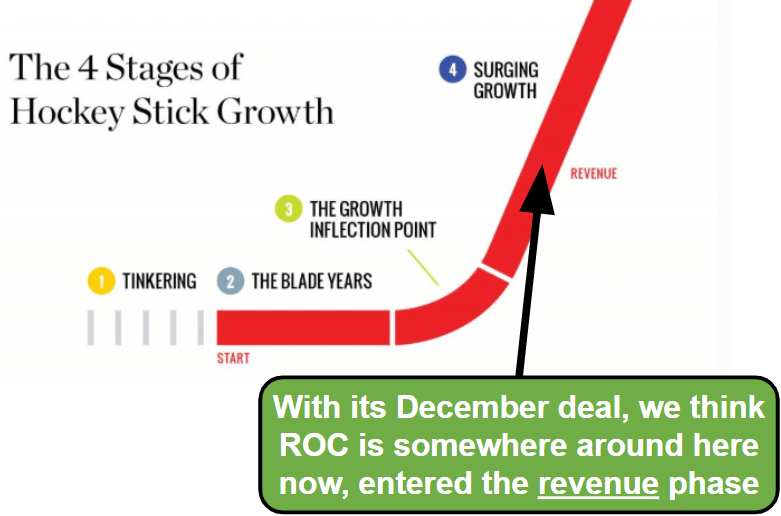
And looking at Pro Medicus’ chart it reminds us a lot of the ‘hockey stick growth’ chart that is typical for tech companies.
We think ROC got its stage 3 “the growth inflection point” deal in December last year:
No guarantees ROC will keep climbing into surging growth of course - this is still an early stage tech company and things can and do go wrong.
As long term ROC investors we just need a few more of those deals in its advanced pipe to land.
IF ROC can get another monster $5M to $10M ARR deal in, then the market will start to put more of ROC's advanced pipeline into the company's current valuation (basically a belief by the market that ROC will convert more of it into deals).
All it takes is for a few investors to start running their own numbers, landing on a $20-30M ARR target and then applying a 10X multiple, and we could see ROC’s valuation move a lot higher than where it is today.
ROC’s current market cap is only $44M.
What ROC does, and the addressable market
Aside from ROC, in our opinion, there still aren't many ways of getting genuine AI exposure in the small cap ASX space.
(especially AI companies that actually make revenue from giant customers - like ROC)
ROC developed its “Vision Artificial Intelligence” technology for giant companies to analyse and respond to in-store customer behaviours.
This means using AI on live in-store camera footage to analyse customer behaviours, allowing the giant company to improve operations.
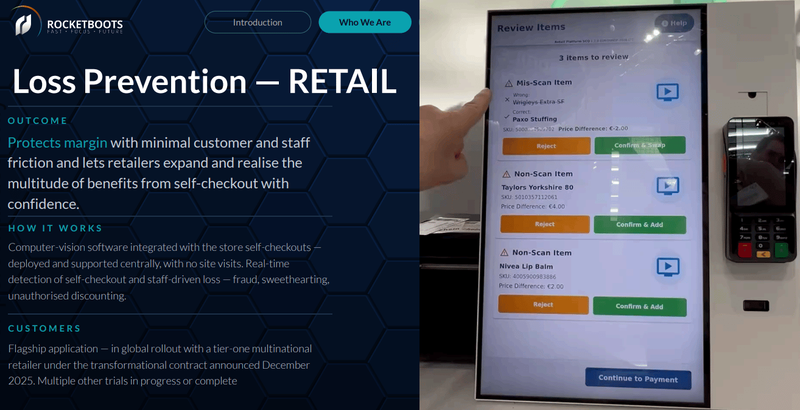
Or in a supermarket setting for “loss prevention”, providing a solution to a big problem the supermarket giants face at their self checkouts - theft.
(this is called ‘shrinkage’ in the retail industry - all up its estimated to cause a US$100BN plus annual loss to retailers - this impact on the bottom line is why retailers are so interested in ROC’s technology)
(source)
ROC sells to giant retail and banking enterprises - not an easily disruptable, replicable sector for new entrants using vibe coding this sort of tech.
ROC's platform has passed the information security reviews of the world's largest banks and retailers - GDPR, SOC 2 (source).
ROC’s tech has been in use by TWO major, Australian household name companies - Suncorp in the banking sector and Bunnings in retail shopping for some time.
And over the last year ROC has added:
- One of Mexico's largest retail banks (paid trial now complete, rollout negotiations underway),
- A "Major Australian Retail Bank" (now feeding ROC's data into its production systems).
- And 2 weeks ago a major New Zealand retail bank renewed for another 12 months. (source)
Most of those deals are small relative to the monster deal ROC signed with a Tier 1 global retailer late last year.
So ROC is already established and operating in two markets that we think are big enough to drive a substantial re-rate higher in ROC’s valuations:
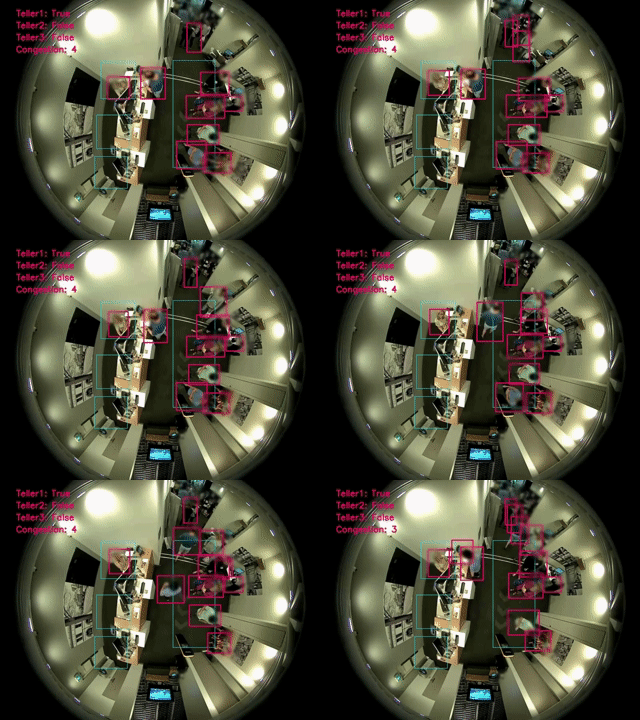
1. AI-driven loss prevention - ROC’s target market here is retailers that have implemented self-checkout systems. ROC estimates these losses to be a ~$100BN per annum problem. ROC’s solution can help reduce this problem.
This is the application the ~$9.1M ARR contract relates to.
AND
2. AI-enabled labour optimisation - ROC also sells workforce management tech. The global workforce management market is estimated to be US$8.38BN in 2025, growing to US$13.03BN by 2030.
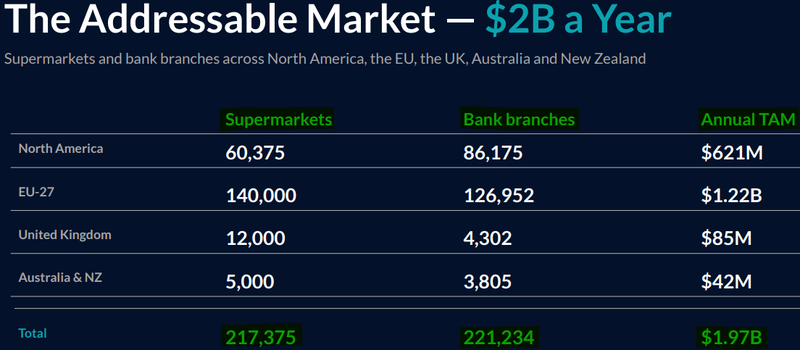
In total, ROC puts the annual addressable market for its software at ~$2BN a year across ~217,000 supermarkets and ~221,000 bank branches in North America, the EU, the UK, Australia and NZ:
(source)
Ultimately, we are Invested in ROC to see it secure large contracts across both those markets and scale up the business to a market cap above $500M as follows.
Our ROC Big Bet:
"ROC re-rates to a $500M market cap by securing multiple large recurring contracts with retail clients and scaling up its business"
NOTE: our "Big Bet" is what we HOPE the ultimate success scenario looks like for this particular Investment over the long term (3+ years). There is no guarantee that our Big Bet will ever come true. There is a lot of work to be done, many risks involved, including development risk, country risk and commodity price risk - just some of which we list in our ROC Investment Memo.
Success will require a significant amount of luck. Past performance is not an indicator of future performance.
The 10 reasons we made ROC our Tech Pick of the Year
We announced ROC as our Tech Pick of the Year back in December last year.
Check out that full note from December here: Introducing our 2025 Tech Pick of the Year: Rocketboots (ASX: ROC)
Here are the 10 reasons why (with updates for some that have changed since then):
1. ROC has long term, paying enterprise customers.
Both Bunnings (large DIY goods retailer owned by Wesfarmers) and Suncorp (a bank owned by ANZ) are paying customers of ROC.
They have been customers since before ROC's December 2021 IPO and continue to renew and expand their licence contracts 7+ years later.
More recently ROC added one of Mexico's biggest retail banks to its customer list, a major unnamed Australian bank...
And then the big one - an unnamed "Tier-1 global retailer" - see next reason.
🚨 UPDATE:
ROC now counts six foundation customers, including two ASX 20 companies. 2 weeks ago a major New Zealand retail bank (a customer since 2019) renewed for another 12 months, and the Mexican bank trial was confirmed successful with contract negotiations for a broader rollout now underway.
Today ROC has officially begun the rollout of the contract it signed late last year, providing $9.1M in ARR once (and if) fully rolled out.
2. ROC signed the big "transformational deal" tech companies can take years to land
ROC signed a deal with a global Tier 1 retailer that once fully rolled out would 12x ROC's FY26 revenues.
The contract is for ~$9.1M in Annual Recurring Revenues per annum for five years once fully rolled out (and potentially longer).
The deal is for only 40% of that single customer's store network - so revenue from that one customer alone could get a lot bigger.
We think this single deal is a sort of "anchor" deal that marks an inflection point for ROC.
🚨 UPDATE:
Rollout has now started, ~9.5 months from signing to the first US store installations. ROC's software is integrated into the customer's self-checkout stack, the US cloud infrastructure is switched on, and a ~A$138k invoice has been issued for the first stores.
3. ROC has ~$60M in potential Annual Recurring Revenues in its "advanced stage deal pipeline"
ROC recently confirmed that it has an advanced stage pipeline of 17,000 sites across grocery, retail and banking verticals from 12 customers.
At $3,500 per site per year, by our rough, basic calcs this represents ~$60M in potential annual recurring revenue if ROC is able to convert into sales. (source, ROC investor deck slide 10 - the pre-December deck)
(using a basic $3,500 per site per year times number of sites calc, ignoring bulk discounts and setup fees)
Of course, there is no guarantee these pipeline deals turn into revenues for ROC.
🚨 UPDATE:
ROC says five of those 12 opportunities are of a similar size to the contract already won, and its own conversion scenarios run from ~$109M in ARR (at a 75% conversion rate).
(Note - that’s a big assumption number and should not be relied upon)
4. One large deal could multiply ROC's current revenue
At a price point of ~$3,500 per store, one deal could be in the millions of dollars in recurring free cash flow.
We have already seen ROC land one of these with the ~$9.1M ARR deal - and we know there is the big advanced stage sales pipeline. One big additional deal could multiply ROC's revenues.
These deals take a very long time to secure (as do most enterprise software deals).
ROC has shown that its enterprise customers tend to be incredibly "sticky" (stay on for a long time).
5. Partnership with Europe's largest Point of Sale company: Gebit Solutions
Gebit Solutions sells self checkouts to supermarkets and retailers.
Gebit is the point of sale system for some of the largest supermarket retailers in Europe and Gebit supports an "out of the box integration" with ROC's software.
High-synergy partners like Gebit help improve ROC's reputation to enter the conversation with big retailers, despite ROC being a smaller player in the space.
🚨 UPDATE:
ROC's June quarterly noted a European grocery retailer used ROC's major client as a reference call, which moved that opportunity into contract negotiations.
6. Original founding team still in place, with experienced tech chairman at the helm
The original team that developed ROC's technology are still running the company (including CTO Robin Hilliard, who founded RocketBoots in 2004 and has grown the technology from consultancy roots to a global SaaS product platform) (source).
This is a positive sign for tech startups when a long term founding team has been working on the product for 10+ years.
ROC also has a Chairman with experience in both private equity and tech enterprise sales.
ROC's chairman Roy McKelvie is also the chairman of an education technology company called Pathify that he helped to scale and raise US$25M at a A$180M valuation.
7. Genuine AI and deep knowledge of how to apply AI to a specific problem
ROC pivoted to machine learning back in 2016 (source).
(well before AI became a big Investment theme - six years before ChatGPT)
Companies developing genuine AI with a decade of development efforts AND internal knowledge on how to apply AI to solve a specific and real world problem are rare on the ASX.
And in our view are the best positioned to leverage and apply the rapid recent advances in AI technology and tools to their specific sector of expertise.
🚨 UPDATE:
ROC made the point in its August investor presentation that its exposure to the AI capital cycle "runs through our cost line, not our revenue line" - as compute gets cheaper, ROC's inputs get cheaper, while its customers are paying for measured outcomes rather than for "AI" itself.
8. Vision capture technology valued in the US$250-500M range
In late 2022 a company called Trigo raised US$100M off the back of its grocery vision software.
In 2023 one of the largest companies in this space Everseen raised US$70M to advance a very similar technology.
Those large raises are evidence of the size of the opportunity in this space that investors are seeing.
If ROC is able to deliver more sales and capture market share, it could grow to the size of these larger competitors in the space.
9. ROC has a good capital structure and has protected it well.
We think ROC's capital structure has been managed well - running the company lean, often with a low cash balance but buying enough time to get a mega deal signed (like the $9.1M ARR one).
ROC's also managed to resist offering options in capital raises which means there are very few shares on issue (~205M today).
(ROC does have ~20.7M options and ~13.7M performance rights on issue, mostly to staff and directors - source)
The major shareholders are the original vendors of the technology and have proven to be sticky since the IPO.
The board and senior management represent more than 25% of the shares on issue (source), which means they are very aligned to shareholders' interests.
🚨 UPDATE:
After the deal in December, ROC raised $7M at 25c per share and now has ~205.5M shares on issue.
10. Institutional backing (which is rare to see in the small cap ASX tech space)
We like that ROC has attracted deep pocketed institutional investors to its register including the Bombora Special Investments Growth Fund, who is a substantial holder of ROC (over 5%).
Bombora has had a previous win with ROC's chairman.
We also like that the most recent capital raise had "4 new institutions" come into the company - ROC now counts five institutions on its register (source).
The institutional ownership means ROC is de-risked from a future funding perspective because as long as ROC can deliver contract wins, these shareholders will be willing to bankroll the company's future cap raises.
For us, it's an implicit de-risking of "funding risk" which is usually a very big risk for early stage tech companies on the ASX.
What's next for ROC?
🔄 Rolling out the $9.1M ARR (+ $3.3M activation contract)
We want to see ROC roll out the contract today's announcement relates to.
Here are the milestones we are tracking:
- ✅ Agreement signed (~$9.1M ARR, 5 years)
- ✅ Activation contract executed (~$3.3M)
- ✅ Integration & planning complete (cloud platform + self-checkout integration)
- ✅ Early EU deployments started (March 2026)
- ✅ First activation invoice paid by the customer
- ✅ First US store installations commenced + US cloud infrastructure activated
- 🔲 Phased global rollout begins (across the ~40% of the customer's network)
🔄 New Sales from the advanced stage pipeline
We want to see ROC convert some of its ~17,000 site advanced-stage sales pipeline into new signed deals.
Here are the milestones we are tracking:
- 🔄 Mexican retail bank - contract negotiations for a broader rollout (1,200+ branches)
- 🔄 European grocery retailer - contract negotiations
- 🔄 US grocery retailers - expanding trials, commercial documentation requested
- 🔲 New deal signed
🔄 Existing customers re-sign or expand
And of course, we want to see ROC re-sign + expand its partnership with existing customers.
- ✅ New Zealand retail bank renewed for 12 months (24-Sep-26)
- 🔲 Existing customer re-signs OR expands #2
What could go wrong?
The single biggest risk right now is without a doubt "Execution / Delivery Risk".
ROC has never deployed at the scale of the deal that is now rolling out.
Until today, the risk was that the rollout wouldn't start. Now the risk is that it doesn't go smoothly.
IF the technology doesn't perform as expected in the first US stores, or IF technical integration issues delay the phased global rollout, revenue recognition could be pushed out further and the customer relationship could be damaged.
The first US stores could almost be a sort of trial for ROC.
The second is "Sales and Delay Risk".
Sales and Delay Risk
ROC could lose key clients or not seal as many deals, hurting their revenue and share price.
Large organisations like the ones ROC works with don't tend to adopt new technology very often and the sales cycle can be long.
This feature of ROC's customer base can cause delays in sales that drag out over a long time.
Source: "What could go wrong" - ROC Investment Memo 24 December 2025
We have already seen this one play out. The first activations were originally scheduled for Q4 FY26 and moved to Q1 FY27.
Finally there is also an element of "Funding Risk".
ROC had $3.7M in cash at 30 June 2026
The $3.3M activation contract is invoiced monthly during rollout and the ARR builds as sites go live - but IF the rollout is slower than expected, ROC may need to tap the market for cash before the contracted revenue arrives.
ROC is still a small cap company that will require more capital to grow.
Funding Risk
There is always a risk that that capital needs to come through capital raises - IF there are any delays in rolling out contracts OR in securing new deals ROC may need to tap the market for cash.
Source: "What could go wrong" - ROC Investment Memo 24 December 2025
See more risks we listed as part of our ROC Investment Memo here.
Other Risks
Like any small-cap technology company, ROC carries significant risk, here we aim to identify a few more risks.
The company's technology relies on smooth integration with third-party hardware and point-of-sale systems like Gebit. Technical issues, hardware supply delays, or software incompatibilities outside of ROC’s direct control could delay site activations and cash collection.
The vision AI and loss-prevention sector is rapidly evolving with heavy global investment. Well-funded international competitors or new entrants could develop competing solutions, leading to pricing pressure or lost market share.
Expanding across multiple jurisdictions including the US, Europe, and Mexico places high demands on a lean team. Rapid international scaling risks stretching operational capacity and management bandwidth thin during critical rollout phases.
Enterprise sales cycles are notoriously long, and trial conversions can suffer unexpected delays. If rollout milestones slip or sales take longer to close, cash burn could force ROC to raise additional capital and dilute existing shareholders.
Investors should consider these risks carefully and seek professional advice tailored to their personal circumstances before investing.
Our ROC Investment Memo
You can read our ROC Investment Memo in the link below.
We use this memo to track the progress of all our Investments over time.
In our ROC Investment Memo, you can find the following:
- What does ROC do?
- The macro theme for ROC
- Our ROC Big Bet
- What we want to see ROC achieve
- Why we are Invested in ROC
- The key risks to our Investment Thesis
- Our Investment Plan
General Information Only
This material has been prepared by StocksDigital. StocksDigital is an authorised representative (CAR 000433913) of 62 Consulting Pty Limited (ABN 88 664 809 303) (AFSL 548573).
This material is general advice only and is not an offer for the purchase or sale of any financial product or service. The material is not intended to provide you with personal financial or tax advice and does not take into account your personal objectives, financial situation or needs. Although we believe that the material is correct, no warranty of accuracy, reliability or completeness is given, except for liability under statute which cannot be excluded. Please note that past performance may not be indicative of future performance and that no guarantee of performance, the return of capital or a particular rate of return is given by 62C, StocksDigital, any of their related body corporates or any other person. To the maximum extent possible, 62C, StocksDigital, their related body corporates or any other person do not accept any liability for any statement in this material.
Conflicts of Interest Notice
S3 and its associated entities may hold investments in companies featured in its articles, including through being paid in the securities of the companies we provide commentary on. We disclose the securities held in relation to a particular company that we provide commentary on. Refer to our Disclosure Policy for information on our self-imposed trading blackouts, hold conditions and de-risking (sell conditions) which seek to mitigate against any potential conflicts of interest.
Publication Notice and Disclaimer
The information contained in this article is current as at the publication date. At the time of publishing, the information contained in this article is based on sources which are available in the public domain that we consider to be reliable, and our own analysis of those sources. The views of the author may not reflect the views of the AFSL holder. Any decision by you to purchase securities in the companies featured in this article should be done so after you have sought your own independent professional advice regarding this information and made your own inquiries as to the validity of any information in this article.
Any forward-looking statements contained in this article are not guarantees or predictions of future performance, and involve known and unknown risks, uncertainties and other factors, many of which are beyond our control, and which may cause actual results or performance of companies featured to differ materially from those expressed in the statements contained in this article. S3 cannot and does not give any assurance that the results or performance expressed or implied by any forward-looking statements contained in this article will actually occur and readers are cautioned not to put undue reliance on forward-looking statements.
This article may include references to our past investing performance. Past performance is not a reliable indicator of our future investing performance.