MNB: Piles of Mined Phosphate? Is this actually happening? Looks like it is...
Disclosure: S3 Consortium Pty Ltd (the Company) and Associated Entities own 44,357,151 MNB Shares and 37,616,526 MNB Options. The Company has been engaged by MNB to share our commentary on the progress of our Investment in MNB over time. This information is general in nature about a speculative investment and does not constitute personal advice. It does not consider your objectives, financial situation, or needs. Any forward-looking statements are uncertain and not a guaranteed outcome.
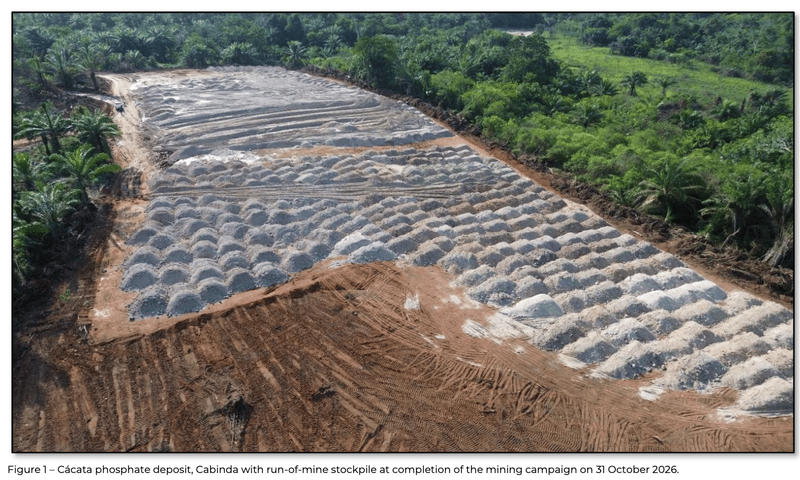
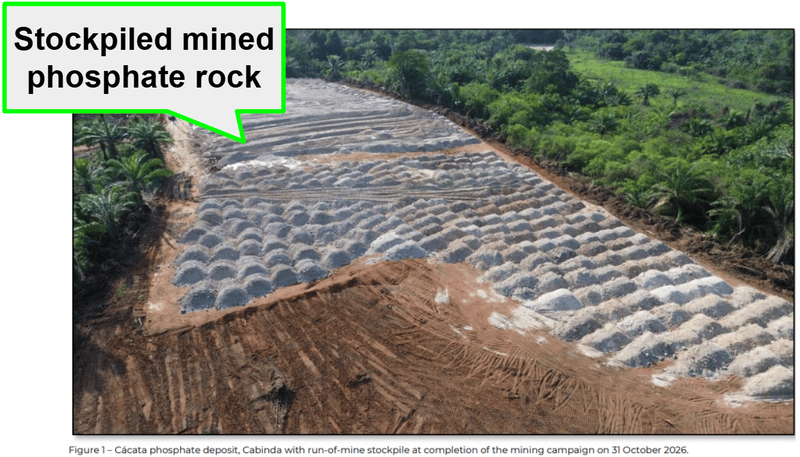
Piles and piles of mined, white phosphate rock...
(source)
That’s 23,495 tonnes of phosphate rock, mined and stockpiled, ready to be put through a processing plant to be turned into fertilizer.
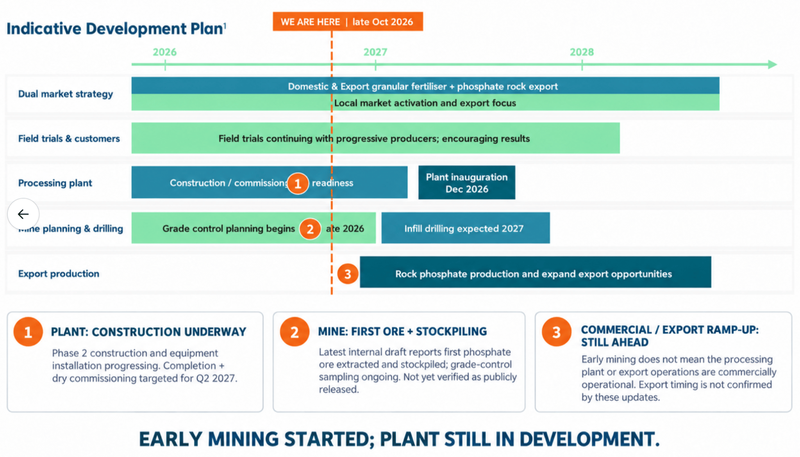
Our Investment Minbos Resources (ASX:MNB) expects to have its plant up and running in Q2 2027.
The plan is for those rocks to be used as feedstock in upcoming plant commissioning.
(Three days ago MNB also announced it has hired a full time guy in charge of finding buyers for MNB’s end product - surely with this hire the company is actually close to production this time around)
MNB has a “Ministerial site visit” scheduled in December to “inspect the completed plant structures”. (source - 29 July project update)
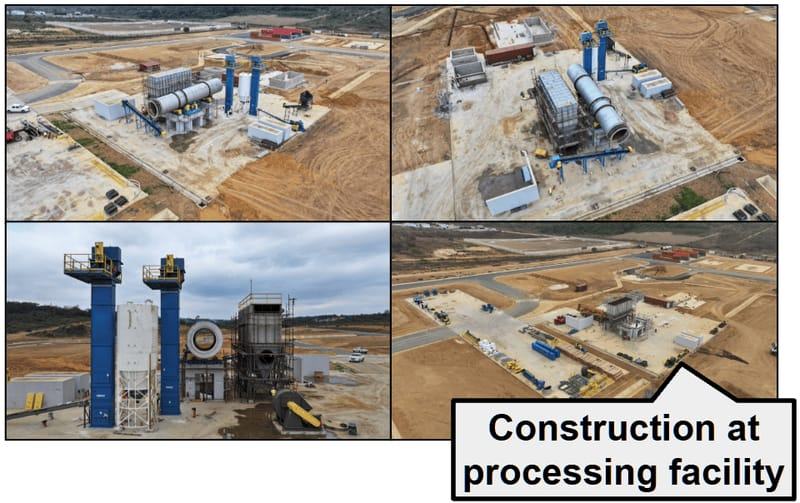
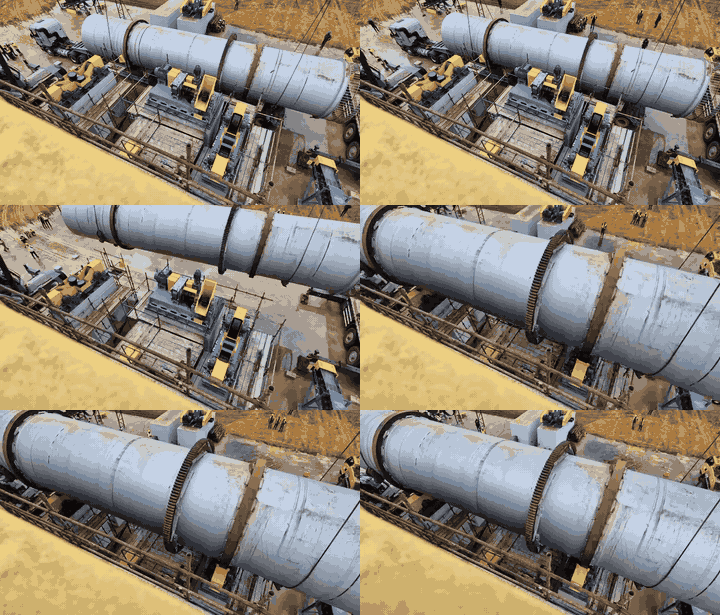
(read our commentary on the plant build from last week here)
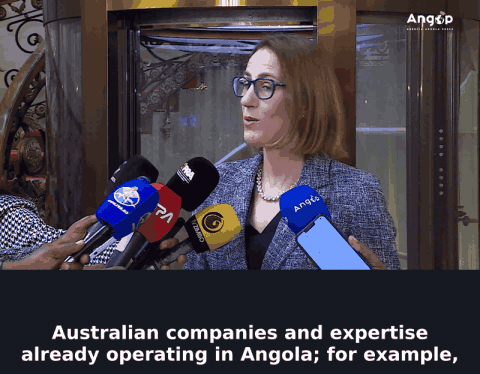
Speaking of ministers, here is Tegan Elizabeth Brink, Australia’s outgoing ambassador to Angola, name dropping MNB’s project to reporters in Angola:
(source)
“Australian companies and expertise are already operating in Angola; for example, the phosphate exploration project in Cabinda, which is led by the Australian company Minbos. This project aims at the production of fertilizers, as it has to do with the development of the agricultural sector.” - Tegan Elizabeth Brink, Australia’s outgoing ambassador to Angola
MNB’s guidance to the market right now is:
- To have its processing plant up and running by Q2 2027. (source)
- First export shipments by H1 2027. (source)
So by the time the market is back after the December-January period, MNB could be a lot closer to processing its stockpiles...
(hopefully the market is in a better mood by then too)
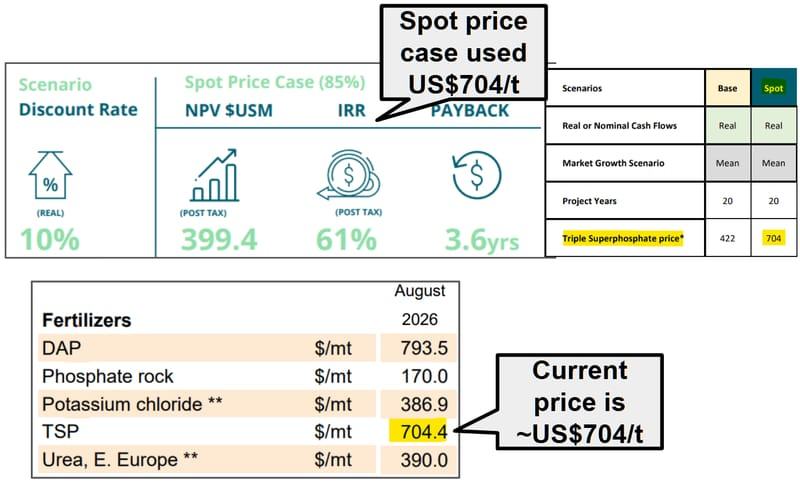
The project that according to MNB's 2022 Definitive Feasibility Study was supposed to generate ~US$55M in EBITDA per year over a 20 year mine life, with a post-tax NPV of US$203M. (source)
And potentially US$399M NPV using today’s input prices - more on that later in today’s note.
We do note though that since that study was completed 4 years ago, MNB’s processing plans have changed, including a simplified plant flowsheet in late 2025.
A number of assumptions used in that 2022 study could be out of date - we would expect these numbers would look different by now.
Having said that, even halfway to US$55M EBITDA per year for a ~$25M market cap MNB would be incredible.
We only use the study as a very rough basis for what the project economics might look like, we expect reality to be different.
The main positive we take away for MNB is that all of the funding deals that needed to be lined up to build its project were done in the last few years.
(phew, imagine trying to land those right in the choppy market conditions of the last few months)
On Monday, MNB started drawing down on its loan with Angolan bank BFA with ~US$2.2M paid straight to MNB's construction contractors and suppliers. (source)
And that another US$2.8M drawdown has been lodged against the bigger US$16M loan facility from the Industrial Development Corporation (IDC) of South Africa. (source)
AND...
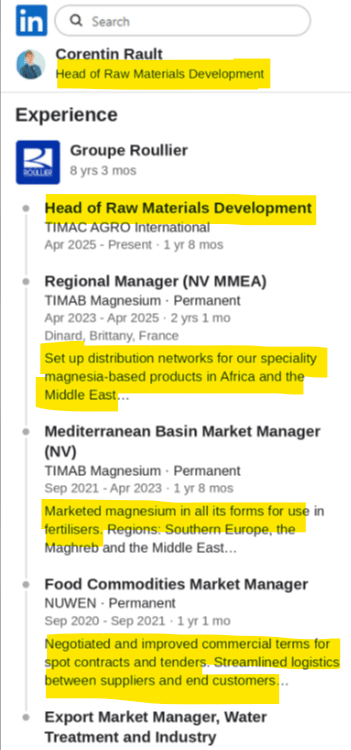
MNB has hired a guy named Corentin Rault to start marketing MNB's product (source) - he spent 8 years in the French industrial group that owns Timac Agro and supplies farmers worldwide with fertilisers, soil improvers and livestock nutrition products.
Here’s his background that is applicable to finding buyers for MNB’s product:
(source - LinkedIn, translated)
More buyers for MNB’s product = more revenue for MNB.
So MNB now has all of the funding agreements in play that it said would be enough to complete construction of its plant: (source)
- ✅ US$10M from Angola's Sovereign Wealth Fund (FSDEA) - received in full already
- ✅ US$16M loan from the IDC of South Africa - US$4.8M drawn so far, US$2.8M drawdown pending.
- ✅ $6M equity placement at 1.5c (July/August) - fully completed now.
- ✅ ~US$5.48M loan from Banco de Fomento Angola (BFA) - first ~US$2.2M drawn last week.
We first Invested in MNB at 3c back in 2020 and have added at 8c, 11c, 7c, 2.6c and 1.5c.
We have followed MNB all the way up and down the different parts of the Lassonde Curve - which is a mining industry accepted pattern a stock’s share price follows over the life of a project:
- A run on discovery (not exactly our experience with MNB, but we did Invest just before the 2020 bull market which saw MNB’s share price run higher),
- A long drift lower through the “boring” years of studies, permits, financing and construction
- Then (hopefully) a second leg up once the mine is producing and cash is coming in.
MNB has spent four long years in that “drift lower” phase - longer than we (and the rest of the market) would have liked, but it's behind the company now.
Not to mention the MNB share price dipped hard after many broken timelines for construction and mining to start.
After a few shaky years sitting in the “feasibility/development” trough of the Lassonde Curve...
It looks like over the next 3-6 months, MNB could start "operating" its mine and generating revenue from production.
Here is where we think MNB is on the Lassonde Curve:
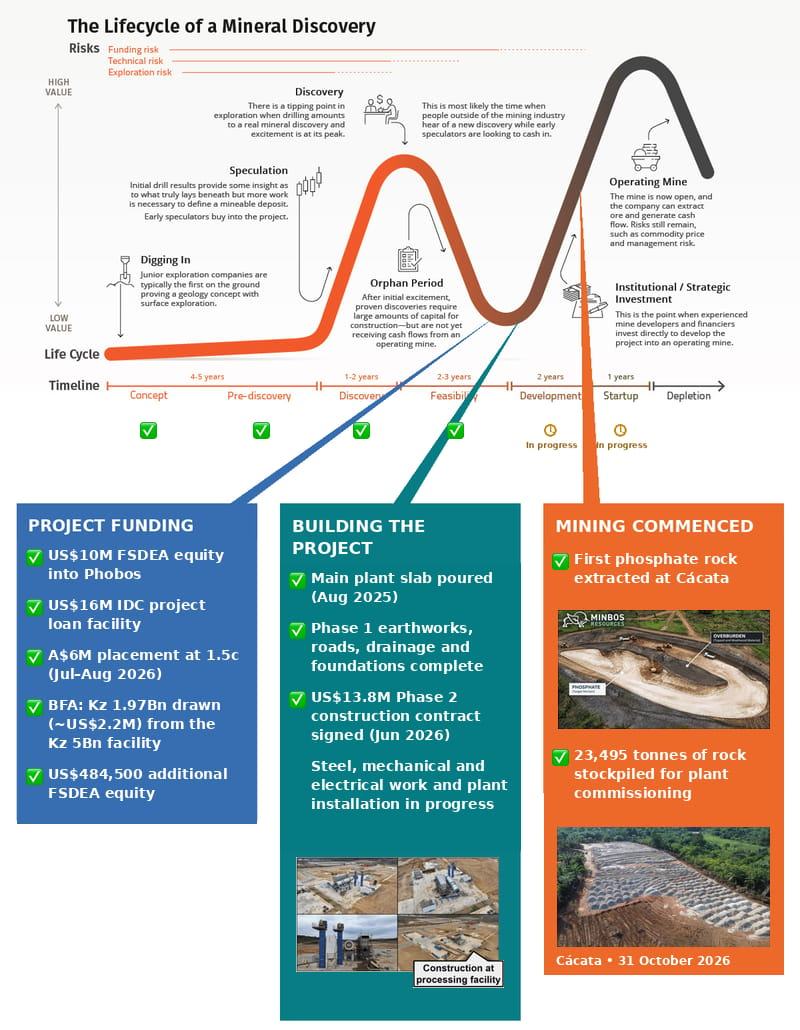
Despite the (slow) but steady transition toward becoming a producer, and the mining/processing plant progress, the MNB share price chart has up until now behaved in line with the Lassonde Curve.
The last thing we need to see now for continued share price appreciation is the market starts to believe that MNB is heading toward that operating mine stage.
And for the stock to re-rate from developer to producer.
And like all small caps (and in fact all investments) - success is no guarantee - the MNB share price might not go up.
As we have written about in the past, we think the reason the market hasn’t re-rated MNB yet from developer status to producer status is because MNB has had false starts before... so this time it could happen a lot later and then all at once.
Maybe for MNB that moment will come when MNB hits its big milestones - including:
1. Commissioning its processing plant (Q2 2027) - MNB has already mined and stockpiled 23,495 tonnes of rock, so the commissioning feedstock is ready.
Surely MNB will push as hard as it can to have that plant built and ready when the ministerial site visit is scheduled to occur in December 2026.
2. MNB gets to first revenues even before that Q2 2027 date - this could be from selling unprocessed rock, or from fertiliser granulated for MNB by Fertiafrica. (source)(source)
IF/when these happen, MNB completes that explorer/developer to producer transition.
And along the way selling the unprocessed rock would (by a technicality) mean MNB officially generates its first revenues (before the plant is commissioned).
Maybe it will be “first revenues” that kicks off a share price re-rate - who knows what the market will want.
(source)
How we got here (the short version)
We Invested to see MNB build a phosphate (fertiliser) mine and processing plant in Angola.
For a few years in a row, the company signalled "financing almost secured" and "about to build"...
The build didn't happen on time, the market stopped trusting what MNB promised = share price went down a lot.
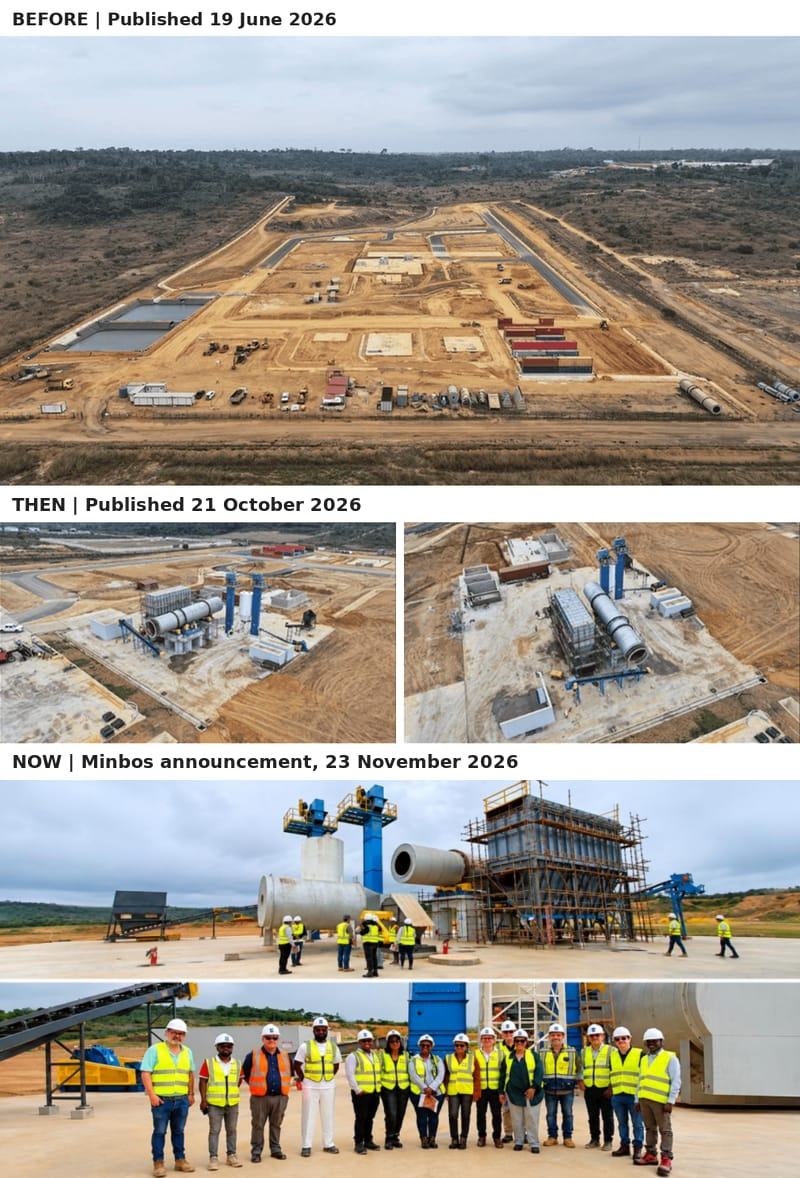
Then over the last ~ six months the plant site went from a bare slab to a rotary dryer, silos and structural steel going up - here are the before and after photos:
MNB has completed its 2026 mining campaign from its giant deposit and has stockpiles ready to go when the plant is built:
(source)
As mentioned earlier, MNB is now a few months from having its mine and processing plant up and running in unison.
Once in production, MNB will own Angola's first and only integrated phosphate mine and fertiliser plant.
MNB’s share price has been punished for delays getting to where it is today.
BUT it may have just been very lucky too...
The macro investment environment for phosphate/fertiliser has now turned in MNB's favour (mainly because of the war in the Middle East).

(source)(source)(source)(source)(source)
Phosphate fertiliser prices are now higher than the numbers MNB used in its 2022 Definitive Feasibility Study - as mentioned earlier in today’s note, at around spot prices, MNB’s project’s NPV in that study would be ~US$399M.
Again - a number of assumptions used in that 2022 study could be out of date - we would expect these numbers would look different by now.
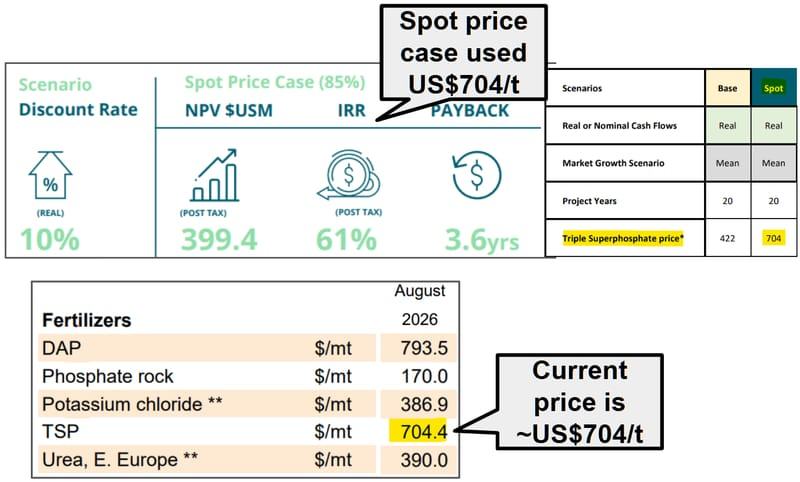
A big part of our MNB thesis is the "food security" macro investing thematic - the idea that governments would eventually start treating fertiliser like a strategic resource.
We had expected this to come from mainly within Africa, which has well documented food security issues over many decades.
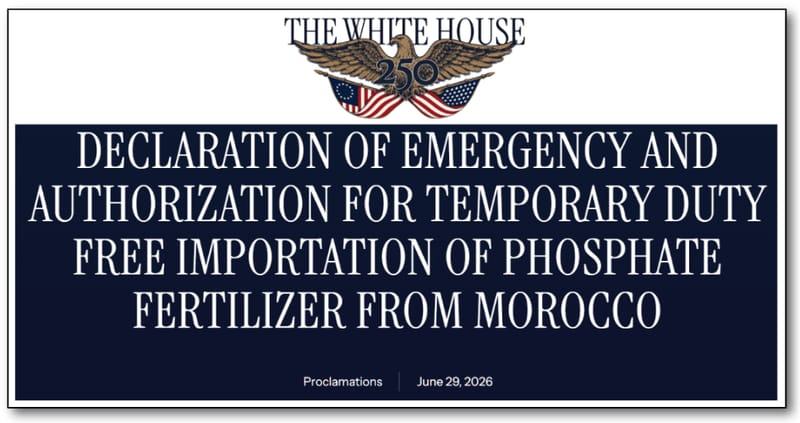
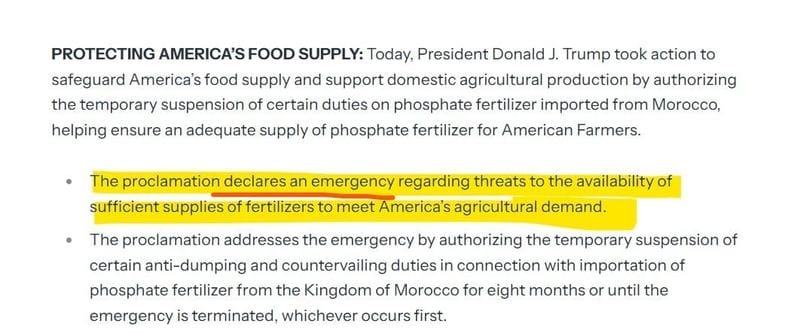
But then on the 29th of June, President Trump signed the following Executive Order, declaring:
"an emergency regarding threats to availability of sufficient supplies of fertilizers to meet America's agricultural demand".
(source)
The US cutting duties on Moroccan phosphate makes two things clear, both of which are clearly outlined in the Executive Order.
- Firstly, domestic production is not enough to cover what American farmers need.
- Secondly, the US is willing to look toward Africa for phosphate supply in the meantime.
The Strait of Hormuz situation doesn't look like it's going to get resolved any time soon.
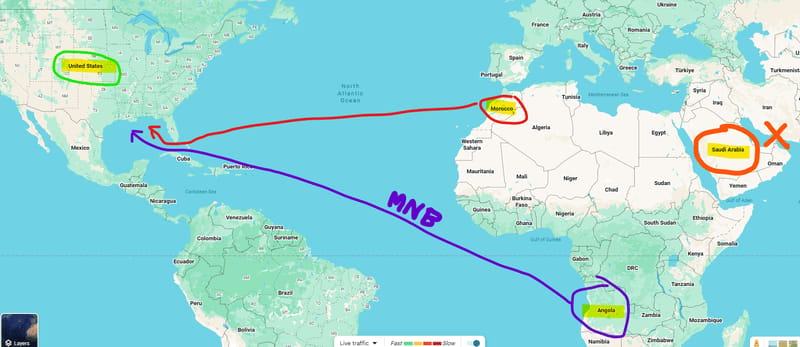
Saudi Arabia's Ma'aden's Ras Al-Khair complex (one of the world's biggest integrated phosphate operations) sits on the Gulf coast - every export cargo must transit Hormuz, no workaround.
Unlike USA's newly crowned phosphate best mate Morocco on the West African coast, which has a clear, Houthi free, Atlantic Ocean run to the USA.
MNB's phosphate fertiliser project is in Angola, also on the West African coast which has the same clear run to the same ports in the USA:
And it's not just the US looking for fertiliser solutions - the EU Agriculture Commissioner is calling for "long-term fertiliser solutions" to avoid food shortages in Europe. (source)
Why does all this matter to MNB?
Because MNB's go to market strategy for its product is to sell locally into the Angolan market AND sell product into the export market.
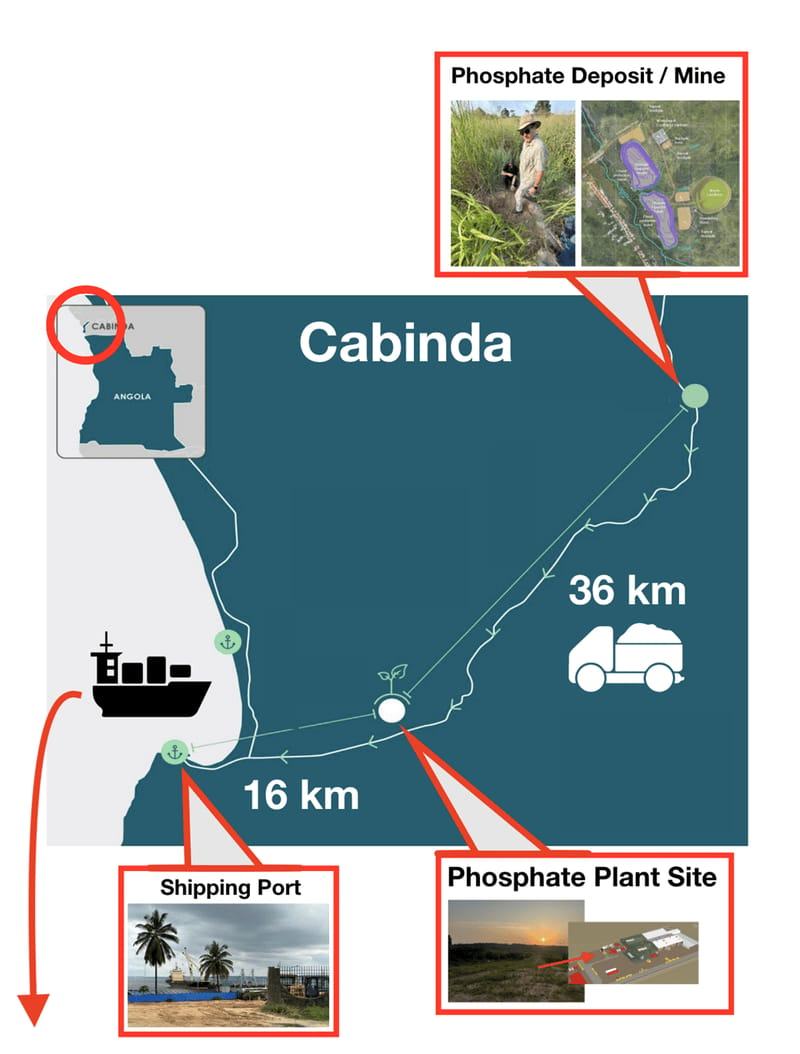
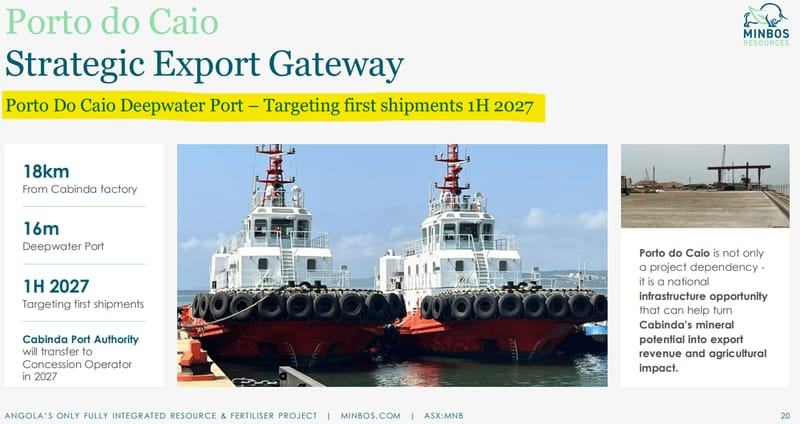
MNB expects to be shipping export product through the Porto de Caio deepwater port in H1 2027:
(source)
The port is ~79% complete as of 29th August this year and its inauguration is expected by the end of this year. (source)
(we saw it being built on our 2023 site visit)
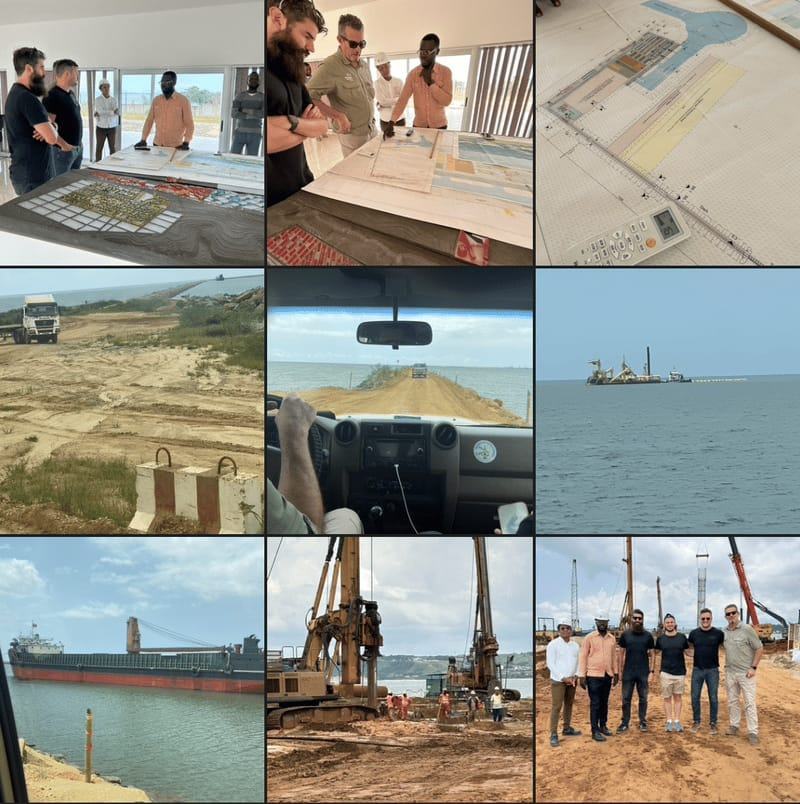
(read our MNB site visit article here)
On the domestic side, twenty of Angola's largest commercial growers have committed to MNB's 2026/27 fertiliser demonstration program. (source)
And NOW there is actual Angolan phosphate rock sitting as a stockpile that could feed those domestic campaigns early - IF the approvals and sales arrangements come together.
Hopefully not long now until we see that first sack of phosphate...
AND hopefully the bigger re-rate toward our Big Bet.
MNB right now is capped at ~$25M.
Our new MNB Big Bet
"MNB re-rates to a $200M+ market cap by completing construction of its Phosphate Project, moving into production and generating its first fertiliser sales - and/or attracts a strategic investment or takeover bid at multiples of our Entry Price."
NOTE: our “Big Bet” is what we HOPE the ultimate success scenario looks like for this particular Investment over the long term (3+ years). The scenario is speculative and does not represent a valuation or forecast. There is no guarantee that our Big Bet will ever come true. There is a lot of work to be done, many risks involved, including development risk, country risk and commodity price risk - just some of which we list in our MNB Investment Memo.
Success will require a significant amount of luck. Past performance is not an indicator of future performance.
What do we want to see MNB deliver over the coming months?
🔄 Complete Phase 2 construction
We want to see the plant assembled and reach dry commissioning.
Here are the milestones we are tracking:
- ✅ Civil works complete
- ✅ Structural steel installation started
- 🔄 Mechanical modules delivered to Cabinda and installed
- 🔄 Electricals, instrumentation and process control installed
- 🔲 Ministerial site visit (scheduled for December 2026)
- 🔲 Dry commissioning (Q2 2027)
🔄 Start mining
We want the mine side to keep pace with the plant.
Here are the milestones we are tracking:
- ✅ Mining contractor appointed
- ✅ Site prep + access roads
- ✅ Overburden removed, first phosphate rock extracted (NEW - this WEEK)
- 🔲 First grade control / assay results from mined rock
- 🔲 First ore hauled to the processing plant site
🔄 Complete the funding package
Now that the BFA loan is locked in and funds available, we want to see MNB get the licence transfers completed which were outstanding from earlier in the year.
MNB’s latest update was that:
“Administrative processes regarding operational instruments and title transfer procedures are progressing with the regulators, ensuring alignment between government stakeholders, local communities, and the Company’s operational schedule.” (source)
Here are the milestones we are tracking:
- 🔄 Transfer of Mining Investment Contract and Mining Licence
- ✅ US$10M FSDEA equity received
- ✅ US$16M IDC loan signed, drawdowns underway
- ✅ US$5.48M Banco de Fomento Angola facility formalised
- 🔄 Working capital facility secured
🔲 First production and first sales
We want to see the plant wet commissioned, first product produced, and first revenue banked.
Here are the milestones we are tracking:
- 🔲 Wet commissioning
- 🔲 First shipment to a customer (including any unprocessed rock sales).
- 🔲 Binding offtake agreement(s) converted from existing MoUs/HOAs
- 🔲 First revenues
What could go wrong?
With the plant going up and now rock coming out of the ground, the biggest risk in the near term is still "Construction and commissioning risk".
Construction and commissioning risk
This is the big one right now. Plants rarely bolt together on time and on budget, and commissioning a first-of-its-kind-in-country plant can surface problems that take months to fix. Any delay would likely hit the share price hard given MNB's history.
Source: "What could go wrong" - MNB Investment Memo 20 July 2026
The other major risk is "tenure formalisation risk".
MNB's rights to the deposit sit under a Mining Investment Contract (December 2020) and a Mining Licence (March 2021) held by MNB, these need to be transferred to MNB’s Angolan subsidiary.
MNB’s latest update on the matter said "operational instruments" is still "progressing with the regulators". (source)

(source)
Meaning the formal licensing hasn’t been transferred into MNB’s Angolan subsidiary YET.
If the paperwork drags, it could delay MNB’s transition to a steady state producer.
Other risks
Like any small-cap mining developer, MNB carries significant risk, here we aim to identify a few more risks.
While MNB has lodged a second US$2.8M drawdown with the IDC, the drawdown remains subject to the requirements of the facility. Any delay in releasing those funds could slow payments to contractors at a key stage of the build.
Although MNB now has 23,495 tonnes of phosphate rock stockpiled, that rock cannot be processed until the plant is commissioned, currently targeted for Q2 2027. If commissioning slips, MNB may hold that inventory for longer before it turns into revenue.
Given MNB's history of missed timelines, the Ministerial site visit planned for December is an important marker. If the visit moves, or the plant structures are not finished in time, the market may read it as another delay.
Although MNB has appointed an experienced Marketing and Sales Manager from Timac Agro, building a customer base for a new product takes time. Existing MoUs and LOIs may take longer than we hope to convert into binding offtakes.
With seven large field trials progressing with established farms, early results look encouraging, but growers may want more than one season of data before switching products. This could slow early domestic sales.
Investors should consider these risks carefully and seek professional advice tailored to their personal circumstances before investing.
Our MNB Investment Memo
You can read our MNB Investment Memo in the link below.
We use this memo to track the progress of all our Investments over time.
In our MNB Investment Memo, you can find the following:
- What does MNB do?
- The macro theme for MNB
- Our MNB Big Bet
- What we want to see MNB achieve
- Why we are Invested in MNB
- The key risks to our Investment Thesis
- Our Investment Plan
General Information Only
This material has been prepared by StocksDigital. StocksDigital is an authorised representative (CAR 000433913) of 62 Consulting Pty Limited (ABN 88 664 809 303) (AFSL 548573).
This material is general advice only and is not an offer for the purchase or sale of any financial product or service. The material is not intended to provide you with personal financial or tax advice and does not take into account your personal objectives, financial situation or needs. Although we believe that the material is correct, no warranty of accuracy, reliability or completeness is given, except for liability under statute which cannot be excluded. Please note that past performance may not be indicative of future performance and that no guarantee of performance, the return of capital or a particular rate of return is given by 62C, StocksDigital, any of their related body corporates or any other person. To the maximum extent possible, 62C, StocksDigital, their related body corporates or any other person do not accept any liability for any statement in this material.
Conflicts of Interest Notice
S3 and its associated entities may hold investments in companies featured in its articles, including through being paid in the securities of the companies we provide commentary on. We disclose the securities held in relation to a particular company that we provide commentary on. Refer to our Disclosure Policy for information on our self-imposed trading blackouts, hold conditions and de-risking (sell conditions) which seek to mitigate against any potential conflicts of interest.
Publication Notice and Disclaimer
The information contained in this article is current as at the publication date. At the time of publishing, the information contained in this article is based on sources which are available in the public domain that we consider to be reliable, and our own analysis of those sources. The views of the author may not reflect the views of the AFSL holder. Any decision by you to purchase securities in the companies featured in this article should be done so after you have sought your own independent professional advice regarding this information and made your own inquiries as to the validity of any information in this article.
Any forward-looking statements contained in this article are not guarantees or predictions of future performance, and involve known and unknown risks, uncertainties and other factors, many of which are beyond our control, and which may cause actual results or performance of companies featured to differ materially from those expressed in the statements contained in this article. S3 cannot and does not give any assurance that the results or performance expressed or implied by any forward-looking statements contained in this article will actually occur and readers are cautioned not to put undue reliance on forward-looking statements.
This article may include references to our past investing performance. Past performance is not a reliable indicator of our future investing performance.