Bonds stopped doing their job - Commodities are auditioning to replace them
Published 25-JUL-2026 13:44 P.M.
|
14 minute read
Disclosure: S3 Consortium Pty Ltd and its associated entities may hold direct or indirect interests in securities referred to in this publication and may receive fees or other forms of consideration from entities mentioned. These interests and arrangements may create a potential conflict of interest in the preparation of this material.
The information contained in this communication is provided for general information purposes only and may relate to speculative investments. It does not constitute financial product advice, and has been prepared without taking into account your personal objectives, financial situation or needs. You should consider obtaining independent financial advice before making any investment decision.
Any forward-looking statements are uncertain and not a guaranteed outcome.
Iran war back on, Hormuz closed again, oil surging...
Tariffs back on, US bond yields rising.
Some money (and heat) coming out of USA AI mega-stocks...
SpaceX trading below IPO price. Tesla spanked.
Blah, blah, blah - just tell me when my small ASX stocks are going to go up, please?
Well, with all the above in the news this week - the general global sentiment that infects the ASX has taken a defensive turn.
And even though we had a pretty sweet start to the week on the small end of the ASX, the last two trading days kinda sucked... really sucked.
So I continue to be wrong on my “the small end of the ASX will run starting in July” prediction...
Does the buoyant little run we had for the first 3 days of this week count? I uhhhh, didn't say how long the run would go for, right? No, nice try? OK, that's fair.
One more week of July to go....
After reflecting on two things I’ve been wrong on over the last few weeks (remember: not wrong... just early).
We DID get this one right.
We spent the last 2 years building a big part of our Portfolio to include stocks with critical minerals projects INSIDE USA borders.
The thesis being that after China withheld critical mineral supply to exert negotiating pressure on the USA, the USA’s reaction will be to throw huge sums of money and support at rebuilding its domestic supply as quickly as possible until FULLY self-sufficient.
(that’s just how the USA rolls)
NO MORE relying on other countries, foe OR friend.
We get shown a LOT of critical minerals companies in many different countries, and the first thing we ask is “is the project located in the USA?” - that has been our thesis.
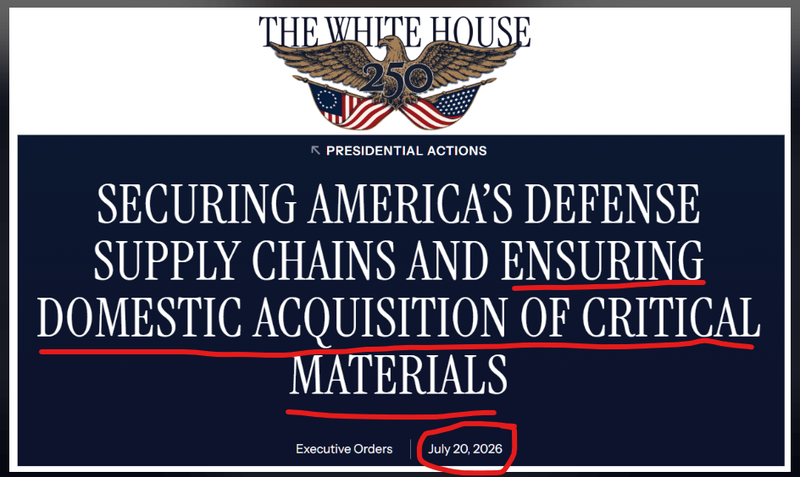
This week US President Trump signed an Executive Order telling the trillion dollar US military industrial complex to source critical minerals from inside US borders.
(Read the full Executive Order here)
Military suppliers can no longer get waivers to import from China UNLESS they first prove SERIOUS efforts to secure domestic supply - with real financial and legal consequences if they don't.
We think that means offtakes with pre-payments, funded test work and capital injections flowing into "up and coming" US critical minerals projects.
We have 11 Portfolio companies that fit the bill:
- ION - Rare earths recycling tech in Oklahoma (memo)
- RML - Antimony, tungsten + gold in Idaho (memo)
- VKA - Tungsten in Nevada (memo)
- OD6 - Fluorspar in Nevada (memo)
- AW1 - Indium, gallium, germanium in Utah (memo)
- SS1 - Silver (potentially antimony) in Nevada (memo)
- BKB - Silver in Texas, + gold in Nevada (memo)
- RCM - Gallium + germanium in Canada (memo)
- LKY - Antimony + rare earths in California (memo)
- LSR - Heavy rare earths in Arizona (memo)
- PFE - Antimony + silver in Arkansas (memo)
Mind you, is it actually “getting it right” if you haven't made any money yet?
Or if the stocks haven't gone up 5x to 10x and we are screenshotting the ripping share price charts to our mates instead of selling?
Like I did with silver’s mind boggling price run in the 6 months leading up to January - I’ve never been so right on something and made so little money...
(...YET, still holding for the next and hopefully bigger silver run)
So let’s not stretch the hammies for a USA critical minerals victory lap just yet.
This Executive Order is an important step in the right direction, but the actual outcomes for our stocks will take longer.
The trillion dollar US military industrial complex is a slow moving beast.
While I was sniffing around on the “recent USA Executive Orders” page this week, I saw this Executive Order that came out 25 days ago:
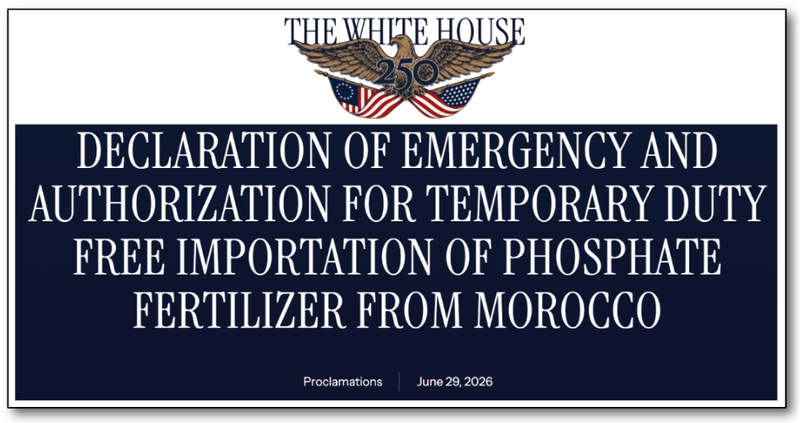
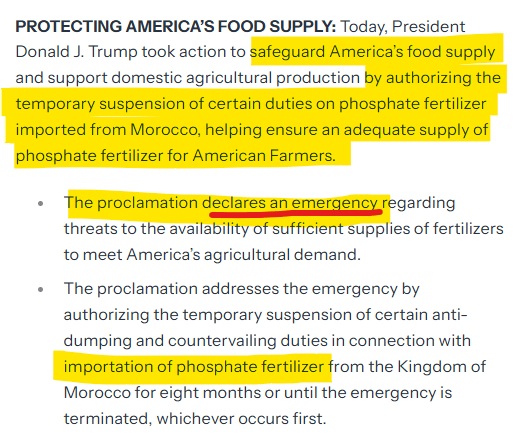
President Trump declares a state of emergency regarding securing supply of PHOSPHATE fertilisers into the USA.
And to help fix it, lifted all duties and tariffs on phosphate imports from the world's biggest phosphate exporter - Morocco, for 8 months or until the emergency is terminated whichever happens first.
(source)
Our Investment Minbos Resources (ASX:MNB) owns a world-class, high-grade phosphate deposit in Angola.
MNB says they are now fully funded to build their mine and processing plant and expect first phosphate fertiliser production this year.
And first exports in H1 2027.
(we just Invested in the MNB placement)
Phosphate is the key ingredient in fertiliser, which is used to grow our food.
We think the global “food security” theme is due for a flare up during the geopolitical world power and global supply chains reshuffling that is currently playing out.
Especially now that the Strait of Hormuz situation is firmly back on...
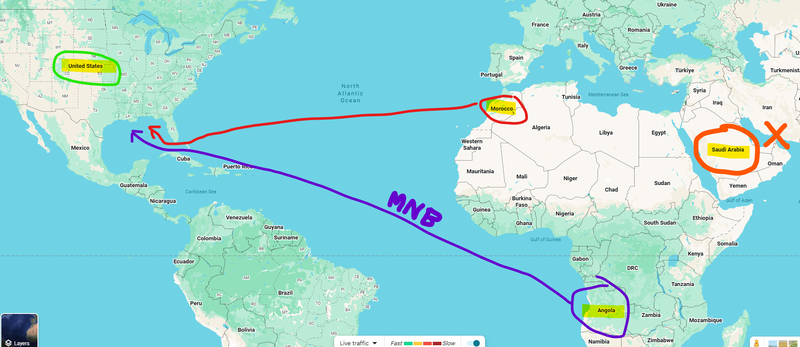
Saudi Arabia’s Ma'aden's Ras Al-Khair complex (one of the world's biggest integrated phosphate operations) sits on the Gulf coast - every export cargo must transit Hormuz, no workaround.
Unlike USA’s newly crowned phosphate best mate Morocco on the West African coast, which has a clear, Houthi free, Atlantic Ocean run to the USA.
MNB’s phosphate fertiliser project is in Angola, also on the West African coast which has the same clear run to the same ports in the USA:
MNB has previously said that it can build a phosphate (fertiliser) plant for ~US$30M-US$40M that will generate US$55M EBITDA per year (base case, on average) over a 20 year mine life. (source: 2022 Definitive Feasibility Study).
MNB is currently capped at ~$22M.
Note: those numbers above are early stage desktop economic numbers pre production, with a lot of assumptions baked in, things can and will change. There’s no guarantee MNB will generate these numbers.
MNB reckons they are now fully funded to build and less than 6 months away from getting the plant built and first fertiliser production.
Here is a look at MNB’s fertiliser plant construction progress from last month:


Nothing like a USA presidential declaration of a phosphate and food security emergency to get some attention on MNB’s project.
And if the US response to the “China withholding critical minerals” situation is anything to go by, the USA doesn't like it when critical resource supply is disrupted and will do whatever it takes to fix the situation.
(also, ask any US voter what's more “critical” - feeding their family or buying more patriot missiles)
And it's not just the USA that is affected...
Up to 30% of the world's traded fertiliser normally moves through the Strait of Hormuz.
Including around a third of global urea exports and close to half of all the sulfur used to make phosphate fertiliser.
The buyers left most exposed are import-dependent countries (which is also why we think there is a tailwind for MNB now).
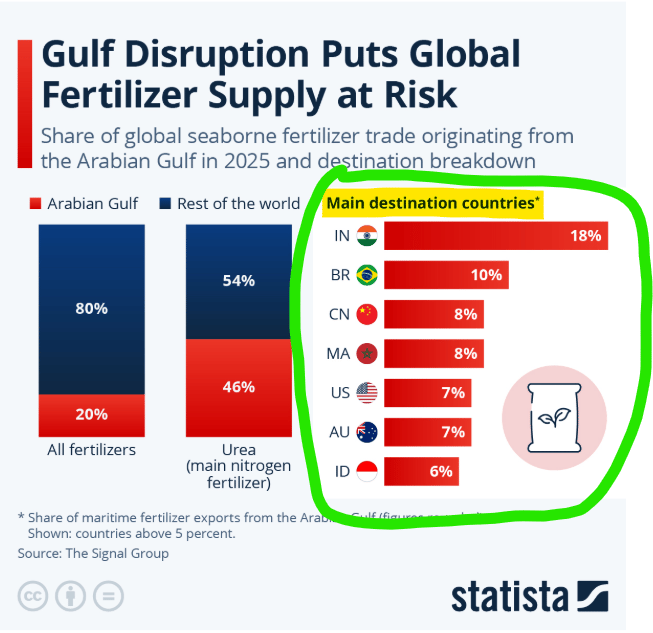
(source)
Here is how the strait closure impacts fertiliser prices:
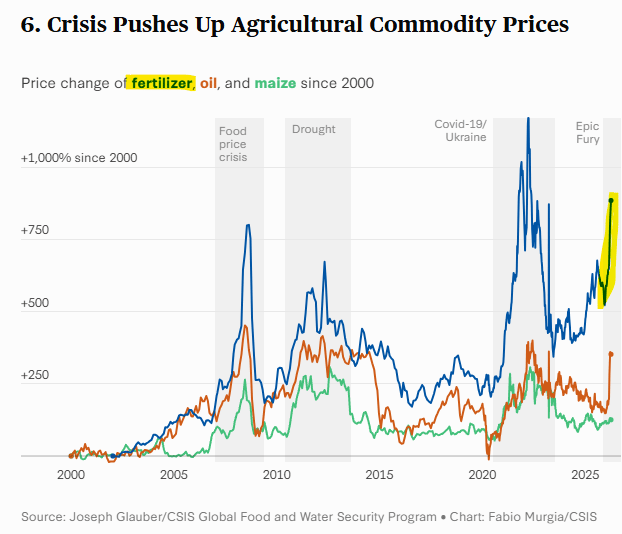
(source)
MNB’s go to market strategy for its product is to sell locally into the Angolan market AND sell product into the export market.
MNB expects to be shipping export product through the Porto do Caio deepwater port targeted in H1-2027. (source)
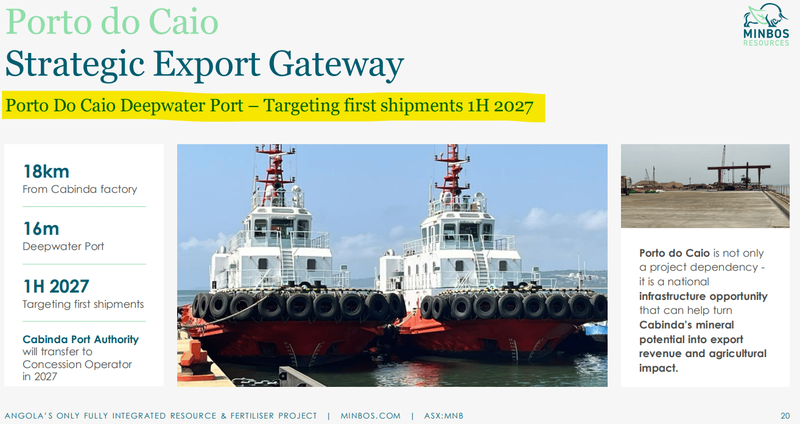
We think the “phosphate emergency” announcement out of the US has made the export story more interesting (and urgent) for MNB.
Urgency is what drives attention and capital into small stocks.
We just increased our Investment in MNB - read our note from Monday to see why: We just put more money into MNB...
Investors cycling into commodities.
We’ve been calling this one for a while now.
(I was smart enough not to put a time frame on this prediction - can't be “not wrong, just early” if I don't set a deadline hehe)
Remember that giant green NVIDIA ball we talk about once every few months that demonstrates the lop sided allocation of US capital into big tech versus into resources?
(in the USA tech and the "Magnificent 7” tech mega caps has been hoovering up the lion's share of capital over the last 15 years)
Which we think will eventually need to correct and rebalance more into resources?
Here it is again:
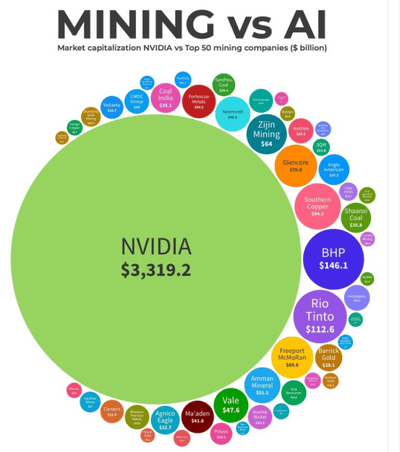
(Source, Mining.com October 28, 2024 all figures are in USD)
Our view has been that capital would eventually start to come out of that big green ball and into mining companies.
Now what about money cycling from the US$31 trillion treasury bond market into commodities?
This week we saw reports of a couple of high end wealth managers recutting Portfolio construction for their high net worth clients.
Moving some out of the traditionally safe and low risk bonds... and into commodities.
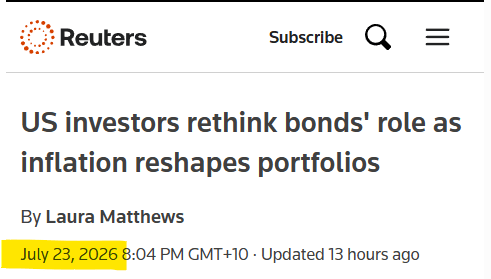
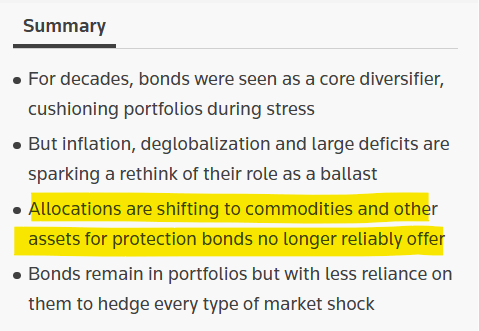
(source)
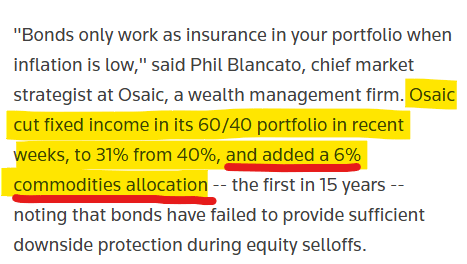
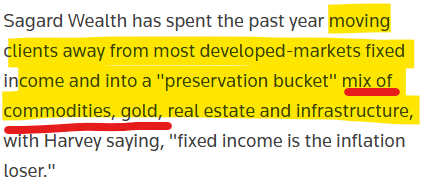
Going back to our green NVIDIA ball example, the US bond market size is $31 trillion - a much bigger ball than NVIDIA...
WTF is a “bond” anyway, and why are some investors moving from bonds to commodities?
And why should us microcap degenerates care?
We spend most of our days staring at illiquid small caps moving 20% up or down in a day...
So never really had the time or motivation to become experts in "safe and sensible government bonds" that promise 4% a year in returns.
I’ll admit, I didn't really spend any serious time trying to understand the bond markets until a few years ago.
But we have learnt over time that anyone playing in financial markets needs to have some base level understanding of the bond market.
(it’s the biggest market in the world - bigger than stocks).
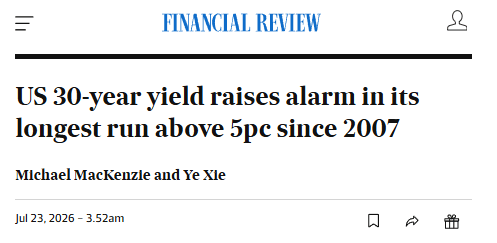
And this week there was some noise in the media about 30 year US government bond yields rising above 5% for the longest stretch since 2007...
Woah... easy there “finance” guy - What does that even mean?
It means investors are worried about growing debt and persistent inflation, not just saying it but voting on it with where they are putting their money.
(source)
Sorry to ruin your Saturday with a dry finance lesson, but here’s a quick explainer of how bonds work which helps (eventually) explain why the rotation into commodities makes sense.
So here's the quick pub version of what a bond is:
A bond is a loan - except you (the investor) are the bank.
A government or company (or your dodgy mate) needs cash now, so it borrows it from investors (you).
In return, it promises two things:
- To pay back the full amount on a set date, and
- To pay regular interest along the way for the privilege of using your money.
That's a bond.
The regular interest payments are called the coupon.
Getting your original money back at the end is the bond maturing.
The difference between stocks and bonds?
Stocks mean you own a tiny piece of a company.
Bonds mean you lent money to the company - and they owe you.
Because the payments are fixed and (usually) reliable, bonds are considered the "safe" end of investing - and US government bonds (Treasuries) are considered the safest of all.
So what's a "yield"?
The yield is your annual return - the interest payment you receive each year as a percentage of what you paid for the bond.
Pay $100 for a bond that pays you $5 a year, and your “yield” is 5%.
You don't have to hold a bond until maturity.
Bonds are bought and sold all day on a giant global market - and the price investors will pay for your bond changes constantly.
That's what makes yields move.
Why yields go up and down
Say interest rates rise, and newly issued bonds start paying $6 a year instead of $5.
Nobody wants your lame old $5-a-year-paying bond at full price anymore - why would they?
So to sell it, you have to drop the price... say to $85.
(and you lose $15 on your $100 bond)
The buyer still collects the same $5 a year, but they only paid $85 - so their yield is higher (~5.9%).
The reverse works too.
If new bonds only pay $3, your $5 bond looks great, and buyers will pay more than $100 for it, locking in a lower yield.
The golden rule: bond prices and yields move in opposite directions, like a seesaw.
Bond price up, yield down.
Bond price down, yield up.
One more thing: trust matters (will your dodgy mate pay you back?)
If investors worry the borrower might not pay them back, they'll only buy its bonds at a discount, which pushes the yield up.
That's why riskier companies (and riskier governments) pay higher yields = extra return for extra risk.
Why bonds are the "40" in the classic 60/40 portfolio
For decades, the default advice for building a portfolio was simple: 60% stocks, 40% bonds.
Here's why.
Stocks are the growth engine... but they're volatile.
Bonds were the “shock absorber”, for three reasons:
Steady income. The coupon payments arrive rain, hail or shine... whether the stock market is up 20% or down 20%.
Capital preservation. Hold a quality bond to maturity and you get your money back. Governments (uhh usually) don't go broke.
The magic ingredient: bonds usually move opposite to stocks. When markets panicked and stocks fell, investors historically rushed into safe government bonds. That buying pushed bond prices up (seesaw: yields down) right when stocks were falling. Your 40% cushioned the blow from your 60%.
So bonds smoothed the ride: decent returns in good times, protection in bad times.
At least, that's how it traditionally worked.
The catch: that relationship relies on inflation being low and boring.
When inflation becomes a problem (like in 2022, and arguably now) stocks AND bonds can fall together, and the shock absorber stops absorbing.
Which brings us to this week...
US government bond yields have been marching higher.
The alarm bell has been sounded on the US 30-year Treasury yield that has now held above 5% for its longest stretch since 2007... 27 days this year, including the last 12 in a row.
(The last time it did that was the eve of the global financial crisis, just before gold and silver’s glorious runs)
Rising yields mean bond prices are falling. Investors are selling US government bonds, or demanding a discount to buy them.
Why? Two of the things we just covered.
Inflation risk: if inflation eats away at those fixed coupon payments for 30 years, investors want a higher yield to compensate.
Trust: the US Treasury market has ballooned from US$4.5 trillion in 2007 to US$31 trillion, and US debt now exceeds 100% of GDP. Lenders are quietly asking for more return to fund a borrower that keeps borrowing more.
It's the seesaw in action and it's the "safest borrower in the world" (the USA) being asked to pay up.
So why would investors now start moving some of that 40% bond allocation into commodities?
Because the two things breaking bonds are the two things that reward commodities.
If inflation is eating your fixed coupon payments, the answer is to own the stuff causing the inflation - oil, gold, copper, food.
Commodity prices ARE inflation, so they hedge it by definition.
And if the trust problem is a government borrowing more and more against a currency it can print at will... the answer is hard assets that can't be printed.
(Gold's job description for 5,000 years and why central banks have been buying it hand over fist lately.)
In other words, bonds have stopped doing the one job the "40% allocation" was hired for: protecting the portfolio when things go wrong.
Commodities are auditioning for that job.
The best part is that the pool of money sitting in bonds is enormous.
The US Treasury market alone is US$31 trillion. Commodity markets are tiny by comparison.
(NVIDIA green ball example times ~10)
If even a few percent of that "40% bond allocation" rotates into hard assets, it's a flood of capital chasing a small door.
Which is usually very good news for the companies that dig the stuff up.
This isn’t the first time the big capital allocators have been hinting at a move away from bonds either...
Until recently it’s been into gold:
Morgan Stanley CIO Mike Wilson: backs a "60/20/20" portfolio, 60% stocks, 20% bonds, 20% gold. Half the bond bucket goes to gold as the better inflation hedge. (source)
Ray Dalio (Bridgewater founder): recommends ~15% of a portfolio in gold, says it "does very well when the typical parts of the portfolio go down" and that 60/40 isn't built for skyrocketing US debt. (source)
"Bond King" Jeffrey Gundlach (DoubleLine): said a 25% gold weighting is "not excessive", calling it "an insurance policy". Later settled on ~15% real assets: 10% gold plus 5% broad commodities. (source)
CNBC: gold's record run could drive "the biggest change ever" to the classic 60/40 portfolio. (source)
Have a great weekend.
Next Investors
General Information Only
This material has been prepared by StocksDigital. StocksDigital is an authorised representative (CAR 000433913) of 62 Consulting Pty Limited (ABN 88 664 809 303) (AFSL 548573).
This material is general advice only and is not an offer for the purchase or sale of any financial product or service. The material is not intended to provide you with personal financial or tax advice and does not take into account your personal objectives, financial situation or needs. Although we believe that the material is correct, no warranty of accuracy, reliability or completeness is given, except for liability under statute which cannot be excluded. Please note that past performance may not be indicative of future performance and that no guarantee of performance, the return of capital or a particular rate of return is given by 62C, StocksDigital, any of their related body corporates or any other person. To the maximum extent possible, 62C, StocksDigital, their related body corporates or any other person do not accept any liability for any statement in this material.
Conflicts of Interest Notice
S3 and its associated entities may hold investments in companies featured in its articles, including through being paid in the securities of the companies we provide commentary on. We disclose the securities held in relation to a particular company that we provide commentary on. Refer to our Disclosure Policy for information on our self-imposed trading blackouts, hold conditions and de-risking (sell conditions) which seek to mitigate against any potential conflicts of interest.
Publication Notice and Disclaimer
The information contained in this article is current as at the publication date. At the time of publishing, the information contained in this article is based on sources which are available in the public domain that we consider to be reliable, and our own analysis of those sources. The views of the author may not reflect the views of the AFSL holder. Any decision by you to purchase securities in the companies featured in this article should be done so after you have sought your own independent professional advice regarding this information and made your own inquiries as to the validity of any information in this article.
Any forward-looking statements contained in this article are not guarantees or predictions of future performance, and involve known and unknown risks, uncertainties and other factors, many of which are beyond our control, and which may cause actual results or performance of companies featured to differ materially from those expressed in the statements contained in this article. S3 cannot and does not give any assurance that the results or performance expressed or implied by any forward-looking statements contained in this article will actually occur and readers are cautioned not to put undue reliance on forward-looking statements.
This article may include references to our past investing performance. Past performance is not a reliable indicator of our future investing performance.