PNN secures $5M cornerstone investment from $1.7BN NASDAQ listed Critical Metals Corp - US government watching?
Disclosure: S3 Consortium Pty Ltd (the Company) and Associated Entities own 9,123,223 PNN Shares and 5,292,285 PNN Options at the time of publishing this article. The Company has been engaged by PNN to share our commentary on the progress of our Investment in PNN over time. This information is general in nature about a speculative investment and does not constitute personal advice. It does not consider your objectives, financial situation, or needs. Any forward-looking statements are uncertain and not a guaranteed outcome.
A $1.7BN NASDAQ listed critical minerals company just invested $5M to acquire ~8% of our ASX Investment Power Minerals (ASX:PNN).
PNN is developing a rare earths asset in Brazil and is capped at $66M.
PNN has been delivering some of the highest grade rare earth drill hits we have ever seen.
This seems to have gotten the attention of NASDAQ listed Critical Metals Corp - which aside from a billion plus market cap, also happens to have ~$500M in the bank.
Critical Metals Corp has a Greenland rare earths asset, and a bid in a tender for “one of the largest rare earth and niobium projects in the world” in Kenya...
... and CRML has now agreed to buy an ~8% interest in a Brazil rare earths project through (our Investment) PNN.
Interestingly, the US government pressured the Greenland rare earth asset owner NOT to sell it to China, but instead to sell it to (PNN’s new investor) Critical Metals Corp:
(long snippet but it's worth a read):
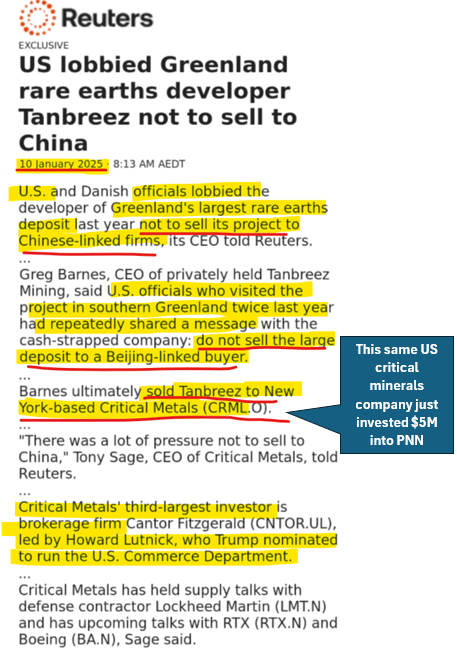
(source: Reuters)
So it sounds like Critical Metals Corp (who now owns ~8% of PNN) has somewhat close ties to the US government.
As far as we could find - this is Critical Metals Corp’s first cornerstone investment into another company:
$5M into our Portfolio stock PNN.
The last ASX listed stock Critical Metals Corp did an M&A deal with, ended up 20+ bagging in the last two years.
(more on this in a second, and also - past performance is not an indicator of future performance)
No other investor put money into this PNN round - so no short term flippers, just $5M into PNN’s bank account and a new, cashed up, USA listed critical metals big brother in the PNN canoe.
It looks to us like this is all part of a plan for Critical Metals Corp to become like a USA listed “BHP of critical minerals that the USA needs for AI, robots and advanced weapons”...
Commenting on the investment, the Critical Metals Corp Executive Chairman said:
“Power (PNN) is on the cusp of unlocking a major rare earths discovery at its Morro do Ferro Project in Brazil, with the Project delivering consistently exceptional rare earths grades from surface.”
In Brazil, the $66M capped PNN is drilling out its asset next door to Meteoric Resources (which ~$12BN Lynas just offered $968M for) and the $574M capped Viridis.
PNN’s plans will be accelerating now given the fresh lick of cash incoming.
We think PNN has a strong chance of climbing in value as it develops and de-risks its asset over the coming months and years.
Critical Metals Corp seems to agree - and as we saw above, is investing $5M into PNN at 14c per share.
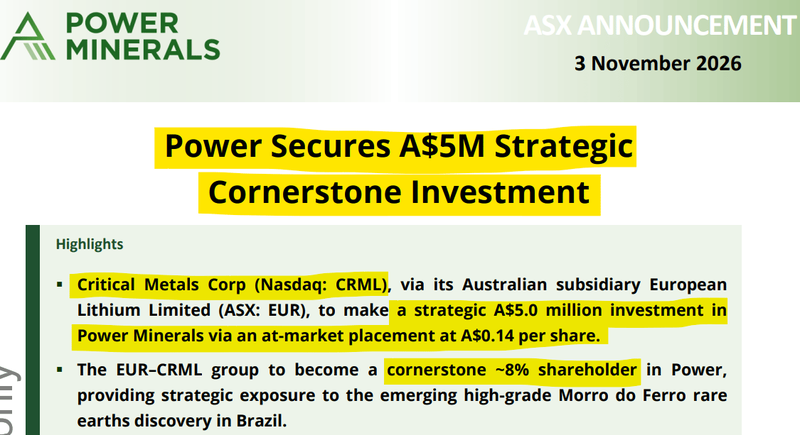
(source)
More on PNN’s new cornerstone investor - Critical Metals Corp
To us, it looks like the $1.7BN capped, NASDAQ listed Critical Metals Corp is aiming to build a global rare earths company across multiple assets and jurisdictions.
It is already the 100% owner of a multi-billion tonne rare earths asset in Greenland.
Critical Metals Corp was early into Greenland before Trump started talking about taking the country over for (amongst other things) its rare earths resources.
Last year there were even rumours that the US government would take a stake in CRML.
The stock ran ~431% in two weeks on those rumours alone. (source)
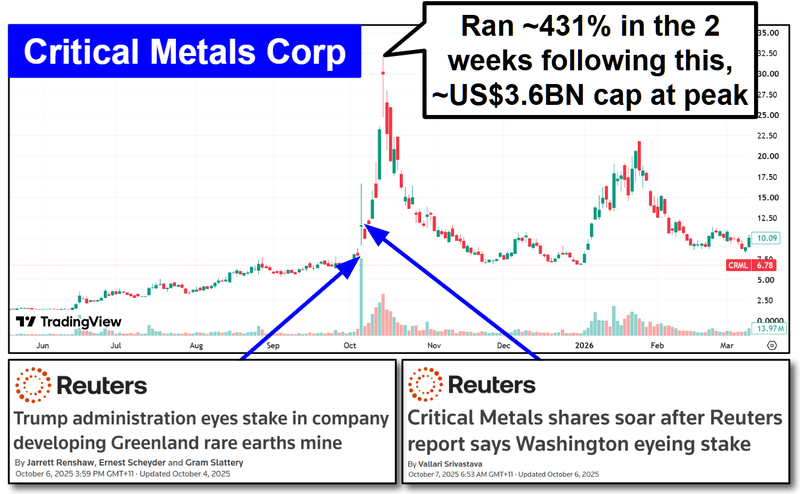
The past performance is not and should not be taken as an indication of future performance. Caution should be exercised in assessing past performance. This product, like all other financial products, is subject to market forces and unpredictable events that may adversely affect future performance.
Critical Metals Corp already has a 10-year binding offtake with a US defence supplier for its Greenland rare earths. (source)
As we noted above, Critical Metals Corp has also been shortlisted in the Kenyan government tender for “one of the largest rare earth and niobium projects in the world” the Mrima Hill Rare Earth and Niobium project.
The outcome of that tender is expected in the next 2-3 weeks. (source)
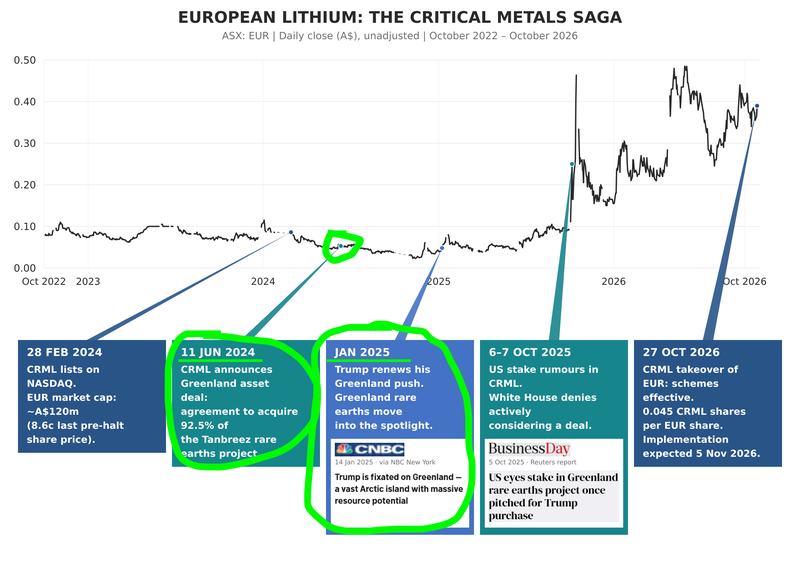
Putting aside the US big boy coming onto PNN’s register - we also like that the last company that ended up doing an M&A deal with Critical Metals Corp ended as a 20+ bagger for its shareholders.
That was European Lithium - which went from ~2c to 50c in under two years:
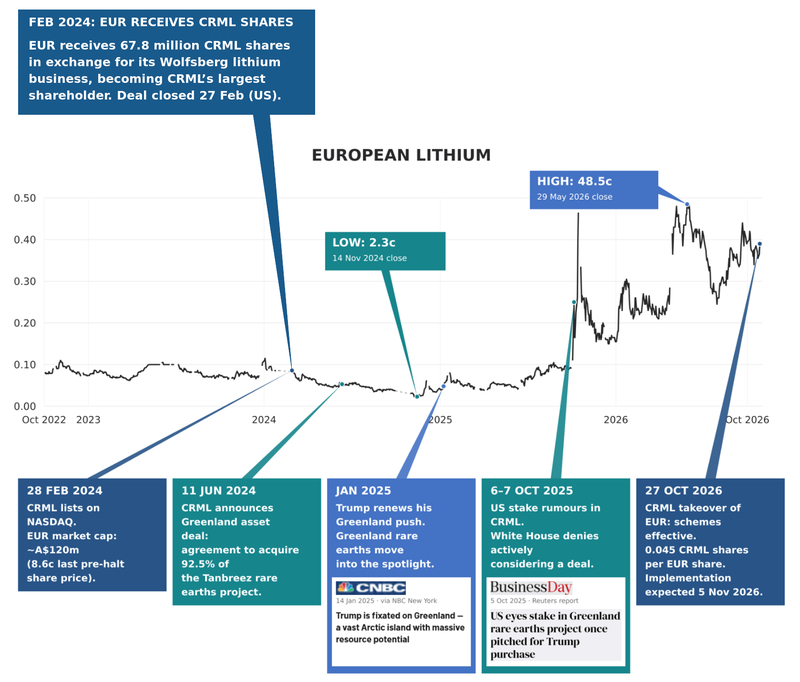
The past performance is not and should not be taken as an indication of future performance. Caution should be exercised in assessing past performance. This product, like all other financial products, is subject to market forces and unpredictable events that may adversely affect future performance.
PNN’s new investor Critical Metals Corp is also catching mainstream attention in the USA
Critical Metals Exec Chairman and CEO Tony Sage is now one of the ‘go to’ guys when it comes to rare earths in the US - here he is on Fox Business News (perhaps this is where he caught avid Fox News viewer Trump’s attention?), and CNBC, not once, but twice.
Here he is on a Bloomberg podcast too.
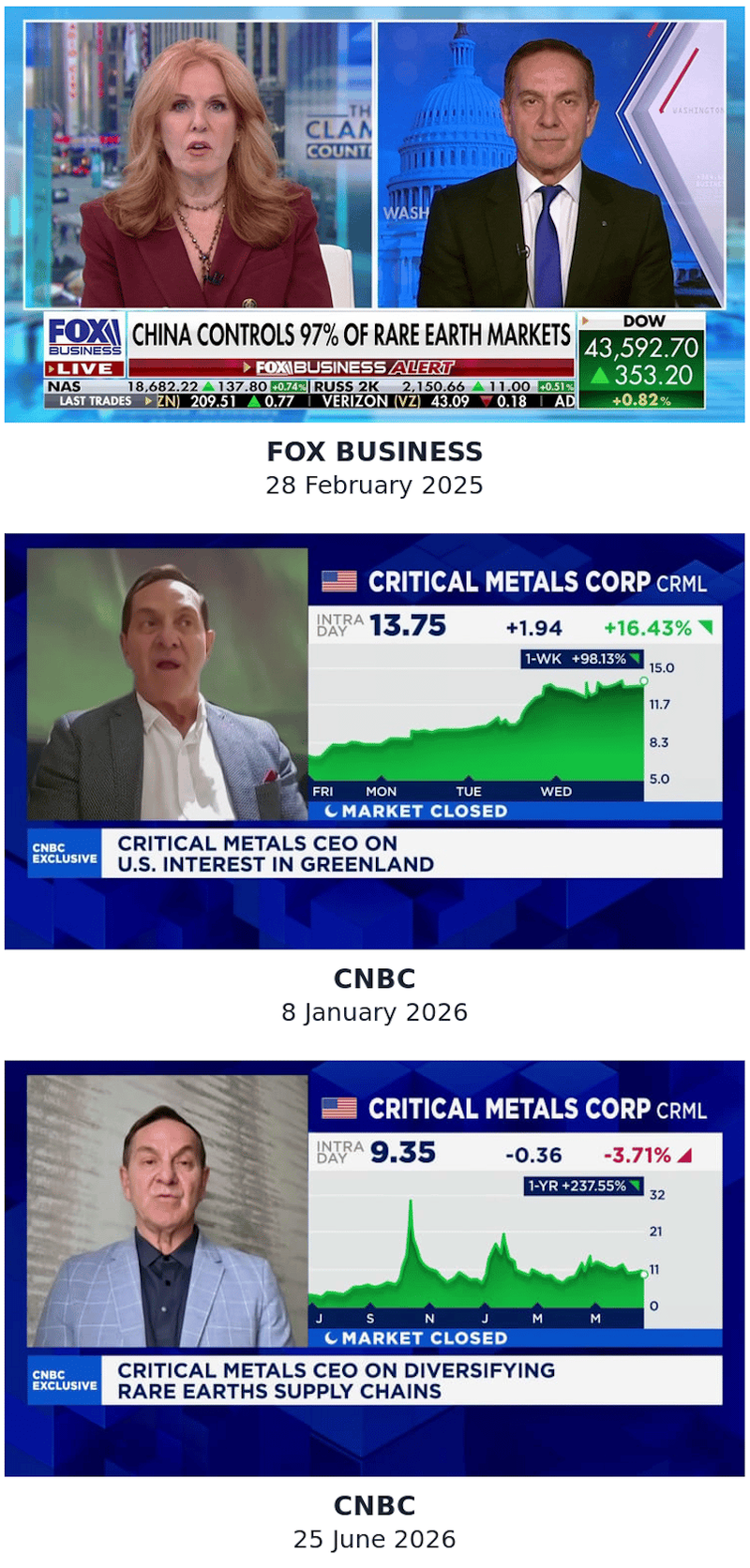
It’s almost like Critical Metals Corp is becoming the US vehicle for taking positions in the world’s biggest and best rare earth assets...
Today, that strategy has brought Critical Metals Corp into Brazil and onto PNN’s register, as a cornerstone 8% shareholder.
Brazil has the largest rare earth reserves of any country outside of China - so it wouldn’t be a “global rare earths vehicle” without some sort of exposure to Brazil.
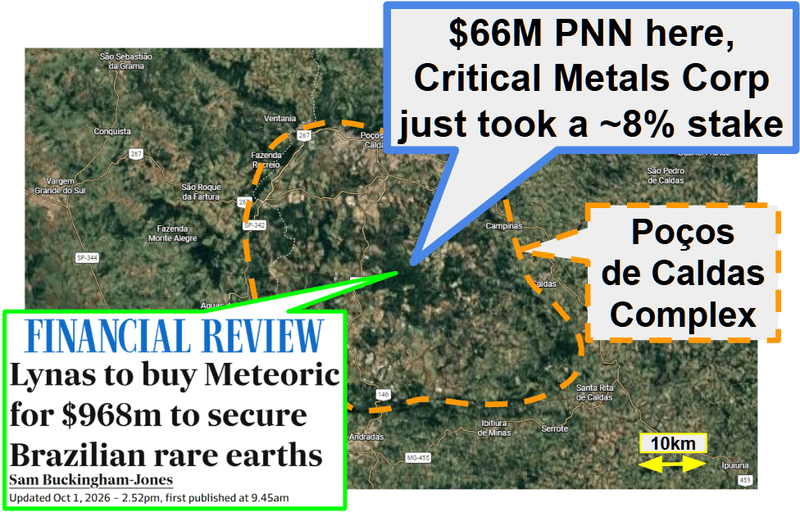
Brazil, more specifically the region PNN’s project sits in, has been in the Wall Street Journal recently, as a potential saviour to the US rare earths problem.
(The region has also been in the media for ~$12BN Lynas’ takeover of PNN’s neighbour - more on this in a second)

(source)
Our Investment PNN is right next door to Meteoric.
And IF PNN’s CEO is right, its project could even be the host structure for all of the rare earths in the area... (source)
(just a geological theory for now based on limited data, unproven with the drill bit - but it could be pretty epic if proven to be correct)
So why is Critical Metals Corp coming into PNN?
According to its CEO:
"Power is on the cusp of unlocking a major rare earths discovery at its Morro do Ferro Project in Brazil, with the Project delivering consistently exceptional rare earths grades from surface... and aligns with the focus and methodology of our business”.
Plus it could also be because:
- In 59 days (Jan 1st 2027) the US military has to stop buying rare earth magnets made with Chinese material. (source)
- As mentioned earlier, Critical Metals Corp already has the 10-year offtake deal with the US Defence contractor, and
- Now, maybe Critical Metals Corp is out looking for an asset it thinks could be a producer in the near term... (complete speculation on our part)
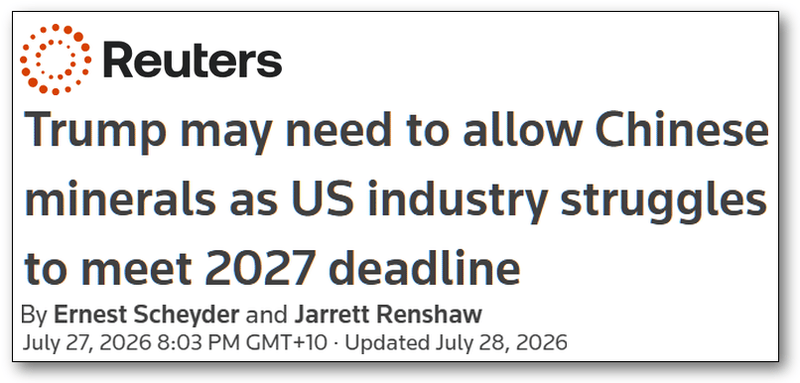
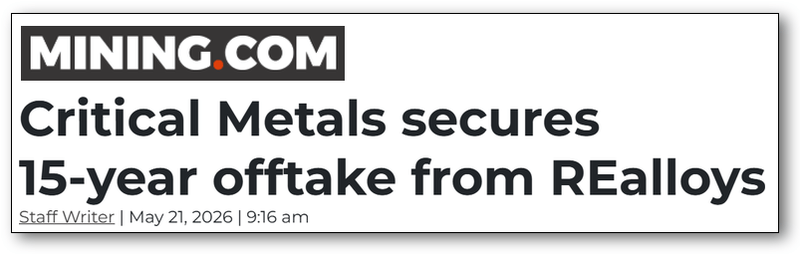
That US defence offtake deal means Critical Metals Corp COULD qualify for US government funding across any one of its projects, and so things sort of work in reverse for Critical Metals.
Instead of progressing a project then looking for financing and offtake.
Critical Metals Corp has the offtake and the potential funding pathways that the offtake unlocks.
Meaning it can backfill its corporate structure with projects it thinks will see the light of day.
Then use those projects to deliver into the offtake contracts...
Here is why we think PNN’s asset could fit the sort of criteria that makes it suitable for the above strategy:
- PNN's project sits on a "Manifesto de Mina" - a mining title with no expiry. Only environmental permitting is needed to get to production, and PNN owns the freehold land on top.
- PNN’s project is hosted in “bastnäsite” - we are not geos but according to PNN it’s the same mineral type that MP Materials is mining at its project in California - so it's a very well understood mineral type in the US.
- It sits next door to Meteoric’s project - the one Lynas Rare Earths have offered ~$968M for - meaning there is corporate activity nearby (and clearly the other corporate thinks that project can get up too).
- The project also has “ionic clay” potential - PNN has said in the past that parts of its project could ALSO host a similar mineralisation style as Meteoric’s.
- The project has very high magnet rare earth grades - The four “magnet rare earths” used in EV motors, drones, humanoid robots, fighter jets and guided missiles.
- PNN’s project has a very high grade exploration target - 9.2 - 10.7Mt at 7.8% - 9.2% TREO (total rare earth oxides) (source)
- AND It sits next door to ~$12BN Lynas Rare Earths proposed rare earth separation plant - which if developed would be massive for other projects in the area. (source)
PNN sits in one of the world’s prime real estate hot spots for rare earths
It’s very early days in the PNN / Critical Metals relationship, but we think PNN's asset has the “global appeal” to become a cornerstone asset for a US rare earths vehicle like Critical Metals Corp.
As mentioned earlier - PNN's asset sits in a part of Brazil that was plastered all over the Wall Street Journal a few months ago as a potential saviour to the US rare earths problem:

(source)
That article is all about one part of Brazil (the Poços de Caldas complex) - which is home to three ASX listed companies:
- Meteoric Resources - which received a $968M takeover offer from ~$12BN Lynas Rare Earths. (source)
- Viridis Mining & Minerals - capped at ~$574M.
- And our Investment PNN - capped at ~$66M.
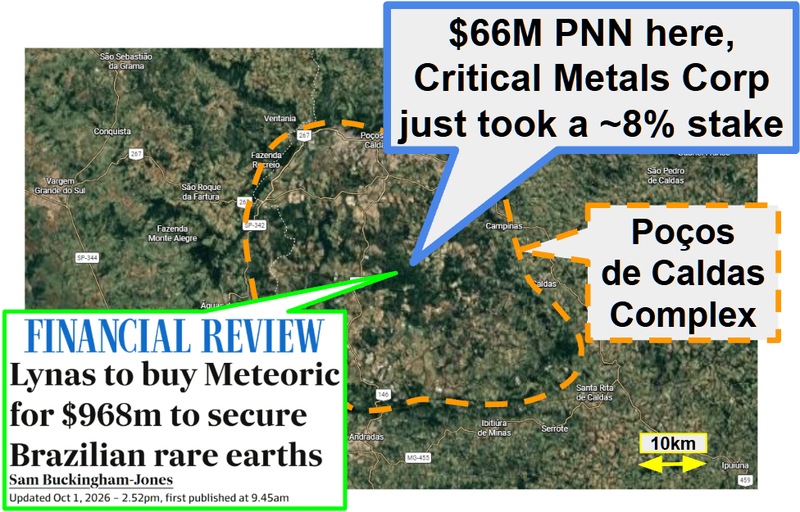
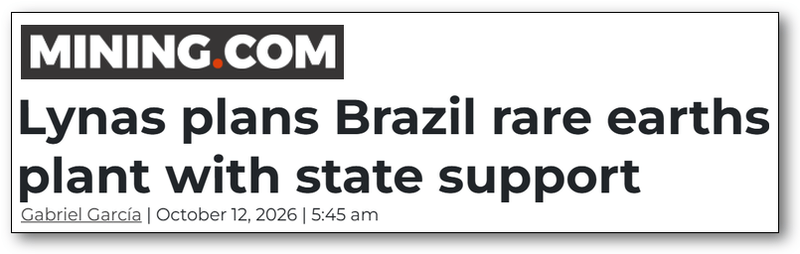
Making the region even hotter, around a month ago Lynas put a proposal to the Brazilian government for a rare earths separation plant in the Poços de Caldas region (33km from PNN).
Which “could become one of the largest such facilities outside China”. (source)
(source)
So Lynas’ entry into this part of Brazil is massive for PNN - especially if Lynas want to bolt on a deposit style that they understand well.
PNN’s project is a hard rock carbonatite - like Lynas’s cornerstone asset in WA, as opposed to Meteoric which is ionic clays - a new deposit style for Lynas.
Put this in your pipe...
We note PNN's CEO Alistair Stephens has previously mentioned how its project has the potential to host the source structure for all the ionic clay deposits in the area (like Meteoric's).
Here is what he said in an interview a few months back:
“At this stage it looks like what we’ve got is primary mineralisation and it may well be the pipe that’s actually feeding that entire Caldeira project with all the rare earths.
So you get minerals at the pipe, and as you get further and further away you get minerals and clay, and then further away again you get clay on the outskirts.”

(check out the full interview here)
Critical Metals Corp CEO, Executive Chairman & Director Tony Sage also said as much in today’s PNN announcement:
“Power is on the cusp of unlocking a major rare earths discovery at its Morro do Ferro Project in Brazil, with the Project delivering consistently exceptional rare earths grades from surface. This investment will allow Power to continue to drive its plans to realise value from MDF, and aligns with the focus and methodology of our business, which has had tremendous success identifying significant critical minerals projects with significant upside at an early stage.”
He was right on the Greenland rare earth asset...
The past performance is not and should not be taken as an indication of future performance. Caution should be exercised in assessing past performance. This product, like all other financial products, is subject to market forces and unpredictable events that may adversely affect future performance.
Maybe he thinks everything Lynas is doing in Brazil is going to turn this into a rare earth hub that is accessible to the US.
We already know the US likes Brazilian rare earths assets - see our take on that here.
PNN’s project has the highest grades of any project in the region too
Maybe, Critical Metals Corp are seeing those drill hits PNN keeps putting out and really like what’s coming together.
For now, PNN's exploration target grades 7.8-9.2% TREO. (source)
~35x Meteoric's grades which sit at ~0.23% TREO. (source)
In terms of grades, there are only really two listed projects we know of that come close:
- ~$10BN capped MP Materials' Mountain Pass mine in California - the USA's ONLY producing rare earths mine, and
- The ~$487M capped Brazilian Rare Earths' Monte Alto deposit, and as the company name suggests, like PNN, it's also in Brazil.
Again, PNN is capped at just $66M.
MP's Mountain Pass is ~26Mt at ~6.0% TREO - and it is the cornerstone asset for the US government's rare earths national champion. (source)
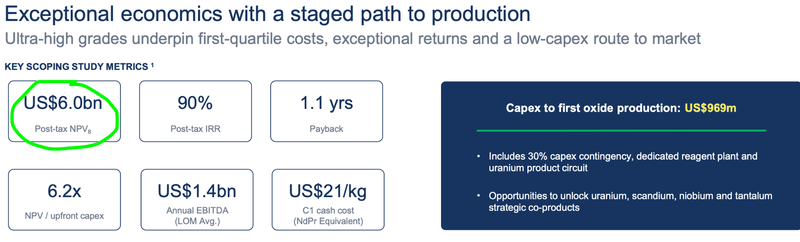
Brazilian Rare Earths' deposit is much smaller, but it's a higher grade - 3.4Mt at 11.26% TREO - enough grade to deliver a scoping study with a Net Present Value of ~US$6BN. (source)
(source)
Arguably, it looks like PNN’s project will be a lot easier to mine than Brazilian Rare Earths’ - here is how they look side by side (Brazilian Rare Earths is high grade, thin veins, PNN is high grade all in one spot):
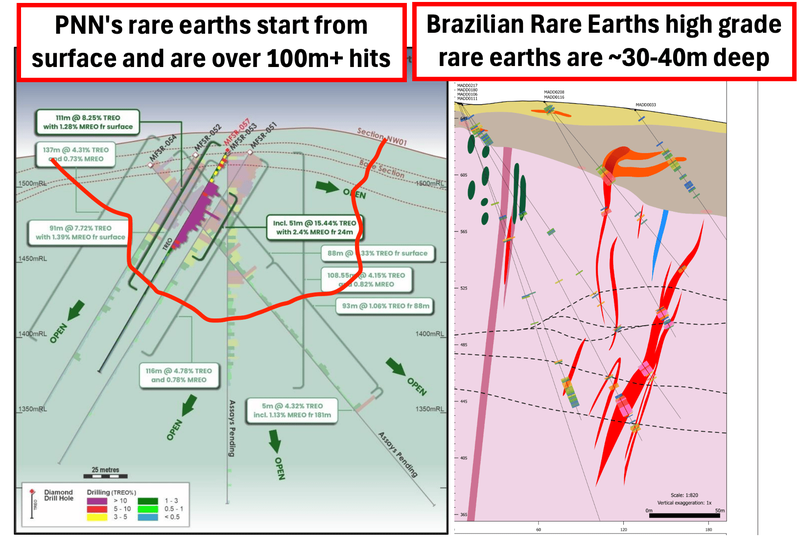
We are not mining engineers, and PNN hasn't done any official mining or economic studies yet - but on face value, one of those looks a lot simpler and cheaper to dig than the other.
And yes, we are conflicted here - we are long term PNN Investors with a large position in the company... and we currently hold zero Brazilian Rare Earths shares, so perhaps some bias from us here.
Right now, PNN's project has an exploration target of 9.2 - 10.7Mt at 7.8% - 9.2% TREO.
When PNN's maiden JORC resource estimate arrives (expected this quarter or next), the market can start to draw more direct comparisons with the peers we mentioned above.
Whatever happens between now and then, Critical Metals Corp are coming in early.
Before any of those peer comps can happen.
And will have time to allow the asset quality/potential to permeate into US investor brains...
If it hasn’t started doing that already...
Critical Metals Corp has often traded US$100M+ in volumes a day over the past 12 months and is one of the few big names representing the critical minerals thematic in the US.
So a lot of US investors have definitely heard about the stock... (see those CNBC, Bloomberg and Fox appearances from its CEO from earlier)
We think the macro interest is only going to get stronger - the western rare earths problem hasn’t been resolved YET.
From 1 January 2027, the Pentagon is banned from buying rare earth magnets containing material mined or processed in China, Russia, Iran or North Korea. (source)

(source)
Those rules cover off mining, refining, separation, metal making, magnet making.
It's a big part of the reason why Critical Metals Corp already has a 10-year binding offtake with a US defence supplier for its Greenland rare earths.
(signed in May, and explicitly citing "the 2027 defense procurement restrictions") (source)
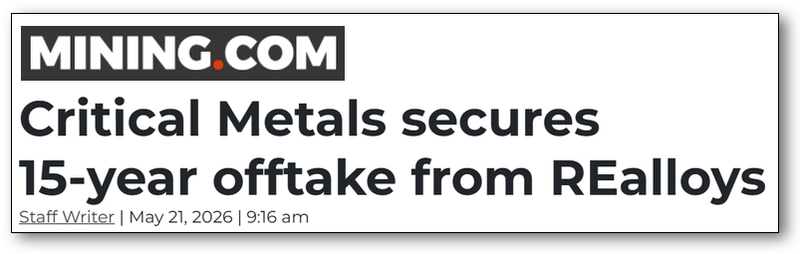
(source)
The big rare earth elephant (panda?) in the room is still there for western supply chains.
China still controls ~90% of the world's rare earth magnet supply chain. (source)
For the heaviest, most valuable rare earths like dysprosium and terbium, China controls ~98-99% of refined supply. (source)
China announced these export restrictions in April 2025 (in response to Trump’s tariff threats). (source)
Then momentarily paused while China and the US worked on a deal (that pause was extended by 2 months in September, it was due to expire November 10 - source).
Right now dysprosium and terbium (two of PNN's four magnet metals) still need case-by-case export licences out of China.
And a few months ago, China banned exports of “dual-use items” to US defence contractors including two US rare earths companies:


(source)
Rare earths are considered “dual-use” items:
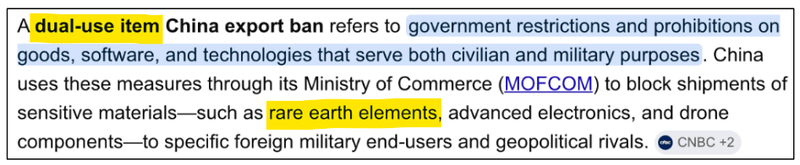
(source - we google’d dual-use item China ban)
So while the official export ban hasn’t really kicked into place, China has maintained its right to stop any export at any time whenever it sees fit.
Which probably explains why the US put that explicit ban in place so soon - 1st of January 2027.
Why we are bullish rare earths - it's the future - flying cars, humanoid robots and robot soldiers
Rare earths are a group of 17 metals.
Four of them, the magnet rare earths: neodymium, praseodymium, dysprosium and terbium - are used to make high performance magnets used in robots, drones, fighter jets, guided missiles, smartphones and the cooling systems of AI data centres.
These have no commercial substitutes.
An F-35 reportedly contains ~400kg of rare earth materials. (source)
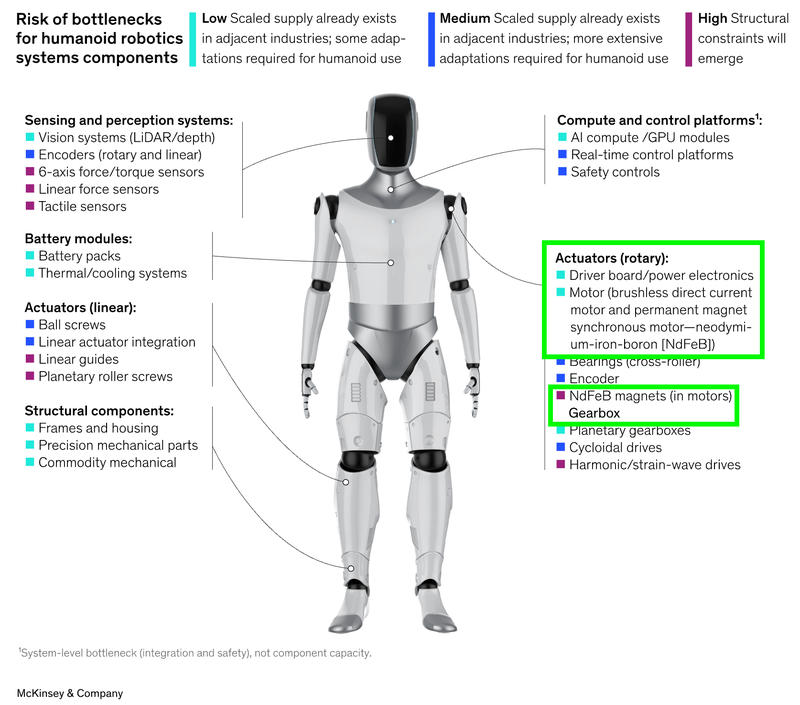
A single Electric Vehicle uses 1-2kg of rare earth magnets and a humanoid robot is expected to use more. (source)
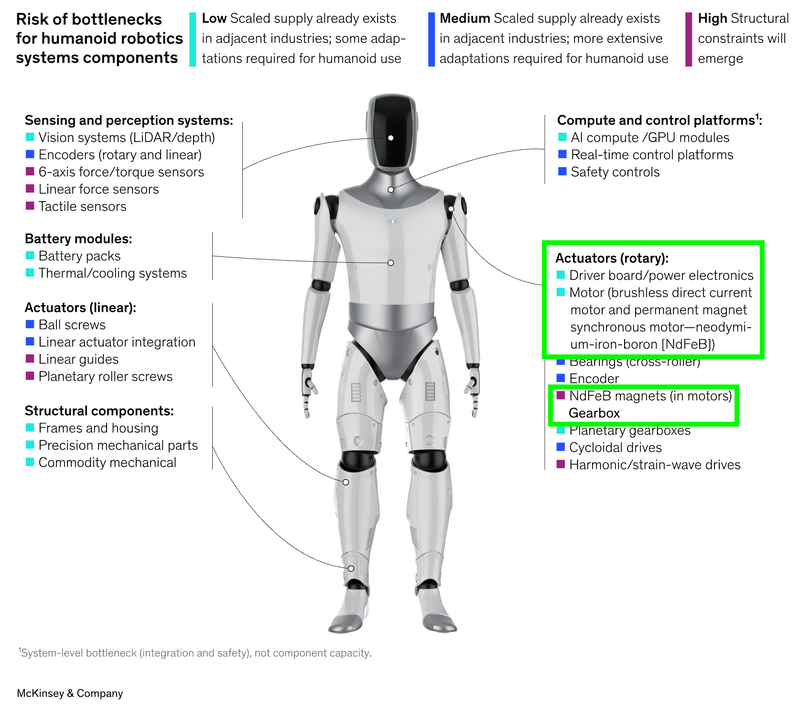
(source)
So every robot, every drone and every data centre that gets built from here needs more rare earths.
With everything happening around the world right now we think the fragility in military supply chains is what has created a big sense of urgency in the rare earths market.
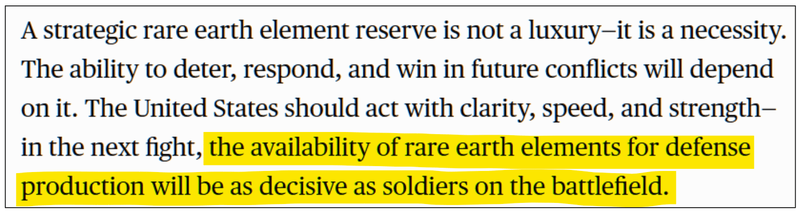
US think-tank CSIS (Center for Strategic and International Studies) has previously said:
"The availability of rare earth elements for defense production will be as decisive as soldiers on the battlefield."
(source - CSIS, Deterrence Runs on Rare Earths, July 2025)
Then, a few weeks ago we listened to a podcast with popular energy analyst Doomberg.
~1 hour in he makes a big call saying "that World War III is a war of attrition around rare earths."

(source - from ~1:07:10)
Both the CSIS and Doomberg are underlining the fact that modern conflicts chew through weapons inventories - missiles, interceptors, drones - faster than anyone can rebuild.
He also says "You can't go to war with your own factories." (source at ~1:07:44)
Meaning: if your adversary controls the input to your weapons factories, you're not really independent.
Taking a dig at Western dependence on the raw materials that go into the military supply chain...
We think he is right and think the current rush of capital and government support into rare earths is primarily because of the military conflicts that seem to be constantly escalating around the world.
Whatever happens from here - we think there is a 3-5 year window for assets like PNN's to capture market, corporate and government attention and get enough funding to be developed.
We are Invested in PNN to see it achieve our Big Bet as follows:
Our PNN Big Bet:
"PNN proves up a major high-grade rare earths resource in Brazil and re-rates 1,000% from our Initial Entry Price - via development, strategic investment or acquisition"
NOTE: our "Big Bet" is what we HOPE the ultimate success scenario looks like for this particular Investment over the long term (3+ years). The scenario is speculative and does not represent a valuation or forecast. There is no guarantee that our Big Bet will ever come true. There is a lot of work to be done, many risks involved, including development risk, country risk and commodity price risk - just some of which we list in our PNN Investment Memo.
Success will require a significant amount of luck. Past performance is not an indicator of future performance.
11 reasons why we are Invested in PNN
Here are the reasons we set out as part of our most recent PNN Investment Memo on the 15th of June 2026. Read that full article here.
We have added some minor updates to the reasons where necessary.
1. Rare earths as an exposure to AI and Robotics
Rare earths are a group of 17 metals, a small group of them - neodymium, praseodymium, dysprosium and terbium - are used to make the strongest permanent magnets on earth.
Those magnets are in EV motors, wind turbines, robots, drones, fighter jets, guided missiles, smartphones and the cooling systems of AI data centres.
There are no commercial substitutes.
An F-35 contains ~400kg of rare earth materials. A single EV uses 1-2kg of rare earth magnets. A humanoid robot is expected to use more.
(source)
2. PNN's project is advanced stage (an existing discovery)
PNN’s project has passed the early exploration stage with ~156 holes drilled into it.
The asset has already had 50 drill holes for a total of over 4,000m of diamond core drilling AND 106 holes for a total of 846.5m of auger drilling.
The existing discovery de-risks the asset from an exploration perspective and gives PNN something to expand.
🚨UPDATE:
PNN has now drilled 20 holes of its own 25-hole program with two rigs, and reported 7 of them - every hole mineralised from surface.
A maiden exploration target of 9.2-10.7Mt at 7.8-9.2% TREO was released on 22 September, the Maiden JORC is expected either this quarter or next (source).
3. PNN’s project has some of the highest rare earth grades we have seen on the ASX
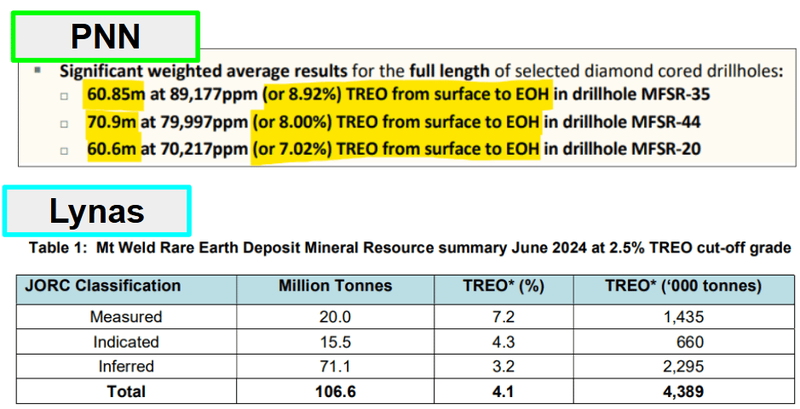
Historic drilling at Morro do Ferro returned 60.85m at 8.92% TREO, 70.9m at 8.00% TREO and 100.44m at 4.99% TREO - all from surface to the end of the hole.
For context $18BN Lynas Rare Earths project (which is the highest grade on the ASX) has a resource with an average grade around ~4.1% TREO.
🚨 UPDATE:
Lynas is currently capped at $12BN and PNN’s early drill results have continued to repeat these historic high grades over long intercepts.
4. The grades are rich in the rare earths that actually matter
PNN’s due diligence confirmed MREO values up to 3.53% of whole rock - and one hole averaged 1.47% MREO over its entire 60.85m length, a higher magnet rare earth grade than the total rare earth grade of many deposits globally.
The four magnet rare earths (MREO) - Nd, Pr, Dy, Tb - account for more than 80% of the market value of all rare earths. (source)
They are the ones that go into humanoid robots, drones, jet fighters, missile guidance systems, naval propulsion, next-gen submarine sonar, AI data storage & displays.

5. PNN’s project has a special type of mining title - “Manifesto de Mina"
A "Manifesto de Mina" is a legacy Brazilian mining title with no expiry date that already grants the right to mine, with only environmental permitting required to move to production. (source)
PNN also owns the freehold land above the deposit, so there are no third-party landholders to negotiate with.
We think the special type of license means IF PNN can define a large enough resource to put the project into production it can get to a decision point a lot quicker than other rare earths projects globally.
6. Geology analogous to the world’s highest grade operating rare earths mine
PNN says that its project's mineralisation is hosted in bastnäsite - the same well-understood mineral processed for decades at MP Materials' ~A$10BN Mountain Pass operation in California.
That gives the metallurgical workstream a meaningfully better starting point than most early-stage rare earths projects.

(source)
🚨 UPDATE:
PNN’s mineralogy studies are now feeding into metallurgical test work design, with initial outcomes expected this quarter. (source)
7. Next door to two ASX rare earths success stories
Morro do Ferro is in the Poços de Caldas complex alongside the ~$494M capped Meteoric Resources and the ~$463M capped Viridis Mining & Minerals.
PNN is capped at ~$44M.
We think that with some drilling, PNN can close the gap to its neighbours (assuming exploration is successful).
🚨UPDATE:
Meteoric has a $968M takeover from Lynas Rare Earths.
Viridis is capped at $574M.
PNN is capped at $66M.
8. We have had success Investing in Brazil before
Brazil has an established mining industry - Minas Gerais (the state where PNN’s project sits in) literally translates to "General Mines" - the state was founded on mining and has hosted it for over 300 years.
This is not a frontier jurisdiction. The workforce, the drilling contractors, the labs, the infrastructure and the regulator all exist at scale.
Some of our biggest wins have come from companies with projects in Brazil (both of them also being in Minas Gerais):
- Latin Resources - which made a lithium discovery in Brazil and went from ~3c to a high of ~45c per share - at its peak LRS returned 2332% for us. Eventually the company was taken over by Pilbara Minerals in a deal worth ~$560M.
- St George Mining (ASX: SGQ) - We Invested in SGQ at 2.5c when it first acquired its rare earths project in Brazil. At its peak SGQ was up 620% for us - now it trades at 11c per share - still 340% above our Initial Entry Price.
The past performance of LRS and SGQ is not a reliable indicator of the future performance of PNN.
🚨 UPDATE:
SGQ's share price has come down since we first wrote the above in June 2026.
SGQ is now trading at 5.2c/share, 108% above our Initial Entry Price.
9. Brazil matters for US critical minerals independence
China still controls ~90% of the world's rare earth magnet supply chain.
For the heaviest, most valuable rare earths like dysprosium and terbium, China controls ~98-99% of refined supply.
The US is pouring capital into Brazil to try and solve its domestic rare earth supply chain dependency issue.
Brazil is home to the world's second biggest rare earth reserves (behind only China).
The US has so far committed more than US$565M to Brazilian critical minerals projects and just last month US listed USA Rare Earth agreed to a US$2.8BN takeover of a producing rare earths mine in Brazil. (source)
Both of PNN's Brazilian projects sit in states (Minas Gerais and Goiás) that have been in talks to sign critical minerals cooperation agreements with the US. (source)
We think more of these type deals between the US and Brazil are possible for rare earths assets.
🚨 UPDATE:
The Serra Verde takeover was completed in September, with a 15-year offtake backed by US$750M from the US Department of War.
The US signed a critical minerals memorandum with the state of Goiás.
And TODAY we have NASDAQ listed Critical Metals Corp coming into PNN as a ~8% shareholder.
10. The "SGQ 2.0" set-up
PNN's deal has a lot of similarities to the deal our Investment SGQ did for its asset in 2024.
SGQ paid a similar amount for its project AND the same corporate advisor behind SGQ is behind PNN.
SGQ re-rated from ~2.5c to a high of 18c and is now capped at ~$435M.
We are hoping some of the capital from people who had a winner with SGQ finds its way into PNN as it proves out its asset.
The past performance of SGQ is not a reliable indicator of the future performance of PNN.
🚨 UPDATE:
SGQ's valuation has come down since we wrote the above in June 2026. At the current 5.2c share price, SGQ's market cap is $244M.
11. PNN’s project also has ionic clay optionality
Parts of PNN's ground trend toward its neighbours' ionic clay deposits - the style of rare earths mineralisation the ASX understands well with PNN’s two neighbours - $463M Viridis and $494M Meteoric.
IF PNN defines an ionic clay resource on top of its existing discovery then it could all of a sudden draw comparisons to its project and that of Viridis and Meteoric.
🚨UPDATE:
Meteoric has a $968M takeover from Lynas Rare Earths.
Viridis is capped at $574M.
PNN is capped at $66M.
What's next for PNN?
🔄 Drill results & maiden JORC resource estimate
PNN is drilling its project right now with two rigs right now.
~20 holes into the current 25 hole program.
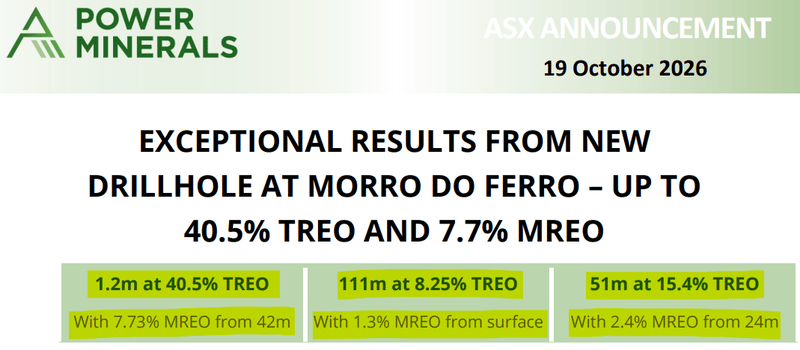
So far we have seen some pretty incredible hits - results like 51m at 15.4% TREO and 2.4% MREO:
(source: PNN announcement)
Those MREO (Magnetic Rare Earth Oxides) grades are especially interesting because they are the high value rare earths that go into robotics, EVs, military hardware and more.
Until a few weeks back, our understanding of PNN’s project was that it was really high grade starting from surface down to ~100-150m depths, BUT PNN has hit high grade rare earths in deeper parts of the project:
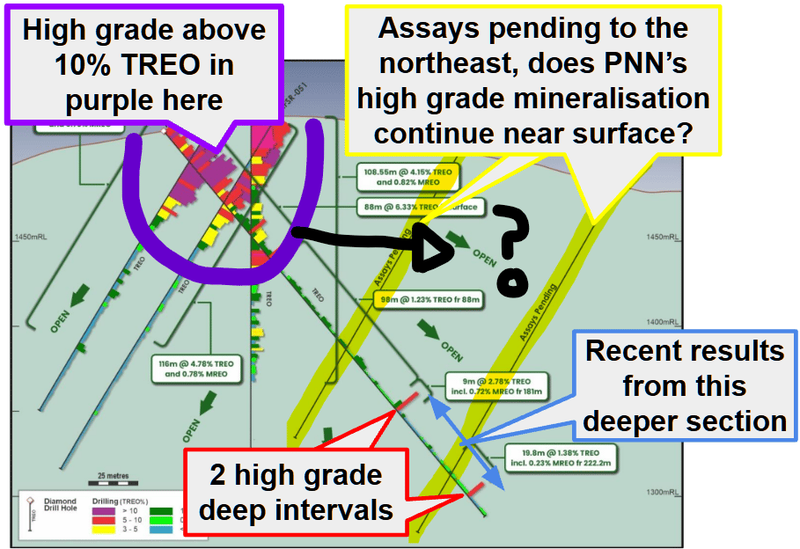
(source)
Now, with the cash raised from Critical Metals Corp - PNN’s plan is to go hard drilling those deeper targets:
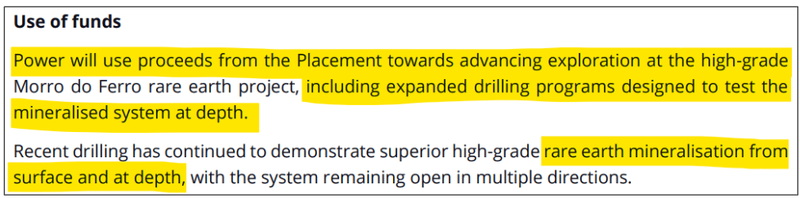
(source)
Here are the milestones we are tracking:
- ✅ Maiden exploration target
- 🔄 More drilling (currently drilling with two rigs)
- 🔄 Assay results
- 🔄 Metallurgical and mineralogy test work (underway). (source)
- 🔲 Maiden JORC resource estimate (expected in Q4-2026, Q1-2027)
🔲 Ionic clay potential tested at PNN’s project
The "free shot" at the style of deposit that made PNN's neighbours worth a combined ~$1BN+.
This one is especially relevant now after the recent news with Lynas’s takeover of Meteoric.
What could go wrong?
The single biggest risk right now is “Exploration Risk".
Hole 57 (released ~2 weeks ago) is the best we have seen so far.
BUT, most of the drilling PNN’s done is in and around parts of the project that have been drilled before.
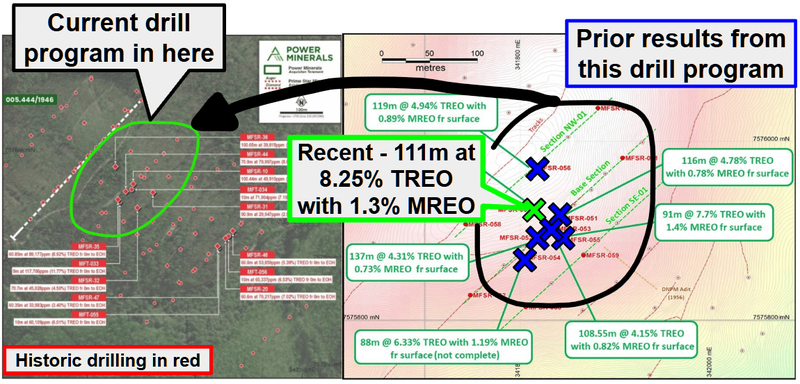
There is always a risk that as PNN starts to step out OR drill a lot deeper, the assays fail to match the expectations that hits like that may set.
IF results were to weaken as PNN steps out from areas where it knows there is mineralisation the market may interpret these as exploration failures.
Exploration risk
All of Morro do Ferro's headline grades were drilled by previous owners, mostly in shallow holes. The project has no JORC resource yet. IF PNN's drilling fails to confirm the historic grades, or the deposit doesn't extend, the investment thesis takes a direct hit and we would expect the share price to re-rate lower.
Source: "What could go wrong" - PNN Investment Memo 15 June 2026
Other Risks
Like any early-stage exploration company, PNN carries significant risk, here we aim to identify a few more risks.
Rare earth extraction and processing is notoriously complex, and PNN’s metallurgical test work is still in the early stages. Even with favourable bastnäsite mineralogy, there is no guarantee that commercial recovery rates can be achieved economically at scale.
The project currently relies on an exploration target and historical data rather than a defined JORC resource. If the maiden JORC estimate expected in Q4-2026/Q1-2027 fails to confirm grade continuity or falls short of tonnage expectations, the stock could re-rate lower.
PNN is running two active drill rigs alongside staged acquisition commitments of up to $12M in cash. Funding ongoing exploration and acquisition milestones will require capital, which could mean future capital raises at a discount and dilution for existing shareholders.
While holding a "Manifesto de Mina" removes the need for a standard mining concession grant, full environmental permitting is still required. Environmental licensing in Brazil can involve extensive regulatory scrutiny and unexpected timeline delays.
Investors should consider these risks carefully and seek professional advice tailored to their personal circumstances before investing.
Our PNN Investment Memo
You can read our PNN Investment Memo in the link below.
We use this memo to track the progress of all our Investments over time.
Our PNN Investment Memo covers:
- What does PNN do?
- The macro theme for PNN
- Our PNN Big Bet
- What we want to see PNN achieve
- Why we are Invested in PNN
- The key risks to our Investment Thesis
- Our Investment Plan
General Information Only
This material has been prepared by StocksDigital. StocksDigital is an authorised representative (CAR 000433913) of 62 Consulting Pty Limited (ABN 88 664 809 303) (AFSL 548573).
This material is general advice only and is not an offer for the purchase or sale of any financial product or service. The material is not intended to provide you with personal financial or tax advice and does not take into account your personal objectives, financial situation or needs. Although we believe that the material is correct, no warranty of accuracy, reliability or completeness is given, except for liability under statute which cannot be excluded. Please note that past performance may not be indicative of future performance and that no guarantee of performance, the return of capital or a particular rate of return is given by 62C, StocksDigital, any of their related body corporates or any other person. To the maximum extent possible, 62C, StocksDigital, their related body corporates or any other person do not accept any liability for any statement in this material.
Conflicts of Interest Notice
S3 and its associated entities may hold investments in companies featured in its articles, including through being paid in the securities of the companies we provide commentary on. We disclose the securities held in relation to a particular company that we provide commentary on. Refer to our Disclosure Policy for information on our self-imposed trading blackouts, hold conditions and de-risking (sell conditions) which seek to mitigate against any potential conflicts of interest.
Publication Notice and Disclaimer
The information contained in this article is current as at the publication date. At the time of publishing, the information contained in this article is based on sources which are available in the public domain that we consider to be reliable, and our own analysis of those sources. The views of the author may not reflect the views of the AFSL holder. Any decision by you to purchase securities in the companies featured in this article should be done so after you have sought your own independent professional advice regarding this information and made your own inquiries as to the validity of any information in this article.
Any forward-looking statements contained in this article are not guarantees or predictions of future performance, and involve known and unknown risks, uncertainties and other factors, many of which are beyond our control, and which may cause actual results or performance of companies featured to differ materially from those expressed in the statements contained in this article. S3 cannot and does not give any assurance that the results or performance expressed or implied by any forward-looking statements contained in this article will actually occur and readers are cautioned not to put undue reliance on forward-looking statements.
This article may include references to our past investing performance. Past performance is not a reliable indicator of our future investing performance.