PR1 outlines US defence materials platform strategy
Our advanced materials Investment Pure Resources (ASX: PR1) has just pulled all the pieces of its story together into a single, formalised "Defence Materials Platform Strategy" aligned with United States and AUKUS defence supply chains.
PR1 now three separate threads:
- The Rice University carbon nanotube fibre (CNTF) thermal management R&D collaboration (which is the main reason we’re Invested - see our deep dive here)
- The Oak Ridge National Laboratory (ORNL) Strategic Partnership Projects Agreement for heavy rare earth recovery (covered here)
- The abrasive garnet play - For the NAVSEA naval shipbuilding qualification pathway
Today PR1 has shown it is stitching these into a single integrated strategy.
All three of which are aimed at US defence and critical materials supply chains.
We are most interested in the Rice University carbon nanotube fibre (CNTF) thermal management side of things, but these other projects could end up opening doors and opportunities for each other.
We wrote a bit about PR1 in our Saturday article, read that here: How about substituting scarce critical metals with specialty materials?
(Usually when we talk about material substitution, it’s for technically inferior products, in this case the performance is aiming to be vastly improved.)
This piece also covered why we think US capital could be coming for critical minerals related projects on the ASX.
The three streams from one orebody
Garnet Hills sits on a granted mining lease in WA.
PR1’s now positioning it to sit inside three workstreams:
Stream 1: Large-to-jumbo flake graphite
The 200-300 µm flake graphite confirmed at Garnet Hills is the exact feedstock class needed for advanced thermal management applications.
This is the feedstock side of PR1’s Rice University CNTF program which uses Garnet Hills graphite as the precursor for next-gen carbon nanotube fibre.
So the same orebody that supplies the abrasive garnet for shipbuilding also supplies the graphite feedstock for the CNTF program targeting AI data centres and weapons cooling systems.
Stream 2: Heavy rare earths + yttrium
The third stream is the HREE+Y recovery program with Oak Ridge National Laboratory under the Strategic Partnership Projects Agreement.
The heavy rare earths (Dysprosium, Terbium, Erbium, Thulium, Ytterbium, Lutetium, plus Yttrium) are on both the DOE 2023 Critical Materials Assessment and the USGS 2022 Critical Minerals List as high supply risk critical materials.
Global production is dominated by China and the US currently imports substantially all of its HREE+Y requirements.
These elements aren’t optional as they are mission critical inputs to:
- F-35 Lightning II fighter jets
- Virginia-class and Columbia-class nuclear submarines
- Precision guided munitions
- AESA phased-array radar and electronic warfare suites
- Directed energy weapons
Stream 3: Abrasive garnet
Premium andradite garnet for high-spec jet cutting, precision abrasives, and naval shipbuilding.
This is the most mature stream and the near-term entry point into US defence supply chains.
The qualification pathway is being run against US Navy specifications administered by NAVSEA - which gives PR1 direct exposure to:
- Huntington Ingalls Industries (the largest US military shipbuilder)
- General Dynamics Electric Boat (US submarine builder)
This is the abrasive garnet used for hull preparation and surface treatment on aircraft carriers and submarines.
The new bit - DoD engagement is now commencing in parallel
PR1 has now started a structured US Department of Defense engagement program, running in parallel with the NAVSEA abrasive qualification pathway.
The DoD funding vehicles PR1 will be pursuing include:
- Defense Production Act Title III
- Office of Strategic Capital
- Industrial Base Analysis and Sustainment (IBAS) program
- DARPA advanced materials programs
- AUKUS Pillar 2 (the technology-sharing side of AUKUS, covering hypersonics, AI, quantum, advanced materials)
And on the Australian side - the US-Australia Critical Minerals Framework, the Australian Department of Defence, and the Department of Industry, Science and Resources.
The ORNL agreement is the technical anchor and it’s the piece that lets PR1 walk into DoD funding conversations with a US national laboratory partnership already in hand.
A reminder on why we are Invested in PR1
The primary reason we Invested in PR1 is for the CNTF thermal management R&D collaboration with Rice University.
The carbon nanotube fibres being developed there are ~10x more thermally conductive than copper at the fibre level, with applications across AI data centres, robotics, and defence systems.
Garnet Hills is the upstream asset that feeds that downstream program (and the others since announced).
You can see our most recent DeepDive from last week on PR1: PR1: Test results show 1.5x more conductive than copper, 2.5x more than aluminium - an alternative material for cooling AI datacentres, robots and weapon systems?
What we want to see next from PR1
🔄 US government funding outcomes
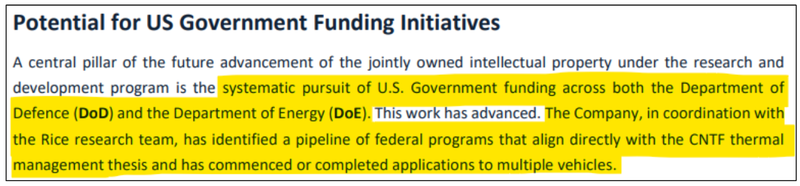
PR1 has commenced applications to DoE and DoD funding programs. We want to see at least one of these land - it would validate the program and provide additional capital:
(source)
🔄 End user collaboration progress
Multiple organisations are already engaging. We want to see this progress toward joint development agreements or testing partnerships with named parties.
🔲 Workstream milestones
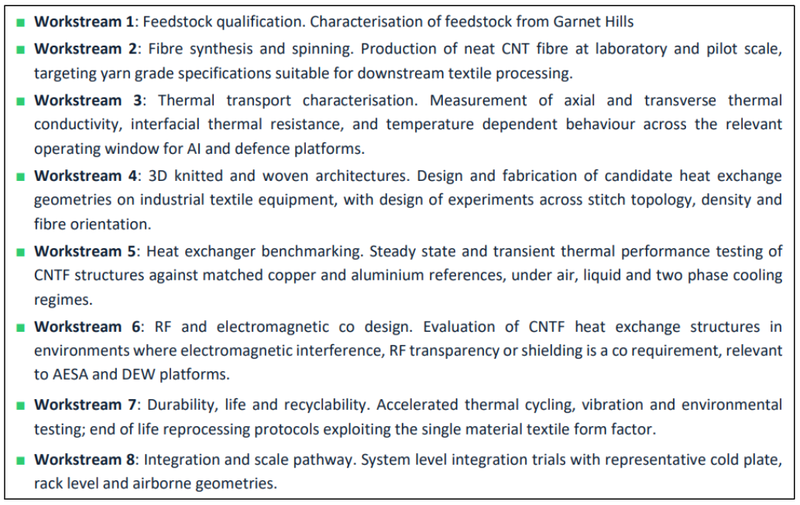
With 8 workstreams now defined, we want to see PR1 start ticking off deliverables - starting with feedstock qualification and fibre synthesis.
Recently PR1 confirmed the 8 step program to get this underway:
(source)