PR1: Test results show 1.5x more conductive than copper, 2.5x more than aluminium - an alternative material for cooling AI datacentres, robots and weapon systems?
Disclosure: S3 Consortium Pty Ltd (the Company) and Associated Entities own 3,100,000 PR1 Shares at the time of publishing this article. The Company has been engaged by PR1 to share our commentary on the progress of our Investment in PR1 over time. This information is general in nature about a speculative investment and does not constitute personal advice. It does not consider your objectives, financial situation, or needs. Any forward-looking statements are uncertain and not a guaranteed outcome.
We think the urgent global buildout of AI and robotics will be bigger than any of humanity's past industrial leaps.
Adding to concurrent military rebuilds underway in a fragmenting post-WW2 global world order.
All fighting for scarce commodity supply that can’t catch up - driving the next multi decade commodity supercycle.
Hyperscale AI data centres, robots, advanced weapons all use electricity... and hence need cooling (thermal management).
Thermal management is currently achieved using conductive metals copper or aluminium to pull away and dissipate excess heat.
Copper and aluminium are supply constrained - our 3 “strategically critical” global buildouts are fighting for supply.
It takes 17 years to build a new copper mine.
The AI datacentres, robots and military buildout race is urgent and can’t wait that long...
What if there was a lighter weight alternative with better conductivity?
Our Investment Pure Resources (ASX:PR1) is developing a lightweight, thermal management alternative to copper and aluminium with Rice University in the USA:
Carbon Nanotube Fibres (CNTF) for thermal management.
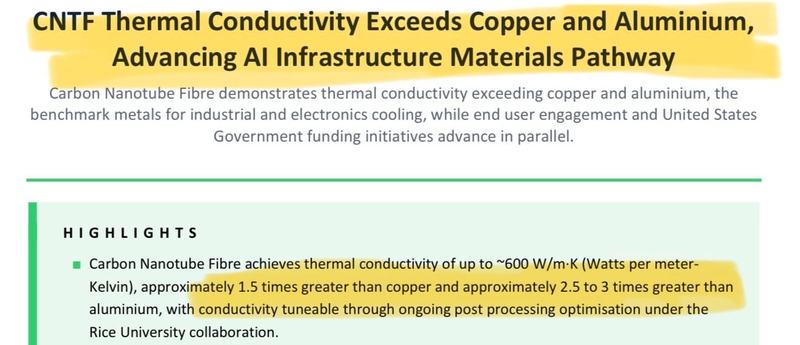
And today PR1 announced conductivity (moving heat) test results showing that its:
“Carbon Nanotube Fibre’s (CNTF) had thermal conductivity ~1.5x more than copper AND ~2.5-3x more than aluminium"
(source)
And with some manufacturing improvements (weaving trillions of CNTF into one fibre) could potentially be ~15x more conductive than copper.
(source)
We think it's pretty safe to assume CNTF are lighter weight too - (Its not a metal, its fibre woven out of carbon nanotube threads)
Higher conductivity AND lighter weight would be perfect for drones and robots - where space and weight are key design constraints.
(PR1 says weight test results are coming next)
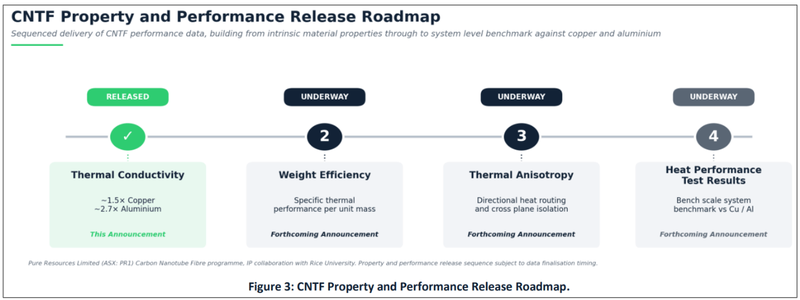
Today's numbers are the first of four planned data releases from the PR1 / Rice University R&D collaboration.
Here is what to expect next from PR1:
- Weight efficiency - (Basically measuring thermal performance relative to its weight) 🔲
- Thermal anisotropy - (Measuring how well the material can direct heat) 🔲
- System-level heat performance (This is the big one - actual tests in systems VS traditional materials - copper / aluminium) 🔲
(source)
PR1 is our exposure to the AI/Robotics/military buildout supply chain.
PR1 has a collaboration agreement with Rice University to take carbon nanotube fibres and apply it to thermal management for advanced electronics.
Like hyperscale AI data centres and robots...
PR1 and Rice University will jointly own any IP that comes out of the R&D collaboration.
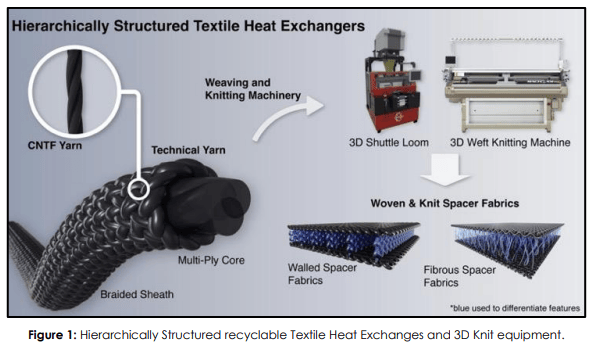
More on what a carbon nanotube fibres are later - for now here is what they look like:
(source - PR1 announcement)
We keep hearing about how “there won't be enough copper” OR ‘insert other mineral’ for the AI, robotics, and military global buildouts...
Critical mineral prices will skyrocket driven by demand.
The capital markets will “do its thing”, attracting investment to companies trying to build new mines to plug the supply gap.
(great for small critical minerals stocks)
But skyrocketing mineral prices ALSO drive attention and capital to finding and developing cheaper alternatives.
Which is where we think PR1 comes into play and could end up offering everyone an alternative.
PR1 has partnered with Rice University - “The Birthplace of Carbon Nanotechnology”
A big part of the reason we Invested in PR1 was because of the R&D collaboration agreement with Rice University.
PR1 and Rice University will jointly own any IP that comes out of the R&D collaboration.
Rice University tech deals have a history of doing really well on the ASX:
- ~$1BN capped Weebit Nano (ASX: WBT) - ReRAM semiconductor - up ~700% at peak.
- ~$405M capped Metallium (ASX: MTM) - Flash Joule Heating - up ~800% at peak, AND
- ~$51M capped Locksley Resources (ASX: LKY) - one of our best performers of 2025 - up over 40% the day they announced their Rice collaboration.
Past performance of these companies is not indicative of future performance of PR1.
We also like that Rice has what we think is the only complete chain in the world from carbon nanotube fibre chemistry through to deployable thermal-management systems:
- Prof. Matteo Pasquali - global pioneer in CNT fibre. Co-founder of Dexmat. Backed by Shell Ventures, with funding from US DOE, NASA, US Air Force and ARPA-E.
- Prof. Daniel Preston - The extreme heat guy - pushing heat rejection to its limits.
- Prof. Vanessa Sanchez - The textile engineer - turning fibres into real-world structures.
- Prof. Geoff Wehmeyer - The thermal switch guy - making the thermal system intelligent and adaptive.
Pasquali makes the fibre. Preston pushes the heat. Sanchez weaves it into something a customer can use. Wehmeyer makes it smart.
(we did a deep dive on the team in our initiation note here: The Rice University research team on PR1’s project)
So PR1 is working with the cream of the crop when it comes to carbon nanotube fibres.
IF there is anyone PR1 could have worked with on this type of technology we would have wanted it to be a group like the one at Rice.
The four markets PR1 is going after
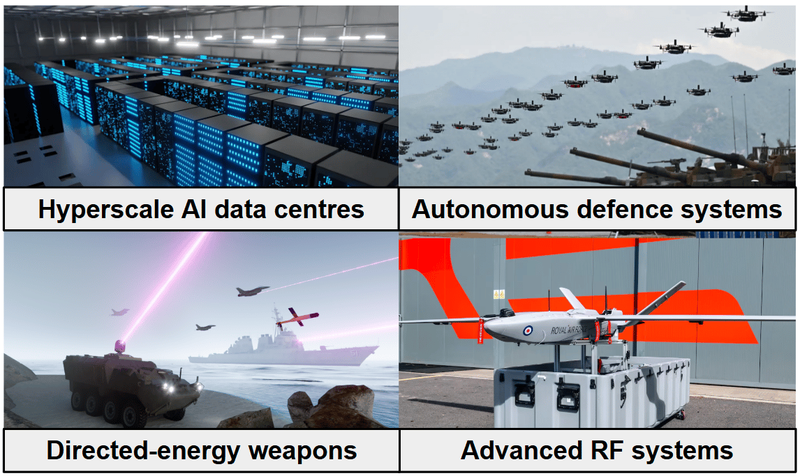
PR1 with Rice are going to apply carbon nanotube fibre for thermal management (cooling) across four different markets that on their own could be worth tens of billions of dollars:
- Hyperscale AI data centres - where air and liquid cooled racks are creating bottlenecks. CNTF is more conductive than copper and 80% lighter.
- Directed-energy weapons (lasers, high-power microwaves) - Mounted on ships, vehicles, aircraft. Most of the input power becomes heat. Copper-only cooling means you fire a few short bursts then wait minutes to cool down. CNTF could extend those usage cycles.
- Advanced RF systems (radars, electronic warfare pods, jammers) - Thousands of tiny RF chips packed into the nose of a jet or a wing-mounted pod. No room for fans. CNTF because its flexible and can be woven into any shape it could help solve the conductivity issues in tight spaces.
- Autonomous defence systems (drones, robot dogs, unmanned vehicles) - Onboard AI compute in sealed boxes operating in hot environments. Copper is too heavy. CNTF is ~50x stronger than copper by weight and fully recyclable.
PR1 will provide Rice with up to US$500,000 in Research and Development funding (over a maximum 24 month period).
PR1 and Rice will have joint ownership of any intellectual property where there are inventors from both PR1 and Rice.
(source)(source)(source)(source)
Of course, there is no guarantee PR1's research agreement leads to a commercial outcome.
This is early-stage R&D and many research collaborations don't result in commercial products.
So why PR1 and why thermal management?
As mentioned earlier, carbon nanotube fibres have thermal conductivity that could potentially be around ~15x copper. (source)
It’s also ~80% lighter...
(perfect for thermal management in tight, compact places)
Higher thermal conductivity = higher cooling requirements.
That’s where thermal interface materials (TIMs) and heat sinks matter.
AND where PR1 is focusing with its collaboration deal.
Ever seen one of these inside a computer?
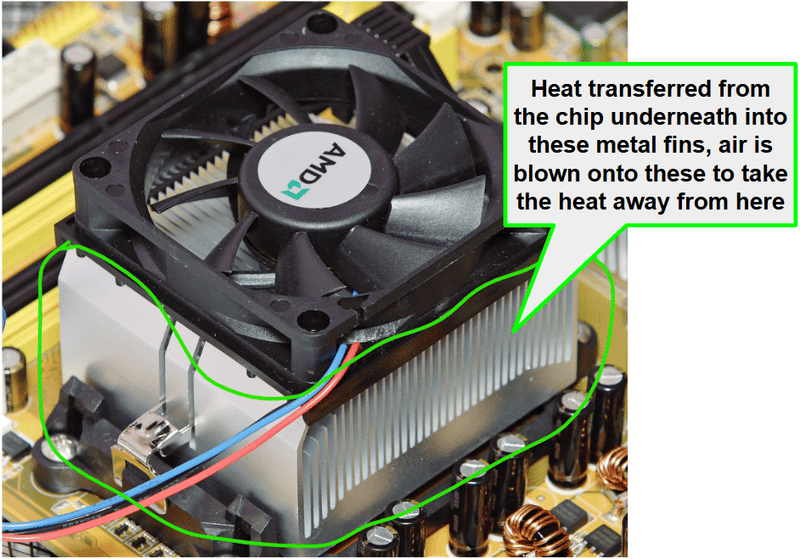
That's the heat sink that sits between the chip and the cooling equipment (in the above case a fan).
Then there is also liquid cooled chips - basically the same concept except they use a liquid instead of air to cool it (but both scenarios still need a copper/aluminium heat sink to sit between the cooling device and the chips below):
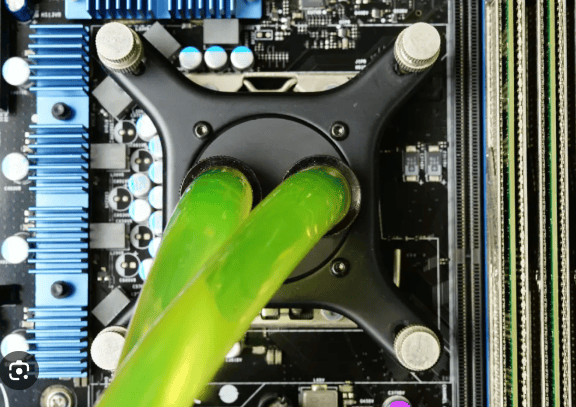
Here is where the carbon nanotubes would fit - replacing the (mostly aluminium or copper) heat sink materials - because carbon nanotube fibres are more conductive and can transfer heat away from the chip more effectively.
More efficient heat transfer = lower cooling requirements.
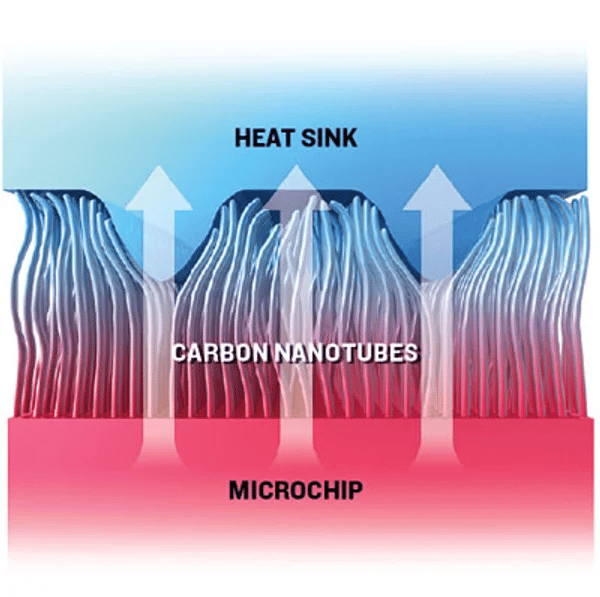
(Source)
A carbon nanomaterial made of extremely aligned and densely packed carbon nanotubes, processed into continuous fibres and thin films:
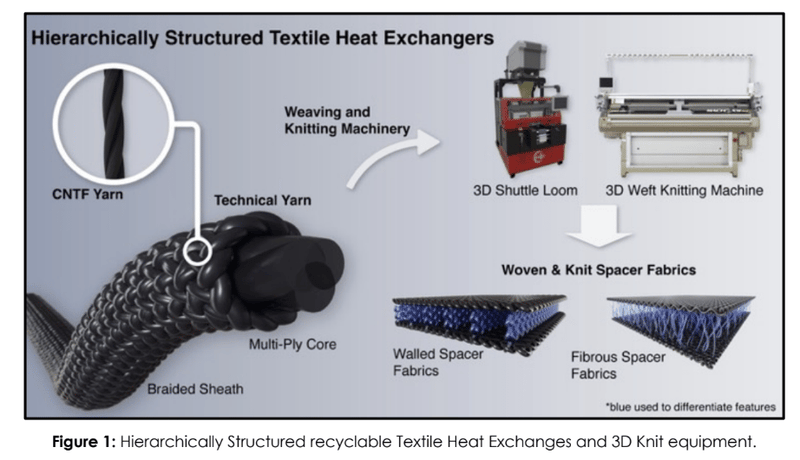
(source: PR1 announcement)
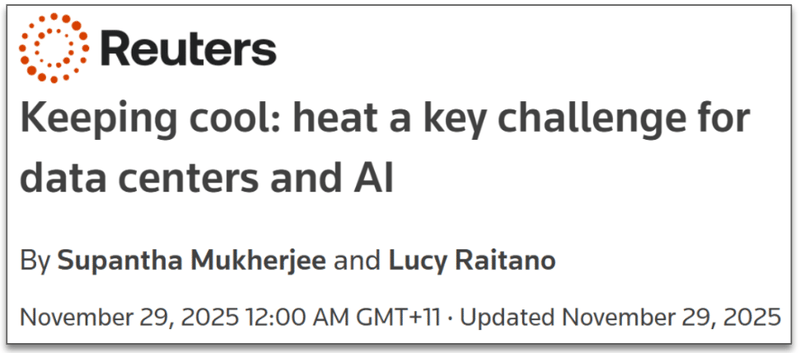
We think the cooling issue for AI data centres could be one that all of the big tech companies face (NVIDIA, Google, Meta, Amazon) - and a material/product that can solve that problem for them could become valuable and of interest to them.
(source)
We are already seeing this play out, inside the last 30 days, there have been some mega deals happen in the cooling tech space:
- Google is in talks to buy cooling-systems from Chinese company Envicool (Reuters, 17 March 2026).
- Bloomberg, 20 March 2026)
Ecolab (NYSE-listed and US based) announced a cash takeover of CoolIT Systems (Canadian-based): US$4.75BN (announced 20 March 2026) ( - Reuters, 4 November 2025) Eaton (NYSE listed, US headquartered) has closed on an acquisition of Boyd Thermal (owned by Goldman Sachs Alternatives / Goldman Sachs Asset Management): US$9.5BN (closed March 2026) (
The ASX is also warming up to materials science stocks - PR1’s peer is up 413% in the last few weeks.
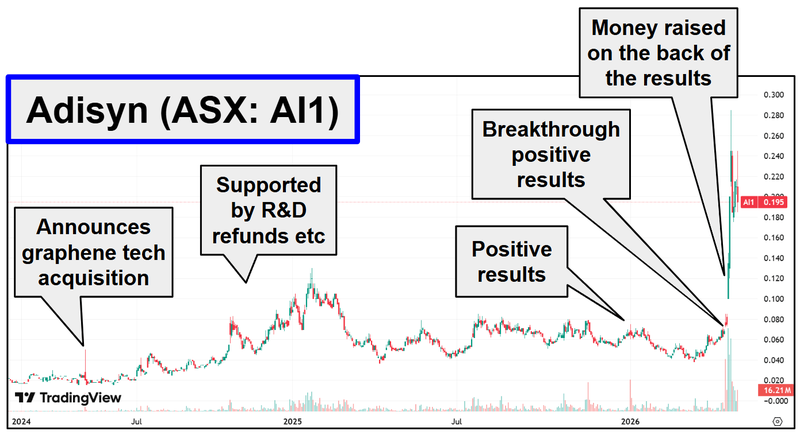
Two weeks ago, ASX-listed Adisyn (ASX: AI1) closed a $14M placement at $0.0675 per share.
Cornerstoned by Regal Funds Management and Israel's largest investment house Meitav (~A$190B AUM).
Off the back of that placement, Adisyn ran by >400%.
Adisyn is now capped at ~$203M.
The past performance is not and should not be taken as an indication of future performance.
(source)
The past performance is not and should not be taken as an indication of future performance. Caution should be exercised in assessing past performance. This product, like all other financial products, is subject to market forces and unpredictable events that may adversely affect future performance.
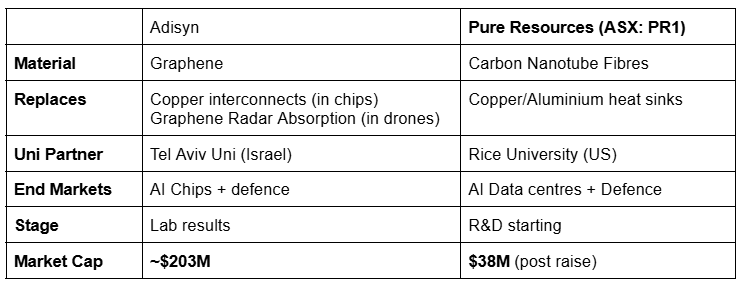
We think there are a lot of similarities between that company and PR1.
Both are small ASX-listed companies with world-class university partnership.
Both are working in the “materials science” space - with next gen materials looking to solve the shortcomings of existing materials (like copper).
The main difference between the two is AI1 is working with Graphene and has some decent lab data) - PR1 is working with Carbon Nanotube Fibre’s and lab data is incoming...
Here is how the two rank side by side:
Going based on how the market’s re-rated Adisyn so far, we think PR1 could have a similar re-rate moment across three of the following milestones:
- A reproducible lab milestone from Rice - IF PR1 can show its nanotube fibre as a working thermal interface material in an industry-relevant test the market could get interested in the stock and fast.
- A defence or hyperscale customer signal - PR1 could do a deal with an from an Ai data centre builder interested in CNTF heat sinks, or with a US government agency...
We note PR1 is already inside the US DOE ecosystem after signing a Strategic Partnership Agreement with Oak Ridge National Laboratory AND is engaging with DOE and DoD funding programs. - A cornerstone institutional capital event - Like Adisyn did, PR1 could have some specialised investment fund see the potential and take a position - which could wake up the broader market.
(none of those three are guaranteed. We could be wrong about the comparison entirely.)
We think that at this stage - there is still so much more to come from PR1...
And ultimately, we think one of the three above could contribute to PR1 achieving our Big Bet as follows:
Our PR1 Big Bet:
"PR1 re-rates to a +$200M market cap by securing a pathway into the carbon nanotube fibre thermal management supply chain, attracting strategic partnerships with major data centre or defence customers, and/or being acquired at a multiple of our Initial Entry Price."
NOTE: our “Big Bet” is what we HOPE the ultimate success scenario looks like for this particular Investment over the long term (3+ years). There is no guarantee that our Big Bet will ever come true. There is a lot of work to be done, many risks involved, including development risk, country risk and commodity price risk - just some of which we list in our PR1 Investment Memo.
Success will require a significant amount of luck. Past performance is not an indicator of future performance.
6 reasons why we Invested in PR1:
1. Our three favourite macro thematics - AI, Robotics and Defence
We have been looking for ways to get exposure to the "AI infrastructure buildout", "robotics" and “defence” thematic on the ASX for a while now.
PR1’s focus will be on a problem that combines a mix between materials science, AI and robotics - where the blue sky upside could be anything really...
(We literally don't know, it could also never eventuate into anything commercial).
PR1 is going after thermal management - a critical problem for two of our favourite macro thematics - AI data centres, autonomous robots/vehicles.
We think the two macro thematics are going to be the main character for the markets over the next decade at least.
2. First micro-cap on the ASX going after thermal management
We like first movers on the ASX - especially when it comes to advanced technologies across AI and robotics.
PR1 is working with Rice Uni to develop thermal management tech based on the work of Professor Matteo Pasquali - who leads Rice University's Carbon Hub.
Pasquali developed “carbon nanotube fibres” a material that is 17% more thermally conductive than copper, nearly double the thermal conductivity of aluminium, 50x stronger than copper by weight, 5.6x lighter than copper, and fully recyclable (unlike carbon fibre, which cannot be recycled at all).
Carbon nanotube fibres showed that for the first time you could get metal-level conductivity and carbon fibre-level strength in the same material.
Under the R&D collaboration agreement, PR1 is applying that material to thermal management.
3. Collaboration deal with Rice University who were involved in multiple ASX tech success stories.
PR1 is not the first ASX company to partner with Rice University.
Rice University has been associated with some of the most successful industrial materials projects on the ASX in the last few years.
Rice University is the same university that developed the:
- ~$757M capped Weebit Nano (ASX: WBT) ReRAM semiconductor technology and
- ~$413M capped Metallium (ASX: MTM) Flash Joule Heating technology.
- ~$34M capped Environmental Clean Technologies (ASX: ECT) Flash Joule Heating technology for PFAS.
- One of our best performers of 2025 - Locksley Resources (ASX: LKY) signed a collaboration with Rice Uni - on that day alone LKY’s share price was up over 40%.
The past performance of the above companies is not an indicator of future performance of PR1. Caution should be exercised in assessing past performance.
Update: Market caps are now - WBT $1BN, MTM $405M, ECT $52M
4. Proven technology that’s been funded by the US DoE and DoW
The tech that underpins PR1’s thermal management research isn't just a lab experiment.
Rice's carbon nanotube fibre technology that is being commercialised by a company called DexMat and has received funding from the US Department Of Energy, NASA and the US Air Force.
The DoE grant from 2024 was specifically targeting further improvements to thermal conductivity so there is a demand signal in the market too.
The US Department of War is also funding carbon nanotube fibre research.
(Team members of Dexmat are also part of the collaboration deal with PR1)
5. PR1 is collaborating with experts in carbon nanotube fibres and thermal management
PR1 will now be doing its R&D programs alongside:
- Prof. Matteo Pasquali - the inventor of Rice Uni’s carbon nanotube fibres technology. He's the reason the material exists and how to optimise it for any specific application.
- Prof. Daniel Preston - At Rice, he explicitly works on "thermal management for high-powered electronics, both military and civilian applications." He's the one who can take a carbon nanotube fibre heat exchanger and make it perform at its absolute physical maximum.
- Prof. Vanessa Sanchez - She knows how to take advanced fibres and weave, knit, and integrate them into functional structures. She's the bridge between "we have a great fibre" and "we have a product that fits on an actual platform."
- Prof. Geoff Wehmeyer - the thermal switch guy. He builds devices that can turn heat flow on and off, like a light switch, but for thermal energy.
Put them together and you have the full chain - from carbon nanotube fibres chemistry all the way to thermal management systems.
6. Tiny market cap and tight capital structure
PR1 has a market cap of just ~$17.5M and ~70 million shares on issue (after today’s capital raise).
The last annual report also showed that the top 20 held ~83% of the company's stock (source) - so we think the company could re-rate to multiples of where it is today IF the company can develop, license and commercialise its tech partnerships.
No guarantees this will eventuate of course. Commercialising technology is hard to do, and an investment in PR1 carries risk.
What's next for PR1?
The Rice University CNTF program
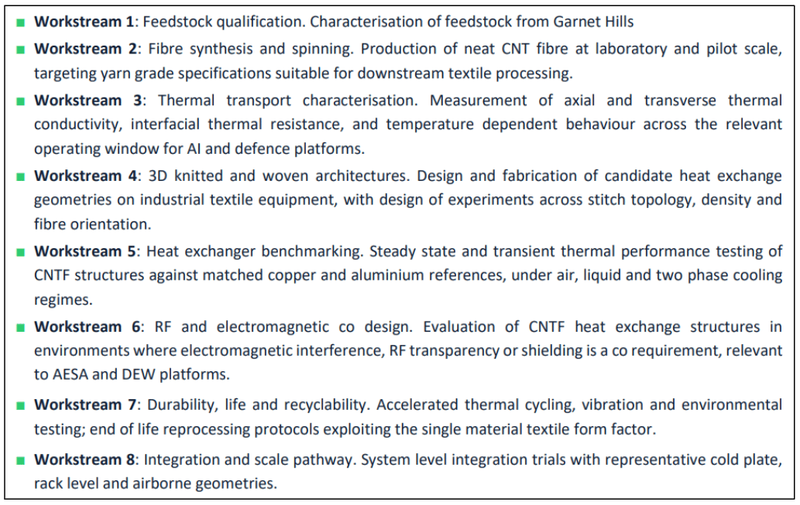
PR1 has now defined 8 different workstreams that are the highest priority for the company as follows:
(source)
After today’s announcement the three specific milestones we are looking out for over the coming months will be:
- ✅ Conductivity proof point delivered
- 🔲 Weight efficiency data release
- 🔲 Thermal anisotropy data release
- 🔲 System-level heat performance test results
We think the system-level heat performance test results could be what attract industry attention. At which point we would like to see one of the following:
- 🔲 Industry-relevant prototype demonstration
- 🔲 Joint development agreement with a named end-user
PR1’s funding strategy
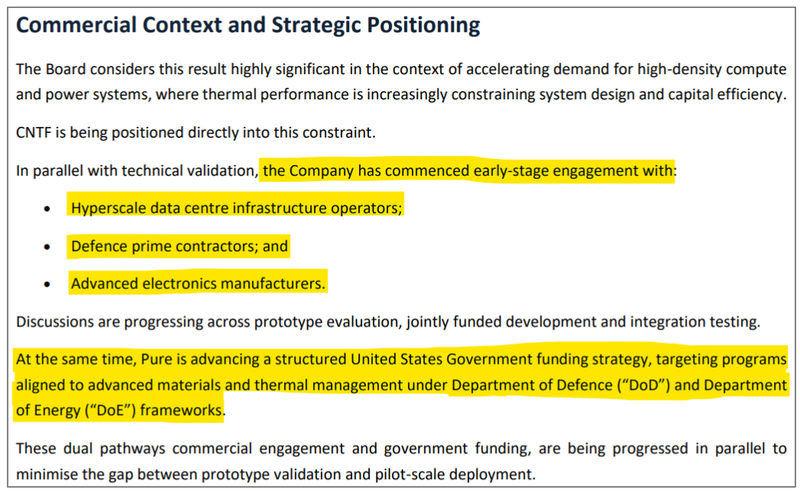
PR1’s explicitly said it's “advancing a structured United States Government funding strategy, targeting programs aligned to advanced materials and thermal management under Department of Defence (“DoD”) and Department of Energy (“DoE”) frameworks.”
(source)
There are also mentions of end-user engagement discussions, so should either of these sides come through (ideally both), then PR1 would have access to real world settings to test and develop the technology and funding to progress the technology much further.
Here are the types of funding deals we would love to see:
- 🔄 US Department of Defence (DoD) funding
- 🔄 US Department of Energy (DoE) funding
- 🔄 Hyperscale data centre operators
- 🔄 Defence prime contractors
- 🔄 Advanced electronics manufacturers
What could go wrong?
The two key risks in the short/medium term are “R&D risk” and “commercialisation risk”.
There is no guarantee that the R&D work PR1 does results in any positive data.
So there is always a risk the R&D program fails to deliver anything of commercial value.
There is also no guarantees that any of the R&D work results in any IP developed that is owned by PR1.
The terms of the R&D agreement with Rice University is that PR1 gets IP ownership on anything invented jointly.
There is no guarantees that occurs and in that case PR1 would have nothing to show for its R&D work.
Technology / R&D risk
PR1's research agreement with Rice University is early-stage R&D.
There is no guarantee that the collaboration leads to a commercial product.
Many research partnerships do not result in commercially viable outcomes.
Carbon nanotube fibre thermal management products are mostly in the “lab-demonstrated” but not yet commercially ready stage for PR1’s specific use case.
The gap between laboratory-scale and commercial-scale is real and has killed many promising technologies.
Source: “What could go wrong” - PR1 Investment Memo 31 March 2026
Other Risks
Like any small-cap technology company, PR1 carries significant risk, here we aim to identify a few more risks.
The jump from lab-based R&D to industrial-scale manufacturing is often where early-stage tech companies stumble. There is no guarantee PR1 will be able to achieve this.
PR1 is operating in a capital-intensive field and will likely require further funding rounds to reach commercial maturity.
Future capital raises are a common feature of small-cap life and can result in shareholder dilution if the company cannot secure non-dilutive funding or strategic partnerships.
The sales and integration cycles for the defence and high-performance computing sectors are notoriously long and complex.
Gaining the necessary certifications to replace established materials like copper in mission-critical hardware could take much longer than investors anticipate.
The company’s heavy reliance on the Rice University partnership and its key professors creates a level of key-person risk.
Should the collaboration face challenges or the joint IP ownership become complicated, it could significantly impact PR1's ability to commercialise the technology.
Investors should consider these risks carefully and seek professional advice tailored to their personal circumstances before investing.
Our PR1 Investment Memo
Our PR1 Investment Memo sets out our full thesis:
- What PR1 does
- The macro theme for PR1
- Our PR1 Big Bet
- What we want to see PR1 achieve
- Why we are Invested in PR1
- The key risks to our Investment Thesis
- Our Investment Plan
General Information Only
This material has been prepared by StocksDigital. StocksDigital is an authorised representative (CAR 000433913) of 62 Consulting Pty Limited (ABN 88 664 809 303) (AFSL 548573).
This material is general advice only and is not an offer for the purchase or sale of any financial product or service. The material is not intended to provide you with personal financial or tax advice and does not take into account your personal objectives, financial situation or needs. Although we believe that the material is correct, no warranty of accuracy, reliability or completeness is given, except for liability under statute which cannot be excluded. Please note that past performance may not be indicative of future performance and that no guarantee of performance, the return of capital or a particular rate of return is given by 62C, StocksDigital, any of their related body corporates or any other person. To the maximum extent possible, 62C, StocksDigital, their related body corporates or any other person do not accept any liability for any statement in this material.
Conflicts of Interest Notice
S3 and its associated entities may hold investments in companies featured in its articles, including through being paid in the securities of the companies we provide commentary on. We disclose the securities held in relation to a particular company that we provide commentary on. Refer to our Disclosure Policy for information on our self-imposed trading blackouts, hold conditions and de-risking (sell conditions) which seek to mitigate against any potential conflicts of interest.
Publication Notice and Disclaimer
The information contained in this article is current as at the publication date. At the time of publishing, the information contained in this article is based on sources which are available in the public domain that we consider to be reliable, and our own analysis of those sources. The views of the author may not reflect the views of the AFSL holder. Any decision by you to purchase securities in the companies featured in this article should be done so after you have sought your own independent professional advice regarding this information and made your own inquiries as to the validity of any information in this article.
Any forward-looking statements contained in this article are not guarantees or predictions of future performance, and involve known and unknown risks, uncertainties and other factors, many of which are beyond our control, and which may cause actual results or performance of companies featured to differ materially from those expressed in the statements contained in this article. S3 cannot and does not give any assurance that the results or performance expressed or implied by any forward-looking statements contained in this article will actually occur and readers are cautioned not to put undue reliance on forward-looking statements.
This article may include references to our past investing performance. Past performance is not a reliable indicator of our future investing performance.