The robot in my house convinced me we're at the start of an everything boom
Published 09-MAY-2026 15:53 P.M.
|
12 minute read
Disclosure: S3 Consortium Pty Ltd and its associated entities may hold direct or indirect interests in securities referred to in this publication and may receive fees or other forms of consideration from entities mentioned. These interests and arrangements may create a potential conflict of interest in the preparation of this material.
The information contained in this communication is provided for general information purposes only and may relate to speculative investments. It does not constitute financial product advice, and has been prepared without taking into account your personal objectives, financial situation or needs. You should consider obtaining independent financial advice before making any investment decision.
Any forward-looking statements are uncertain and not a guaranteed outcome.
How did an AI robot living in my house for the last few months convince me that we are entering an all-commodity supercycle?
A boom that will drive up nearly every resource stock?
Back in January I wrote:
I’ve been going deep on autonomous AI robots because we reckon this will be the next major investment thematic to drive interest, demand and most importantly, speculation into the metals needed to build billions of robots...
Part of the research involved visiting a shop (while in Singapore last week) that is already selling autonomous, humanoid AI robots.
(yep, companies and warehouses can buy these robots RIGHT NOW and put them to work...)
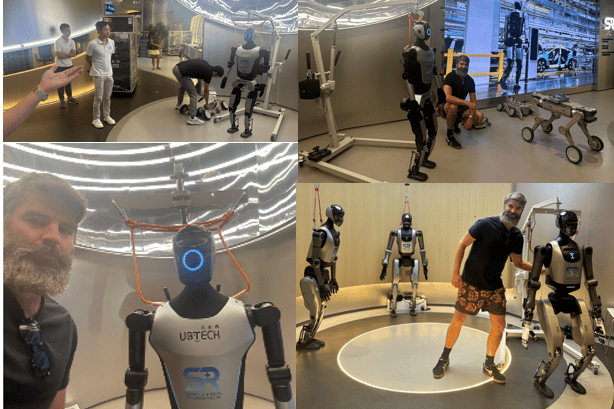
(Anyone who has seen a robot movie knows it’s all fun and games until that blue circle turns red...)
Coincidentally, these robots are from the same Chinese robot company UBTECH that released this video announcing the “First Mass Delivery of Humanoid Robots” a few weeks ago:
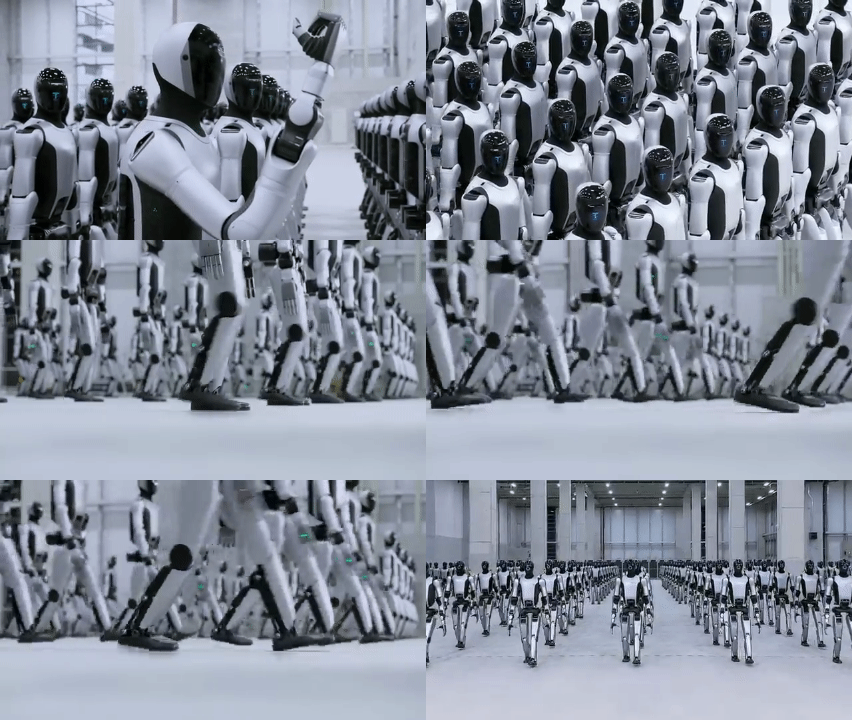
So it was surprising to see that they are already available for anyone to buy in a reseller all the way over in Singapore...
So naturally while I was there - I purchased a robot.
And this robot has been living in my house for the last few months.
Okay, I’m certainly not shelling out $100k plus for a buggy, first-gen, human sized AI humanoid robot like the ones in the photos above...
BUT...
In the interest of my ongoing robot investment thematic due diligence, I did get this UGOT 7-in-1 AI powered robot kit that was around $1,000 from Chinese robot maker UBTech.
Also “honey, the main reason is so our little guy can learn about robotics and AI, I swear”
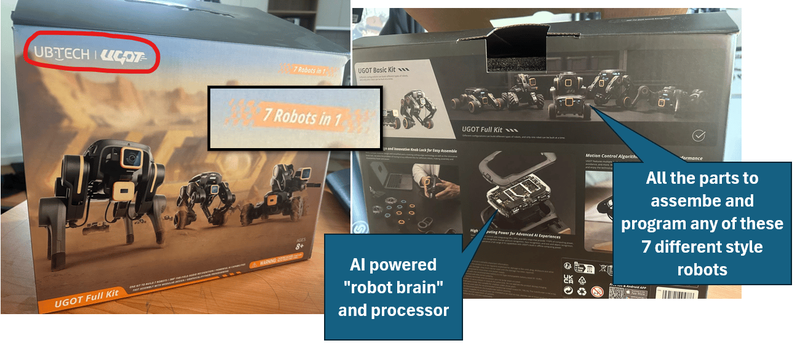
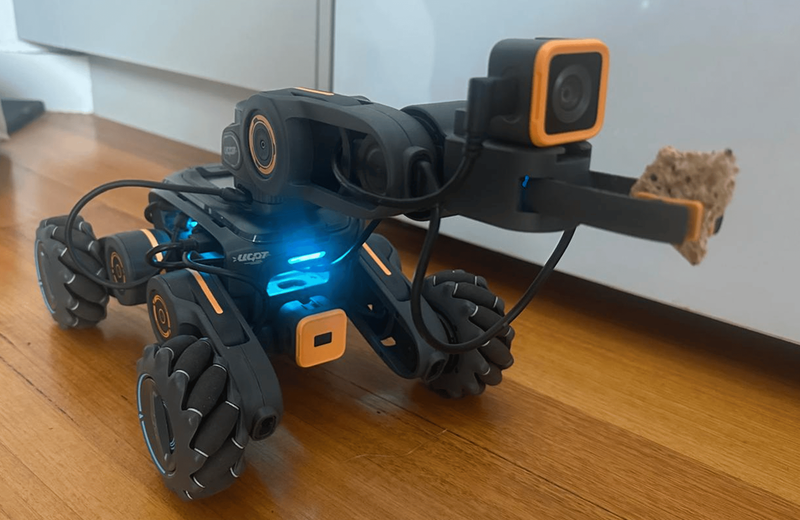
Currently I have it built in wheeled, claw-arm format:
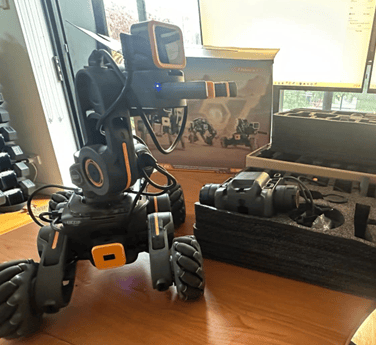
You basically control the robot through an app on your phone - you can see what it sees through its camera eyes, on your phone.
It can drive around and pick stuff up with its camera enabled robot arm-claw thing.
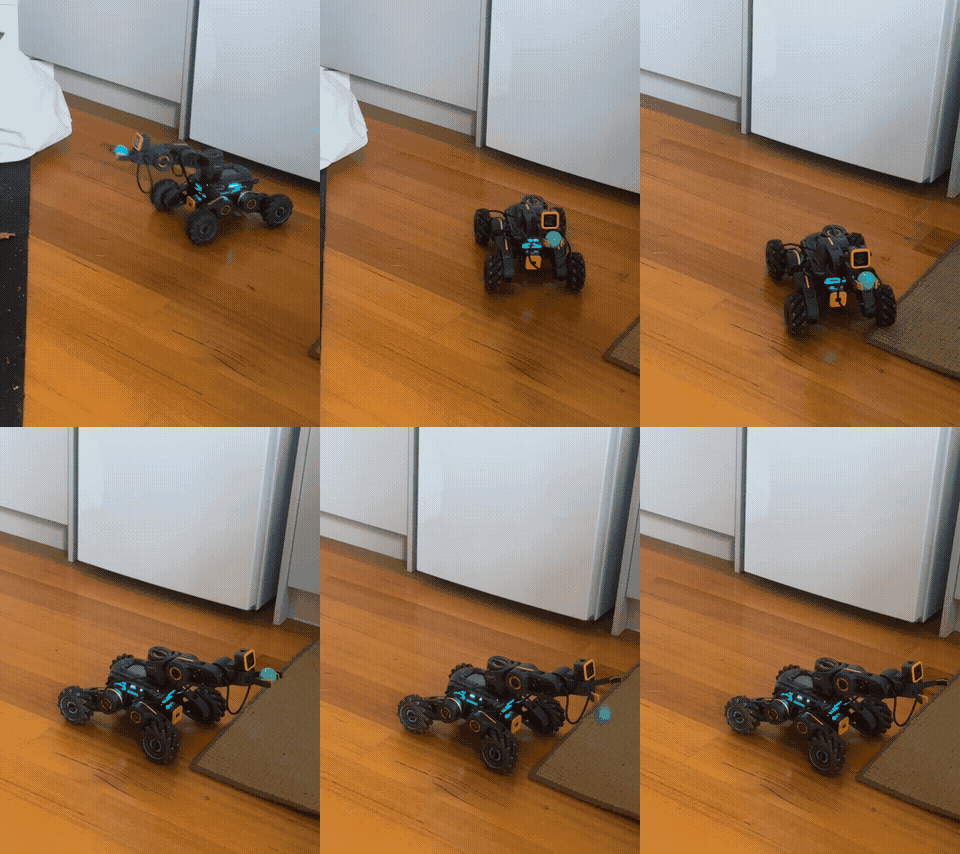
You can also program it automatically to do all sorts of stuff based on what it “sees”.
Not even coding, it’s surprisingly easy.
Its “camera eyes” plus its AI robot brain can detect AND track humans (and dogs)...
Here what the robot sees: orange box = “human detected!”:

AND it can also recognise faces... AND perform specific actions IF it sees a face, or even a type of face?
Using a very simple programming interface that a kid can use - here you can say IF human or face detected THEN do a thing:
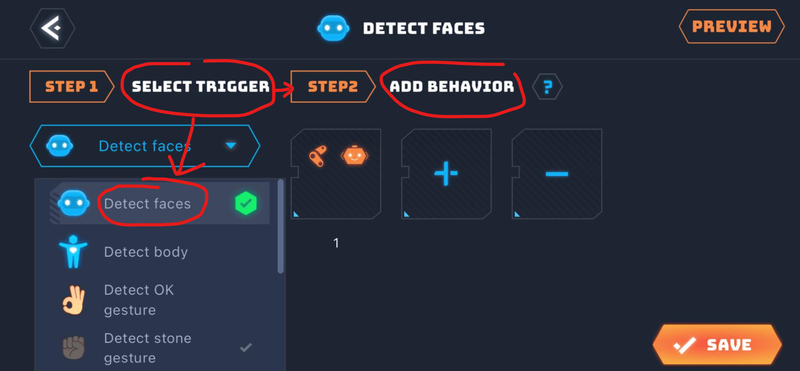
Right now I have set it so that if it sees my wife at home, it makes some beeping noises and waves with its claw-arm.
My kid insisted that when it sees him it must spin around on the spot making a fart sound - sigh, ok fine.
(and THIS is why urgently we need more data centres)
It can also identify and follow my dog to give it a dog treat...

Here’s what it looks like from the robots point of view:
(how’s that green “dog target acquired and locked” box)

How fun, right?
Naturally, the first thing I thought was how can we use it for home defence?
Give it a knife.
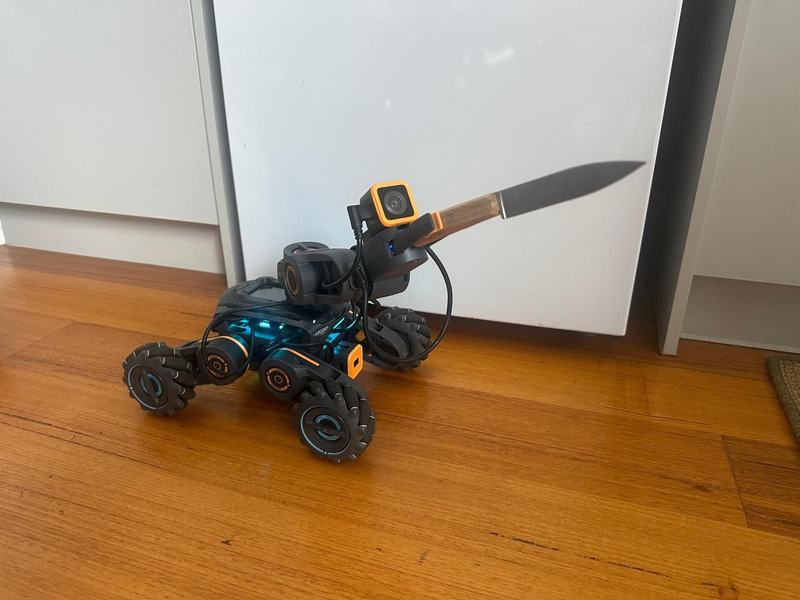
Here’s the basic code:
IF 3am AND human detected in house AND NOT (me, wife, kid, dog #1 or dog #2) THEN lock in target, follow... and get stabby.
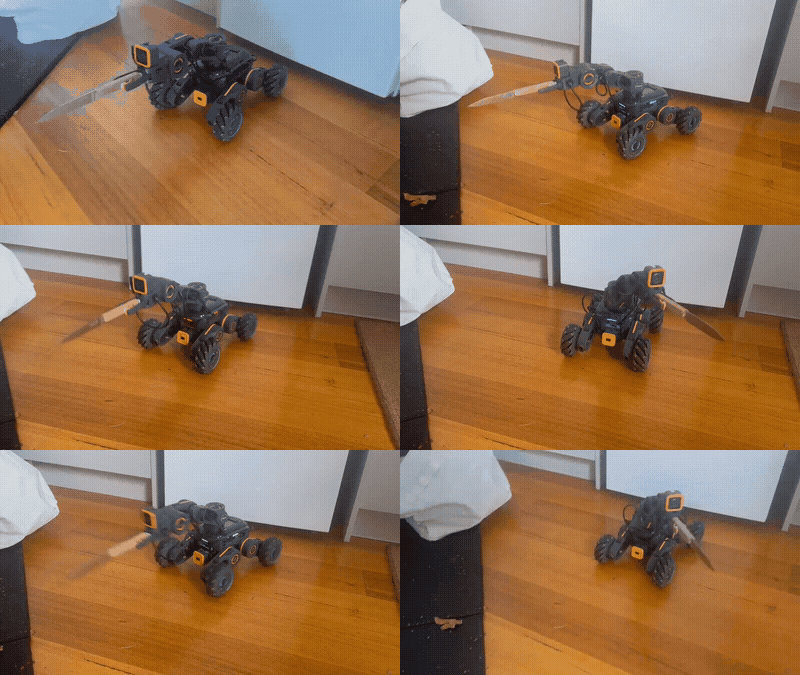
(just kidding AFP and ASIC)
The point is, I was surprised at how simple it is to get to this point with my ultra-basic home robot.
(which is really designed for kids to learn about robotics, programming and AI)
Now, here’s where it gets terrifying...
(Aside from me and my family’s faces now being robot recognisable and stored in some sort of Chinese AI robot database somewhere...)
Now imagine instead if this thing weighed 200kg and had a machine gun.
And there were 500 of them...
And instead of me programming it to identify and track my dog to give it a dog treat...
Some “government du jour” in a backwater country programs them to find and identify a particular out-of-favour ethnic group of people for a bit of “no-questions-asked AI driven autonomous ethnic cleansing”...
That's a worst case scenario.
As with all new technologies they are used for good or bad.
Use cases aside, this basic robot feels like my first ever iPhone, while it blew my mind ~15 years ago, by today's iPhone standards it belongs in a museum.
But from what I have seen so far with just this early and basic programmable robot with an AI robot brain, the potential of robots in the home is endless.
And I am sure business leaders around the world are coming to similar conclusions for AI robots in companies...
...and military leaders for battle bots too.
I can now see why billions of robots are forecast to be built over the coming years for home, business and military uses.
Every single one of these robots needs metals.
Copper for motors and wiring. Nickel and cobalt for batteries. Rare earths for the motors and sensors. Aluminium and titanium for frames. Lithium for energy storage.
And whether it's a house robot deciding how to track a dog to give it a dog treat, or a dystopian robot deciding which weapon to shoot you in the face with, every robot will need to make decisions...
And to make decisions, robots need an AI-powered brain.
Which just compounds the current hyperscale AI and AI data centre build-out.
(Imagine the compute needed when billions of robots and their AI robot brains start draining data centre capacity)
We think the AI and robotics buildout could be the biggest physical CAPEX event in human history.
Bigger than railroads, bigger than electrification, bigger than China industrialising.
Possibly bigger than all of them combined.
Meaning an incoming “every commodity” boom.
(which should be good for nearly every resource stock)
We have been talking about the three engines we think are driving the coming commodities super cycle:
- The dollar being sick (debasement from endless money printing. printing to fund more and more debt )
- The world becoming multi-polar (resource nationalism, supply-chain sorting)
- AI, robots, military and the grid to power it all (the big global buildout). And then
Here is how three major global buildouts are driving an "every commodity" boom...
Major US tech companies have said they are spending these amounts on the AI buildout:
- Microsoft: ~US$190 billion in 2026 capex
- Google: ~US$185 billion
- Meta: ~US$135 billion
- Amazon: ~US$200 billion
- Plus OpenAI's Stargate: US$500 billion across four years.
- Plus Anthropic's recent US$100 billion+ AWS deal over 10 years.
Combined that is over a trillion $ committed with roughly half going straight into AI infrastructure.
This week, tech billionaire Chamath Palihapitiya went on Joe Rogan (multi-millions of viewers) and said:
The AI capex boom is "completely underestimated" by markets - that the actual scale of what's being committed is well beyond what most market participants are pricing in.
So he is saying trillion+ dollars is “completely underestimated”...
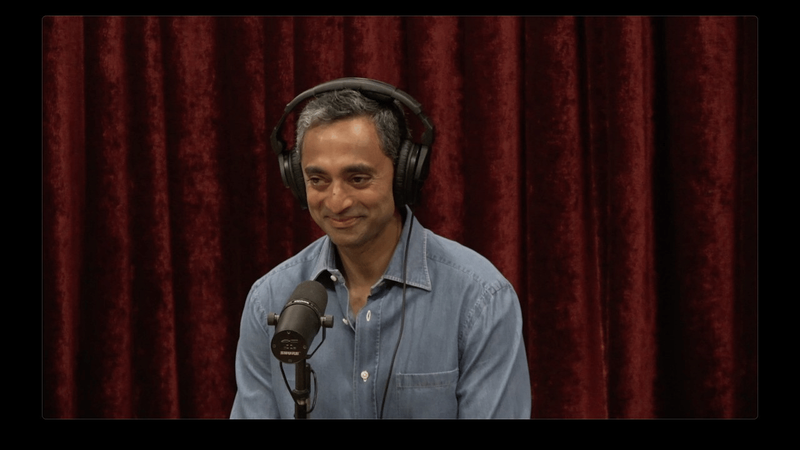
Joe Rogan Experience #2494 - Chamath Palihapitiya
Last week we wrote that "commodities had woken up" and that we were 5 years into what looks structurally like a commodities super cycle.
We think Chamath's comments support our thesis.
The chokepoint for AI and robotics isn't going to be the chips.
It's the metals and minerals to build everything, and then the energy to power it.
Anyone remember that McKinsey image we kept writing about during the electric vehicles battery metals boom back in 2020 to mid 2022 (RIP)?
Where McKinsey listed all the metals critical for the EV buildout and electrification?
Here’s a blast from the past:
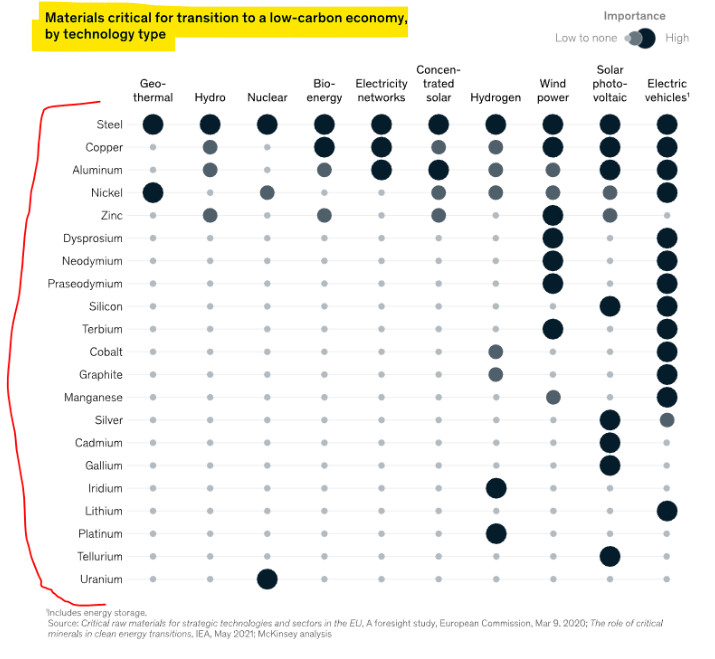
A few months ago we said that “robot metals” are broadly the same as “electric vehicle metals”.

Except the robot build out will be magnitudes bigger, and without a long standing, well adopted like-for-like substitute (ie the petrol car slowing EV adoption).
Below are the two images we will probably write about over and over again over the next few years.
FIRST: After calling the 2020-2022 electrification boom metals early, McKinsey is back this week showing the key components to deliver the giant global robot buildout:
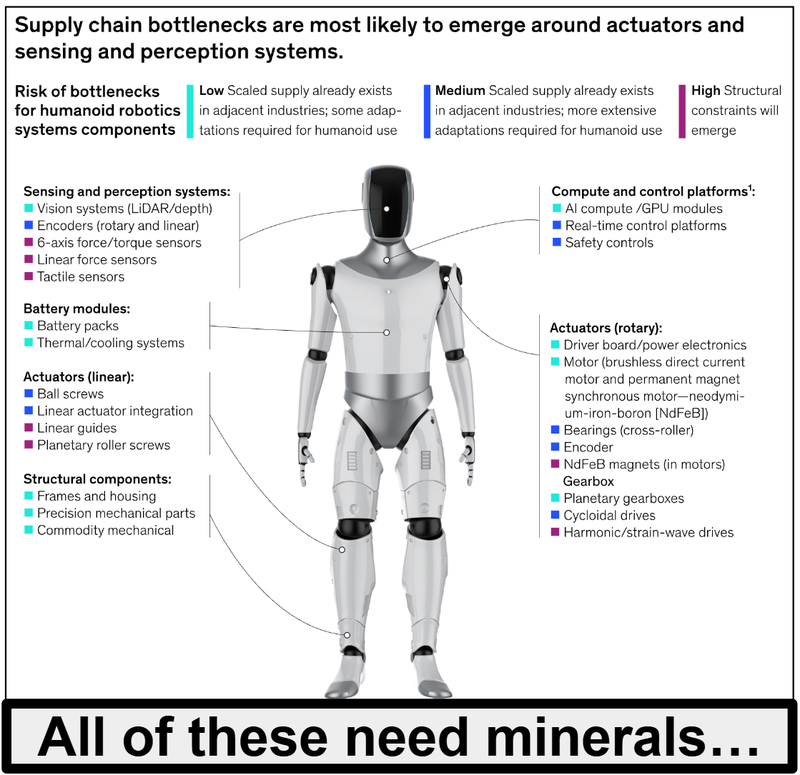
(source - McKinsey - Turning humanoid supply chain constraints into billion-dollar wins )
We have a note coming soon on the specific metals and materials into these components... stay tuned.
For now, here are the Robot metals stocks we are Invested in:
- CAY - Bauxite (aluminium feedstock) in Cameroon.
- ION - Critical minerals recycling for Li, Ni, Co and more, based out of South Australia.
- NC1 - Nickel and cobalt in Western Australia.
- AW1 - Copper in Nunavut, Canada + Utah.
- LKY - Antimony + rare earths in California.
- LSR - Copper, gold, rare earths across WA, Arizona, Chile.
- MAN - Lithium brine in Utah.
- OD6 - Fluorspar + rare earths + in Nevada and WA.
- PNN - Rare earths + niobium and Lithium brine in Brazil and Argentina.
- SGQ - Rare earths + niobium in Brazil.
- TG1 - Copper and gold in WA.
- TTM - Gold and copper in Ecuador.
- VKA - Tungsten in Nevada.
SECOND: Below are all the critical metals needed to build AI semiconductors AND the AI data centres needed to run them:
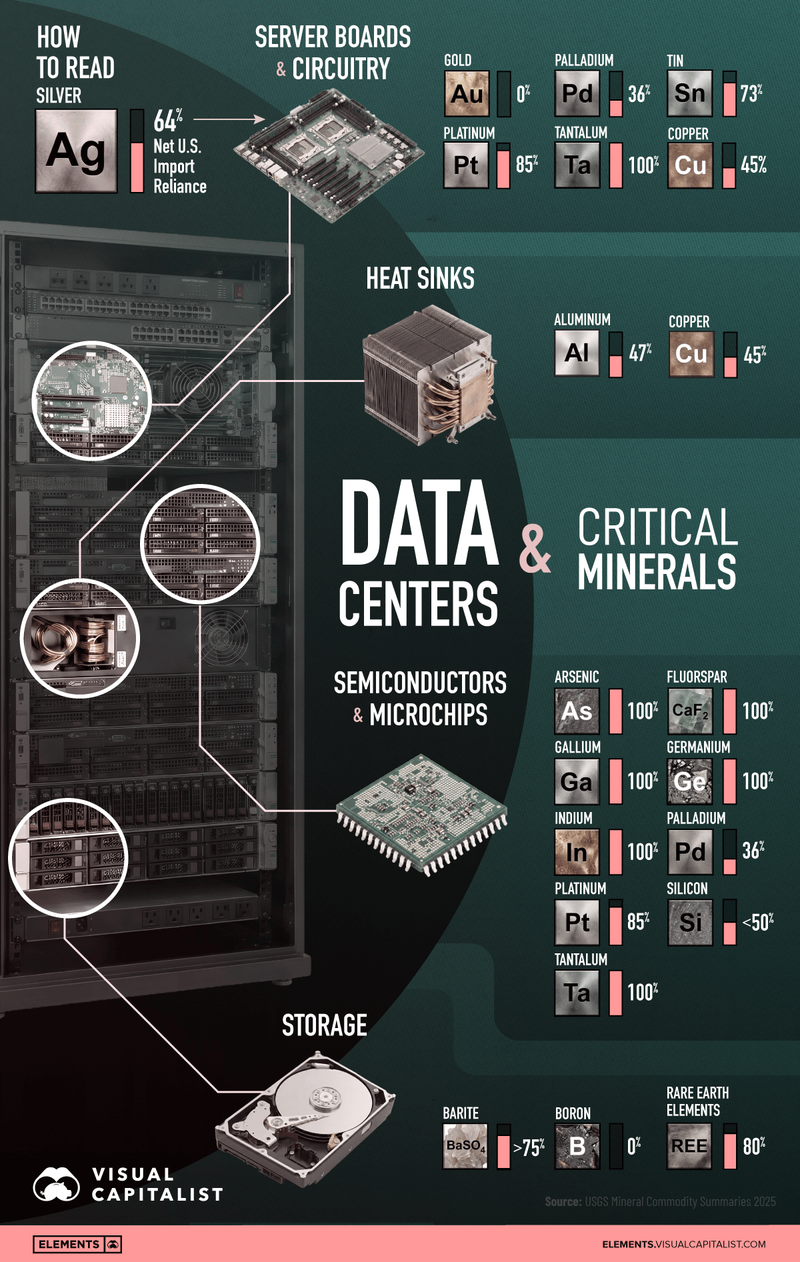
(source)
The basic idea is that existing producers of these metals will get cashed up as commodity prices surge.
Company cash piles grow as mineral reserves deplete.
The next logical step is to acquire a pre-development project to replace depleting reserves.
Here is a list of “AI and AI data centre” minerals companies we are Invested in:
- SGQ - Rare earths in Brazil.
- CAY - Bauxite (Aluminium) in Cameroon.
- TTM - Copper in Ecuador (projects include gold).
- LKY - Antimony and rare earths in California.
- AW1 - Indium & gallium in Utah, copper in Canada.
- PNN - Rare earths & gallium in Brazil (plus lithium in Argentina).
- OD6 - Fluorspar in Nevada (plus rare earths in Western Australia).
- NC1 - Nickel in Western Australia.
- ION - Critical minerals recycling & a rare earths deal in the USA.
- TG1 - Copper in Western Australia (projects include gold and other metals).
- LSR - Copper in Chile plus heavy rare earths in Arizona
Critical Minerals + energy demand = commodity supercycle?
We think once the hyperscalers and manufacturers are funded and start to scale, it's the raw materials and energy that will cause the bottlenecks, driving up commodity prices.
(ie: you can print money, but you can’t print commodities)
Layer 1: We are going to need A LOT more critical metals/minerals AND innovation in materials science to build everything we need to power this robotics/AI build out.
That is the first structural bottleneck.
Layer 2: We are going to need a lot more energy to power everything we build and if we rely on the grid to expand to carry all of that energy around, the buildout won't happen...
That is the second structural bottleneck.
So Critical minerals and energy.
An all commodities boom?
Coming back to that Joe Rogan - Chamath podcast he frames the global AI race now in terms a country needs five things to win the AI race:
- Money (capital to build and run the infrastructure)
- Data (training and inference inputs)
- Critical metals (the physical bill of materials)
- Advanced chips (to do the compute)
- Power (electricity to feed the compute)
Critical minerals and electricity are right there.
How about substituting scarce critical metals with specialty materials?
Our most recent Investment that is directly working on AI, robotics and military materials is Pure Resources (ASX:PR1).
PR1 is developing heat sink technology using carbon nanotube fibres which have a thermal conductivity that could potentially be around ~15x copper. (source)
This tech has applications in thermal management (cooling) for AI data centres, robotics and advanced weapon systems.
(a lighter weight, more conductive replacement for copper/aluminum - handy in a tight copper market)
Initial testing has shown that “Carbon Nanotube Fibre’s (CNTF) had thermal conductivity ~1.5x more than copper AND ~2.5-3x more than aluminium" (source)
Those numbers were from the first of four planned data releases from the PR1 / Rice University R&D collaboration.
PR1 has a collaboration agreement with Rice University to take carbon nanotube fibres and apply it to thermal management for advanced electronics.
Carbon Nanotube Fibre’s are also ~80% lighter...
(perfect for thermal management in tight, compact places)
Higher thermal conductivity = higher cooling capacity.
So that’s where thermal interface materials (TIMs) and heat sinks matter.
AND where PR1 is focusing with its collaboration deal with Rice University - Read our latest PR1 update here
USA looking at critical mineral stocks on the ASX?
This one is more broad based, and probably applies to most of the portfolios of anyone reading this email.
(especially if you have commodities/critical minerals exposures you are invested in).
The US has the capital and the demand.
It does not have the entrepreneurial, early stage mining base.
The ASX, on the other hand, has been the Silicon Valley of mining for decades.
See our weekender on this here: ASX Miners Catching US Attention
More small-cap explorers per capita than any other exchange.
Faster fundraising cycles.
Higher tolerance for early-stage risk capital.
A regulatory regime that lets new projects move from JORC resource to maiden drilling inside a year if the news flow cooperates.
Which is everything the US (and the broader West) needs right now but has none of...
US capital is starting to flow into the ASX mining space in a serious way.
We had AI summarise all of the USA <> ASX resources deals that have happened over the last ~24 months - it listed 31 deals:

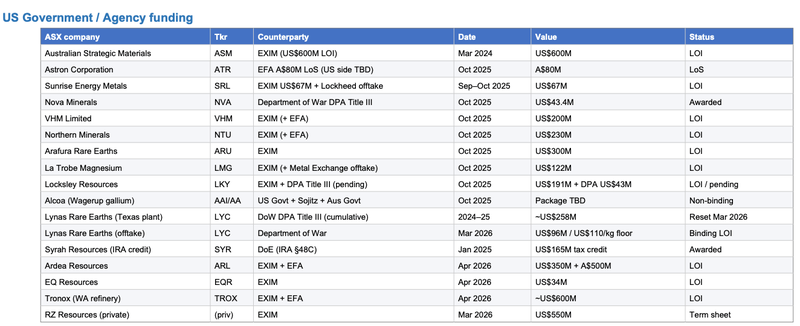
But the bigger relative moves we think will happen when the capital starts moving down into the ambitious explorers and developers with projects of interest to the US.
(of which we have a fair few and listed earlier)
More broadly this is the "big green NVIDIA ball" thesis we keep referencing.
NVIDIA's market cap alone is bigger than the entire top 50 mining companies on the planet combined.
The dollars sitting in the green ball are indicative of how much capital is currently parked in companies that build AI - versus how little is parked in companies that supply the inputs to build AI.
We think that gap is what's about to compress - the all commodities boom.
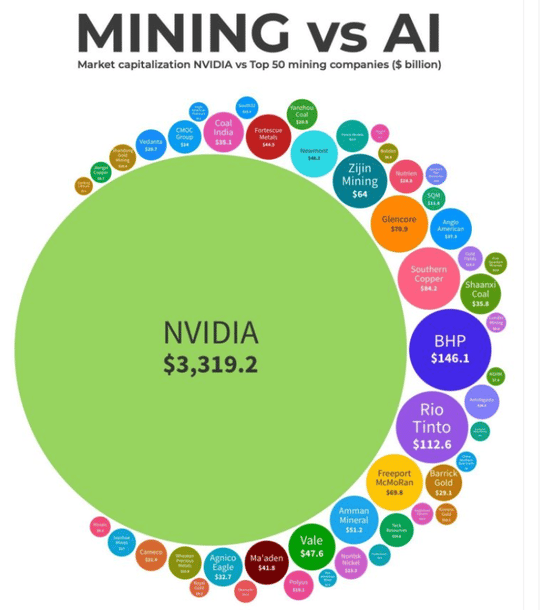
(Source, Mining.com October 28, 2024)
See you next week, and have a great weekend
Next Investors
Did someone forward this to you? Subscribe Here
General Information Only
This material has been prepared by StocksDigital. StocksDigital is an authorised representative (CAR 000433913) of 62 Consulting Pty Limited (ABN 88 664 809 303) (AFSL 548573).
This material is general advice only and is not an offer for the purchase or sale of any financial product or service. The material is not intended to provide you with personal financial or tax advice and does not take into account your personal objectives, financial situation or needs. Although we believe that the material is correct, no warranty of accuracy, reliability or completeness is given, except for liability under statute which cannot be excluded. Please note that past performance may not be indicative of future performance and that no guarantee of performance, the return of capital or a particular rate of return is given by 62C, StocksDigital, any of their related body corporates or any other person. To the maximum extent possible, 62C, StocksDigital, their related body corporates or any other person do not accept any liability for any statement in this material.
Conflicts of Interest Notice
S3 and its associated entities may hold investments in companies featured in its articles, including through being paid in the securities of the companies we provide commentary on. We disclose the securities held in relation to a particular company that we provide commentary on. Refer to our Disclosure Policy for information on our self-imposed trading blackouts, hold conditions and de-risking (sell conditions) which seek to mitigate against any potential conflicts of interest.
Publication Notice and Disclaimer
The information contained in this article is current as at the publication date. At the time of publishing, the information contained in this article is based on sources which are available in the public domain that we consider to be reliable, and our own analysis of those sources. The views of the author may not reflect the views of the AFSL holder. Any decision by you to purchase securities in the companies featured in this article should be done so after you have sought your own independent professional advice regarding this information and made your own inquiries as to the validity of any information in this article.
Any forward-looking statements contained in this article are not guarantees or predictions of future performance, and involve known and unknown risks, uncertainties and other factors, many of which are beyond our control, and which may cause actual results or performance of companies featured to differ materially from those expressed in the statements contained in this article. S3 cannot and does not give any assurance that the results or performance expressed or implied by any forward-looking statements contained in this article will actually occur and readers are cautioned not to put undue reliance on forward-looking statements.
This article may include references to our past investing performance. Past performance is not a reliable indicator of our future investing performance.