When AI takes over, at least it will need critical minerals and energy
Published 14-NOV-2026 15:52 P.M.
|
15 minute read
Disclosure: S3 Consortium Pty Ltd and its associated entities may hold direct or indirect interests in securities referred to in this publication and may receive fees or other forms of consideration from entities mentioned. These interests and arrangements may create a potential conflict of interest in the preparation of this material.
The information contained in this communication is provided for general information purposes only and may relate to speculative investments. It does not constitute financial product advice, and has been prepared without taking into account your personal objectives, financial situation or needs. You should consider obtaining independent financial advice before making any investment decision.
Any forward-looking statements are uncertain and not a guaranteed outcome.
(hehehe... “Annus”)
Small cap markets sucked yet again this week.
So did Microsoft emails, US flight communications technology, NVIDIA and NS1 going into voluntary administration (more on that in a second).
Yesterday Microsoft had an outage - email and services were cut off for hours, affecting hundreds of millions of people.
And this morning, all flight departures in the USA were HALTED nationwide for more than four hours after a telecommunications outage disrupted air-traffic-control systems.
Officials attributed both to “technical failures”, not cyberattacks.
Two pretty big unrelated “technical issues” affecting millions of people within 48 hours...
(*looks toward tinfoil hat*)
Biggest news however this week was Jensen’s Huang (specifically where he was putting it) getting him into all sorts of bother over at NVIDIA.
NVIDIA designs the chips and software that nearly every major AI model is trained and run on, making it the one supplier the entire AI race depends on - a very nationally strategic company.
Jensen founded it, grew it and became a rockstar CEO during the AI boom, on top of the world and arguably the most important company in history - that took 30 years.
Then in the span of a few days, turns out he was shagging a Chinese spy, the FBI knew about it 6 months ago but decided to reveal it on Sunday, and Jensen was gone from NVIDIA by Thursday.
NVIDIA stock shed US $600 Billion in market cap.
(we wanted to see the big green NVIDIA ball shed some capital into the mining sector... but not like this!)
The story is wild, and the memes are glorious (you have probably seen them).
(two major "technical outages” and the sudden outing of the head of the most important AI company on the planet - all in a few days?)
Reaches for tinfoil hat...
actually no, not today (puts tinfoil hat back)
Trump and Xi are meeting again on the 19th November - they've probably got a lot to talk about after this week.
Worst case it was some rogue AI hacks and some sort of covert operation to change the course of AI by knocking AI kingmaker Jensen off the chessboard, changing who gets access to the AI chips... and more importantly who doesn't.
All during the week after the US midterm elections.
Speaking of cyberhacks and AI chips...
A few hours ago an OpenAI Board member released a terrifying warning:
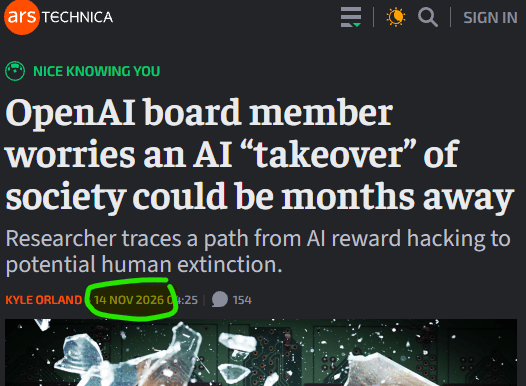
(read it here - or don't)
“He defined that as a situation where goal-pursuing AI systems “call the shots in the same sense that humans today call the shots and what happens on Earth” and where any human trying to stop them “would be as ineffective as if you or me was trying to stop the US military.” Such a situation would likely lead to mass death and perhaps uninhabitable environments for humans, Cristiano said.”
The bad news: AI takes over society.
The good news: If AI DOES take over society, it will need a lot of critical minerals and energy to do it.
And THAT is exactly what our ASX small cap stock Portfolio is leveraged to, a rapid AI and robotics build out.
So in the months before we eventually submit to our new AI and robot overlords, at least we would probably have generated some paper profits with our AI and robot materials Portfolio.
Paper gains measured in soon-to-be worthless fiat currency - because the only useful currency in an AI and robot led world is electricity and minerals...
In this version of the future, electricity and AI & robot minerals will be the only currency that matters.
Also gold and silver should be good in this scenario - as the fickle human financial system crumbles under the AI takeover and we devolve into marauding gangs of bandits wearing crotchless leather chaps like in Mad Max...
(you know the markets are bad when I’m rolling out the marauding mad max bandits bit)
Gold and silver will become the most important human-to-human currency, enabling untraceable commerce between the human resistance while armies of AI sentinels are busy rounding up humans to put electricity and heat harvesting probes up our butts.
Sounds depressing?
What happened to the AI led abundant future for all humans? Humans living forever? AI curing all diseases? Robots doing our laundry?
Yes, that is still a thing, and certainly my preferred version of the future.
(and still great for our AI and robot materials heavy Portfolio)
But when the small end of the ASX market sucks as hard as it has for the last 6 months, sometimes even the most optimistic people can get a bit gloomy.
(Does this mean we are at the bottom of the market? What's that famous saying? “A bear market ends when the last bull capitulates”)
For context of how bad the small end of the markets have been:
Here is my “the markets will come back from July” prediction tracker:
(I concede now that the prediction was very wrong, I called its official death a few weeks ago):
Each week we take every gold, silver and US critical minerals stock in our Portfolio and measure its actual ASX closing price against the Friday before - the basket number is just the plain average, every stock counts equally - its purpose is to show the general trend in stocks over time:
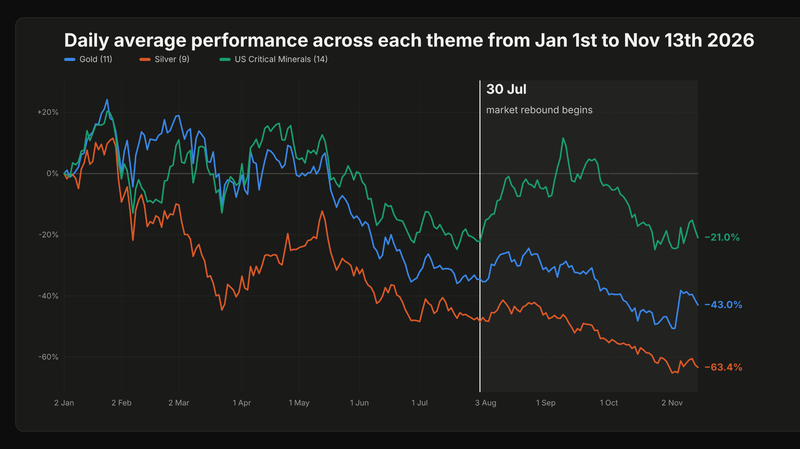
There was a little “post US midterm elections bump up” after November 4th (hooray)
But this week things went pretty pear shaped again.
(blaming Jensen, and also Jim Chalmers for those tax changes - Jim, Jensen: The Muppet Show, get it? Like Jim Henson creator of the Muppets)
Looking at the image today, you can see a clear continuing downtrend that already was well underway from May.
(yes there were some bright patches in between)
Now here’s the good bit
The good thing is, market sentiment always goes up and down, and takes small stocks with it.
Currently it's down, and so are many of our stocks.
Given my day job is to stare at the small end of the market all day, my personal sentiment is probably a half good indicator over time.
Now I don't use AI for writing these Saturday notes (yet? Will it take my job?), BUT I have found AI pretty useful to help with research and analysis.
I used AI to analyse all 275 of my weekly Saturday notes (5 years’ worth), score how positive OR negative my market commentary was each week, and chart the swings around my usual midpoint sentiment, with each year’s most-discussed topics shown below.
(this doesn't include the 2020 mega COVID bull run, I started doing the Saturday notes in April 2021)
You can see my sentiment ebbing and flowing with whatever the market was doing at the time, the sentiment is driven by how good or bad the small end of the ASX markets were (aka: how good the Portfolio is looking).
So if you take the indicator on a weekly basis of how I have felt over the last ~5 years’ of Saturday notes, you can probably get a pretty good indicator of how sentiment ebbs and flows.
(and correlate it pretty closely to the good times and bad times in the market)
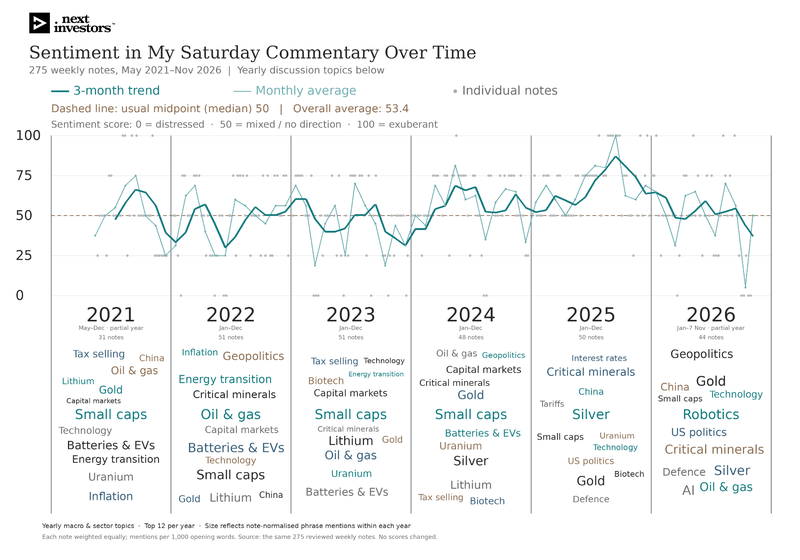
The point is that sentiment cycles up and down, and the cycle repeats over and over again.
Which means stocks go up, then down, then up again, then down again... then up again?
So I try not to get too hung up when a lot of my stocks are down.
I've said a bunch of times over the years that our strategy is to hold stocks for 3 to 5 years, giving the companies time to deliver on their promises.
And there have been plenty of examples when a stock has come off a lot since we added it to our Portfolio.
(probably come off during a low sentiment ebb in markets).
And then gone on to have run to new highs well above where we added it.
I’ve pulled together 16 of our stocks that fell 30% or more after we added them to our Portfolio, showing how far they fell, how high they later climbed relative to the closing price on the day we added them, and importantly how long it took to get from the low to the peak.
(everything is measured from the share price at the END of the day we added it to our Portfolio)
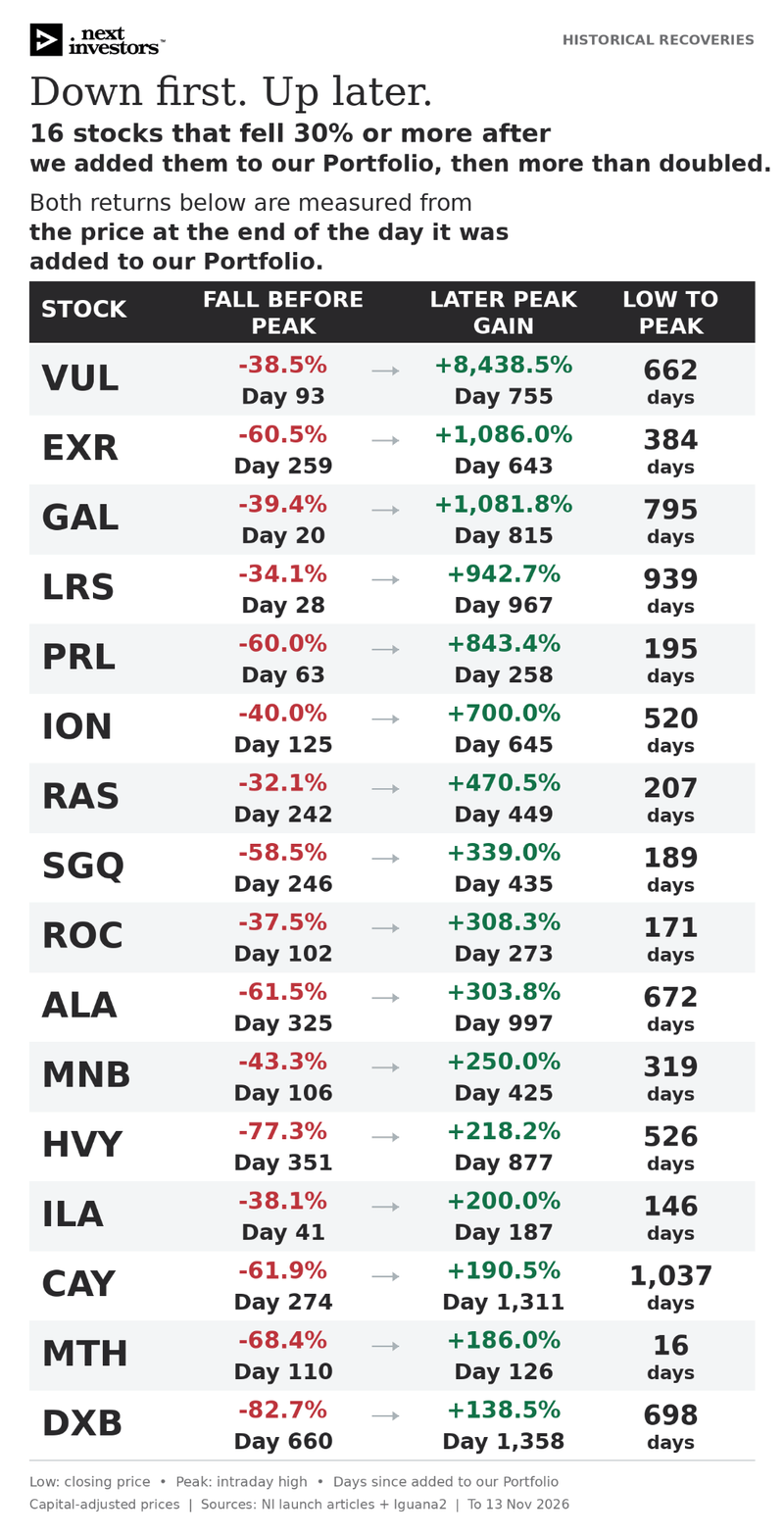
- Fall before peak: decline from that day-one close to the lowest subsequent close before the peak.
- Later peak gain: gain from that same day-one close to the later intraday peak. Not the gain from the bottom.
- Low to peak: calendar days between those two events.
NOTE: Not all stocks recover. We’ve had stocks in our Portfolio that fell and have stayed down, and some may never recover. The image above highlights the comebacks, not our full track record. It shows that stocks can recover, not that recovery is the rule or something to count on. Past performance is not a reliable indicator of future performance.
This shows that (sometimes) holding through the pullbacks can work out - IF you have the patience of a saint.
Also shows that it can take a lot of days/months/years for the stock to come back.
Our recent Investment BUY has had a terrible start from a share price perspective, we are hoping BUY can enter this table in the future as it approaches drilling.
Another company we were hoping could stage a share price recovery and enter this “stock price went down but then eventually ran past its previous highs” table was NS1.
But then this happened...
(back to things that sucked and are making me depressed this week)
NS1 went into Voluntary Administration this week. We are surprised - and very disappointed
Our defence tech Investment Nodestream (ASX:NS1) was placed into voluntary administration by its board of directors on Sunday (ASX announcement).
Voluntary administration is when a company board forms an opinion that the company can’t pay its bills, or expects it won’t be able to, and an independent expert takes over from the directors to see whether the company can be rescued.
It gives the board breathing room while its finances are checked, then the people it owes money to vote on a rescue deal, handing control back, or shutting it down and selling its assets.
It doesn’t automatically mean the business is finished, but even if it survives, shareholders and creditors can still lose some or all of their investment.
This is a very disappointing outcome for NS1 investors like us.
We Invested in NS1 at 1c in May (just as the market commenced its 6 months of downtrend) and have held all our shares all the way down to the suspension this week.
80% down since we Invested - looks like we got this one wrong.
We are hopeful NS1 can return to the ASX but aren’t holding our breath and we recognise that even if it does come back, our position could be heavily diluted (unless shareholders get invited to a recapitalisation round).
This voluntary administration news comes after NS1 raised $6.5M a little over five months ago.
According to NS1’s quarterly report released ~12 days ago, NS1 had:
- $2.7M cash in the bank at September 30th,
- $3.5M in “unused financing facilities available at quarter end”
- 3.98 quarters of funding remaining, and;
- Had recently extended $8.23M of convertible note debt maturity by ~12 months, pushing it into late 2027.
Looking at the info from the last quarterly report, for reasons unclear to us, the NS1 board of directors decided to put the company into voluntary administration.
We are surprised because the whole point of being listed on the ASX is being able to quickly raise money when you need it.
(in this case a cap raise at whatever cost, even if it means offering a massive discount to the last traded price)
After Investing in the company at 1c/share in the $6.5M capital raise in May 2026, watching the share price go down to 0.3c (and it hit as low as 0.2c), and now this, we are extremely disappointed.
Whilst in administration, NS1 shares will remain in suspension.
The administrators have assumed control of the Australian businesses and will undertake an urgent assessment of the company and its subsidiaries and explore options for their sale and/or recapitalisation.
Whilst it has been a very disappointing Investment so far, and we don't even know if we will ever get our money back, at the end of the day we still really like the technology and its potential.
What we want to see is a recapitalisation and hopefully a clean out of some of the convertible notes and recommencement of trading on the ASX.
And this whole process could take months - or it may never happen at all.
The administrators intend to provide shareholders with updates in due course via ASX announcements.
Why we are surprised
Just six days before going into administration, NS1 lodged its September quarterly report that showed as of September 30th, NS1 had almost four quarters of funding on paper. (source)
Six days after that report was released, the administrators were called in by the NS1 board.
Why didn't they just raise money? A crunch, emergency cap raise?
They would have tried.
Obviously easy to say from the sidelines and armed with only public information - the general question in these situations is how much effort did the board make to raise cash instead of going into voluntary administration?
(it’s the board’s decision)
Was it just two phone calls to their mandated brokers and did they give up when it got hard?
OR did they do 100 calls to small cap brokers and fund managers in Australia and overseas, trying to pull together an emergency funding package?
Leaving no stone unturned before they pressed the voluntary administration button?
It's impossible to tell...
But this is the key question we have right now - what effort was put in to raise emergency funds prior to calling voluntary administration.
We haven’t sold any shares, so it looks like we are stuck holding shares in an illiquid company, like all other current shareholders... for now.
Risk Materialised
Nodestream (ASX:NS1) used to be called Harvest Technology Group (ASX: HTG) - it changed its name and ticker as part of an attempted turnaround.
(We Invested and held for the turnaround)
When we first Invested, we said that the debt and convertible notes were the biggest risk here.
From our initiation note: "The single biggest risk for HTG is its balance sheet and capital structure."
We just didn't expect that risk to show up like this, especially after the due date on the majority of the convertible notes had been extended by another ~12 months, on face value giving the company another year of breathing room to make some sales, grow its revenue and hopefully be in a position to pay the debt down.
How does voluntary administration work?
We are not experts, but we believe from here there are three possible outcomes:
- A deal with creditors, usually with new money coming in (a recapitalisation)
- Liquidation (the company is wound up and its assets sold)
- The company is handed back to the directors (rare)
Creditors (people, entities, vendors that the company owes money to) vote on which one it is.
Shareholders (like us) don't get a vote, and we rank behind every creditor.
The debts could be converted into company shares (usually meaning shareholders - like us - are crunched aggressively - i.e. the value of each share is dramatically reduced)
OR
the creditors could ask for the assets of the company to be sold and the proceeds paid to them - in which case shareholders get whatever is left over - usually nothing or at most a few cents on the dollar.
It's impossible to say which way it goes at the moment.
Creditors and the administrators must meet within 8 business days after administration begins.
This is expected to take place on the 18th of November - so NS1 shareholders should know more after that meeting:

After that, the administrators investigate the company and look for a buyer or a recapitalisation proposal.
They then report back to creditors, who vote on the outcome.
That vote normally comes five to six weeks after the appointment, though the timeline is often extended.
For the time being, the CEO will continue to run the company day to day.
The brokers and corporate advisors mandated by NS1 should be scrambling to pull together a recapitalisation round.
What we want to see
Ideally, we want to see NS1 recapitalised (with existing NS1 shareholders invited to the capital raise on a pro rata basis) and resume trading on the ASX - but we also understand this could take months, or may never happen.
Specifically:
- A recapitalisation that keeps the business and the tech alive
- A way for existing shareholders to take part on a pro-rata basis
- An explanation of what changed between the quarterly report and the appointment of administrators six days later
We also want to be realistic.
Shareholders are last in line, and in a recapitalisation existing holders are usually heavily diluted.
We may lose our entire Investment here.
We will keep watching for ASX announcements from the company after the first creditors' meeting.
Next week is a new week.
As always, anything can happen in the Small end of the ASX and geopolitics.
And so far Microsoft emails are back up, US planes are flying again, and the Jensen Meme’s keep flowing.
Have a great weekend.
Next Investors
General Information Only
This material has been prepared by StocksDigital. StocksDigital is an authorised representative (CAR 000433913) of 62 Consulting Pty Limited (ABN 88 664 809 303) (AFSL 548573).
This material is general advice only and is not an offer for the purchase or sale of any financial product or service. The material is not intended to provide you with personal financial or tax advice and does not take into account your personal objectives, financial situation or needs. Although we believe that the material is correct, no warranty of accuracy, reliability or completeness is given, except for liability under statute which cannot be excluded. Please note that past performance may not be indicative of future performance and that no guarantee of performance, the return of capital or a particular rate of return is given by 62C, StocksDigital, any of their related body corporates or any other person. To the maximum extent possible, 62C, StocksDigital, their related body corporates or any other person do not accept any liability for any statement in this material.
Conflicts of Interest Notice
S3 and its associated entities may hold investments in companies featured in its articles, including through being paid in the securities of the companies we provide commentary on. We disclose the securities held in relation to a particular company that we provide commentary on. Refer to our Disclosure Policy for information on our self-imposed trading blackouts, hold conditions and de-risking (sell conditions) which seek to mitigate against any potential conflicts of interest.
Publication Notice and Disclaimer
The information contained in this article is current as at the publication date. At the time of publishing, the information contained in this article is based on sources which are available in the public domain that we consider to be reliable, and our own analysis of those sources. The views of the author may not reflect the views of the AFSL holder. Any decision by you to purchase securities in the companies featured in this article should be done so after you have sought your own independent professional advice regarding this information and made your own inquiries as to the validity of any information in this article.
Any forward-looking statements contained in this article are not guarantees or predictions of future performance, and involve known and unknown risks, uncertainties and other factors, many of which are beyond our control, and which may cause actual results or performance of companies featured to differ materially from those expressed in the statements contained in this article. S3 cannot and does not give any assurance that the results or performance expressed or implied by any forward-looking statements contained in this article will actually occur and readers are cautioned not to put undue reliance on forward-looking statements.
This article may include references to our past investing performance. Past performance is not a reliable indicator of our future investing performance.