Maths solved, AI trade wobbles and small caps wait for sentiment to turn
Published 17-OCT-2026 15:54 P.M.
|
9 minute read
Disclosure: S3 Consortium Pty Ltd and its associated entities may hold direct or indirect interests in securities referred to in this publication and may receive fees or other forms of consideration from entities mentioned. These interests and arrangements may create a potential conflict of interest in the preparation of this material.
The information contained in this communication is provided for general information purposes only and may relate to speculative investments. It does not constitute financial product advice, and has been prepared without taking into account your personal objectives, financial situation or needs. You should consider obtaining independent financial advice before making any investment decision.
Any forward-looking statements are uncertain and not a guaranteed outcome.
Not that much to say this week...
Another brutal week of trading - I’ve been trying to avoid looking at the screen until things get better.
(except Friday - a nice bit of respite, watchlist mostly green, silver up, gold up, HAR up 40%)
Regular readers will know these rough periods in the small end of the market come and go.
(key thing is how long they last)
And the bounce backs from “overly sold off” stocks can be very nice when they finally happen.
Generally when sentiment picks up again the first 10%, 20%, 30% bounce backs are quick and on low volumes, after the fear subsides.
Also, with the market where it has been recently there are a lot of quality stocks that have been sold down.
(for no other reason than being caught up in a market wide sell off)
And with share prices low, and quarterly reporting deadline on October 31st (in 14 days), some companies that came into this rough market patch with low cash balances will be forced to raise money.
Companies try to avoid releasing a quarterly showing a low cash balance.
A low cash balance revealed in a quarterly report tells the market that the company needs to raise money... and soon.
So some people sell in anticipation of putting the money back into the inevitable raise that will be done at a discount to the current price.
(and in this market probably have a 1:1 option with it to encourage investors to participate)
Which makes stocks go down even more.
There are a few stocks we have been watching that we really like, and they are suddenly even more interesting after the across-the-board sell offs we have seen in the last few weeks.
While the market is being sold down, we are going to add a couple of new stocks to the Portfolio.
If you are following any companies (tech, biotech, precious metals, critical minerals in the USA or Europe, oil & gas) with a genuinely great project and management team...
where the share price has taken a hit - send through the stock code and a quick summary.
Especially if the share price has come off a lot AND they are nearly out of cash.
Often the capital raisings you go into when the market is terrible can do pretty well when the market comes back, based solely on sentiment returning.
So what happens next?
Here are some stats that made me feel better about next month (November).
The small end of the ASX is generally impacted by sentiment in the US market.
And the US November mid-term elections are happening on November 3rd (in 17 days).
A US “mid term” election throws a bit of uncertainty into the markets every four years.
It's like a halfway report card on the US presidency, with control of Congress, and the president's ability to get laws passed, on the line.
The good news is, after checking the stats for the last 30 years (thanks AI) - the S&P 500 on average returned 15.5% in the 6 months post a mid term election.
And good sentiment in the US markets is good for the ASX.
The not-so-good news is that over the last week or so the global “AI trade” started getting sold off a bit (thanks Firmus?)
The “AI trade” is a catch-all term for investing through shares, ETFs, bonds, infrastructure funds, commodities and derivatives to profit from AI-driven spending and earnings growth exceeding market expectations.
In summary, after blistering runs and defying all calls of an “AI bubble”, there were jitters in the “AI trade” this week.
As we often see in the markets, sometimes the “financial instruments” side of things can outrun the fundamental potential of a business or sector.
(OR in the case of the last few weeks in small ASX stocks, I think the share prices are well below the intrinsic value of a lot of companies)
With the “AI trade” there are (and have been since it started 3 years ago) many voices calling it a bubble, ahead of its skis, overvalued etc - another “dot-com bubble” ready to pop.
But then taking a quick look at some of the weekly “can you believe AI just did this” news...
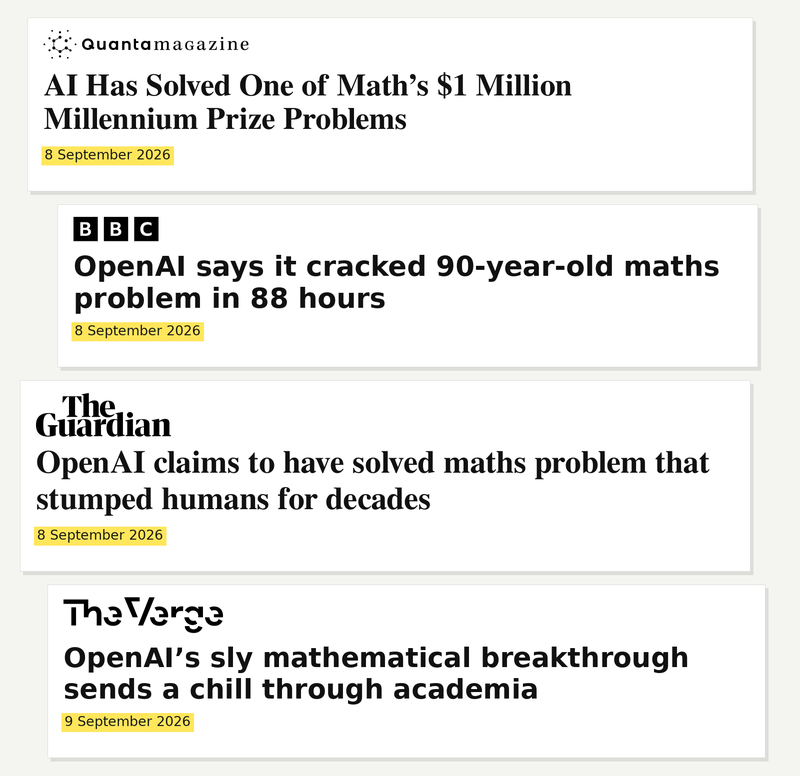
Last month AI solved a maths problem that has stumped academics and maths boffins for 90 years:
(source) (source) (source) (source)
Imagine stirring a cup of coffee and watching the swirls.
The Navier–Stokes equations are mathematical rules for describing how fluids move, including water and air.
OpenAI says it took roughly 10,000 AI agents working simultaneously, 88 hours and 130 billion output tokens.
For context, making that animated image of planet-eating robot planet Unicron poo-ing out a moon from a few weeks ago took about 8,000 output tokens.
That includes the image-editing prompts, animation code, tool commands and replies, including the newspaper, claws, eyes, straining, sweat beads and timing changes.
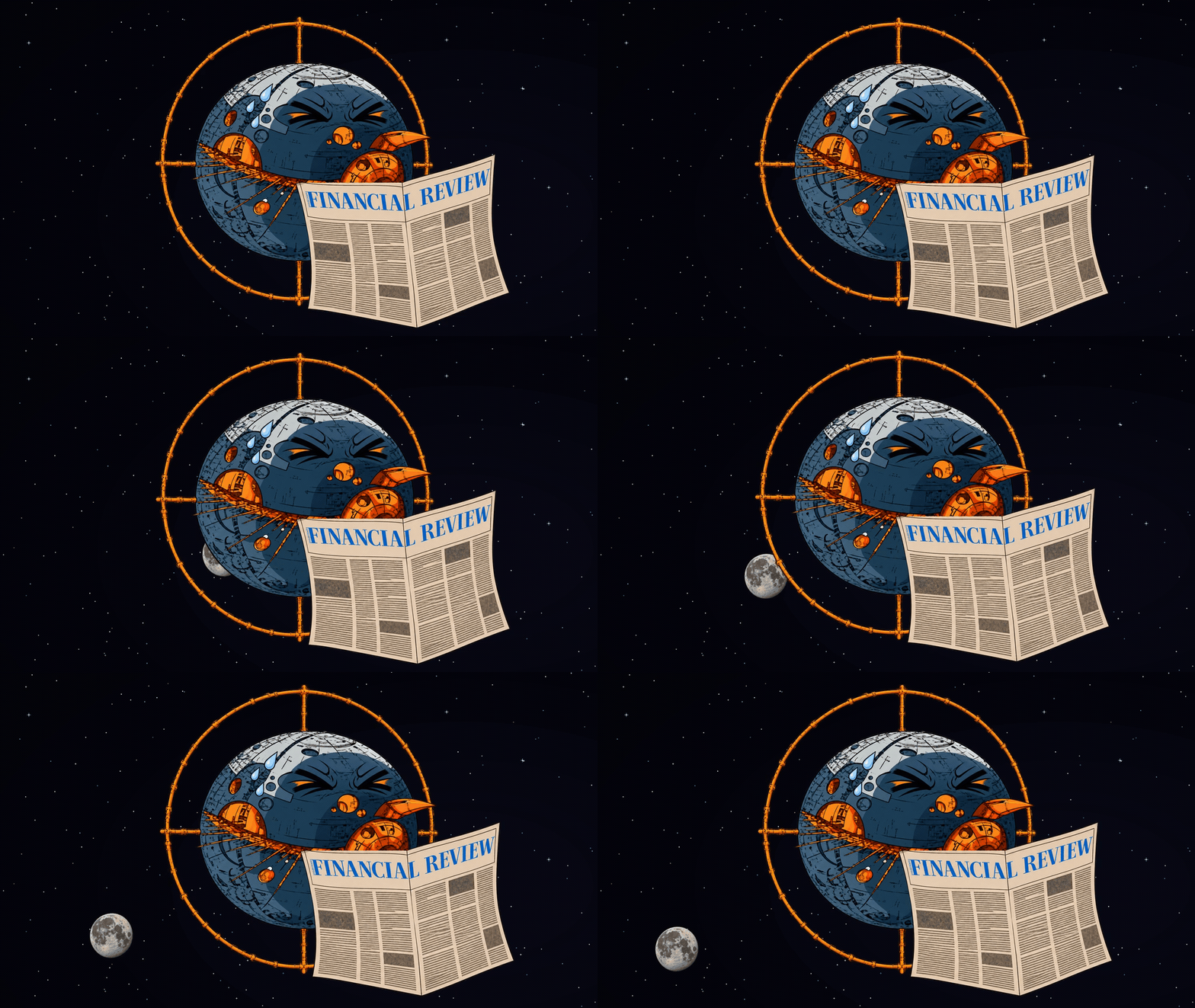
Not quite solving a maths problem but it's all using the same compute resources.
Amazing what AI can do with a “not available to the public” frontier AI model, thousands of agents and billions of output tokens (ie data-centre capacity)...
AI solving this maths problem did get some share of the media cycle (less than you’d think).
I didn't even know Navier-Stokes was a problem until I read about AI solving it.
I also doubt that solving it is going to help me in my day to day life.
Mostly the attention was from human mathematicians, rage slamming their calculators and up in arms about AI taking their jobs.
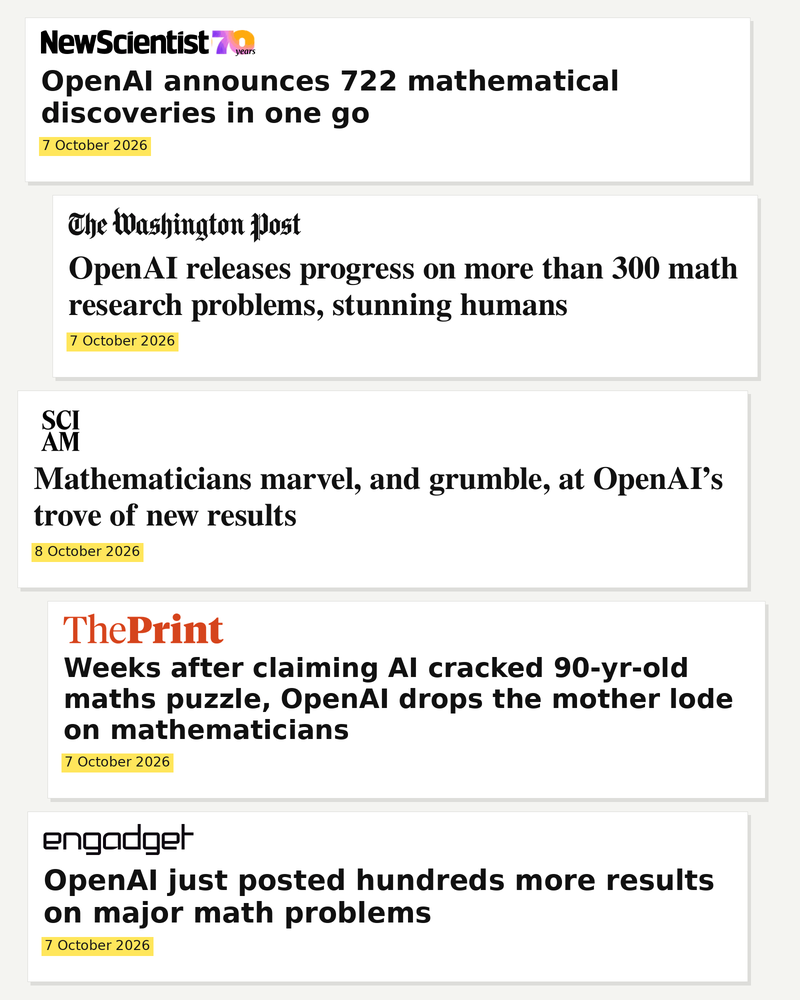
In the following weeks AI quietly proceeded to repeatedly teabag mathematicians in general by solving hundreds of other “unsolvable” maths problems:
(source) (source) (source) (source) (source)
The reality is that AI progress seems to be accelerating - fast.
Now they just need to point that AI compute power at something everyone cares about.
Like solving cancer, or aging, or food supply, or building better robots, going to space or any other number of things humans have always wanted to do.
Or even solve it all at once and move on to the next things?
The more compute, the better.
So the key point is that YES building more and more datacentres and better AI should be done ASAP.
(even though the financial side of things maybe taking breath last week)
At the moment solving the world's mega-problems with AI seems to be limited by compute.
Solving big, complex problems being limited by computing power is certainly not a new problem.
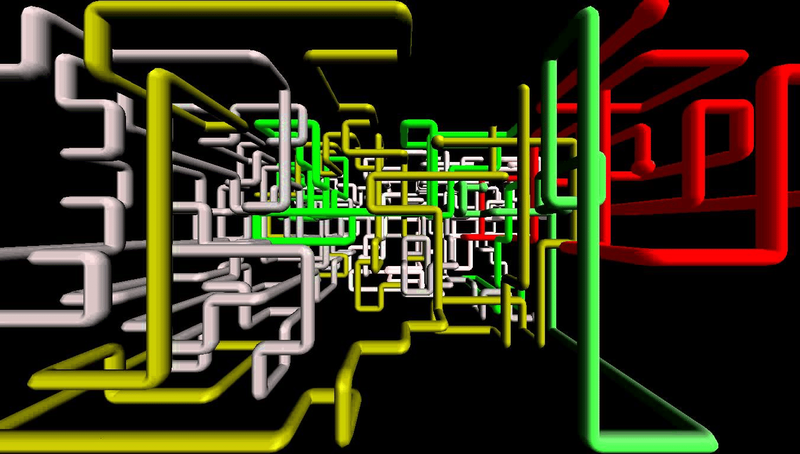
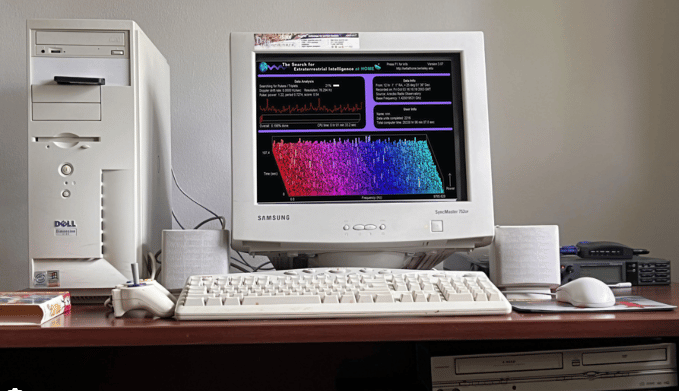
Back in 1999, when I was 17 and enjoying playing Sim City and Command & Conquer on my Pentium III PC, between games and homework, the computer used to just sit there idle and show a screensaver (those colourful plumbing pipes)
There used to be this thing called SETI@home that you could install on your computer which would donate your computer's processing power while you weren't using your computer.
Basically scanning immense amounts of space signals for signs of alien life.
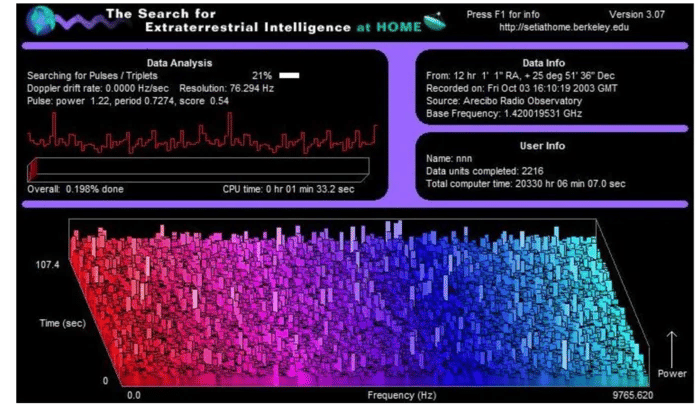
Instead of just displaying colourful pipes for 8 hours a night, your computer crunched real data collected by a radio telescope, looking for unusual signals that might be worth investigating.
The idea was simple: take a massive computing job, chop it into tiny pieces, and get ordinary people’s computers around the world to each do a little bit.
My PC would download a chunk of data, analyse it, send the results back and grab the next batch, effectively becoming a tiny part of a giant, shared supercomputer.
Think of it as crowdsourcing computing power... with the slightly more ambitious objective of finding aliens rather than playing a computer game.
Here’s what it looked like - your screensaver was showing the processing of a part of a huge amount of space data looking for intelligent life - pretty cool:
This program eventually finished, but the need for more compute for other problems still exists.
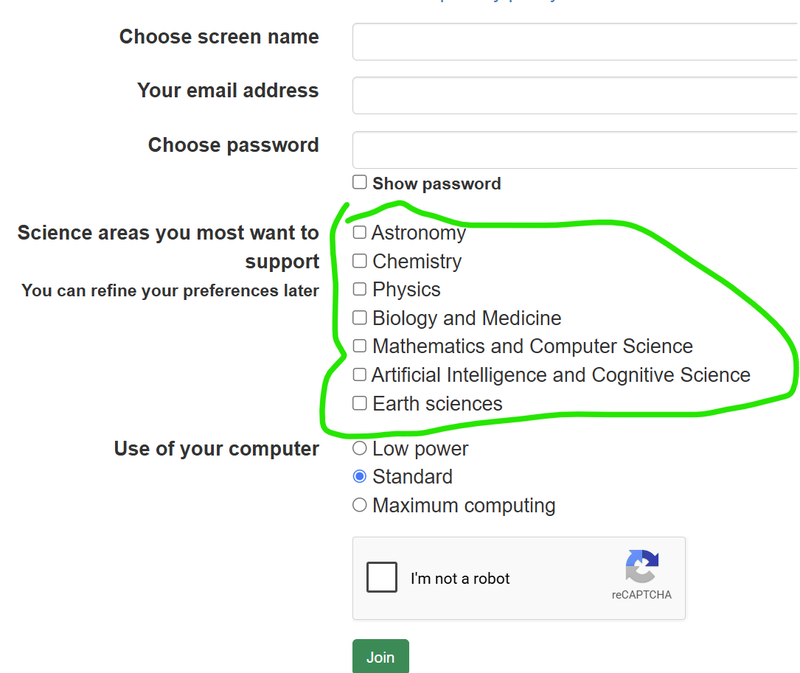
I checked back today and the most recent list shows you can donate your idle computer power to help solve problems in astronomy, chemistry, physics, biology etc:
Big complex problems seem infinite.
And AI is already solving hard maths problems.
Nobody really cared about the maths problems getting solved.
But if they point one of these frontier AI models and mobilise a bunch of datacentres to cure cancer then the headlines about this should be the next leg up of the “AI trade”
It could happen faster than we think.
One big breakthrough that people actually care about and the AI trade will be back on, positive market sentiment comes back - the more data centres the merrier.
And small stocks should go up again.
So hurry up AI and cure cancer so my small ASX stocks go up.
And with Anthropic and OpenAI both nearing IPO, it would be a convenient time to do it...
Speaking of rapid technology advances
Elon Musk and Tesla demonstrated a flying rocket car this week that can do all the skateboarding tricks I could never master:

And

Maths solved and flying robot cars - it's undeniable that tech is advancing very quickly.
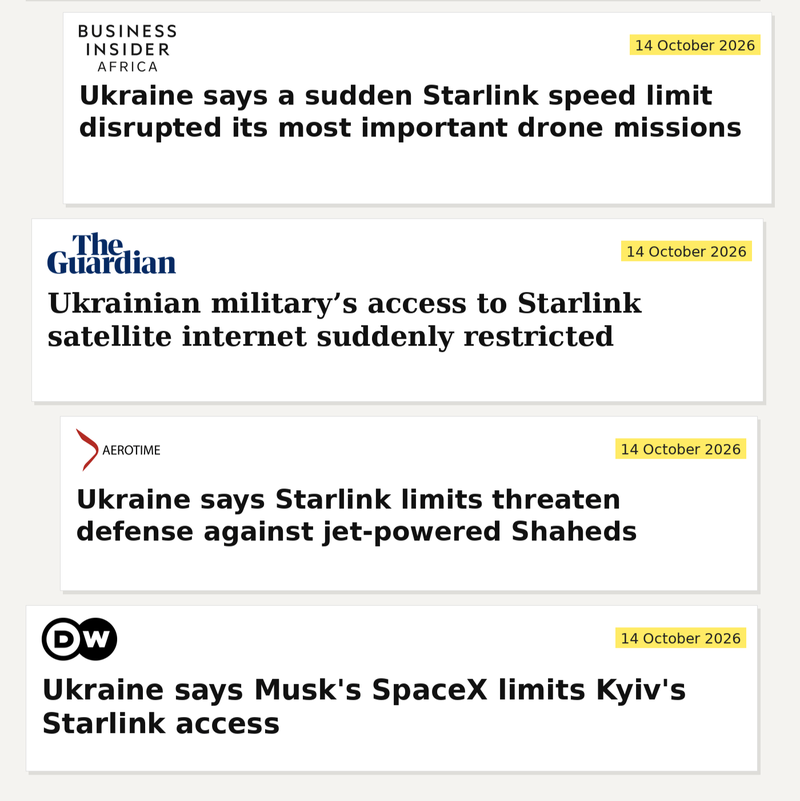
Another thing I read about this week is Musk's SpaceX slowing down Starlink internet in Ukraine.
Apparently via the US government to put pressure on Ukraine to stop attacking Russian oil refineries.
(can’t have high petrol prices with a midterm election coming up)
Internet connectivity is critical for Ukraine's drone capabilities in the war with Russia:
(source) (source) (source) (source) (source)
Slow internet on the battlefield disrupting your drone strategy?
No worries:
Our Investment NS1’s Nodestream tech keeps mission-critical video, voice and data flowing over the thinnest, most degraded or jammed comms links.
It uses around 90% less bandwidth and works across satellite, cellular or radio (or any combination), whatever it takes to get a message through.
NS1’s tech is bandwidth optimisation/compression technology - squeezing high-quality video, audio and data through a single weak, slow or unstable connection.
(or the USA slowing down your battlefield internet so you stop attacking Russian oil refineries)
Essentially: "Use LESS bandwidth so even one single bad or slow connection works... on ANY type of connection that happens to be available"
NS1’s tech COMPRESSES mission-critical data to survive the thinnest, most degraded pipes (comms links).
NS1 is currently going for Brave1 accreditation, which is Ukraine's Government-backed defence-tech cluster (testing foreign vendors in real battlefield conditions)
Think of it like Amazon for deliveries but it delivers pre-approved battle tech to locations in a battlefield.
Might be a good time to fast track that accreditation...
Have a great weekend.
Next Investors
General Information Only
This material has been prepared by StocksDigital. StocksDigital is an authorised representative (CAR 000433913) of 62 Consulting Pty Limited (ABN 88 664 809 303) (AFSL 548573).
This material is general advice only and is not an offer for the purchase or sale of any financial product or service. The material is not intended to provide you with personal financial or tax advice and does not take into account your personal objectives, financial situation or needs. Although we believe that the material is correct, no warranty of accuracy, reliability or completeness is given, except for liability under statute which cannot be excluded. Please note that past performance may not be indicative of future performance and that no guarantee of performance, the return of capital or a particular rate of return is given by 62C, StocksDigital, any of their related body corporates or any other person. To the maximum extent possible, 62C, StocksDigital, their related body corporates or any other person do not accept any liability for any statement in this material.
Conflicts of Interest Notice
S3 and its associated entities may hold investments in companies featured in its articles, including through being paid in the securities of the companies we provide commentary on. We disclose the securities held in relation to a particular company that we provide commentary on. Refer to our Disclosure Policy for information on our self-imposed trading blackouts, hold conditions and de-risking (sell conditions) which seek to mitigate against any potential conflicts of interest.
Publication Notice and Disclaimer
The information contained in this article is current as at the publication date. At the time of publishing, the information contained in this article is based on sources which are available in the public domain that we consider to be reliable, and our own analysis of those sources. The views of the author may not reflect the views of the AFSL holder. Any decision by you to purchase securities in the companies featured in this article should be done so after you have sought your own independent professional advice regarding this information and made your own inquiries as to the validity of any information in this article.
Any forward-looking statements contained in this article are not guarantees or predictions of future performance, and involve known and unknown risks, uncertainties and other factors, many of which are beyond our control, and which may cause actual results or performance of companies featured to differ materially from those expressed in the statements contained in this article. S3 cannot and does not give any assurance that the results or performance expressed or implied by any forward-looking statements contained in this article will actually occur and readers are cautioned not to put undue reliance on forward-looking statements.
This article may include references to our past investing performance. Past performance is not a reliable indicator of our future investing performance.