VKA finalises processing plant design for US tungsten project
Our US critical minerals Investment Viking Mines (ASX: VKA | OTC: VKALF) just finalised a modular processing plant design for its tungsten project in Nevada, USA.
VKA’s project had produced tungsten back in the 1950’s.
VKA is now working toward building a mine restart strategy around the project.
(while tungsten prices are at all time highs and US critical minerals are in favour)
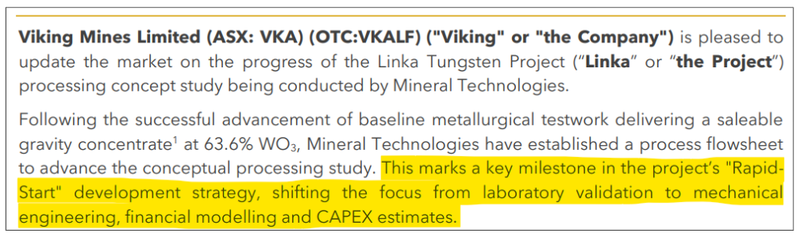
Today VKA announced that design work had been completed for an 43t/hour processing plant.
AND that “mechanical, engineering, financial modelling and CAPEX estimates” for the plant had started.
(source)
Put simply, rather than spending years drilling to define a resource before moving onto studies, VKA is trying to get the studies started before drilling.
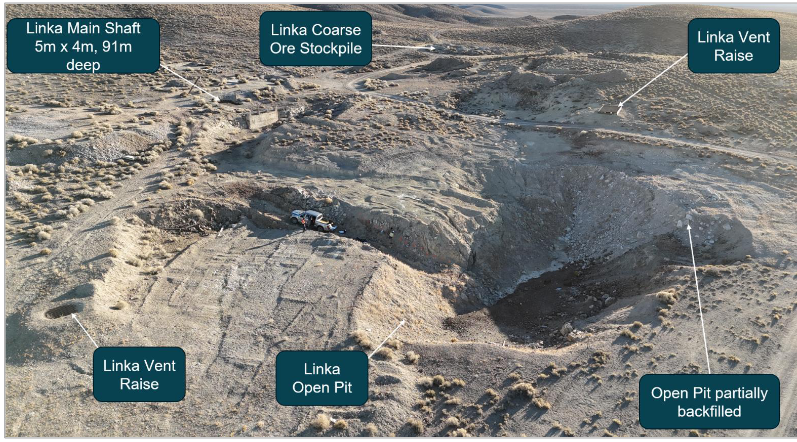
As mentioned earlier - VKA’s project has historic production of a combined ~123,000t at 0.54% tungsten grades from an open pit.
We are Invested in VKA to see VKA rapidly define and get into production this project, taking a faster approach by producing a high grade concentrate it could ship to refiners for further processing.
Between 1955 and 1956, 360 tonne per day was milled from VKA’s project from an open pit mine - here is a photo of that old pit in December when VKA acquired the project:
(source)
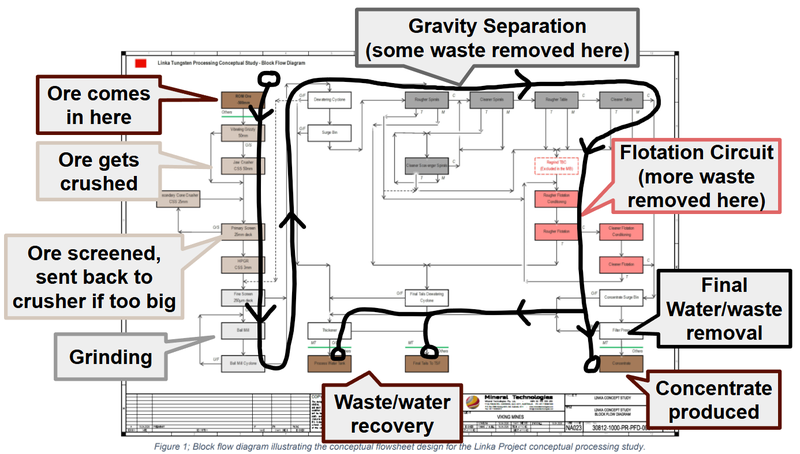
Basically what VKA has announced today is that the conceptual flowsheet has been built directly off VKA’s strong baseline metallurgical results.
This included the recent 63.6% WO3 gravity concentrate results, which we covered here, this concentrate is comfortably above the minimum value that refiners look for.
VKA included this diagram which shows that quite a bit of planning and work has already been done to this point (don’t worry, we aren’t going to go through this specifically, just a general overview):
(source)
Here are our key takeaways from what was a fairly technical announcement today:
- Conceptual processing rate of 43 tonnes per hour has been adopted for evaluation purposes (this isn’t a production target, just a working assumption to size equipment needs).
- Modular design - The plant is being designed so that additional recovery stages such as Wet High-Intensity Magnetic Separation (WHIMS) or a Falcon Concentrator, could be bolted on later without redesigning the primary circuit.
- Comminution testwork (rock-breakage and energy testing) will start this month and will feed directly into the OPEX (operating or ongoing costs to produce) estimates for power and water.
- “Purchase vs Hire” assessment for specific modules (like the crushing circuit) designed to keep upfront CAPEX down and shorten development lead times.
Why the modular design matters
The big kicker for VKA could be that its processing plant is being designed as a modular plant.
In simple terms, VKA can start with a relatively cheap, gravity-led circuit (which has already produced a 63.6% WO3 concentrate) and get into production.
At this point it is able to prove the operation works for minimal capital outlay.
Once this point is reached then it can add higher-recovery modules later if testwork supports it.
So if (for example) the upcoming WHIMS or flotation testwork demonstrates that recoveries can be lifted further, VKA doesn’t need to rip out the plant and start again.
It can simply just bolt another module on.
This “build small, expand later” approach is the opposite to the usual small cap mining playbook of trying to design and finance one massive plant up front and then rely on economies of scale.
As a reminder of what VKA has and why it makes sense to push the “fast to market” / “Rapid-Start” plan:
- A previously producing tungsten asset
- Located inside US borders
- Tungsten prices are at all time highs
- The US has zero domestic tungsten production
- The Pentagon is flagging US$100M to US$500M for domestic critical minerals
What we want to see next from VKA:
Here are the key milestones we want to see VKA hit over the coming months:
🔄 Processing concept study with Mineral Technologies
Mineral Technologies (a subsidiary of the ~$5BN Downer Group) is working on flowsheet design and CAPEX/OPEX estimates.
Further testing is ongoing with more results from cleaner flotation testwork expected in late April / early May.
We also would like to see how existing tailings (that were recently sampled) performs with similar testing or even on this exact same circuit.
Recent/ongoing results will feed directly into that study - the gravity-led flowsheet is looking increasingly viable.
Here are the milestones we are tracking for this:
- ✅ Rougher gravity testwork - 16x upgrade (source)
- ✅ Cleaner gravity testwork - 53x upgrade to 63.6% WO3 (source)
- 🔄 Cleaner flotation testwork - underway now to produce saleable grade from flotation circuit
- 🔄 Ore sorting testwork - ~40kg sample being tested
- 🔄 3D geological model - being finalised
- 🔄 Modular "Rapid-Start" gravity circuit design - to feed into development studies
🔲 Maiden drilling program (late June quarter).
VKA is submitting a Notice of Intent to Federal Agencies for drill permitting.
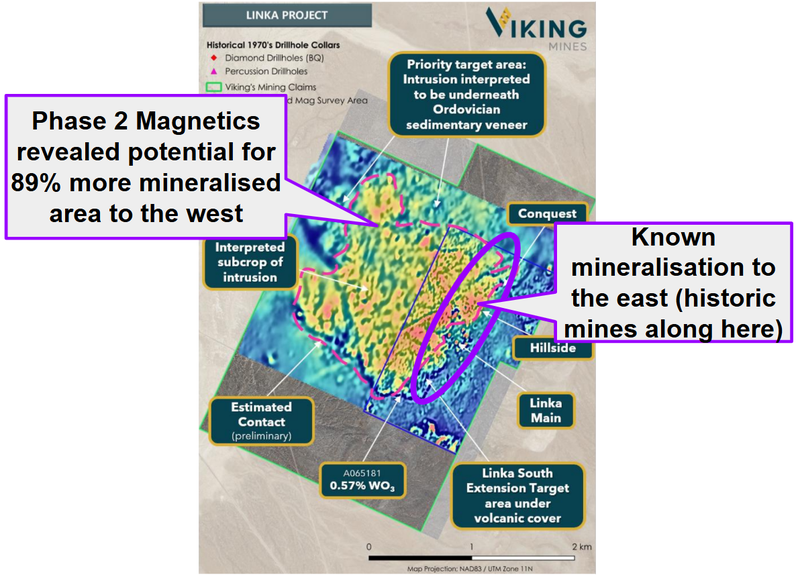
The expanded geophysics showed that 89% of the prospective contact zone has never been tested - so there’s a lot of ground to cover.
(source)
🔄 Permitting and 3D geological model
WSP (~C$28BN WSP Global) is running baseline environmental and permitting work.
A 3D geology model is being completed using recently digitised mapping and drillhole data.

(source)
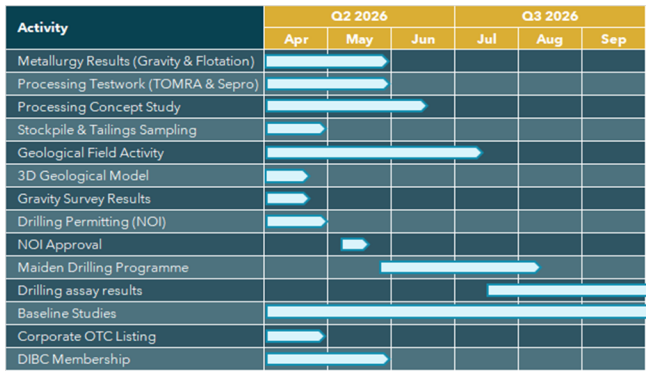
Here is a gantt chart VKA recently put out that details everything being worked on more broadly:
(source)