OD6 rediscovers "Big Jim" - highest grade fluorspar target to date at US project
Our USA fluorspar Investment OD6 Metals (ASX: OD6) has just rediscovered the historically referenced Big Jim Fluorspar Lode at its Quinn Fluorspar Project in Nevada.
This is now the third extensive fluorspar system on the project - alongside the existing Mammoth and Horseshoe discoveries.
Based on the visual estimates, Big Jim is the highest-grade target on the project to date.
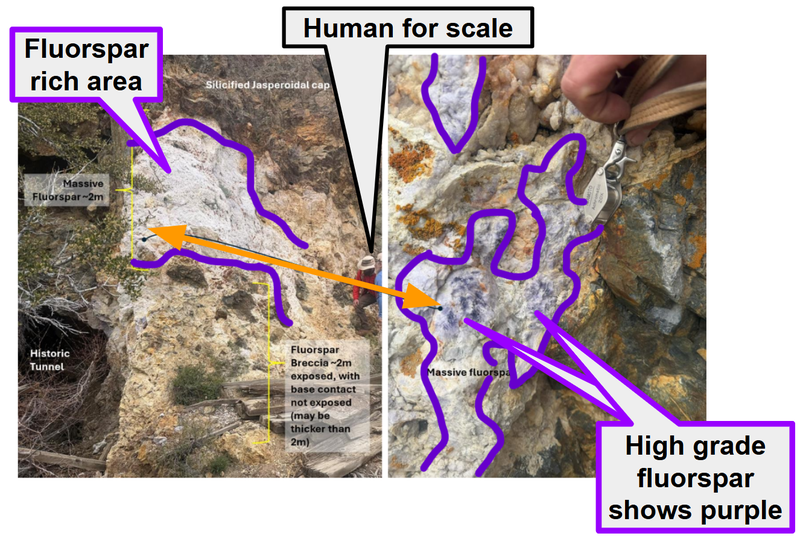
Big Jim has been visually estimated at up to 85-95% fluorspar (historically reported at 98.6%)
Fluorspar generally is seen as purple in the rock formation, here is a look form today’s announcement:
(source)
We note only lab assays are a reliable indicator of grade and will be required to confirm, along with drilling to confirm the thickness and continuity of grades.
There was also a ~2m wide footwall breccia estimated at 40-60% fluorspar and this lower contact is not yet fully exposed, so it could be wider.
Breccia here is basically rocks that got cemented back together, the rocks being the original host rock (here limestone) and the cement is that fluorspar which infiltrated the rock as a liquid and cooled.
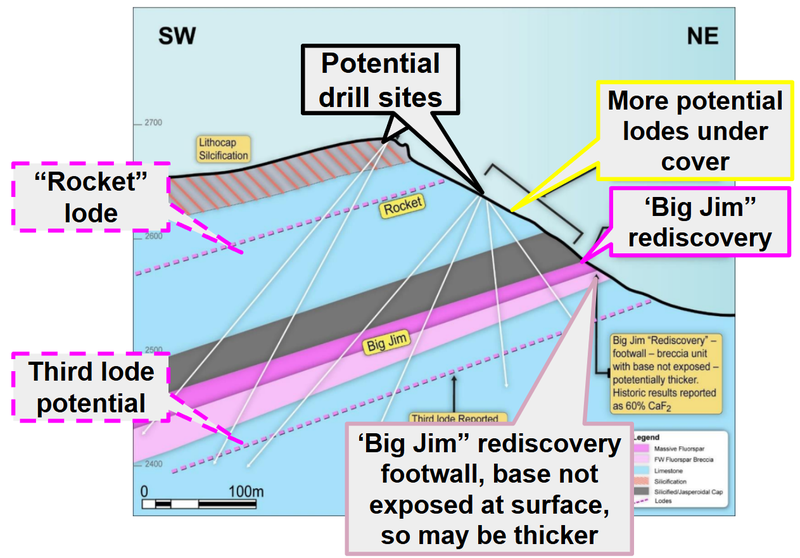
Today OD6 has mapped historic workings out at over 220m of strike length AND this system is open to the north and south.
OD6 believes that this mineralisation dips shallowly to the west, to sit just under the lithocap so is a clear drill target:
(source)
Samples have already been collected and sent to ALS Global in Reno, Nevada for assay.
Metallurgical samples have also been collected and testwork is now underway covering optical sorting, crushing, grinding and flotation.
(visual estimates here today of course aren’t a substitute for the laboratory results - so we now wait for the assays to confirm the visuals).
How "Big Jim" was found
Big Jim was originally discovered and mined intermittently by Frank and Joe "Big Jim" Perkins starting in 1934.
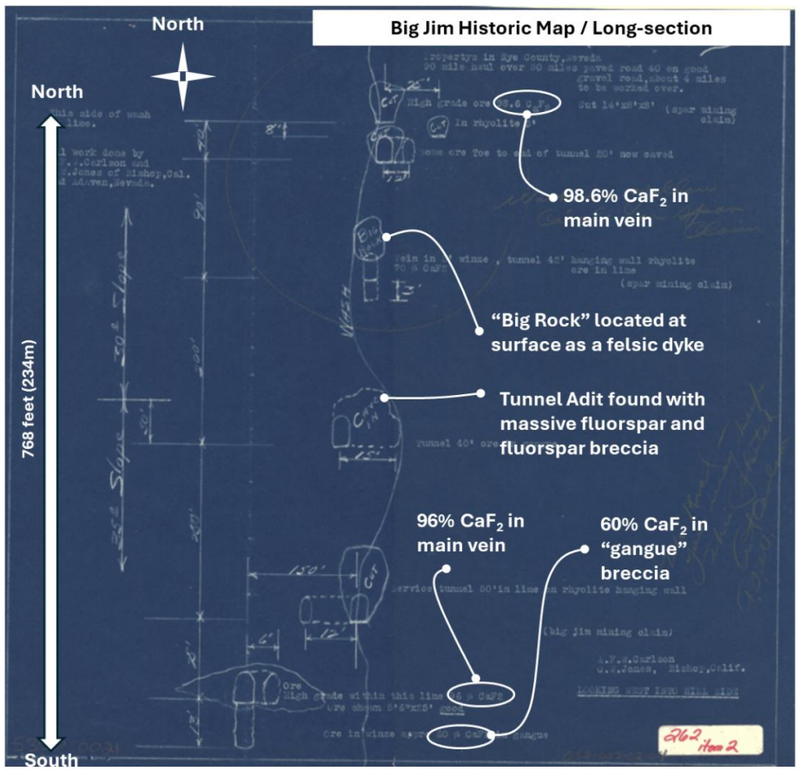
A report from 1947 (Goulet & Jones) documenting a high-grade shallow-dipping lode over 6 feet (2m) wide with reported grades of 94.6%, 96% and 98.6% fluorspar.
But until now, the exact location of the workings had been lost to time.
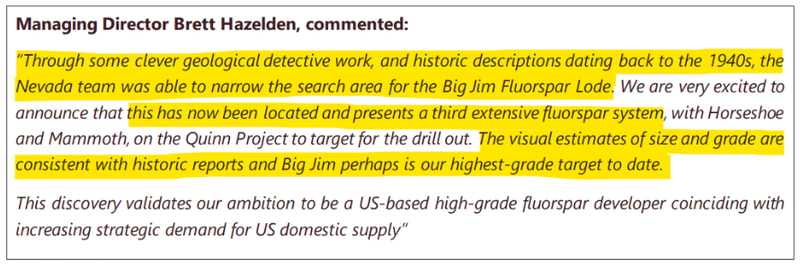
The OD6 Nevada team essentially used geological detective sleuthing by combining old USGS reports, historic descriptions dating back to the 1940s, and field reconnaissance.
Here is a look at one of these documents, so this would be why they called them blueprints back in the day…
(source)
This narrowed down the search area and then they were able to physically inspect the likely areas to locate the workings on the ground.
OD6’s MD commented on this:
(source)
There was another bit of news today that we also found particularly interesting.
In the original 1947 report, the historic miners noted the footwall breccia contained "gangue" material grading 60% fluorspar.
"Gangue" is the old mining term for commercially valueless rock…
But here’s the thing, in 1947 they weren’t able to economically process the breccia material.
Today, projects with grades >20% fluorspar are generally economic (stated in today’s announcement)- and some companies are suggesting >8% fluorspar is economic.
So what the 1940s miners discarded as worthless is actually extremely valuable in today’s market.
To the extent that these grades are already high enough to be used in the metspar market, where 60% is considered the number to get in.
So, the old timers were literally discarding parts of the resource that potentially could be fed straight into the market with minimal if no processing…
We covered the 2 main fluorspar markets in our recent article here: How the new data could change the size and scale of OD6's project
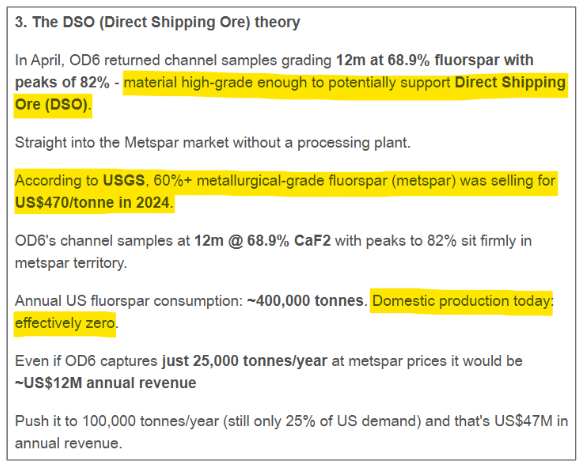
So this dramatically expands the size of the target zone Big Jim could cover as it’s not just the 2m massive vein at the top.
It’s the underlying 2m+ breccia body underneath as well (the lower contact wasn’t even exposed, so it could be thicker).
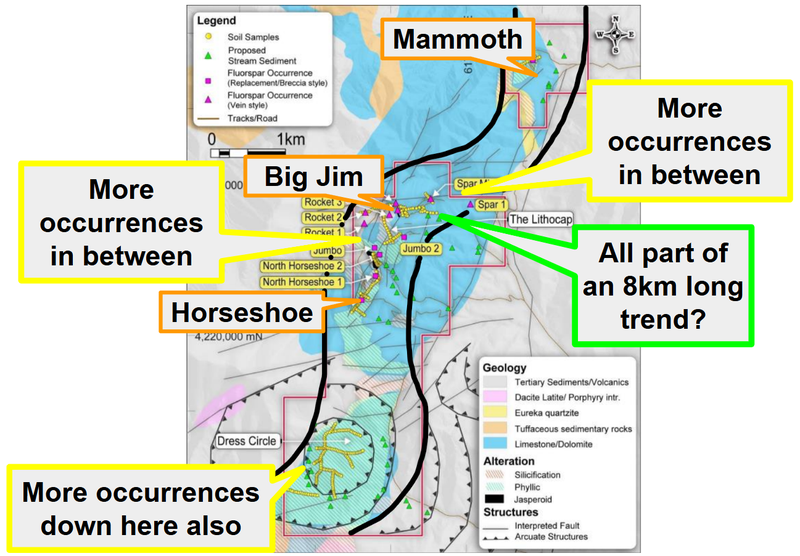
With today’s update, OD6 has a third extensive fluorspar system:
- Mammoth - replacement/breccia mineralisation over a 9,000m² area
- Horseshoe - replacement/breccia mineralisation over a 3,000m² area
- Big Jim (new) - >220m strike length, open to north and south, shallow dipping under a lithocap
Big Jim is only 1km NNE of Horseshoe, so the three systems are clustered together on the project:
(source)
This is starting to look exactly like the "iceberg theory" we put forward in our recent OD6 article that we think OD6 is going about unveiling.
The individual fluorspar occurrences on the project might actually be part of one bigger, district-scale system underneath.
We covered this in our recent article: OD6: Acquires rare historical data set on its USA fluorspar project... revealing what’s inside over the coming weeks.
And first mentioned this theory back in March: OD6: Multiple surface outcroppings... are they connected?
What's next for OD6?
🔄Complete the acquisition of its US fluorspar project
We want to see OD6 complete acquisition of the US fluorspar project, this will give it full unencumbered access to help it progress the asset.
Milestones:
- 🔄 Due diligence process completed
- 🔲 Option to acquire exercised
- 🔲 Acquisition completed
🔄 Target generation for US fluorspar project
We want to see OD6 sample in and around the old workings on its project, run some geophysics and generate high priority drill targets ahead of its maiden drilling program.
Milestones:
- ✅ Rock chips
- ✅ Channel sampling
- 🔄 Soil sampling
- 🔲 Geophysics
- 🔲 Drill targets generated
Strategic / Government Engagement for fluorspar in the US
- 🔲 Engage with US Department of War, Department of Energy, or DLA regarding domestic fluorspar supply
- 🔲 Explore strategic partnerships or offtake discussions