CAY to produce bauxite from US$853M NPV project in Q1-2026
Our bauxite Investment Canyon Resources (ASX: CAY), just released an updated Definitive Feasibility Study for its project in Cameroon.
CAY is looking to get into first production by early 2026, ramping up into full production by 2030.
CAY has one of the biggest, highest grade undeveloped bauxite assets in the world, and is one of few projects that aren’t owned by the major mining conglomerates.
Here are our quick takeaways from the feasibility study (updated from the one that was published in 2022)
- A net present value of US$835M, which is nearly double the US$452M NPV estimated in the 2022 bankable feasibility study.
- The project’s ore reserves increased by 33% to 144MT (up from 108MT in the 2022 study) which is the basis for its 20 year mine life. CAY still has 1,102MT resource estimate, which is massive.
- A bauxite price used for the study of US$78 per dry metric tonne of product - compared to the recent ~US$110 bauxite price highs, and above the bankable feasibility study done in 2022 which used US$45.
- A C3 all in sustaining cost of ~US$49.46 per dry metric tonne of product - well below the base case sale price of bauxite of US$78 per tonne.
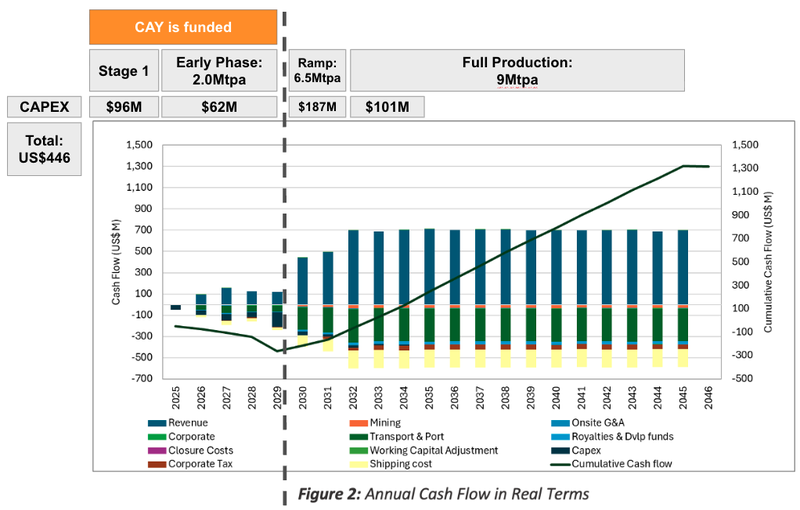
- A CAPEX of US$96M for phase 1 (targeting first ore shipment in Q1-2026) and total CAPEX of US$446M for all three phases of development.
- CAY will move to a multi-phased approach Early Phase, Ramp and Full Production. CAY is fully funded for Stage 1 and Early Phase 1 of 2.0Mtpa of bauxite.
We note CAY made mention of an expectation to receive a premium on other products because of the high purity, low silica content of its resource so we think CAY is being conservative here.
Basically, the project on an overall basis would have an NPV just under 2x its total CAPEX requirement, which is above the 1:1 CAPEX/NPV ratio that the market typically wants to see get beaten with these economic studies.
CAY’s feasibility study is also mostly relevant for the latter stages of CAY’s project, given CAY has already started construction of phase 1 of the project.
CAY has already:
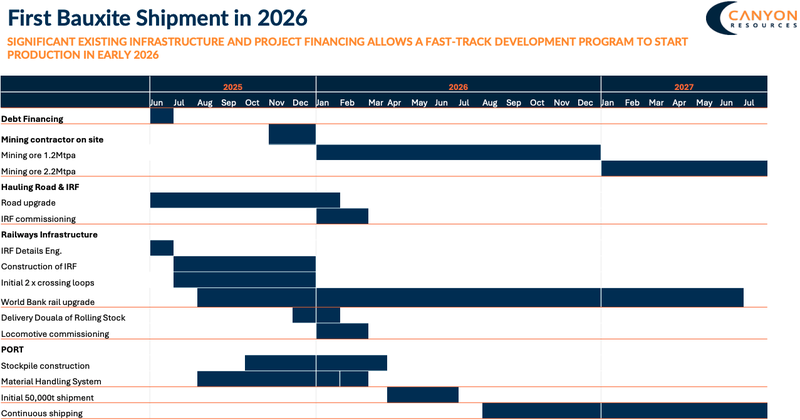
- Made purchase orders for rail locomotives and wagons have been placed with first equipment deliveries scheduled for Q1, 2026
- Mining, ore haulage and road upgrade contracts placed, and mining equipment scheduled to arrive on site Q1, 2026
- Project construction commenced in July 2025
- Project team in place with additional key hires to be made in H2, 2025
We will have a deeper dive on CAY’s feasibility study later this week after listening to the CAY webscast which you can access here:
What’s next for CAY?
2025
- Mining fleet on site (December)
- Makan & Ngaoundal permits (2H)
- Offtake discussions (2H)
2026
- Initial fleet of new locomotives and wagons delivered (January)
- First mine production (January)
- First bauxite shipment (H1)
- Alumina Refinery FS (Q3) and downstream value add strategy
The main thing we are watching out for are road upgrades and construction of the inland rail facility.
CAY has a US$140M loan with the AFG Bank Cameroon to support the financing of Stage 1 and the early stages up to 2.0Mtpa of bauxite.