

Why things may settle down soon, even if they… Don’t
Published 21-MAR-2026 15:25 P.M.
|
10 minute read
Disclosure: S3 Consortium Pty Ltd and its associated entities may hold direct or indirect interests in securities referred to in this publication and may receive fees or other forms of consideration from entities mentioned. These interests and arrangements may create a potential conflict of interest in the preparation of this material.
The information contained in this communication is provided for general information purposes only and may relate to speculative investments. It does not constitute financial product advice, and has been prepared without taking into account your personal objectives, financial situation or needs. You should consider obtaining independent financial advice before making any investment decision.
Any forward-looking statements are uncertain and not a guaranteed outcome.
The market certainly sucked this week.
So much so that on Friday morning I decided to take a rare day off and get away from the market horrors being fed to me on my screen.
To surprise the family with a weekday trip to a nearby children's farm...
No good was coming from helplessly watching the market carnage unfold.
So I turned off the screen and went to stare at some giant pigs rolling around in the mud instead:
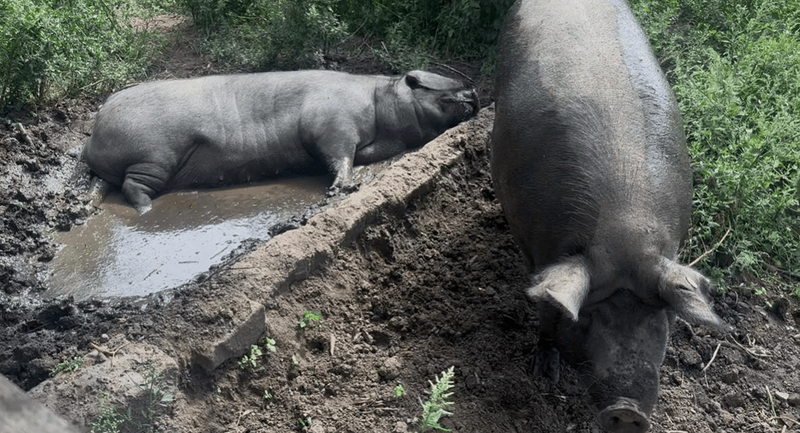
Pig on the left (Winnie) is clearly not exposed to the markets
It was either that or watching nearly every stock in the small end of the market get trashed.
Attacks on Iran had been escalating.
Key global energy sources on both sides being attacked - the oil price is surging.
Hopes for “market lifting” interest rate cuts dashed as oil soars.
AI is trying to take our jobs.
and the indestructible Chuck Norris passes away at the age of 86.
It appears everything we have been told our whole lives and have come to understand about the world order and invincibility of Chuck Norris seem to be unravelling.
(well, at least social media says it is)
Frankly, in the global chaos, nearly everything everywhere (except oil) is getting smashed.
We predicted global chaos a few years ago and spent that time positioning our Portfolio towards... global chaos.
Gold, silver and US military minerals (and more recently AI metals and robot metals).
and now it's happening...
Wait a second...
If global chaos is kicking off as predicted, then why are all the stocks in our “global chaos portfolio” getting pounded this week instead of going up?
The market can become irrational during peak uncertainty - during peak fear, people indiscriminately mash the sell button.
(or is it actually perfectly rational?)
“Sell first, ask questions later”
“everything will be sold off until clarity is achieved”
It could be a smart move for those that sold (we didn’t).
Gold and silver are safe haven assets, right?
Money will be printed to fund the war, debasing currency.
Gold and silver should be going up right?
Nope, both down.
The USA is expending hundreds of missiles a day in the Iran conflict.
Stocks with military minerals projects used to rebuild missile stockpiles should be going up, right?
Nope, also down.
Indiscriminate selling of everything at the moment, including gold, silver and US based military metals stocks.
We are long term believers in our thesis, so we try not to get freaked out and change our behavior too much during short term intense panic periods.
(aside from going to a farm to look at some massive pigs on a trading day)
And in broad, global, uncertainty driven panic sell offs, small stocks (like the ones we are Invested in) get hit the hardest.
My grandad used to have a saying:
“Always remember that things are never so bad... that they couldn’t get even worse”
While he used it mostly to fend off any whingers he encountered while living in the grim times of post-WW2 Eastern Europe, the saying also has some utility in the small end of the market.
If things DO get worse....
the “sell first, ask questions later” crowd probably made a good move...
OR
We could see things quickly come back to “normal, predictable levels of chaos” and the market gets on with it again.
The familiar, slower, predictable march towards a chaos that is always just over the horizon that we have all become used to.
A few hours ago the US President said the US are close to “winding down” the Iran conflict:
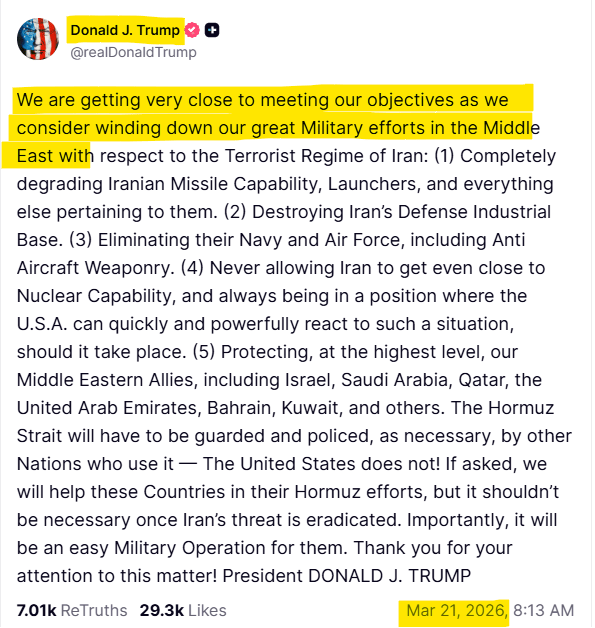
(source)
Contrary to my grandad’s favourite saying, things COULD also get better...
The market would respond well to a USA withdrawal from the conflict.
And small stocks are a “double edged sword”...
They get pounded the hardest in broader market panics.
BUT they also rebound the hardest when market sentiment flips to FOMO and greed.
Breaking News: the S&P 500 stages an “after market” rebound after the above Trump tweet on winding down the Iran conflict very soon:
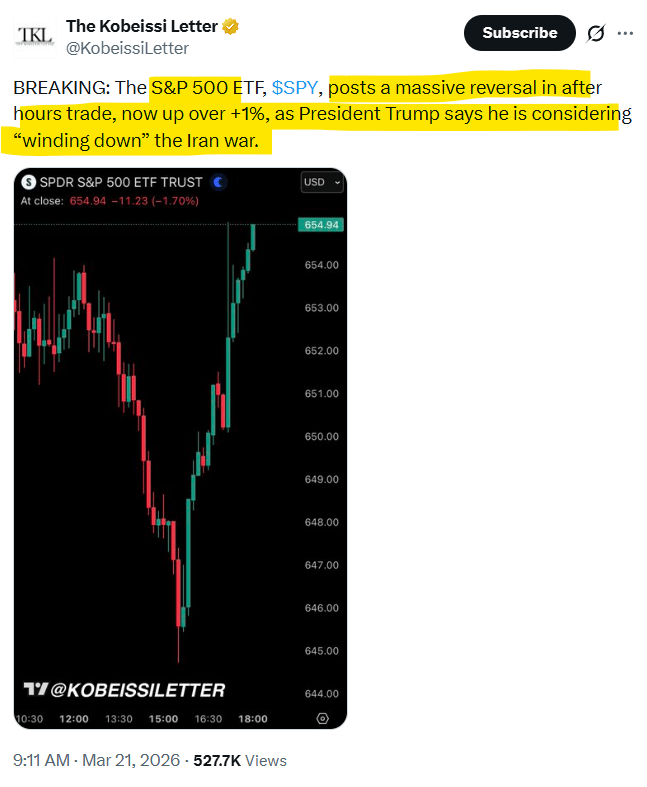
(source)
Remember Trump's market melting, tariff “liberation day” that freaked the market out, and caused massive 7% plus crashes in major indices?
We used to use this “snow globe shake” analogy to describe what Trump was doing to the global order:

And the liberation day “snow” settled faster than anyone expected.
Nobody has talked about tariffs or tariff turmoil for months now.
And the whole peak tariff freakout thing happened less than 12 months ago...
PLUS we had some pretty solid bull runs in the small end of the market since then.
The point is, this could all be another snowglobe shake, and in a few months we’ll be back to positive sentiment and probably freaking out about whatever the next thing is.
We take 3 to 5 year positions and don’t jump in and out during panics.
(no, we just hang on and pray that we are right in the long term... works for us but might not be right for everyone)
We are still holding strong, see all our current holdings here.
There is also an argument to be made that EVEN IF the Iran conflict DOES keeps escalating...
The panic sellers will eventually finish.
Money will be printed to fund the conflict.
The market accepts the turn of global events and gains the clarity it needs to start moving into appropriate sectors.
Like safe haven metals and military minerals - the global chaos portfolio.
Panic selling of the last two weeks aside, Here’s what we think is happening:
What's happening with gold and silver?
Since the attacks on Iran started on Saturday 28th February 2026, gold is down 19.6% and silver down ~40%.
Why on earth are “safe haven” metals that are supposed to go up during war or major conflicts getting so heavily sold off?
(taking small gold and silver stocks with them)
The oil shock has killed rate cut hopes.
Iran's Strait of Hormuz blockade sent oil above $100/bbl, reigniting inflation.
The US Fed now projects just one cut in 2026 (was 55bps of cuts priced in before the war).
(gold and silver reacted with significant price drops when the US fed held rates a few days ago on March 19th)
Gold pays no yield, so higher-for-longer rates are a direct headwind.
(unless oil comes back down and interest rate cuts come back on the table)
A stronger US dollar from inflation fears making gold more expensive for overseas buyers.
Another reason that sounds plausible to us is investors selling gold to raise cash and cover losses in equities.
(especially margin calls...)
Have you ever sold some shares of your best performing stocks to help fund a placement into one of your dogs?
(we often have)
Or even had to sell your best (and most liquid) stocks to fund a margin call?
(we have too)
Bank of America's Lawson Winder writes that investors have "tapped the haven assets for liquidity amid a sharp global equities sell off."
We have seen another theory that the usual money that would flow into safe-havens like gold and silver is now going to oil instead.
Ie: Precious metals moving in "negative correlation with oil."
And as usual, silver's moves (up or down) are accentuated more than gold’s.
Most analysts' views that we read say this correction in gold and silver is a temporary correction within a structural bull market.
Central bank gold buying continues, US debt just crossed $39 trillion, and the longer the war drags on, the more deficit spending will eventually need to be financed.
We are holding on for the precious metals bounceback.
What about US military metals?
803 missiles. In one day.
That's how many Patriot-class interceptors the US fired on day one of “Operation Epic Fury” - the air war against Iran that kicked off on February 28.
To put that in perspective, the US produces about 60-65 Patriot missiles per month. So in a single day, they burned through more than a year's production. (Source)
By Day 4, the coalition had fired 5,197 munitions across 35 weapon types (Source).
By Day 6, the Pentagon privately told senators the cost had already passed US$11.3 billion — mostly ammunition (Source)
By Day 19, Defense Secretary Pete Hegseth was asking the White House to go to Congress for US$200 billion in supplemental war funding (Source)
You can have all the money in the world to order new missiles.
But if you can't get the antimony for the primers, the rare earths for the guidance systems, or the tungsten for the penetrators... the money is irrelevant.
You’d think with the USA using up so much ammunition over the last few weeks, military minerals stocks would be going up?
Nope, panic selling this week.
When looking at how much ammunition is being used, and how reliant the USA is on China to get access to the critical minerals needed to restock their munitions, we think the US military minerals panic selloff is overdone.
Here are some more numbers:
- source)
168 Tomahawk cruise missiles fired in the first 100 hours — more than the US procured over the previous five fiscal years combined (322 total, FY2022-2026) ( - source)
Over 1,000 PAC-3 Patriot interceptors fired in under three weeks — roughly two years of Lockheed Martin's entire production ( - source, source)
25-40% of the entire US THAAD interceptor stockpile consumed — from a fleet of only ~534 missiles total ( - source)
US$5.6 billion in munitions consumed in the first two days alone ( - source) A US$20,000 Iranian Shahed drone destroyed a US$300 million THAAD radar in Jordan (
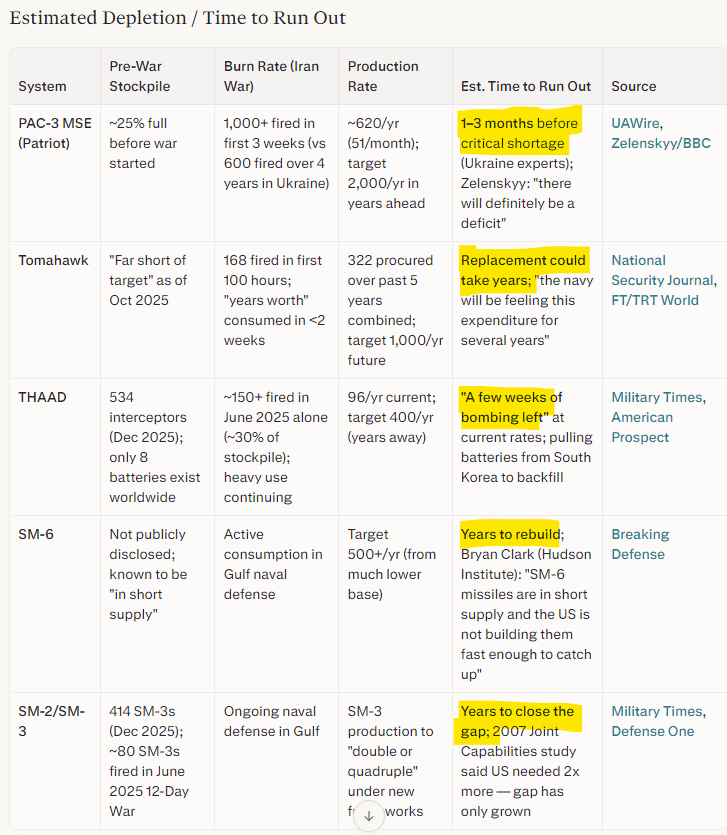
We asked AI for some help on this bit of research (not quite taking our job but it was certainly very helpful):
This table shows how many different US weapon systems were used up in the last 3 weeks versus annual production of those systems:
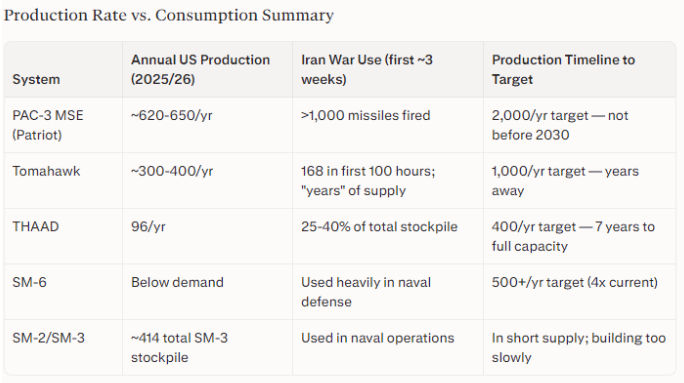
And here are some estimated “time remaining until stocks run out” for each weapon system:
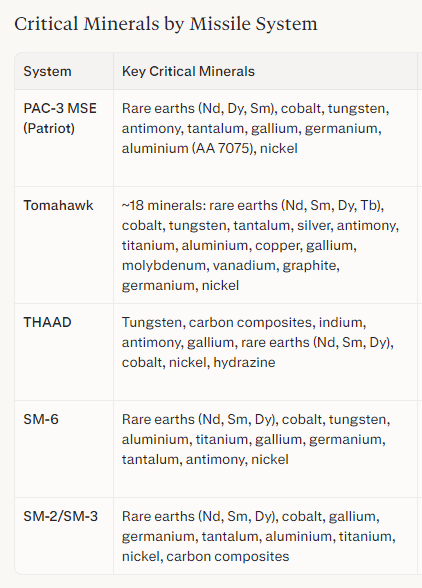
And finally, here are the critical metals needed to build each system:
(source, source, source, source)
Across four key systems, the same handful of minerals keep appearing — and they're the ones with the most concentrated supply chains in “adversarial countries”:
- Rare earths (neodymium, samarium, dysprosium, terbium) — China controls ~90% of processing
- Tungsten — China produces ~80% globally
- Antimony — China + Russia control ~80%
- Gallium & germanium — China dominates and has imposed export restrictions
- Cobalt — DRC produces ~70%, heavily Chinese-financed
- Tantalum — Central Africa dominates supply
As Amanda Van Dyke notes in this article (this is a good read), every batch of missiles fired "quietly chips away at global stocks of tungsten, antimony, tantalum and rare earths"
And the US industrial base cannot currently replace them without Chinese supply chains.
The 2027 ban on Chinese-origin rare earth magnets in defence procurement makes securing alternative supply even more urgent.
With all this in mind, we think the panic selling that also swept up US based military minerals stocks is overdone.
US military minerals stocks we are Invested in:
- SS1 ($252M) - Silver & antimony in Nevada, USA.
- RML ($101M) - Gold, tungsten and antimony in Idaho
- LKY ($59M) - Antimony and rare earths in California.
- AW1 ($45M) - Indium (& gallium) in Utah, copper in Canada (includes base metals).
- VKA ($39M) - Tungsten in Nevada.
- ION ($23M) - Rare earths (and other critical minerals) recycling, with a presence in the USA.
- LSR ($23M) - Heavy rare earths in Arizona (also copper in Chile plus also gold in Western Australia).
- OD6 ($22M) - Fluorspar in Nevada (plus rare earths in Western Australia).
Summary
The situation in Iran has created a bit of panic and the selling is indiscriminate.
It's not the first market panic we have held through (not even the first one in the last 12 months - Tariff “Liberation Day”)
And it won’t be the last.
We still think the gold, silver and US critical minerals themes will be strong over the coming years.
(not to mention AI metals and Robot metals)
And in recent years it feels like the markets bounce back more and more quickly from the crisis of the month - lets see what happens next week.
See you next week, and have a great weekend
Next Investors
General Information Only
This material has been prepared by StocksDigital. StocksDigital is an authorised representative (CAR 000433913) of 62 Consulting Pty Limited (ABN 88 664 809 303) (AFSL 548573).
This material is general advice only and is not an offer for the purchase or sale of any financial product or service. The material is not intended to provide you with personal financial or tax advice and does not take into account your personal objectives, financial situation or needs. Although we believe that the material is correct, no warranty of accuracy, reliability or completeness is given, except for liability under statute which cannot be excluded. Please note that past performance may not be indicative of future performance and that no guarantee of performance, the return of capital or a particular rate of return is given by 62C, StocksDigital, any of their related body corporates or any other person. To the maximum extent possible, 62C, StocksDigital, their related body corporates or any other person do not accept any liability for any statement in this material.
Conflicts of Interest Notice
S3 and its associated entities may hold investments in companies featured in its articles, including through being paid in the securities of the companies we provide commentary on. We disclose the securities held in relation to a particular company that we provide commentary on. Refer to our Disclosure Policy for information on our self-imposed trading blackouts, hold conditions and de-risking (sell conditions) which seek to mitigate against any potential conflicts of interest.
Publication Notice and Disclaimer
The information contained in this article is current as at the publication date. At the time of publishing, the information contained in this article is based on sources which are available in the public domain that we consider to be reliable, and our own analysis of those sources. The views of the author may not reflect the views of the AFSL holder. Any decision by you to purchase securities in the companies featured in this article should be done so after you have sought your own independent professional advice regarding this information and made your own inquiries as to the validity of any information in this article.
Any forward-looking statements contained in this article are not guarantees or predictions of future performance, and involve known and unknown risks, uncertainties and other factors, many of which are beyond our control, and which may cause actual results or performance of companies featured to differ materially from those expressed in the statements contained in this article. S3 cannot and does not give any assurance that the results or performance expressed or implied by any forward-looking statements contained in this article will actually occur and readers are cautioned not to put undue reliance on forward-looking statements.
This article may include references to our past investing performance. Past performance is not a reliable indicator of our future investing performance.