Who wins on the battlefield when everyone's jamming everyone?
Published 30-MAY-2026 15:57 P.M.
|
10 minute read
Disclosure: S3 Consortium Pty Ltd and its associated entities may hold direct or indirect interests in securities referred to in this publication and may receive fees or other forms of consideration from entities mentioned. These interests and arrangements may create a potential conflict of interest in the preparation of this material.
The information contained in this communication is provided for general information purposes only and may relate to speculative investments. It does not constitute financial product advice, and has been prepared without taking into account your personal objectives, financial situation or needs. You should consider obtaining independent financial advice before making any investment decision.
Any forward-looking statements are uncertain and not a guaranteed outcome.
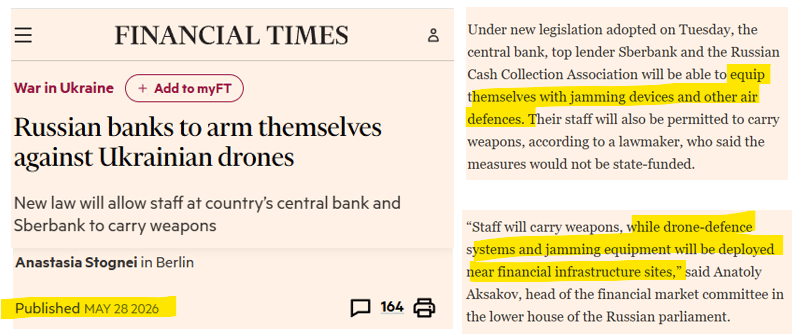
Two days ago, Russia passed legislation allowing banks and financial institutions to operate their own anti-drone defence systems.
Specifically including the jamming of drone communication signals.
(source)
Has “comms link jamming” just gone mainstream?
And how did we arrive at laws for banks being allowed to jam comms links?
The modern day battlefield is more and more reliant on comms link resilience.
The surging numbers of remote operated, unmanned, drones, robots, boats and vehicles on BOTH sides all require communication (comms) links...
Comms links for remote-control, sending back full HD (ideally) video to the operator, receiving commands from the operator and sharing it all live with central command and control.

In 2026, battles are won on which side can best maintain comms and connectivity.
Our latest Investment, Harvest Technology Group (ASX: HTG), has a technology called Nodestream that solves this “comms link resilience" problem.
HTG’s Nodestream tech COMPRESSES mission-critical data to survive the thinnest, most degraded pipes (comms links).
HTG’s Nodestream tech intelligently squeezes HD video, voice, telemetry, and control data through ANY connection that happens to be available: satellite, cellular, RF, or any combination.
HTG’s tech is especially important when the other side is doing their best to jam and severely degrade your comms links.
Read our full HTG launch note here
As part of our due diligence on our HTG Investment, over the last couple of weeks we have been heavily researching all the latest in battlefield technology.
What is currently in use... and what's coming next.
Plus the second and third order effects of these new technologies in real world use.
So what are the events that led up to Russia mandating banks to deploy drone communications jamming systems two days ago?
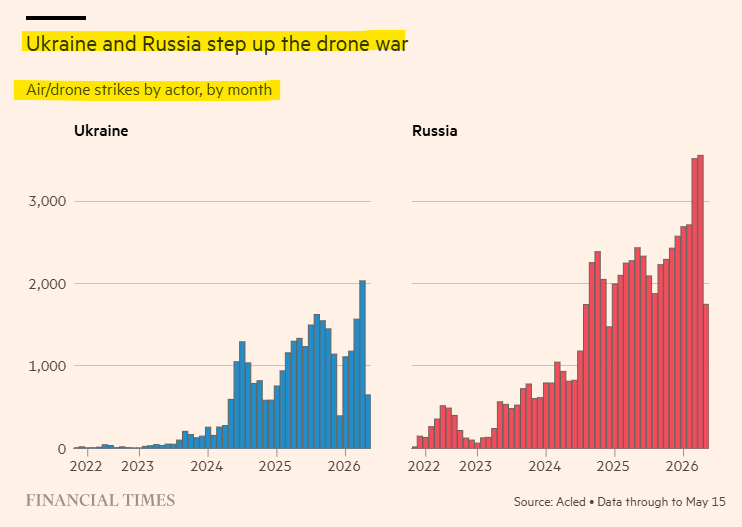
Remote operated small drones have become one of the key tactics in the Ukraine vs Russia war that started in 2022 - and their use is only growing:
(Source)
Small, cheap, plentiful and remote operated drones were the “first cab off the rank” around 2022 when the Russia-Ukraine war started.
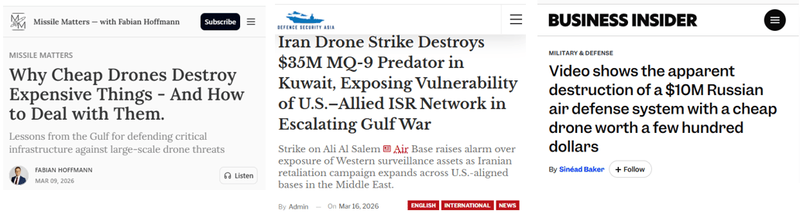
We started seeing headlines like “$20,000 drone takes out $2M tank” - and those headlines are still flowing now:
So how to stop these cheap drones?
Fire some million dollar anti-aircraft missiles at them?
In Ukraine and now more recently in Iran, there have been reports of up to $4 million a pop US missiles being used to take out cheap drones.

The economics of this defence strategy definitely doesn’t stack up.
So as the use of small, relatively inexpensive, remote operated drones, robots, boats and vehicles increases in live conflicts...
It's back to the strategic drawing board for all major militaries... and fast.
And rethinking how to beef up their defences against remote operated, unmanned attacks.
The easiest and most obvious way to defend against remote controlled attacks?
Jam up the communications links.
For an effective remote controlled weapon, you need a communication link.
(for the operator to send control instructions AND a quality video feed sent back for the operator to see where it's going and make decisions).
This is especially important now that remote operated drone attacks are spilling OUT of the war zone itself and attacking strategic non-military targets - like banks in Moscow:
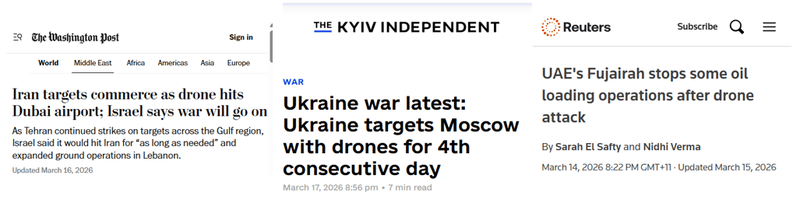
Which is why Russia has legislated comms link jamming systems at banks and financial institutions.
A clear sign of the rapidly growing urgency of comms link jamming - even for strategic and critical non-military targets.
(we doubt this will be the last of these kind of headlines we will see)
Back closer to the actual battlefield, everybody's going to be jamming each other as much as possible.
The side that can best maintain resilient communications links to keep their remote operated unmanned drones, robots, boats and vehicles operating, will win.
(which is where our new Investment HTG comes in)
And it turns out - the Russians are very good at jamming.
This week the Real Eisman Playbook podcast released an episode on defence stocks - interviewing Peter Arment, who is a senior research analyst covering Aerospace & Defense.

(How Silicon Valley Took Over the Defense Industry with Peter Arment | The Real Eisman Playbook Ep 61)
Skip to the following in the video for the bits relevant to HTG:
- ~45:14 - "The Russians aren't great at logistics. We saw that early on in the war."
- ~45:38 - "Where they are exceptional the Russians is in electronic jamming. So a lot of our early stuff that we sent over there didn't land on target because of the Russians' capability to jam things."
- ~46:03 - "Our drones or missiles that the Ukrainians were shooting at them missed because they got jammed."
So jamming is a key battle tactic... for both sides.
And how to BEAT comms link jamming is now the new and urgent problem to solve for both sides.
Last week when we spoke to the HTG Executive Chairman, former Australian Army two star Special Forces General, Jeff Sengelman, he had some very interesting battlefield stories for us.
Not surprising given his CV:
- Spent much of his career in special forces
- Earned his SAS Sandy Beret in 1987 at the age of 25
- Commanded 4th Battalion, Royal Australian Regiment (Commando) (2000–01)
- Commanded 6th Brigade (2010–11)
- Deployed on operations to East Timor and Iraq (Working as director of strategic operations with US General David Petraeus)
- Commander Forces Command (2011)
- Deputy Chief of Army (2011–2012)
- Head of Modernisation and Strategic Planning – Army (2012–2014)
- Special Operations Commander Australia (2014–2017, retirement)
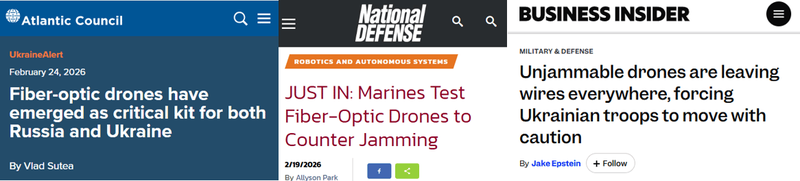
He told us about how Ukraine's (and Russia's) current fastest and best solution for getting around each other’s comms link jamming efforts is to have a fibre optic cable attached from the drone operator to the drone.
Yep - they’ve gone back to using wires.
Quickest - but not the best solution for range and getting tangled etc, but hey, it works.
Subsequently we had a deeper look into it and confirmed that both sides are using this:
ANOTHER solution would be to develop in-house anti-jamming or comms link resilience technology...
(which would take years)
OR
Find and apply already “tried and tested” comms link resilience solutions from the commercial sector.
This is what HTG is doing with its pivot from selling to commercial markets to fully focus on defence.
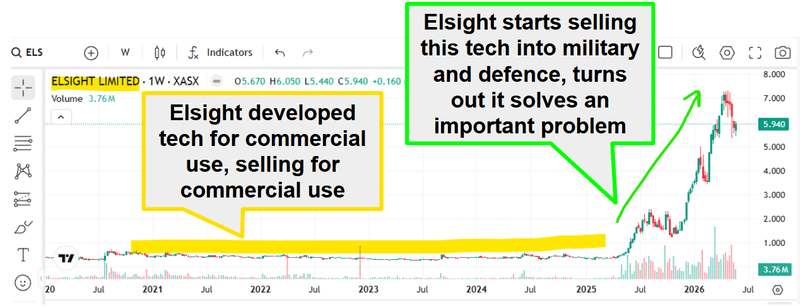
Following the same successful pivot by another ASX company (Elsight Ltd) that was selling comms link resilience tech into the commercial space.
Back in 2025, Elsight cleverly pivoted its “comms link resilience” technology from uses in the commercial sector to solving this newly emerging and urgent modern military battlefield problem.
Helping solve this new problem has seen Elsight’s share price run from 30c to a high of over $7 over just the last 12 months.
(and proven the demand is certainly there)
Elsight is now capped at $1.68BN.
(source)
The past performance is not and should not be taken as an indication of future performance. Caution should be exercised in assessing past performance. This product, like all other financial products, is subject to market forces and unpredictable events that may adversely affect future performance.
Elsight owns a drone connectivity platform that lets unmanned aircraft stay connected across LTE, 5G and satellite networks simultaneously.
Elsight’s tech works in drones and unmanned systems basically as a smart modem - taking whatever connection is available at any given time and then combining them into a single, more reliable connection.
So Elsight's strategy is essentially: "Use MORE networks to guarantee a connection."
HTG’s tech is more about bandwidth optimisation/compression technology - squeezing high-quality video, audio and data through a single weak, slow or unstable connection.
HTG’s tech is more designed for when networks are being jammed or contested (like they are on battlefields).
So HTG's strategy is essentially: "Use LESS bandwidth so even one single bad connection works... on ANY type of connection that happens to be available"
Both spent years deploying and refining their tech in the civilian commercial space - now both are applying their tech to a new and urgent battlefield problem.
HTG’s tech has logged over 500,000 operational hours in commercial sectors already (shipping, oil & gas etc ) and generated a total $12M revenue since 2021.
HTG’s tech is TRL 9 certified - the highest possible US Department of Defence “technology readiness” level. (source)
And as Elsight did in early 2025 when it was trading at 30c/share, HTG is now accelerating its move into the military and defence sector.
Where there is clearly a surge in demand for this kind of solution, based on Elsight's defence sales-led share price run to highs of $7.
Read our full HTG launch note here
This isn’t the first time that technology developed for civilian\commercial uses has been rushed onto a battlefield to solve a new and urgent problem.
Here are some more examples from the past where technology built for commercial uses was adapted to solve a speed-to-battlefield race when the problem is new or the procurement cycle is too slow (thanks AI for your help with this list):
Toyota Hilux pickups (1980s–present) - Civilian trucks became the default light cavalry across insurgencies and irregular forces, from Chad's "Toyota War" against Libya in 1987 to ISIS convoys. Cheap, reliable, and easy to mount a heavy weapon on.
DJI quadcopters (2014–present) - Consumer hobby drones were rigged with grenade drops by ISIS in Mosul around 2016, then industrialised by both sides in Ukraine from 2022. A $1,000 Mavic destroying a $3M tank is now routine.
Starlink terminals (2022) - SpaceX's consumer satellite internet kit became Ukraine's battlefield comms backbone within weeks of the Russian invasion, after traditional military satcom proved insufficient.
GoPros and smartphones (2010s–present) - Used for real-time reconnaissance, artillery spotting, and propaganda. Hezbollah, ISIS, and Ukrainian/Russian units all built workflows around consumer cameras.
FedEx-style logistics thinking in Desert Storm (1991) - The US military borrowed barcode tracking and commercial shipping logistics to manage the largest deployment since WWII.
Cell phones as IED triggers (Iraq/Afghanistan, 2003–onward) - Insurgents used Nokia handsets and key fobs to detonate roadside bombs, forcing the US to spend billions on jammers (CREW systems).
Civilian aircraft conversions (WWI–WWII) - De Havilland airliners, Ford Trimotors, and Junkers Ju 52s were pressed into bombing and transport roles before purpose-built military versions existed.
Merchant ships –> Q-ships and escort carriers (WWI/WWII) - Cargo vessels were rapidly converted to anti-submarine decoys and small aircraft carriers when shipyards couldn't build dedicated hulls fast enough.
Jeeps and Willys MB (WWII) - Originated as a quick commercial-style design contest; became the universal light vehicle of Allied forces within months.
Commercial GPS receivers (Gulf War, 1991) - The military hadn't fielded enough Magellan/Trimble units, so troops bought civilian handhelds with their own money for desert navigation.
Encrypted messaging apps (Signal, Telegram, 2014–present) - Used operationally by Ukrainian territorial defence, Syrian rebels, and Hong Kong protesters for coordination when military comms weren't available.
3D printing in Ukraine (2022–present) - Volunteers print drone bomb-release tails, tourniquet clips, and parts for damaged equipment using hobbyist Prusa/Bambu printers.
Have a great weekend.
Next Investors
Did someone forward this to you? Subscribe Here
General Information Only
This material has been prepared by StocksDigital. StocksDigital is an authorised representative (CAR 000433913) of 62 Consulting Pty Limited (ABN 88 664 809 303) (AFSL 548573).
This material is general advice only and is not an offer for the purchase or sale of any financial product or service. The material is not intended to provide you with personal financial or tax advice and does not take into account your personal objectives, financial situation or needs. Although we believe that the material is correct, no warranty of accuracy, reliability or completeness is given, except for liability under statute which cannot be excluded. Please note that past performance may not be indicative of future performance and that no guarantee of performance, the return of capital or a particular rate of return is given by 62C, StocksDigital, any of their related body corporates or any other person. To the maximum extent possible, 62C, StocksDigital, their related body corporates or any other person do not accept any liability for any statement in this material.
Conflicts of Interest Notice
S3 and its associated entities may hold investments in companies featured in its articles, including through being paid in the securities of the companies we provide commentary on. We disclose the securities held in relation to a particular company that we provide commentary on. Refer to our Disclosure Policy for information on our self-imposed trading blackouts, hold conditions and de-risking (sell conditions) which seek to mitigate against any potential conflicts of interest.
Publication Notice and Disclaimer
The information contained in this article is current as at the publication date. At the time of publishing, the information contained in this article is based on sources which are available in the public domain that we consider to be reliable, and our own analysis of those sources. The views of the author may not reflect the views of the AFSL holder. Any decision by you to purchase securities in the companies featured in this article should be done so after you have sought your own independent professional advice regarding this information and made your own inquiries as to the validity of any information in this article.
Any forward-looking statements contained in this article are not guarantees or predictions of future performance, and involve known and unknown risks, uncertainties and other factors, many of which are beyond our control, and which may cause actual results or performance of companies featured to differ materially from those expressed in the statements contained in this article. S3 cannot and does not give any assurance that the results or performance expressed or implied by any forward-looking statements contained in this article will actually occur and readers are cautioned not to put undue reliance on forward-looking statements.
This article may include references to our past investing performance. Past performance is not a reliable indicator of our future investing performance.