TRI: Drink this water - it could tell you if you have cancer
Disclosure: S3 Consortium Pty Ltd (the Company) and Associated Entities own 23,820,000 TRI Shares at the time of publishing this article. The Company has been engaged by TRI to share our commentary on the progress of our Investment in TRI over time. This information is general in nature about a speculative investment and does not constitute personal advice. It does not consider your objectives, financial situation, or needs. Any forward-looking statements are uncertain and not a guaranteed outcome.
Doctors use MRI scans to spot brain tumours, but the earliest cancer cells can be too small to see.
And we all know that the earlier a cancer is detected, the easier it is to treat.
Here’s an MRI machine - they are those giant tunnels that patients go into (MRI stands for Magnetic Resonance Imaging):
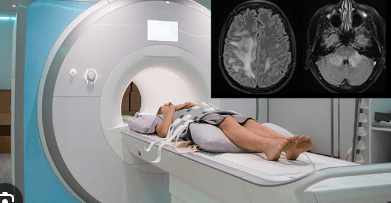
PET scans offer another approach - injecting a radioactive tracer into the body (yikes) that shows what your cells are doing, not just what they look like.
But PET scans use radioactive ingredients that decay quickly, making production and delivery tricky.
And radiation all adds up in a human body, so doctors space out PET scans, and extra caution is needed for children and pregnant women.
Less than ideal.
Our biotech Investment, the $10M capped TrivarX (ASX:TRI), plans to start human safety trials next quarter for technology designed to make brain cancer cells stand out:
WITHOUT needing radioactive ingredients.
BEFORE the cancer is even visible in any existing imaging methods.
IF it works, doctors could spot cancer earlier using EXISTING MRI machines.
In short, TRI is trying to make a safe MRI scan do a job that currently needs a damaging radioactive PET scan.
(an easier path to market because TRI could extend the effectiveness of current imaging methods using the tens of thousands of existing MRI machines out there that doctors already know and love)
TRI’s tech involves a patient drinking a special type of water BEFORE they go for an MRI, and it lights up cancer cells like a Christmas tree - even very early stage cancer cells.
Meanwhile, three cancer imaging takeovers have been announced in roughly four months, with buyers spending billions on the imaging sector.
Including ASX favourite Telix Pharmaceuticals paying $1.6BN upfront for ITM Isotope Technologies (producer of imaging agents).
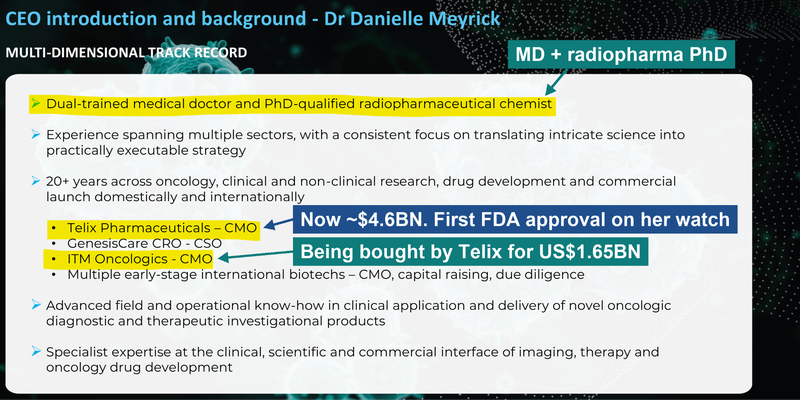
By the way - TRI’s CEO Dr Danielle Meyrick was Chief Medical Officer for both those companies:
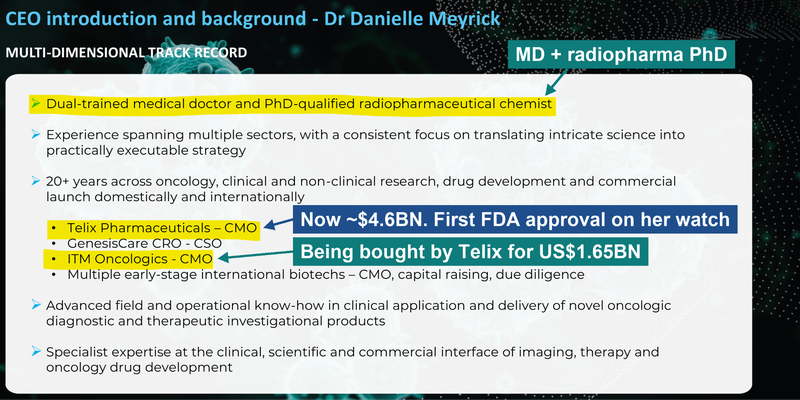
(source)
A great track record in the space, and highly qualified - she has now taken up the CEO role at tiny TRI.
She must have been impressed with TRI’s technology...
Think of this next wave of imaging as highlighting suspicious cells earlier than ever, rather than waiting for a visible lump (when already it's too late).
TRI’s tech is currently pre-clinical BUT the Phase 1 trial starts next quarter.
And in the quarter after that, we will start to see some in-human data.
(as well as some animal data which is coming before the end of the year - and we know the ASX loves pre-clinical animal data)
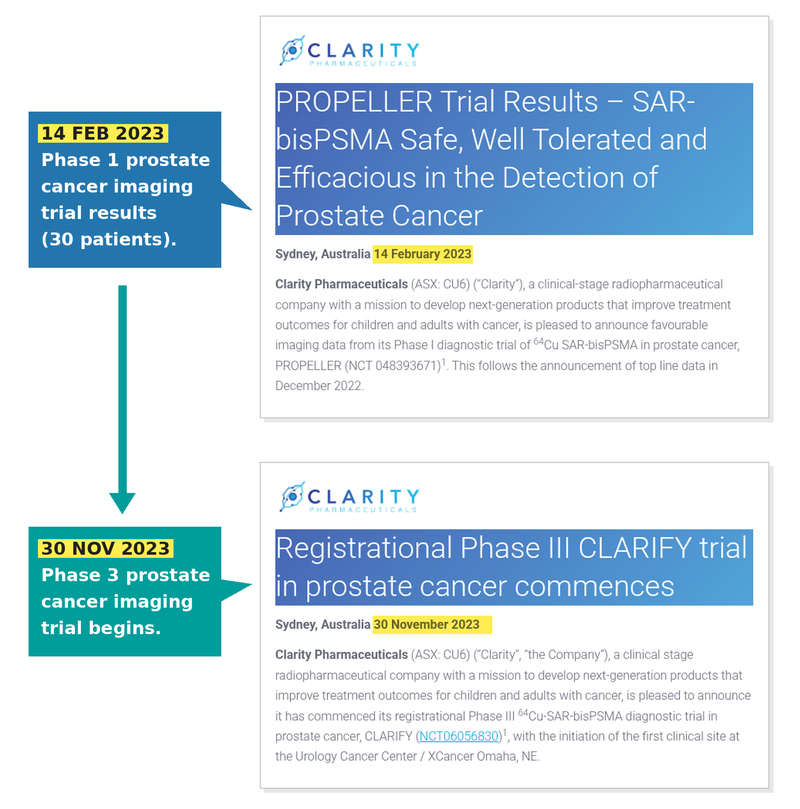
Clarity Pharmaceuticals’ move from a 30-patient Phase 1 imaging trial DIRECTLY into Phase 3 offers a potential precedent for TRI. (source)
The good thing about Phase 1 safety trials in imaging is that it can be argued that the Phase 1 results can provide enough safety AND ALSO diagnostic-performance evidence to support moving directly into Phase 3, so if the FDA agrees it can go straight to Phase 3 = faster to market.
No guarantees of course - at this stage, TRI’s phase 1 is about producing safety data - we don’t know if/when TRI will have imaging data.
TRI’s tech is basically water with a couple of extra steps: you drink water enriched with a heavier, non-radioactive form of hydrogen, then have an MRI.
Sounds pretty safe to us - lets see if the Phase 1 clinical trial data matches...
So how does TRI’s tech work?
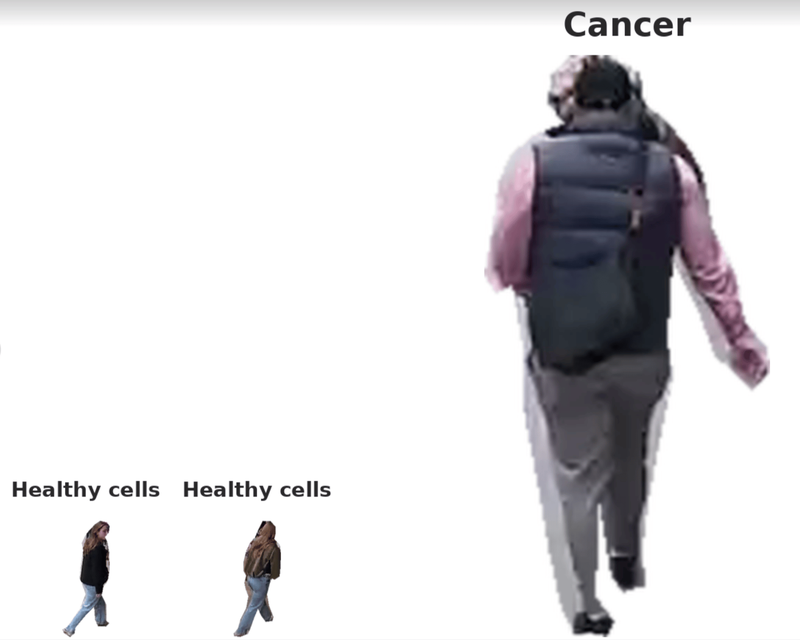
In this analogy, if people in a giant crowd are cells in the body, imagine trying to find early stage cancer cells when they look like everyone else:

TRI’s drink goes into the body and acts sort of like the “cancer version” of the “spray painting of pickpockets” exposers you come across when doomscrolling instagram:
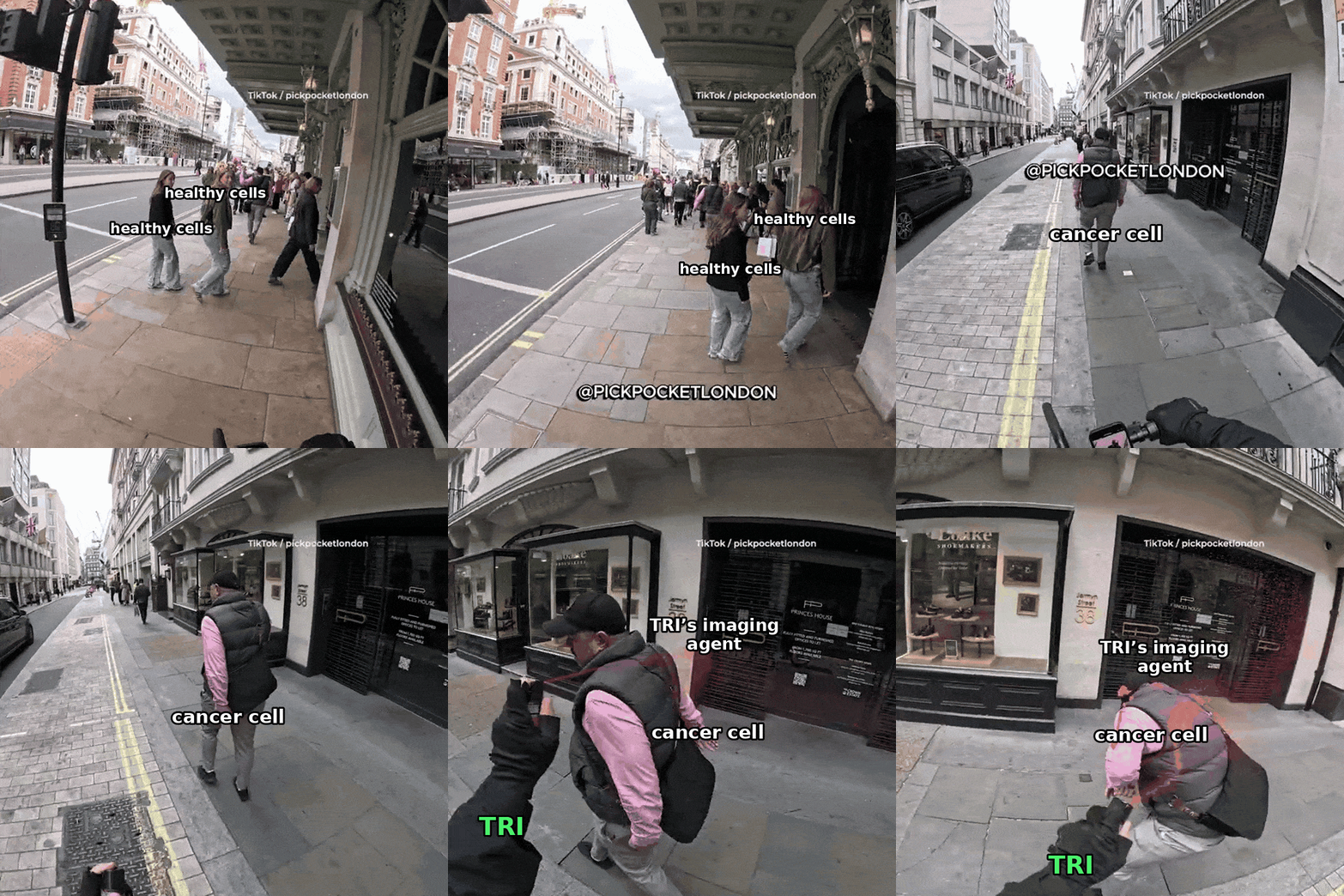
(better than spraying radiation and some of the spray hitting healthy cells like in a PET scan)
AND better than the current MRI standard of care would only be able to see the cancer if it were 10x the size of the healthy cells:
As mentioned earlier, cancer imaging AND especially alternative imaging tech (like TRI’s) is hot right now.
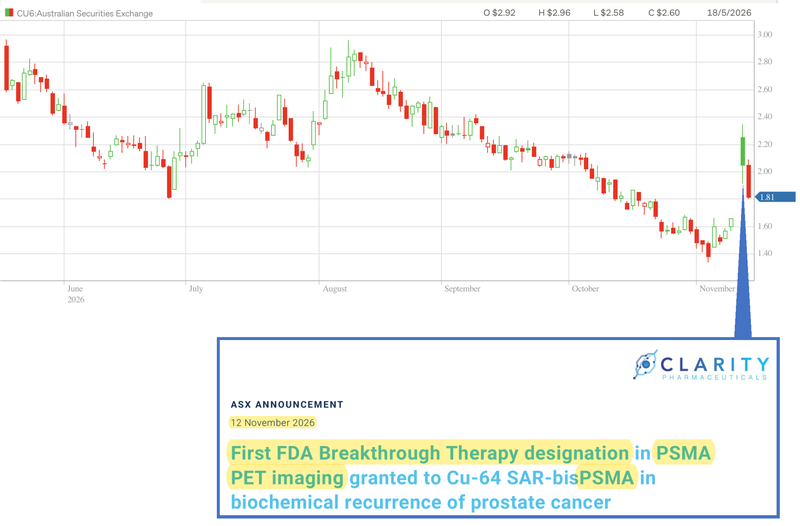
Last Thursday the FDA gave ASX listed $690M Clarity Pharmaceuticals a "Breakthrough Therapy" designation for its prostate cancer imaging agent.
It's the first Breakthrough designation the FDA has ever given in that type of imaging. (source)
That announcement alone added ~$58M to Clarity’s market cap in a single day:
The past performance is not and should not be taken as an indication of future performance. Caution should be exercised in assessing past performance. This product, like all other financial products, is subject to market forces and unpredictable events that may adversely affect future performance.
Also, in September the FDA approved $4.6BN Telix Pharmaceuticals PET imaging agent for glioma (brain tumour). (source)
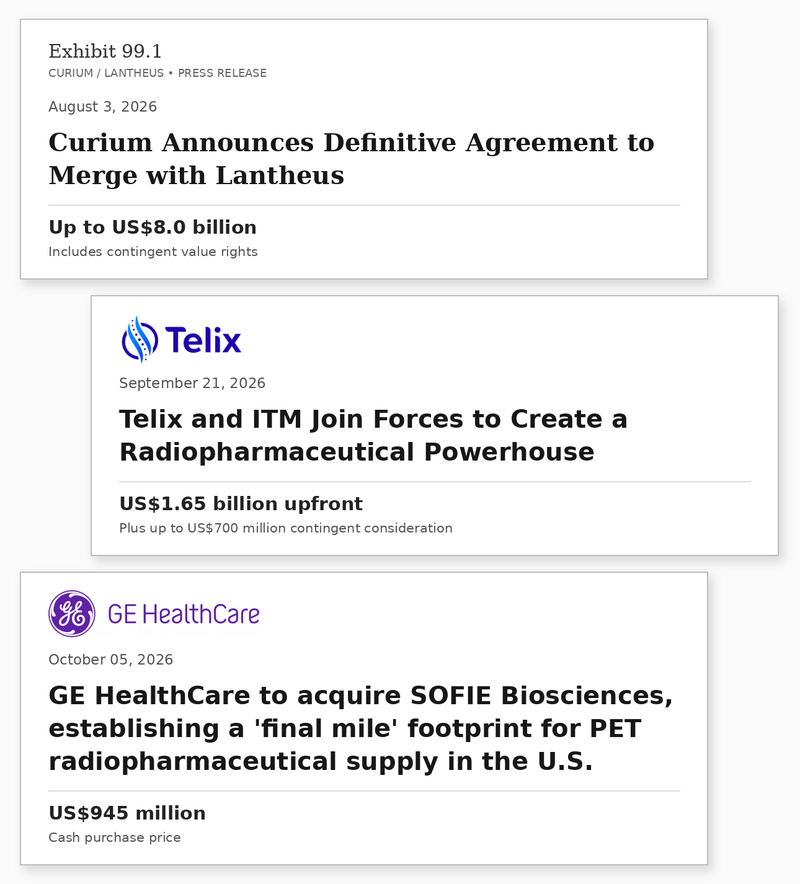
And over the last ~4 months there's been three takeovers in the “imaging agent” space:
- In August: Curium agreed to buy US imaging agent maker Lantheus for up to US$8BN. (source)
- In September: $4.6BN Telix Pharmaceuticals agreed to buy isotope maker ITM for US$1.65BN upfront + milestones. (source)
- And in October: US$38BN GE HealthCare agreed to buy Sofie Biosciences for US$945M. (source)
All of the big companies mentioned above have imaging agents that are radioactive and two of the three deals above were done to accommodate the shortcomings of those radioactive imaging agents.
GE’s reasoning for its deal was for the "final mile" of its delivery chain - its ability to get radioactive material to a hospital ASAP, before it decays and becomes useless.
Telix’s purchase of ITM was for its isotope (radioactive material) production.
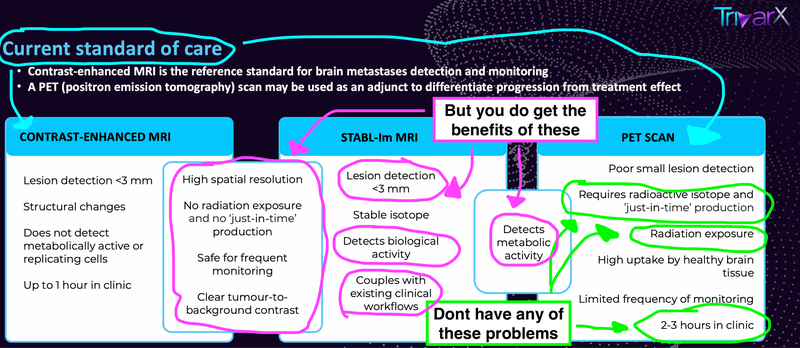
TRI’s tech has no radiation
So IF it works, it could do the job of the current standard of care (contract enhanced MRI and PET scans) without any of the drawbacks (time, radiation, early detection issues etc):
IF the big players in the imaging space are willing to pay billions of dollars to address the drawbacks of working with radioactive isotopes.
Then we think anything that is non-radioactive, and able to do at least an equivalent (if not better) job could be massive.
And as a result we expect to see TRI’s valuation re-rate as the tech is de-risked with clinical trials.
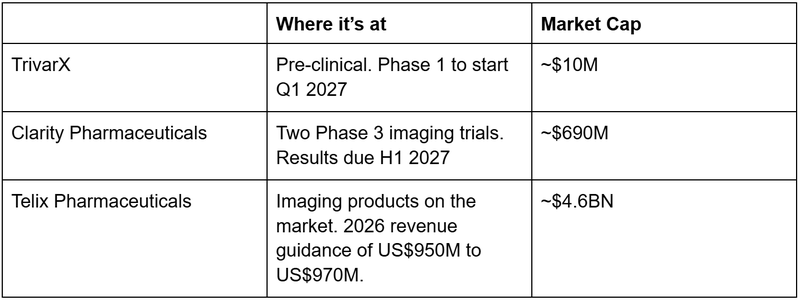
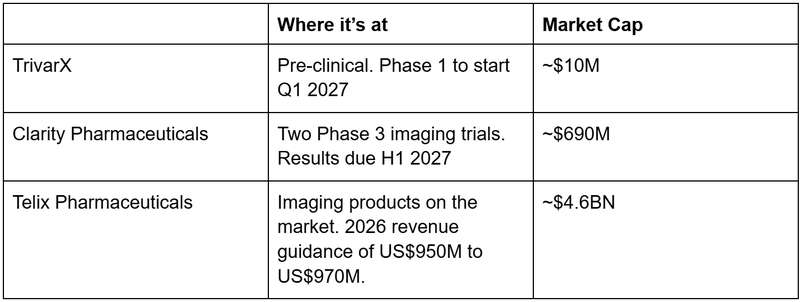
Here is how TRI compares on a very basic level to the two companies we mentioned earlier:
The past performance is not and should not be taken as an indication of future performance. Caution should be exercised in assessing past performance. This product, like all other financial products, is subject to market forces and unpredictable events that may adversely affect future performance.
We think TRI can close the valuation gap to Clarity a lot quicker than the market thinks - remember TRI is about to start its phase 1 study (Q1-2027).
It only took Clarity ~9 months to go from phase 1 results to starting a phase 3 trial.
Anyway...
TRI has a connection to $4.6BN Telix AND the company Telix is paying US$1.65BN for
As we pointed out above, TRI's CEO, Dr Danielle Meyrick, has been Chief Medical Officer at both Telix and ITM.
Dr Meyrick was Telix's Chief Medical Officer (APAC) and Global Head of Clinical Science between Jan 2021 and July 2022.
(Telix's first product, a prostate cancer imaging agent, was approved by the FDA in December 2021 - while she was there)
Telix is buying ITM for US$1.65BN.
After leaving Telix she became Chief Medical Officer at ITM Isotope Technologies. (source)
(source)
So the little old $10M capped TRI’s CEO has spent 20+ years in the isotope-based imaging space AND in some of the biggest names in the game - especially here on the ASX.
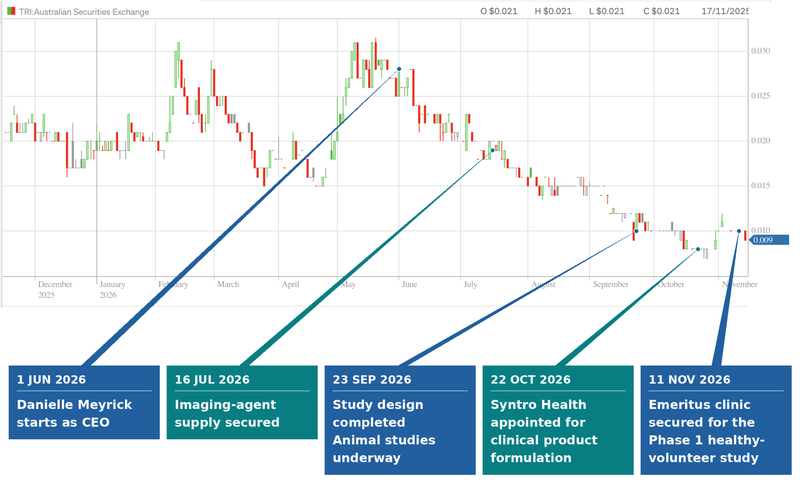
She started with TRI on the 1st of June and has since secured supply of its imaging agent, finished its study design, started animal studies, appointed a manufacturer and locked in a clinic for its phase 1 trials.
However during this time, TRI’s share price is down ~68% and now the company is valued at $10M.
Frustrating... markets don't make a lot of sense right now - good news = sell, bad news = sell...
TRI looks to be another victim of the indiscriminate small ASX stock sell off that started in May this year, and has pounded most of our Portofolio:
Here is the broader performance of our a basket of our small ASX stocks - the broad sell off started in May:
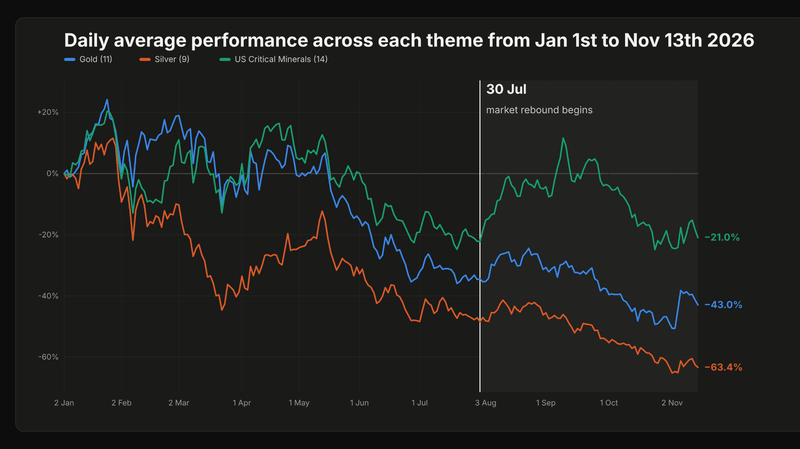
TRI’s share price drop is in line with sentiment down trend - despite lots of positive news flow (it even has that little post US midterm election bump up two weeks ago):
The past performance is not and should not be taken as an indication of future performance. Caution should be exercised in assessing past performance. This product, like all other financial products, is subject to market forces and unpredictable events that may adversely affect future performance.
We think that now, as TRI moves into the clinic (and hopefully broader market sentiment improves), TRI’s share price could really start to move.
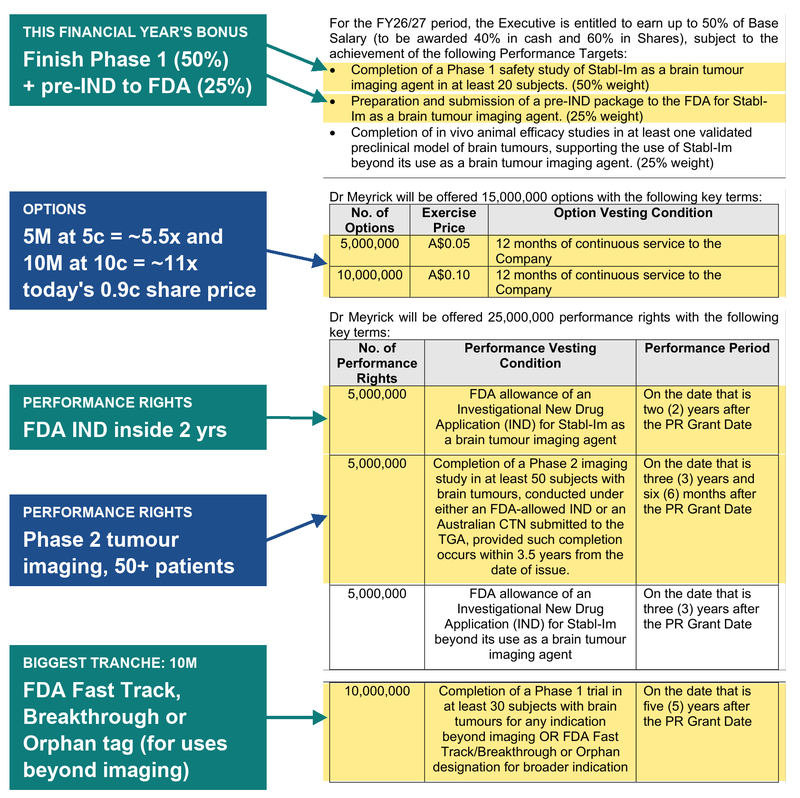
Especially if Dr Danielle is able to trigger a few of her performance milestones:
(source)
We think TRI’s path to FDA approvals might be a lot shorter than the market is giving it credit for
No doubt, TRI’s tech is in a relatively early stage - set to start its first phase 1 human trial in Q1 next year.
When most investors hear "Phase 1" they are usually thinking about Phase 1’s within the context of a drug developer.
With Phase 1, Phase 2 and Phase 3 still to come - potentially tens of millions of dollars and years before any conclusive data is seen on the effectiveness of the drug.
TRI isn’t developing a drug
TRI’s tech is a non-radioactive imaging agent.
Here is why we think TRI could get to regulatory approvals a lot quicker than the market thinks:
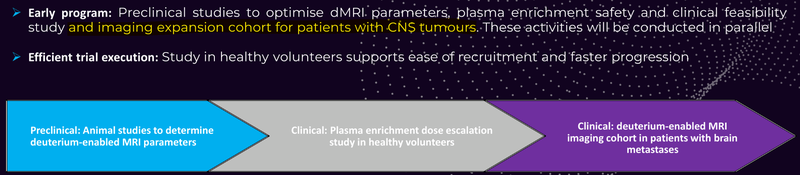
1. We will get to see some “effectiveness” data INSIDE the phase 1 study - a first look at whether it WORKS
With a drug, Phase 1 is usually for safety and then Phase 2 is when the drug's effectiveness is tested.
For imaging agents - when testing safety, you are administering the agent - so you can also check if the agent is coming up in imaging or not.
That is what TRI's “expansion cohort” could be for.
So the whole point of TRI’s tech being “does a tumour light up in a human?” could be shown inside the phase 1 studies (assuming that expansion cohort is related to that)
(source)
2. The FDA has approved imaging agents on small trials before
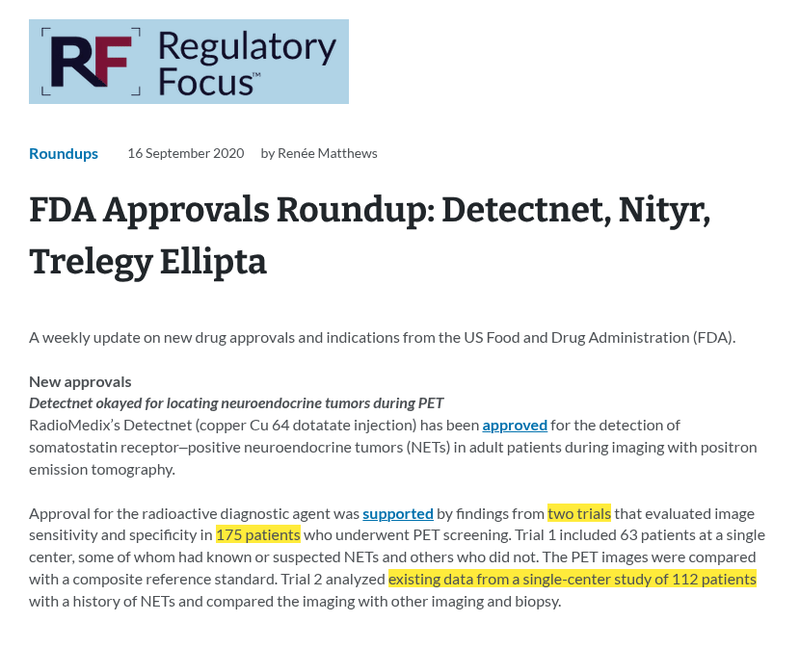
In 2020 the FDA approved a PET imaging agent on just two trials covering 175 patients in total AND data from an existing study (not run by that company). (source)
(Phase 3 drug trials usually enrol hundreds/thousands of patients across multiple sites over years).
3. $690M Clarity Pharmaceuticals went straight from Phase 1 trials to Phase 3 trials - we think TRI could too
Clarity's first trial on its prostate imaging agent was a Phase 1 in 30 patients.
Based on those results, Clarity went directly into a Phase 3 "registrational" trial (the precursor for FDA approvals). (source)
AND... Clarity’s is radioactive, TRI’s isn’t.
Remember this from before...
We think that TRI could get to that phase 3 stage a lot quicker than the market thinks:
The past performance is not and should not be taken as an indication of future performance. Caution should be exercised in assessing past performance. This product, like all other financial products, is subject to market forces and unpredictable events that may adversely affect future performance.
We are obviously biased here as TRI shareholders - there is no guarantee any of the above have an impact on how quickly TRI’s tech is developed.
We will need to wait for TRI to get some FDA feedback first.
We note TRI is targeting the first half of 2027 for when it starts thinking about regulatory pathways, preparing and submitting a pre-IND (Investigational New Drug) package to the FDA is one of the CEO's bonus targets for this financial year (source).
Before then, TRI will have 3 catalysts
First, TRI will have two sets of results due before the end of this year.
The first is TRI's animal studies (expected this quarter) (source)
It will be the first data TRI has generated itself on the tech - and we think the market has barely taken notice of it.
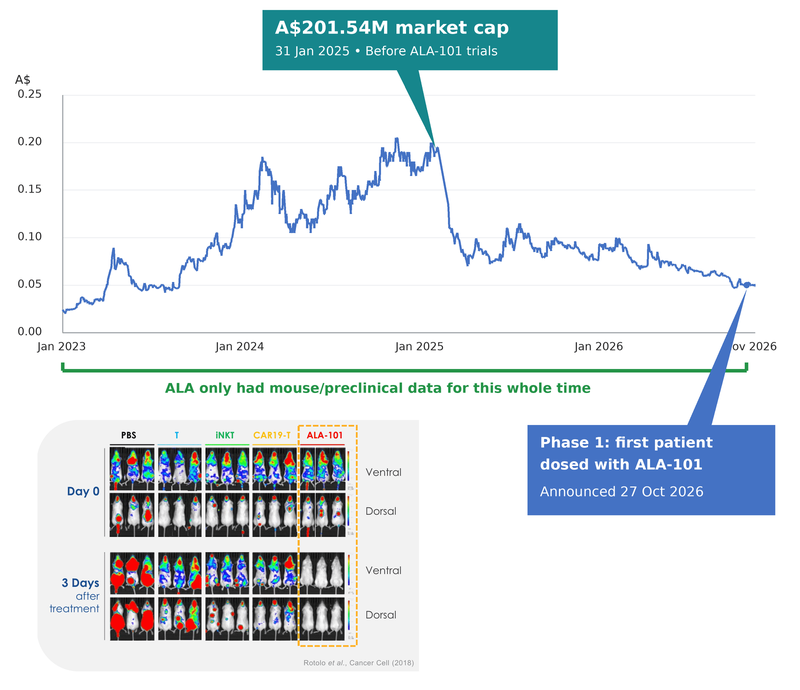
We think it could be important as we have seen how well small cap biotech’s can be re-rated on animal data alone.
One of our Past Investments - ALA - went to a market cap of ~$200M long before it started phase 1 trials:
The past performance is not and should not be taken as an indication of future performance. Caution should be exercised in assessing past performance. This product, like all other financial products, is subject to market forces and unpredictable events that may adversely affect future performance.
TRI also has lab studies happening right now looking at "potential new approach to imaging and therapy". (source)
Sounds mysterious - results from those are also due this quarter.
Who knows how the market will react to any of this.
Then the big one starting in Q1 next year - the phase 1 trial in healthy volunteers.
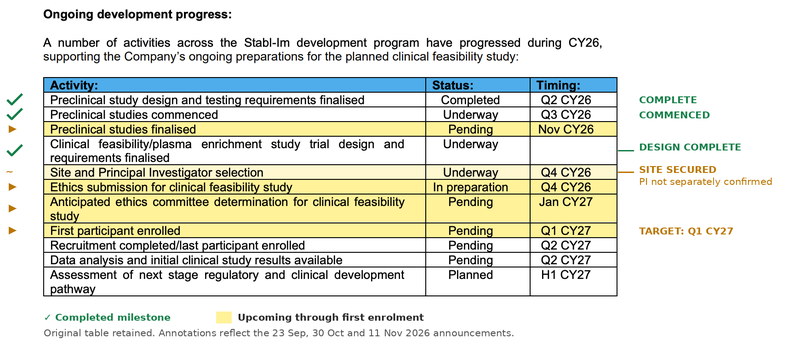
So far TRI has:
- ✅ Engaged trial specialists (May)
- ✅ Had a new CEO start (June)
- ✅ Secured product supply (July)
- ✅ Designed its study (September)
- ✅ Appointed a manufacturer (October)
- ✅ Locked in a clinic (last week)
Next, we want to see:
- Ethics approvals (which TRI expects to apply for this quarter).
- First participants enrolled in Q1 2027, and
- The first set of results in Q2 2027. (source)
8 reasons why we are Invested in TRI
Here are the 8 reasons we are Invested in TRI from our note on the 19th of May, 2026: TRI - Cancer diagnostics. Ex- $5BN Telix Chief starts as CEO in 13 days
(Here they are summarised - check out the note from May for the full take)
- Dr Daniel Tillett has delivered in the past for ASX investors - we are backing him again here
- Same backers behind our 2025 Biotech Pick of The Year
- Brain-tumour imaging that could be a game changer
- The ASX understands these stories.
- A peer comp is approaching a ~$5BN market cap
- TRI just appointed Telix's ex- Chief Medical Officer
- Small market cap relative to addressable opportunity
- Free hit on TRI's AI for detecting Current Major Depressive Episodes.
Ultimately, we are hoping a combination of the eight reasons above contribute to our TRI Big Bet as follows:
Our TRI Big Bet:
"TRI re-rates to a $300M+ market cap on successful clinical trial progress for its cancer diagnostics IP, and/or is acquired for multiples of our Initial Entry Price."
NOTE: our "Big Bet" is what we HOPE the ultimate success scenario looks like for this particular Investment over the long term (3+ years). The scenario is speculative and does not represent a valuation or forecast. There is no guarantee that our Big Bet will ever come true. There is a lot of work to be done, many risks involved, including clinical trial, regulatory and funding risks - just some of which we list in our TRI Investment Memo.
Success will require a significant amount of luck. Past performance is not an indicator of future performance.
What do we want to see from TRI next?
🔄 Phase 1 human trial
We want to see TRI get its "how much, for how long?" study started and finished.
Here are the milestones we are tracking:
- ✅ Trial design completed
- ✅ Product supply secured and manufacturer appointed
- ✅ Clinic appointed (NEW - last week)
- 🔲 Ethics submission (this quarter)
- 🔲 Ethics approval (January)
- 🔲 First participant enrolled (Q1 2027)
- 🔲 Phase 1 results (Q2 2027)
🔄 Animal studies / lab studies
Here are the milestones we are tracking:
- ✅ Animal studies started
- 🔲 Animal study results (this quarter)
- 🔲 Results from studies into other uses (this quarter)
What are the short-term risks?
The biggest risk for TRI right now is "Funding risk".
TRI had ~$1.96M in cash at the end of the September quarter.
We think it's a fairly healthy amount of cash to run a simple phase 1 trial BUT do typically see a cap raise get done when company cash balances are starting to get closer to that ~$1M mark.
We did notice TRI is refreshing its placement capacity at next week's AGM - so a raise could technically happen after that. (source)
Funding risk
TRI is pre-revenue. Phase 1 / Phase 2 trial costs typically run into millions of dollars per program. Additional capital raises are highly likely and may dilute existing shareholders, potentially at a discount to prevailing share prices.
Source: "What could go wrong" - TRI Investment Memo 19 May 2026
Other risks
Like any small-cap healthcare technology company, TRI carries significant risk, here we aim to identify a few more risks.
While TRI has locked in its clinic and manufacturer, the first study it has filed for is a healthy volunteer safety and dosing study. That study is not designed to show whether the tech can image a tumour, so that answer depends on a later imaging cohort in patients that TRI has not yet dated.
Although the Clarity designation and the three imaging takeovers we reference show the value in the space, they are with other companies, not TRI. None of them guarantee that TRI's non-radioactive approach will attract the same interest.
Given the FDA has approved imaging agents on small trials before, a shorter path is possible, but TRI has not yet had any FDA feedback. If the FDA asks for larger or longer studies, the path to approval could take longer than we expect.
TRI's timeline has already moved once, from a start in the second half of 2026 to first participants in Q1 2027. Ethics approvals, product preparation and recruitment could each push the Phase 1 start and the Q2 2027 results back further.
As TRI's animal studies are the first data it has generated on the tech, results that are mixed or need further optimisation could weigh on sentiment ahead of the human trial.
Investors should consider these risks carefully and seek professional advice tailored to their personal circumstances before investing.
Our TRI Investment Memo
You can read our TRI Investment Memo in the link below.
We use this memo to track the progress of all our Investments over time.
In our TRI Investment Memo, you can find the following:
- What does TRI do?
- The macro theme for TRI
- Our TRI Big Bet
- What we want to see TRI achieve
- Why we are Invested in TRI
- The key risks to our Investment Thesis
- Our Investment Plan
General Information Only
This material has been prepared by StocksDigital. StocksDigital is an authorised representative (CAR 000433913) of 62 Consulting Pty Limited (ABN 88 664 809 303) (AFSL 548573).
This material is general advice only and is not an offer for the purchase or sale of any financial product or service. The material is not intended to provide you with personal financial or tax advice and does not take into account your personal objectives, financial situation or needs. Although we believe that the material is correct, no warranty of accuracy, reliability or completeness is given, except for liability under statute which cannot be excluded. Please note that past performance may not be indicative of future performance and that no guarantee of performance, the return of capital or a particular rate of return is given by 62C, StocksDigital, any of their related body corporates or any other person. To the maximum extent possible, 62C, StocksDigital, their related body corporates or any other person do not accept any liability for any statement in this material.
Conflicts of Interest Notice
S3 and its associated entities may hold investments in companies featured in its articles, including through being paid in the securities of the companies we provide commentary on. We disclose the securities held in relation to a particular company that we provide commentary on. Refer to our Disclosure Policy for information on our self-imposed trading blackouts, hold conditions and de-risking (sell conditions) which seek to mitigate against any potential conflicts of interest.
Publication Notice and Disclaimer
The information contained in this article is current as at the publication date. At the time of publishing, the information contained in this article is based on sources which are available in the public domain that we consider to be reliable, and our own analysis of those sources. The views of the author may not reflect the views of the AFSL holder. Any decision by you to purchase securities in the companies featured in this article should be done so after you have sought your own independent professional advice regarding this information and made your own inquiries as to the validity of any information in this article.
Any forward-looking statements contained in this article are not guarantees or predictions of future performance, and involve known and unknown risks, uncertainties and other factors, many of which are beyond our control, and which may cause actual results or performance of companies featured to differ materially from those expressed in the statements contained in this article. S3 cannot and does not give any assurance that the results or performance expressed or implied by any forward-looking statements contained in this article will actually occur and readers are cautioned not to put undue reliance on forward-looking statements.
This article may include references to our past investing performance. Past performance is not a reliable indicator of our future investing performance.