

ILA - our bioterrorism defence stock. Now with clear line of sight to ~US$200M cash AND sales to US gov’ment stockpile?
Disclosure: S3 Consortium Pty Ltd (the Company) and Associated Entities own 3,834,720 ILA Shares at the time of publishing this article. The Company has been engaged by ILA to share our commentary on the progress of our Investment in ILA over time. This information is general in nature about a speculative investment and does not constitute personal advice. It does not consider your objectives, financial situation, or needs. Any forward-looking statements are uncertain and not a guaranteed outcome.
Our 2025 Biotech Pick of the Year, Island Pharmaceuticals (ASX:ILA), is developing a treatment for a deadly viral disease called Marburg Disease.
The US government classifies Marburg Disease as a Category A bioterrorism threat - the highest level.
Marburg is the only Category A biothreat with NO current vaccine or FDA approved treatment - making it a significant biowarfare risk.
The US’s Strategic National Stockpile is the US's largest federal repository of emergency medical countermeasures — vaccines, medicines, and supplies — designed to supplement state and local supplies during public health emergencies like pandemics, natural disasters, or terrorist attacks.
Marburg is the only Category A bioterror threat gap that remains unfilled within the US’s Strategic National Stockpile.
An FDA approved Marburg drug could lead ILA to US Government National Stockpiling deals... potentially worth hundreds of millions of dollars.
FDA approvals could also mean ILA is eligible for a “Priority Review Voucher” (PRV).
PRV’s are a tool the FDA uses to incentivise companies to develop treatments for viral diseases - these are tradeable on the open market and the most recent sale was a few weeks ago for US$200M (A$284M).
ILA is capped at ~A$103M - at the 35c raise price where the company just raised $9M.
(We Invested in this raise)
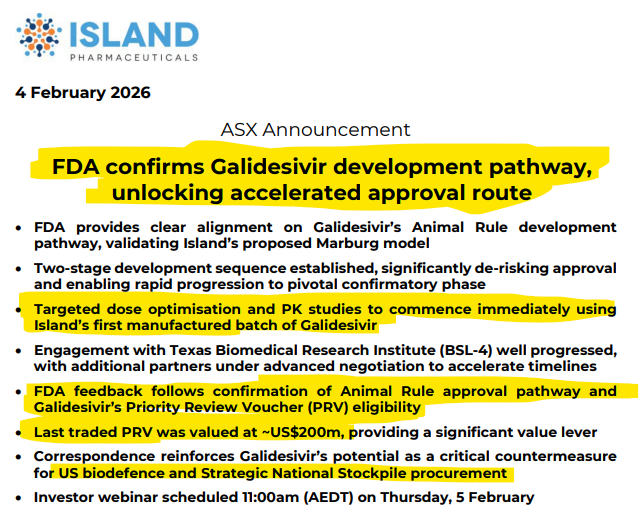
Today ILA announced that the US FDA has given it a clear pathway to fast track approvals.
(source)
Prior to today, the US Food and Drug Administration (the FDA) has already agreed that ILA’s Marburg disease drug would be eligible for:
- Fast track approvals using the Animal Rule process (skipping the 10-15 year phase 2 and 3 trial process), AND
- A Priority Review Voucher (PRV) - a tradeable voucher potentially worth US$200M+ on its own.
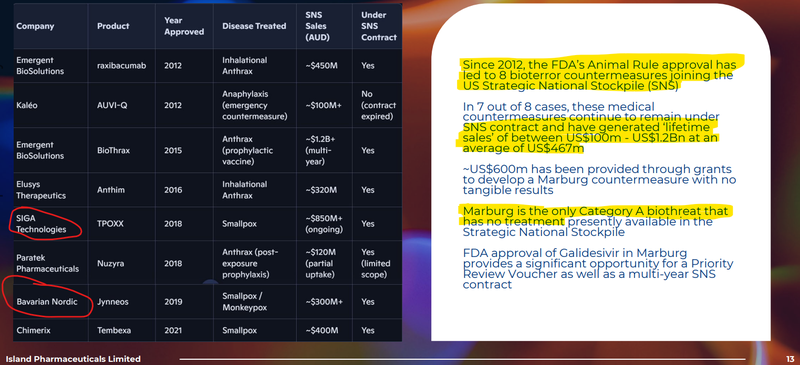
All products approved to date under the FDA’s Animal Rule have secured Strategic National Stockpile contracts averaging ~$US500M in lifetime value.
Today, the FDA confirmed exactly what ILA needs to do to get Animal Rule approvals across the line, split into two stages of clinical work with non-human primates.
(this could be the first biotech in Australia to get it)
As we mentioned above, ILA has just raised $9M - adding to its already strong cash balance of $6.87M at 31 Dec 2025.
Now, ILA’s approach is in line with six other APPROVED Animal Rule applications.
The first of those stages (an optimisation study) is “commencing immediately”....
(basically to work out the optimal dose and when the best time to administer that dose is)
And the second “pivotal confirmatory study” will follow right after.
The pivotal study will be when we see how effective ILA’s Marburg drug really is.
(fingers crossed it improves on the previous studies which had survival rates averaging 94% - more on those results later)
ILA will be hosting a webinar tomorrow, Thursday 5th February at 11:00 am AEDT - hopefully there are some more words on timelines from management then.
Stage 1 begins immediately... and according to ILA’s chair, Jason Carroll in a presentation in August last year, the entire process could be completed in under 12 months.
(Here is a link to ILA’s most recent presentation)
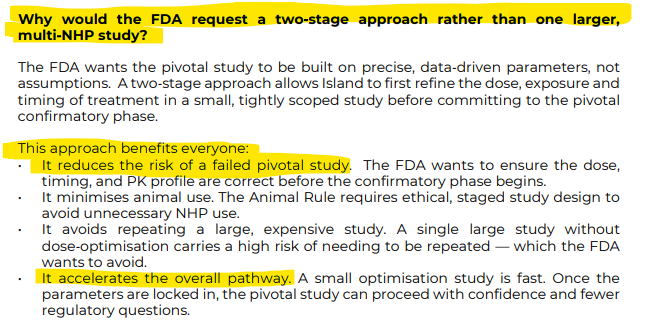
If we go off what this section of today’s announcement said then today’s announcement could actually bring that forward:
(source)
So we have one “small”, “fast” optimisation study, de-risking the regulatory risk of having a failed pivotal study...
(Sounds like the perfect type of trade off)
Especially when approvals could unlock:
- A Priority Review Voucher (PRV) that comes in if ILA’s Galidesivir is FDA approved - a recent PRV sale by Jazz Pharma was for US$200M. (source)
- US Government national stockpiling deals - these can be worth anything between US$100M to US$1.2BN ANNUALLY (check out that slide below).
We note ILA recently hired US advisors (Todd Strategy Group) and joined the Medical Countermeasures Coalition (MC2) to advance US government engagement initiatives.
Some well established companies are a part of the MC2 group including SIGA Technologies and Bavarian Nordic - both of which have received “Strategic National Stockpile” contracts:
(Source)
Yes, the US government stockpiles drugs - just like it stockpiles critical minerals.
If the US governments are willing to put A$17BN into building a critical minerals stockpile - just imagine how much they are willing to spend every year to be ready for potential “biological warfare”.
(more akin to military spending than it is spending for materials to make stuff)
“Biological warfare” is the deliberate use of biological agents like bacteria, viruses, or other toxins to harm or incapacitate humans during conflict.
ILA’s drug has already been shown to be effective against ~20 viruses in lab tests - many of which sit in the “weaponisable” category.
Marburg virus (the disease ILA is targeting first) is classified as a Category A bioterrorism threat (the highest level threat) by the US government (source).
And as mentioned earlier... Marburg is the only Category A biothreat with NO current vaccine or FDA approved treatment...
It's also one of the most deadly with a fatality rate up to 88%.
In natural outbreaks, Marburg virus typically spreads to humans from direct contact with infected fruit bats or bat excretions, or through exposure to fluids from infected people during close contact.
Weaponised Marburg virus is a whole different story...
Marburg virus can be weaponised by concentrating, stabilising, and aerosolising the virus in a laboratory to create infective particles intended for dispersal, potentially through bombs, aerosols, or other delivery systems - allowing for airborne transmission, rapid spread, and targeting of populations.
During the Cold War, the Soviet Union's bioweapons program actively weaponised Marburg virus, producing it in large quantities and favouring it over Ebola due to its stability in weaponised form (source, source).
That potential use as a weapon is why we think any FDA approved Marburg drug could be considered for stockpiling deals...
ILA’s already shown its drug works against Marburg
ILA’s Marburg drug (Galidesivir) has already had US$70M spent on development (most of which was funded by the US government).
The drug has been tested across ~20 viruses in clinical trials before and is proven to be safe in humans already.
All of that data and work matters because it forms the basis for an application for approvals using the FDA’s “Animal Rule” process.
The Animal Rule allows for drugs to be fast-tracked to market because of how deadly these conditions can be (and the urgency around defending against bioterrorism and bioweapon threats).
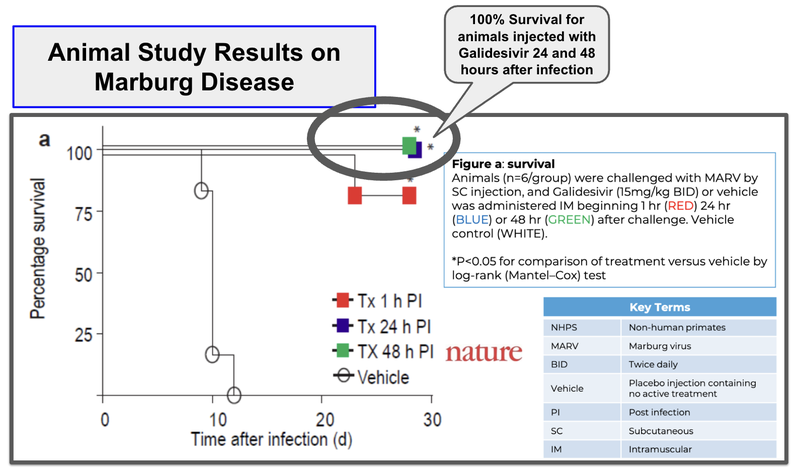
ILA’s drug has shown 100% survival rates for animals 24-48 hours after infection, relative to placebo where survival rates are 0%.
(So we already have some idea of when the best times to dose might be - relevant to the first stage of work ILA has to do from today’s announcement).
(Source)
Overall, ILA’s drug has shown survival rates of up to 94% versus 0% survival in placebo.
Next, it will be all about getting the optimisation studies done, and then hopefully (fingers crossed) the results of that pivotal study later this year replicate (and improve on) the data we have already seen from ILA’s drug.
We are backing the ILA team here...
A big part of the reason why we are Invested in ILA is because of the team behind the company.
Two of ILA’s biggest shareholders (Garner and Tillett) and one of ILA’s directors (Ntoumenopoulos) were part of the Race Oncology team that took that company’s share price from ~6.6c to $4 per share.
Race Oncology, like ILA, was also a drug repurposing company...
We are backing this team to deliver similar success for ILA.
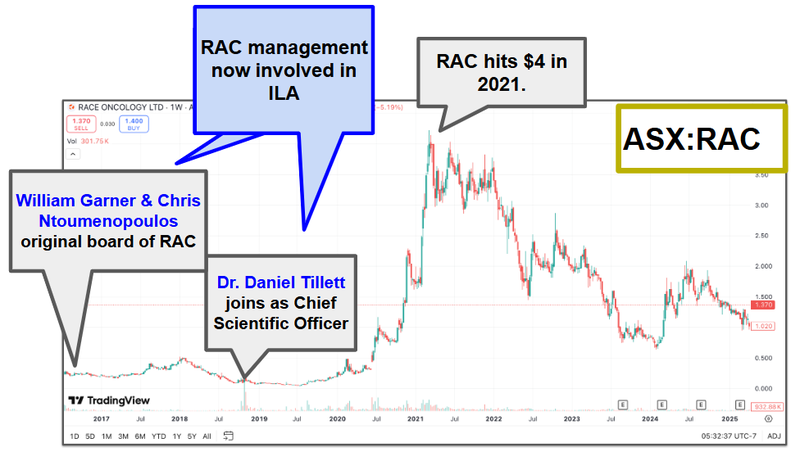
The past performance is not and should not be taken as an indication of future performance. Caution should be exercised in assessing past performance. This product, like all other financial products, is subject to market forces and unpredictable events that may adversely affect future performance.
Here are the ILA substantial shareholders and board members:
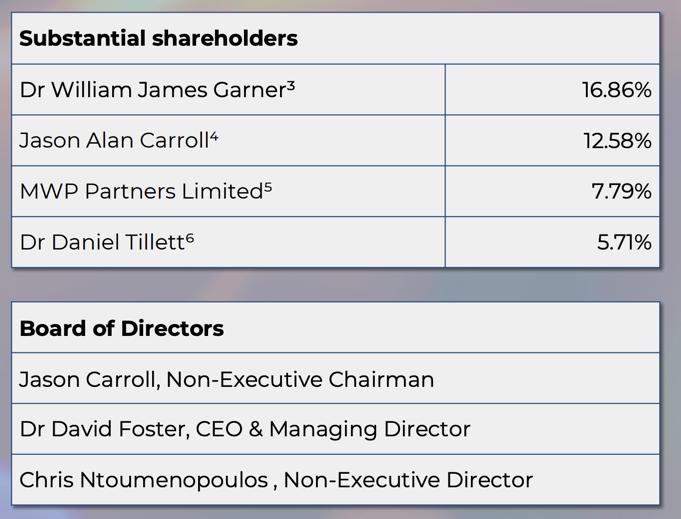
(Source)
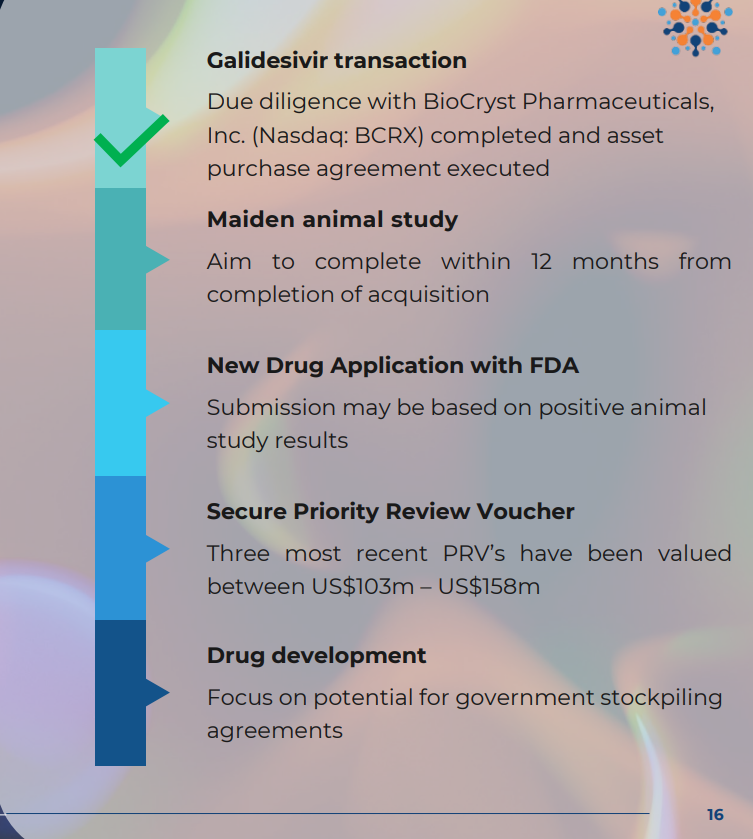
(Source)
What’s next for ILA in the next 6-9 months
Now that ILA has been given the green light to pursue approvals via the Animal Rule AND the FDA has confirmed a staged approach would be appropriate we want to see ILA execute the following:
- 17th November: ILA confirms Animal Rule eligibility for its Marburg drug ✅
- TODAY: staged approach for FDA approvals confirmed ✅
- NEXT: We want to see ILA start “optimisation studies” ahead of a pivotal study later this year.
- NEXT: We want to see ILA sign more agreements with Biosecurity Level 4 (BSL4) facilities that are able to run animal studies - more sites means the studies can be completed quicker...
- THEN, we want to see ILA start animal trials (pivotal trial) for deadly Marburg disease. (this is the big one)
Here are the milestones we will be tracking for the animal study:
- 🔲 Clinical trial design completed
- 🔲 Clinical trial starts
- 🔲 Clinical trial completed
- 🔲 Clinical trial results
Assuming the clinical trial results are positive, ILA will then submit to the FDA for an Investigational New Drug (IND) approval of its drug (6 month review timeframe)
IF APPROVED...
ILA COULD SECURE a Priority Review Voucher, which is a tradeable asset worth on average ~US$100M (think of this like a ‘thank you’ for developing the drug)
ILA COULD SECURE commercial stockpiling contracts with the US Department of Defence for protection against bioweapons. These contracts can be very lucrative.
What are the risks?
The primary risk for ILA now is “clinical trial risk”.
ILA’s de-risked its drug from a regulatory perspective after today’s news.
But the company still needs to run clinical trials which could have significant cost overruns and time delays.
There is also no guarantee the clinical trials deliver results strong enough for the FDA to approve ILA’s Marburg Drug.
Any clinical trial results, if negative, could hurt the ILA share price.
Clinical trial risk
It is important to be aware that clinical trials can be unsuccessful.
Here are some of the standard risks that are associated with biotechs that are undertaking clinical research:
- Patient recruitment is delayed or fails
- Ethics approval is delayed or fails
- Clinical trial cost blowouts
- The drug or treatment is ineffective at treating the particular disease
Source: “What could go wrong” - ILA Investment Memo 21 May 2025
Other risks:
Like any stock market investment, investing in ILA carries a multitude of risks which may affect the value of the company, some of which cannot be foreseen (this is the nature of risks).
Here we aim to identify a few more risks.
ILA is a small-cap biotech company, meaning it is highly speculative and subject to sharp swings in sentiment around trial results, FDA feedback, or broader biotech market conditions.
The company is reliant on timely execution of its clinical and regulatory milestones. Any delays or setbacks in the planned animal trial, or additional data requests from regulators could materially impact the investment case.
ILA will require continued access to funding as it advances its programs. While currently funded for its near-term studies, any unexpected trial or regulatory costs could force ILA to raise additional capital, which could dilute existing shareholders.
ILA is also exposed to geopolitical and government funding risks. Stockpiling contracts are ultimately dependent on US government priorities and budget allocations, which may shift over time.
Finally, the current share price may already be factoring in the possibility of a Priority Review Voucher or lucrative stockpiling contracts. If either of these does not eventuate, the downside could be significant.
Investors should carefully consider these risks and seek professional advice tailored to their circumstances before investing.
Our ILA Investment Memo
You can read our ILA Investment Memo here. We use this memo to track the progress of all our Investments over time.
Our ILA Investment Memo covers:
- What does ILA do?
- The macro theme for ILA
- Our ILA Big Bet
- What we want to see ILA achieve
- Why we are Invested in ILA
- The key risks to our Investment Thesis
- Our Investment Plan
General Information Only
This material has been prepared by StocksDigital. StocksDigital is an authorised representative (CAR 000433913) of 62 Consulting Pty Limited (ABN 88 664 809 303) (AFSL 548573).
This material is general advice only and is not an offer for the purchase or sale of any financial product or service. The material is not intended to provide you with personal financial or tax advice and does not take into account your personal objectives, financial situation or needs. Although we believe that the material is correct, no warranty of accuracy, reliability or completeness is given, except for liability under statute which cannot be excluded. Please note that past performance may not be indicative of future performance and that no guarantee of performance, the return of capital or a particular rate of return is given by 62C, StocksDigital, any of their related body corporates or any other person. To the maximum extent possible, 62C, StocksDigital, their related body corporates or any other person do not accept any liability for any statement in this material.
Conflicts of Interest Notice
S3 and its associated entities may hold investments in companies featured in its articles, including through being paid in the securities of the companies we provide commentary on. We disclose the securities held in relation to a particular company that we provide commentary on. Refer to our Disclosure Policy for information on our self-imposed trading blackouts, hold conditions and de-risking (sell conditions) which seek to mitigate against any potential conflicts of interest.
Publication Notice and Disclaimer
The information contained in this article is current as at the publication date. At the time of publishing, the information contained in this article is based on sources which are available in the public domain that we consider to be reliable, and our own analysis of those sources. The views of the author may not reflect the views of the AFSL holder. Any decision by you to purchase securities in the companies featured in this article should be done so after you have sought your own independent professional advice regarding this information and made your own inquiries as to the validity of any information in this article.
Any forward-looking statements contained in this article are not guarantees or predictions of future performance, and involve known and unknown risks, uncertainties and other factors, many of which are beyond our control, and which may cause actual results or performance of companies featured to differ materially from those expressed in the statements contained in this article. S3 cannot and does not give any assurance that the results or performance expressed or implied by any forward-looking statements contained in this article will actually occur and readers are cautioned not to put undue reliance on forward-looking statements.
This article may include references to our past investing performance. Past performance is not a reliable indicator of our future investing performance.