Global Leader, the $1.9BN Compass Pathways, just selected EMD to run clinical trials for psychedelics in Australia
Disclosure: S3 Consortium Pty Ltd (the Company) and Associated Entities own 13,684,998 EMD Shares and 6,715,138 EMD Options and the company’s staff own 138,889 EMD Options at the time of publishing this article. The Company has been engaged by EMD to share our commentary on the progress of our Investment in EMD over time. This information is general in nature about a speculative investment and does not constitute personal advice. It does not consider your objectives, financial situation, or needs. Any forward-looking statements are uncertain and not a guaranteed outcome.
NASDAQ listed Compass Pathways is a leading global psychedelics company capped at $1.9BN.
16 days ago, the company lodged a New Drug Application with the US FDA for a psychedelic drug.
IF the FDA approves the Compass drug for treatment resistant depression, it would be the first of its kind ever approved in the US.
We are Invested in the $28M capped Emyria (ASX:EMD) - one of the only companies in the world running fully authorised, legal psychedelic therapy clinics.
EMD has been an early mover here - before psychedelics goes mainstream - that’s one of Elon Musk’s inner circle’s big calls.
The WSJ reckons his inner circle is ‘pouring cash into making psychedelics mainstream’:

(source)
Unlike most $28M capped ASX small cap stocks, EMD happens to be generating revenue right now from its clinics - posting over $4M in revenue in FY26.
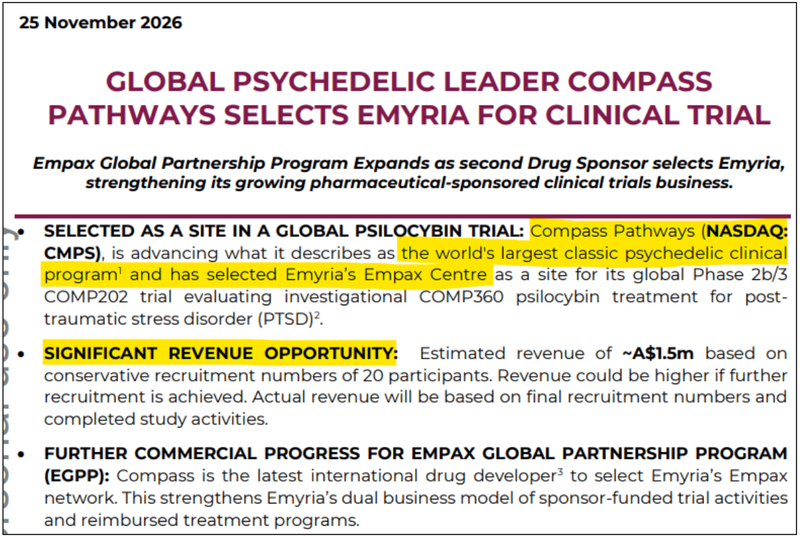
TODAY, Compass Pathways selected one of EMD’s WA clinics as a trial site for its psychedelic drug.
Which could result in a step change increase in revenues for EMD based on Compass’ conservative estimate of 20 patients - $1.5M revenue, (~$75k per patient)...
(the agreement is for up to 32 patients - so revenues from this deal alone could be much higher)
This is the first clinical trial deal we have seen Compass sign with a listed psychedelic clinic operator.
Compass is the closest of any biotech to have a psychedelic drug FDA approved for mental health issues.
(The Economist ‘expects’ Compass’ synthetic form of psilocybin to be approved soon for treatment-resistant depression and to arrive in America in early 2027. (source))
(source)
EMD has five clinics in Australia generating ~$4.05M revenue (FY26) and is growing in Australia.
The Compass deal is estimated to bolt on ~$1.5M revenue based on a conservative recruitment target of 20 patients. (source)
EMD is targeting first patient recruitment next month.
That is ~$75k per patient, more than double the $33k that EMD has previously disclosed (source).
EMD is a very early mover in the space because when the Australian TGA was the first in the world to legalise psychedelic therapies back in 2023, EMD had been prepared and was ready.
Ever since then, EMD has been rolling out psychedelic therapy clinics across Australia.
EMD already has a payer deal with Australia’s largest private health insurer, Medibank, plus the Department of Veterans' Affairs (DVA) in Australia:
(ie the large payer covers the ~$33k per PTSD patient treatment cost - so the patient doesn't have to pay for that by themselves).
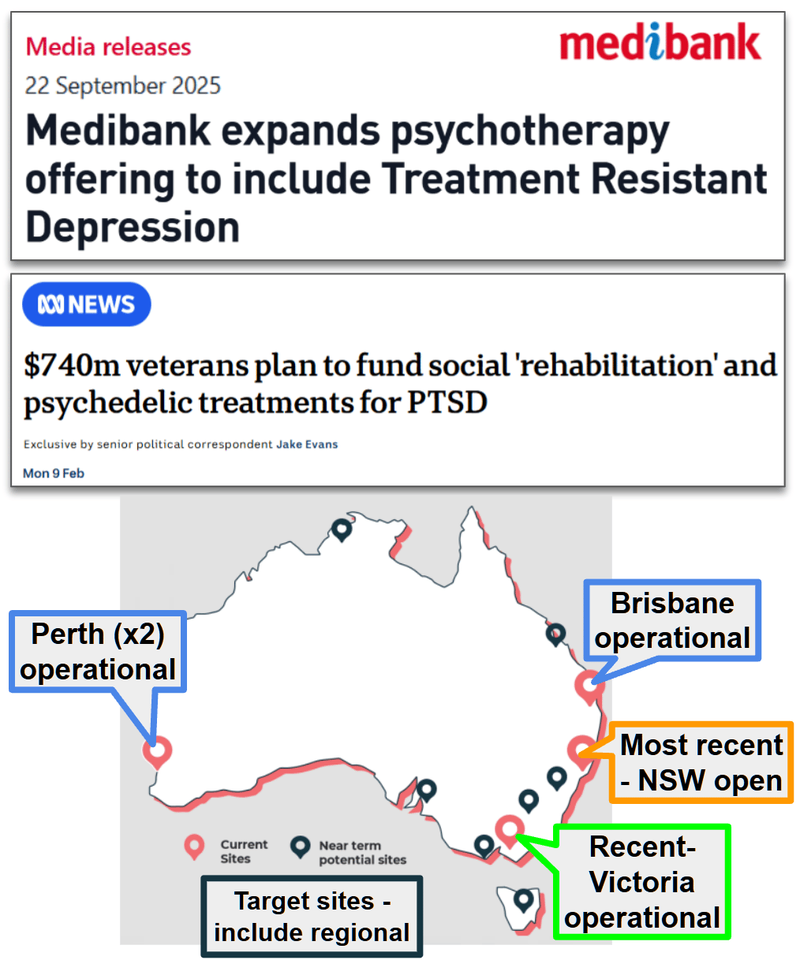
So far, EMD’s Australian business has:
- Delivered ~$4.05M in revenue (FY26). (source)
- Grown from a single Perth clinic to five clinics across four states.
- Increased capacity to up to 90 dosing sessions a week. (source) AND
- Trained a workforce soon to be over 150 staff. (source)
AND is still expanding with more sites in the east coast market across Australia.
So far so good in Australia, and we think those numbers can continue growing - we think the demand is there.
BUT the big blue sky upside for EMD has always been what could happen IF/WHEN EMD cracks the US market.
Rolling out its successful model in Australia, to the much bigger US market.
EMD has previously signed similar pharmaceutical-sponsored clinical trial deals with NASDAQ-listed Psyence Biomed and New York-based Transcend Therapeutics. (source) (source)
But doing a deal with a drug developer who MIGHT be the first to have an FDA approved drug is pretty material.
IF Compass’ drug gets approved by the FDA, the next problem it has is how to actually deliver the drug to patients.
Outside of the US, Compass’ CEO is on the record saying that "from an ex U.S. perspective, we will probably likely need to partner" - and that Compass would look at it "once we have U.S. approval in hand". (source)
Whoever ends up distributing it, we are hoping they naturally look at a potential clinic operator like EMD with a national footprint to roll it out with them.
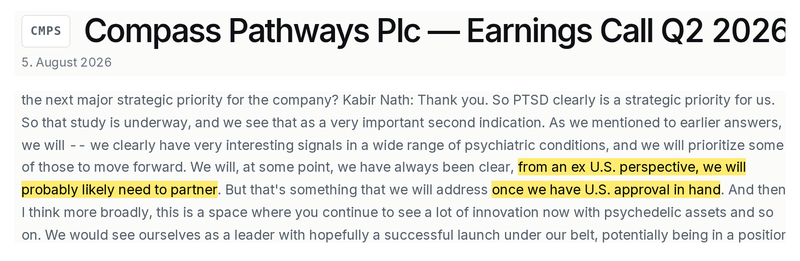
IF Compass gets FDA approval and starts looking around the world for a partner who can help with drug delivery, there will be EMD who has delivered Compass’ drug in a Compass approved way to real patients.
That’s a big part of why we think today’s announcement is a major catalyst for EMD.
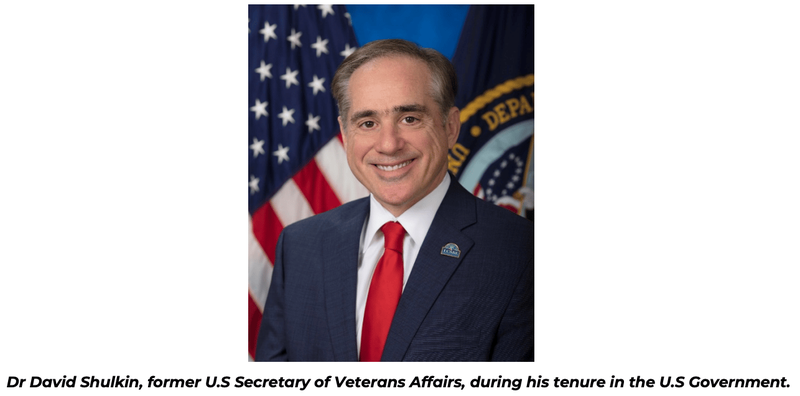
We also like that this news has come nine weeks after EMD appointed Dr David Shulkin as a Strategic Advisor back in September. (source)
(source)
Shulkin used to run the US Department of Veterans Affairs.
In that role he was responsible for ~1,400 facilities and healthcare for over 9 million US veterans. (source)
Shulkin’s ASX connection comes from his time at 4D Medical - where he has been an advisor since April 2023. (source)
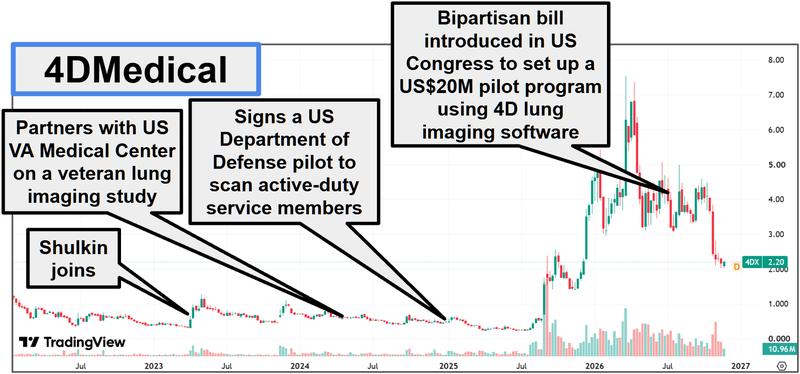
Here's what happened with 4D Medical on the US federal side in the ~3 years Shulkin’s been there:
- May 2024 - 4D Medical partners with the West Los Angeles VA Medical Center on a veteran lung imaging study. (source)
- January 2025 - 4D Medical signs a US Department of Defense pilot to scan active-duty service members. (source)
- July 2026 - a bipartisan bill is introduced in the US Congress directing the VA to set up a US$20M pilot program licensing FDA-cleared 4D functional lung imaging software. (source)
4D Medical shares were ~87c the week Shulkin joined.
They got as high as $7.55 earlier this year and are ~$2.20 per share today:
(source)
The past performance is not and should not be taken as an indication of future performance. Caution should be exercised in assessing past performance. This product, like all other financial products, is subject to market forces and unpredictable events that may adversely affect future performance.
Remember EMD is able to administer the Psychedelic Assisted Psychotherapy funded by the DVA in Australia. (source)
Veterans are one of the biggest PTSD demographics anywhere.
The US VA has ~9.2 million enrolled veterans and has a budget of US$445BN. (source)
And the US Veterans Affairs is already moving on psychedelics.
In July, the VA and the US Department of Health signed an MoU to work together on psychedelic research and "the responsible deployment" of future FDA-approved therapies for veterans. (source)
The VA currently has 20 active clinical trials running on psychedelic therapies.

(source)
We are hoping Dr Shulkin can work his networks in the US now - especially now with Compass coming in as a trial partner with EMD.
Shulkin can roadshow EMD with a lot more credibility to anyone who has never heard of the little Australian company before.
The other way to look at today's deal
At the moment EMD has private health insurer Medibank, the Department of Veterans' Affairs in Australia and NSW state's workers' compensation scheme program paying for its therapies.
Now, with the Compass deal, EMD has shown to the market that it can sign up drug developers as “payers”.
Where EMD acts as a sort of “clinical research organisation” - getting paid by drug developers to run trials for them.
That makes EMD a kind of "picks and shovels" exposure to the whole psychedelic drug sector.
IF Compass gets its drug approved, we think it could open the floodgates for money coming into the space.
We have already seen:
- $1.9 trillion capped Eli Lilly make an acquisition in the space for up to US$3.8BN. (source)
- $798BN AbbVie paid up to US$1.2BN for Gilgamesh's psychedelic drug. (source)
- $61BN Otsuka paid up to US$1.225BN for Transcend (source) (these guys have worked with EMD before). AND
- $997BN Johnson & Johnson's ketamine-based nasal spray (given in a clinic) also does ~US$624M in sales in a single quarter. (source)
AND "Elon Musk's inner circle" - SpaceX and Tesla directors backing the push to get MDMA-assisted therapy approved. (source)
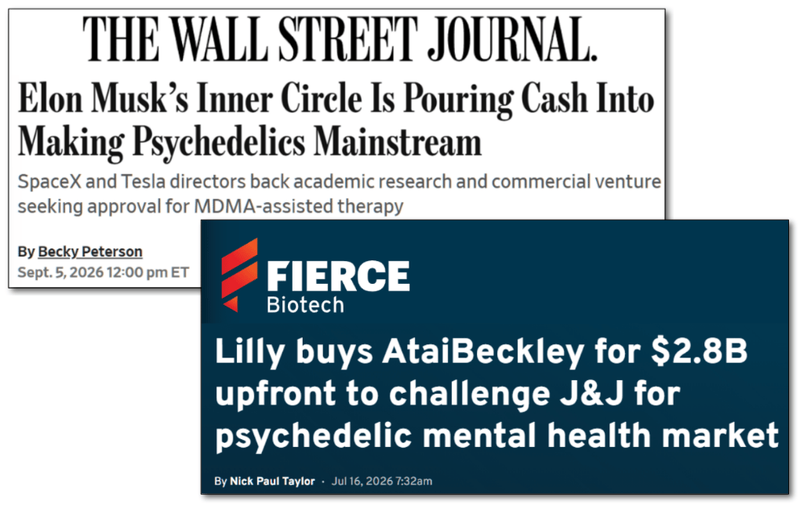
Psychedelic drug developers raised over US$1.3BN in the first half of 2026 - more than they raised in all of 2025. (source)
And the drugs keep getting through their trials.
Since June, two more developers (Definium and Helus) have reported FOUR successful Phase 3 trials between them. (source) (source)
More money coming in = more drugs being developed = more trials = more demand for the type of service EMD provides.
AND the US government has been asking for "real-world evidence"
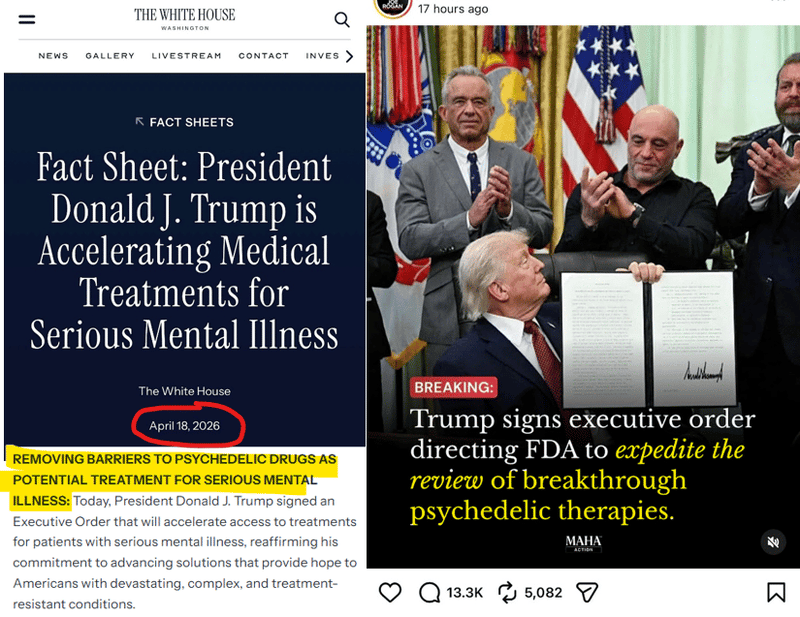
Seven months ago, US President Trump signed an Executive Order to accelerate access to psychedelic treatments for serious mental illness.
(with Joe Rogan in the room - what a way to give psychedelic therapies free publicity)
(source)
That order directs the US Health Department and the FDA to work with the VA and the private sector to:
"increase clinical trial participation, data sharing, and real-world evidence generation regarding psychedelic drugs". (source)
(Exactly what EMD has been doing for years)
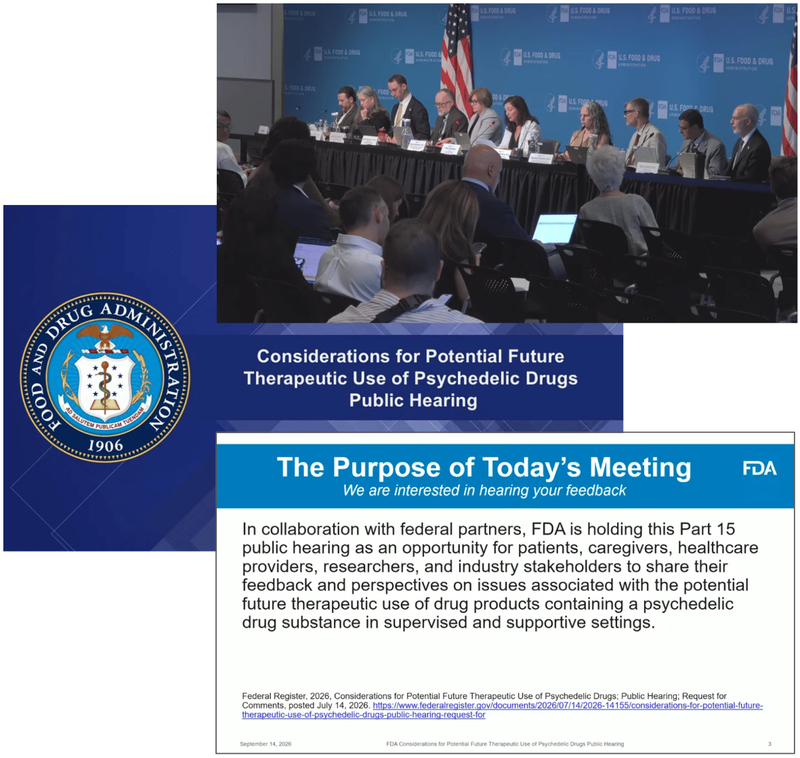
Then... a few months ago EMD presented that real life evidence at the US FDA’s “Considerations for Potential Future Therapeutic Use of Psychedelic Drugs” public hearing:
(See our article on this - EMD presents at US FDA psychedelics hearing and appoints former US Veterans Affairs Secretary as “strategic advisor”)
The key takeaway for us after watching through the hearing is that the US regulators seem like they are open to psychedelics in healthcare.
BUT have no idea how psychedelic drugs will be administered to patients effectively.
Which is why they want the drug developers to work with the delivery companies (like EMD) when developing their drugs.
IF/WHEN they get approved, there is a pathway to distribution...
So really, as we mentioned earlier, EMD is the picks and shovels to getting drugs developed (during the drug development process) and then the picks and shovels to delivering the drugs (during the distribution phase).
The US is working out how to deliver these treatments, right now.
EMD has been doing it for over three years.
The next big catalysts we are looking out for from EMD
We think the two biggest catalysts going forward for EMD will be related to:
- How many "payers" emerge for EMD's service - there is already Medibank & the Department of Veterans’ Affairs (a payer is the group funding patient treatments on their behalf)
- Which indications (specific mental health issues) get legalised for psychedelic treatments - at the moment, EMD can legally treat PTSD and Treatment-Resistant Depression.
On the payer's side we think everything happening in the US could work in EMD’s benefit.
And hopefully we see more deals like today’s one with Compass out of the US.
On the indications side:
We read the following article in the Australian which said “considering whether to expand access to psilocybin-led therapy to people in end-of-life distress”.

(source)
Palliative care alone in Australia means hundreds of thousands of patients per year.
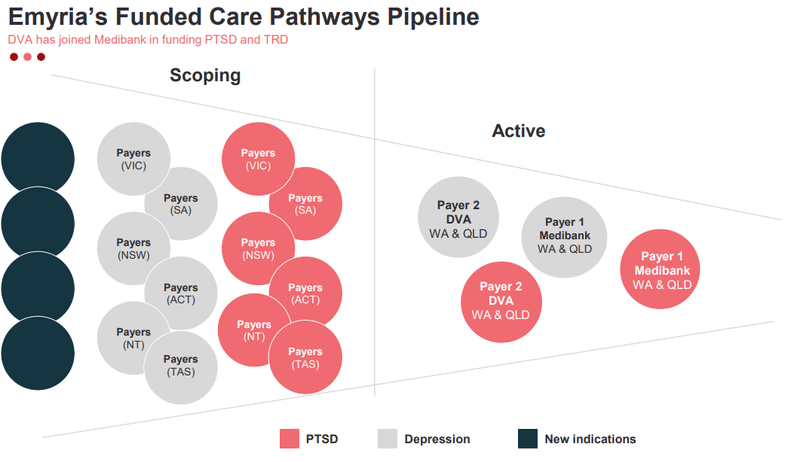
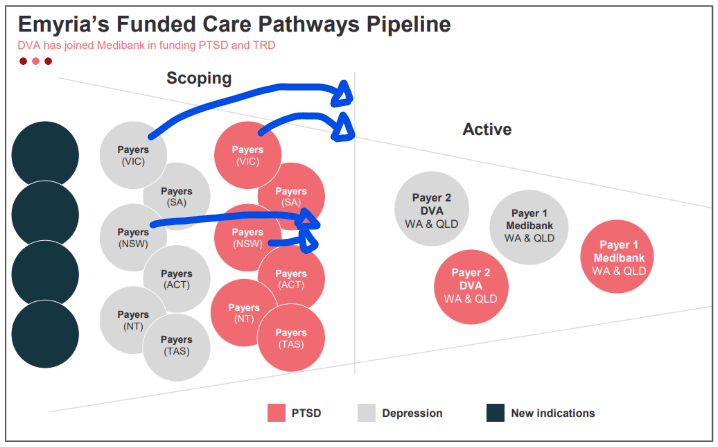
Ultimately, what we want to see is progress on the image below (more of the circles move from scoping into active status):
(source)
We already know EMD's therapy works - and better than expected
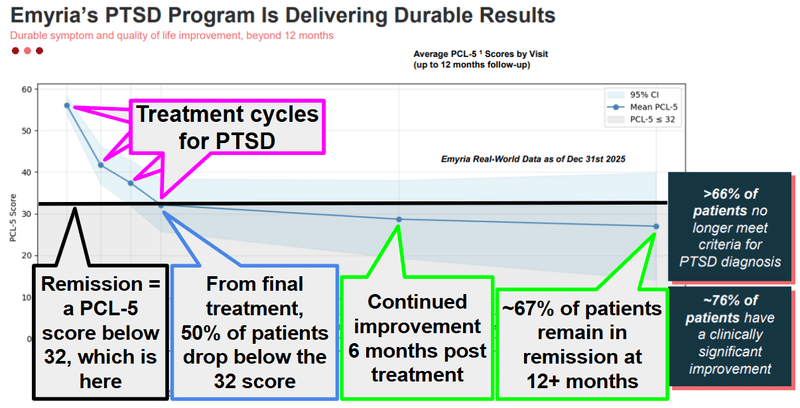
Back in February, EMD published real-world data showing that its PTSD treatment program produces durable, lasting recovery.
EMD showed that two thirds of patients were in “remission” - not just at the end of treatment, but over 12 months after treatment ended.
(Remission means a significant decrease in, or disappearance of the signs and symptoms of a disease by a particular treatment).
And that patients were continuing to improve even after EMD’s therapy was complete.
Improvement post therapy is a strong signal because it tells us that EMD’s treatments aren’t just suppressing symptoms temporarily - it's leading to genuine, lasting recovery.
In a cohort of patients with severe, treatment-resistant PTSD who had tried everything else and failed, ~67% no longer met the criteria for a PTSD diagnosis more than a year after EMD's psychedelic-assisted therapy.
~76% showed clinically significant improvement.
(source)
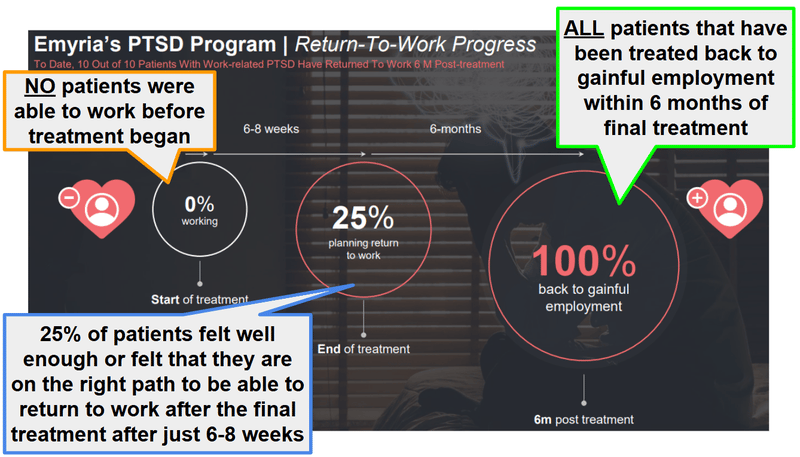
The one case study we found super interesting was of “Kate” - a first responder with cumulative workplace trauma. She was on permanent disability for nearly 5 years, tried every therapy under the sun, and was completely stuck.
Six months after EMD's MDMA-assisted therapy, she returned to work.
More than 12 months after treatment, she remains in remission.
(EMD reported 10/10 patients with work-related PTSD returned to work within 6 months of finishing treatment)
(source)
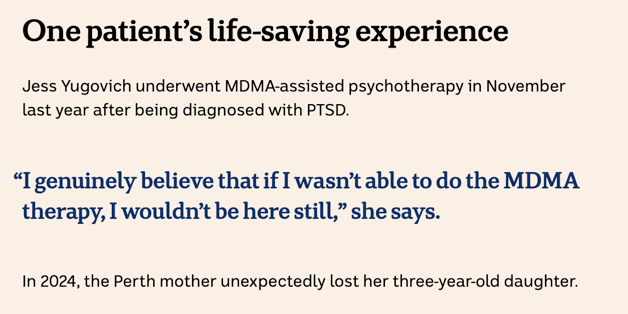
The ABC report also covers the story of Jess Yugovich who tragically lost her three-year-old daughter. Jess underwent MDMA-assisted psychotherapy at EMD’s Empax clinic, and the results were life saving for her:
(Source)
Ultimately, rolling out these treatments in Australia (and the rest of the world) forms the basis for our EMD Big Bet as follows:
Our EMD Big Bet:
"EMD re-rates to a +$300M market cap by making a breakthrough with one or more of its clinical trial programs (MDMA, psilocybin, ketamine, CBD) while rapidly growing the footprint of its mental health treatment clinics."
NOTE: our "Big Bet" is what we HOPE the ultimate success scenario looks like for this particular Investment over the long term (3+ years). The scenario is speculative and does not represent a valuation or forecast. There is no guarantee that our Big Bet will ever come true. There is a lot of work to be done, many risks involved, including funding risk, scale up risk and regulatory risk - just some of which we list in our EMD Investment Memo.
Success will require a significant amount of luck. Past performance is not an indicator of future performance.
What we want to see next from EMD
EMD execute its national rollout in Australia
We want to see EMD open more clinics around Australia.
Here are the milestones we are tracking:
- ✅ WA, QLD and VIC clinics - operational
- ✅ NSW clinic opened (September)
- 🔄 31 new therapists trained and onboarded (from Q1 2027)
- 🔲 Next new site confirmed
- 🔲 Revenue growth from existing clinics
🔲 New payer deals
EMD has both Medibank Private (~$15BN market cap) and DVA (government program) as current “payers” for its treatment protocol.
And after TODAY has Compass Pathways too.
We want to see EMD add more to its payer pipeline:
- 🔲 First DVA-funded veteran treated
- 🔲 A third major payer in Australia
- 🔲 MORE payer commitments out of the US (drug developers/government programs)
🔲 Expansion into new indications
We also want to see EMD expand its therapy programs to new indications and drug therapies over time to broaden its addressable market beyond PTSD and treatment-resistant depression.
Here is the image we shared in a recent note which helps visualise the impact this would have on EMD’s business.
What we want to see over the coming months is that more of those circles move from the “scoping” stage into the “active” stage, this is where EMD gets the revenue...
(source)
What could go wrong?
The two biggest risks for EMD right now are “scale up risk” and “funding risk”.
Clinic scale ups are not easy to execute, especially across multiple geographic locations.
EMD must replicate its Perth success in multiple states, which involves securing new physical locations, establishing more payer relationships as well as onboarding qualified physicians.
This may not run smoothly by running into unforeseen issues, so until EMD achieves self-sustaining profitability it remains reliant on external market funding to fuel this growth.
Any delays in the scale up could impact the market’s perception of EMD’s ability to execute its strategy and re-rate the company's share price lower.
Scale up risk
Even though EMD can secure funding for Medibank, there is a lot that needs to go right in terms of scale. This includes securing more sites to operate its services as well as securing more MDMA supply to meet the expected demand. Scaling costs money, and EMD needs to reach a level of profitability before it can scale without continuing to tap the market for resources.
Source: "What could go wrong" - EMD Investment Memo 18 June 2025
EMD also had $4.7M in cash at 30 September after spending $2.3M on operations in the quarter. (source)
Revenue is growing and the Compass work should add to it BUT EMD may need to raise capital to fund its national growth, especially with so many clinics ramping up.
Funding risk
Small caps often need to raise cash to fund their growth. Whilst EMD is generating revenue now, it is still making a loss (it spends more cash than it brings in). If EMD is unable to develop a self-sustaining business model with positive operating cash flow, this could force EMD to raise capital in the future, likely at a discount to market prices to secure funds.
Source: "What could go wrong" - EMD Investment Memo 18 June 2025
Other risks
Like any small-cap healthcare company, EMD carries significant risk, here we aim to identify a few more risks.
Today's Compass deal comes with no guaranteed patient numbers.
The revenue figure depends on EMD getting ethics approval, having its site activated and then recruiting and completing patients. Recruitment could be slower than expected, the December start could slip, and trial agreements like this can typically be wound up early by the sponsor.
The trial itself is not expected to finish until 2028-29, so any revenue arrives over a long period.
There is also a risk the FDA does not approve Compass’ new drug application, IF that were to happen it would likely hurt sentiment across the whole sector, EMD included.
Around half of FY26 revenue came from patients funded by a single private health insurer, with agreements due for renewal in 2027. Any change to those arrangements would hit revenue.
Therapist availability is currently what limits how many patients EMD can treat. Trial work for drug sponsors draws on the same clinics and the same people, so EMD needs its new therapist intake to come through on time to grow both lines of business at once.
Investors should consider these risks carefully and seek professional advice tailored to their personal circumstances before investing.
Our EMD Investment Memo
You can read our EMD Investment Memo in the link below.
We use this memo to track the progress of all our Investments over time.
Our EMD Investment Memo covers:
- What does EMD do?
- The macro theme for EMD
- Our EMD Big Bet
- What we want to see EMD achieve
- Why we are Invested in EMD
- The key risks to our Investment Thesis
- Our Investment Plan
General Information Only
This material has been prepared by StocksDigital. StocksDigital is an authorised representative (CAR 000433913) of 62 Consulting Pty Limited (ABN 88 664 809 303) (AFSL 548573).
This material is general advice only and is not an offer for the purchase or sale of any financial product or service. The material is not intended to provide you with personal financial or tax advice and does not take into account your personal objectives, financial situation or needs. Although we believe that the material is correct, no warranty of accuracy, reliability or completeness is given, except for liability under statute which cannot be excluded. Please note that past performance may not be indicative of future performance and that no guarantee of performance, the return of capital or a particular rate of return is given by 62C, StocksDigital, any of their related body corporates or any other person. To the maximum extent possible, 62C, StocksDigital, their related body corporates or any other person do not accept any liability for any statement in this material.
Conflicts of Interest Notice
S3 and its associated entities may hold investments in companies featured in its articles, including through being paid in the securities of the companies we provide commentary on. We disclose the securities held in relation to a particular company that we provide commentary on. Refer to our Disclosure Policy for information on our self-imposed trading blackouts, hold conditions and de-risking (sell conditions) which seek to mitigate against any potential conflicts of interest.
Publication Notice and Disclaimer
The information contained in this article is current as at the publication date. At the time of publishing, the information contained in this article is based on sources which are available in the public domain that we consider to be reliable, and our own analysis of those sources. The views of the author may not reflect the views of the AFSL holder. Any decision by you to purchase securities in the companies featured in this article should be done so after you have sought your own independent professional advice regarding this information and made your own inquiries as to the validity of any information in this article.
Any forward-looking statements contained in this article are not guarantees or predictions of future performance, and involve known and unknown risks, uncertainties and other factors, many of which are beyond our control, and which may cause actual results or performance of companies featured to differ materially from those expressed in the statements contained in this article. S3 cannot and does not give any assurance that the results or performance expressed or implied by any forward-looking statements contained in this article will actually occur and readers are cautioned not to put undue reliance on forward-looking statements.
This article may include references to our past investing performance. Past performance is not a reliable indicator of our future investing performance.