Buffett-backed Anadarko to drill US$100M+ well next to $15.5M capped CND's Peru block. CND's big catalyst is now pending
Disclosure: S3 Consortium Pty Ltd (the Company) and Associated Entities own 48,634,867 CND Shares and 13,675,000 CND Options at the time of publishing this article. The Company has been engaged by CND to share our commentary on the progress of our Investment in CND over time. This information is general in nature about a speculative investment and does not constitute personal advice. It does not consider your objectives, financial situation, or needs. Any forward-looking statements are uncertain and not a guaranteed outcome.
Six months on and the Strait of Hormuz is still shut.
Now, there is a second chokepoint at risk and one of the biggest solutions to the strait (a pipeline running east-west in Saudi Arabia) also offline.
Oil coming out of the Middle East (~30% of the global supply) is now offline or at risk.
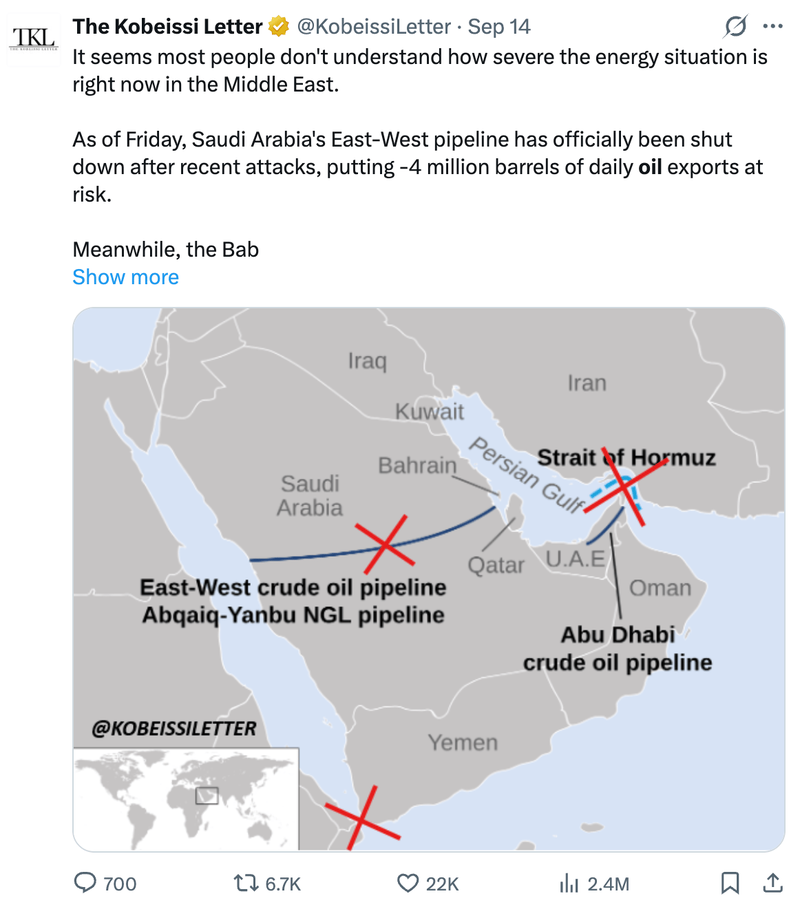
Terrible news for anyone who depends on oil coming out of the Middle East.
We think the lesson for big middle east energy buyers would have to be a re-think of where they get supply.
(Sort of like what the US is doing with critical/military minerals)
And we think South America might be a part of the world these buyers turn to for that supply.
Which is why we are Invested in Condor Energy (ASX:CND)
CND holds 100% of a block offshore northern Peru with:
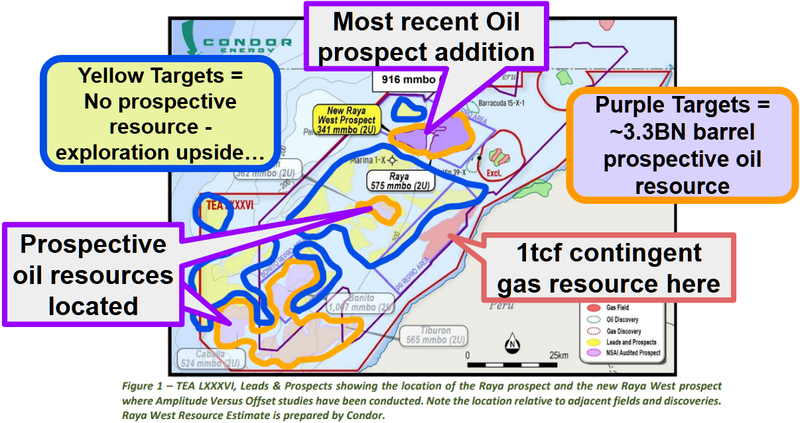
- 3.3 billion barrels of oil in prospective resources across (unrisked) six prospects. (source
- AND an existing 1 Tcf gas DISCOVERY - Piedra Redonda, which has already flowed gas to surface. (source)
And just quietly... it looks like the big supermajors agree on our South America call too...
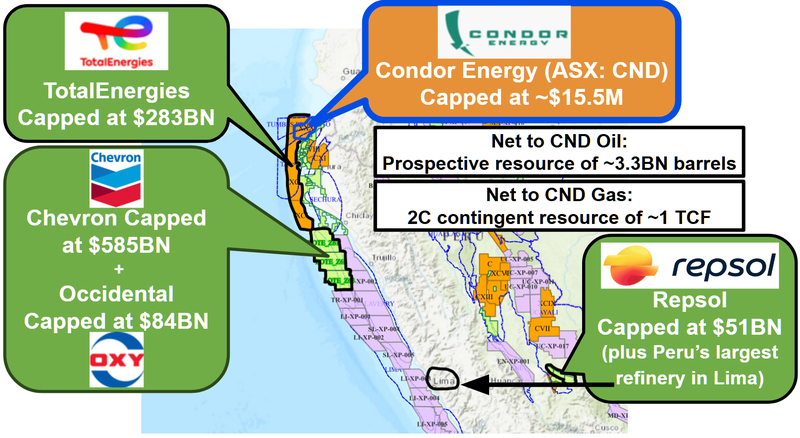
CND’s blocks are surrounded by $283BN Total and a few other majors have entered offshore Peru over the last ~2 years:
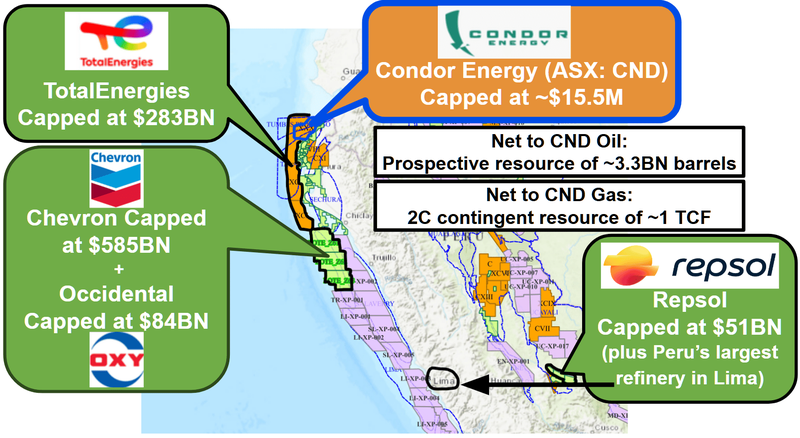
(source)
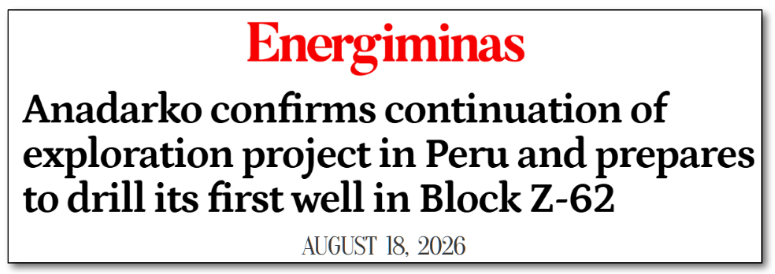
We even saw Warren Buffet backed Anadarko (Occidental in the image above) commit to a first well on its block in 2027:
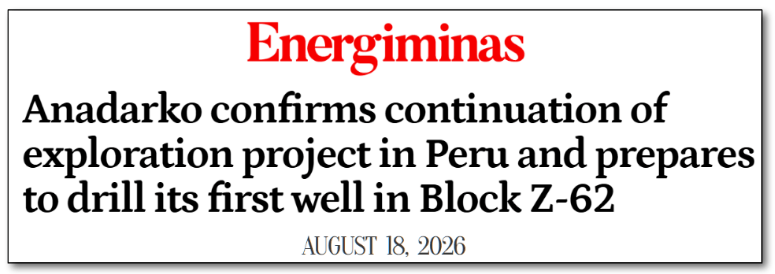
(source - article is originally in Spanish)
We think South America (and fingers crossed Peru) is going to be one of the regions those buyers look to allocate capital to and diversify supply chains out of the Middle East from...
Inside the last ~90 days:
- Japan's Prime Minister announced an energy security package including state financing for pipelines that bypass Hormuz and a levy to fund alternative crude supply. (source)
AND
- South Korea just took delivery of oil from Argentina for the first time ever... (with plans to make it more of a regular thing from next year). (source)
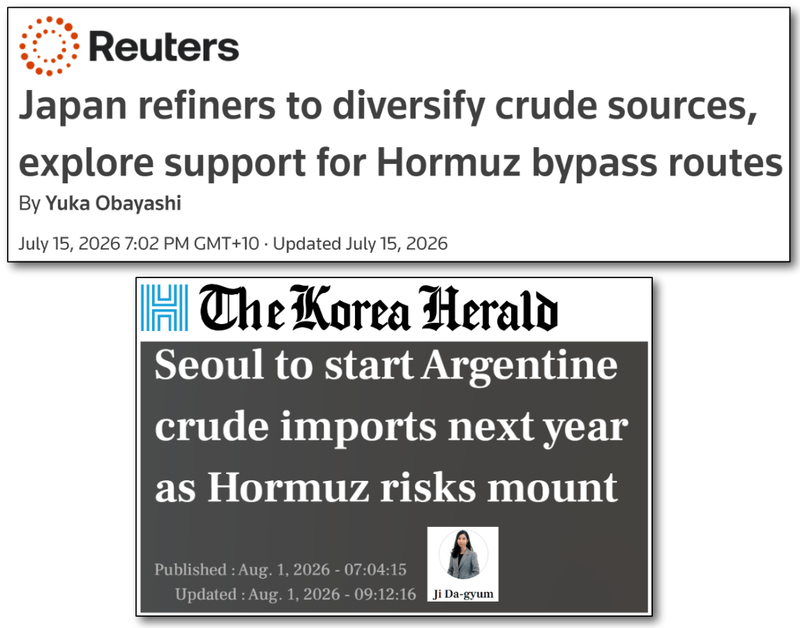
Korea's National Security Adviser even said:
"This is expected to provide an opportunity to diversify our crude oil supply sources, which are currently concentrated in the Middle East, by expanding them into South America." (source)
Confirmation to us that one of the up and coming oil & gas regions in the world right now is South America.
So CND with 3.3 billion barrels of oil in prospective resources across and an existing 1 Tcf gas DISCOVERY...
... is capped at just ~$15.5M.
(source)
Hold on - why is it capped so low?
Because CND's block is held under something called a TEA - a Technical Evaluation Agreement.
Think of it as a "look before you buy" permit.
CND has had the exclusive right to study the block - but NOT allowed to drill it.
Which brings us to the single biggest risk - or opportunity, depending on how you look at it - for CND right now:
Converting that TEA into a full Licence Contract.
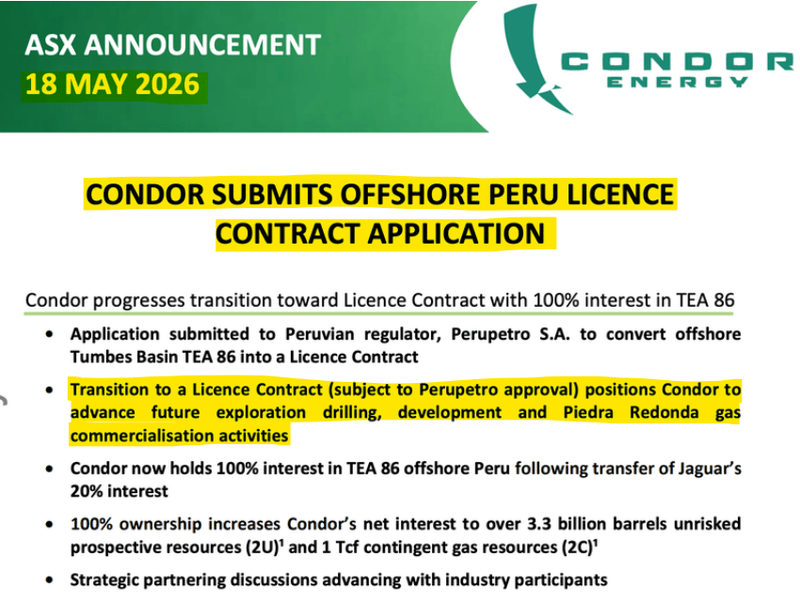
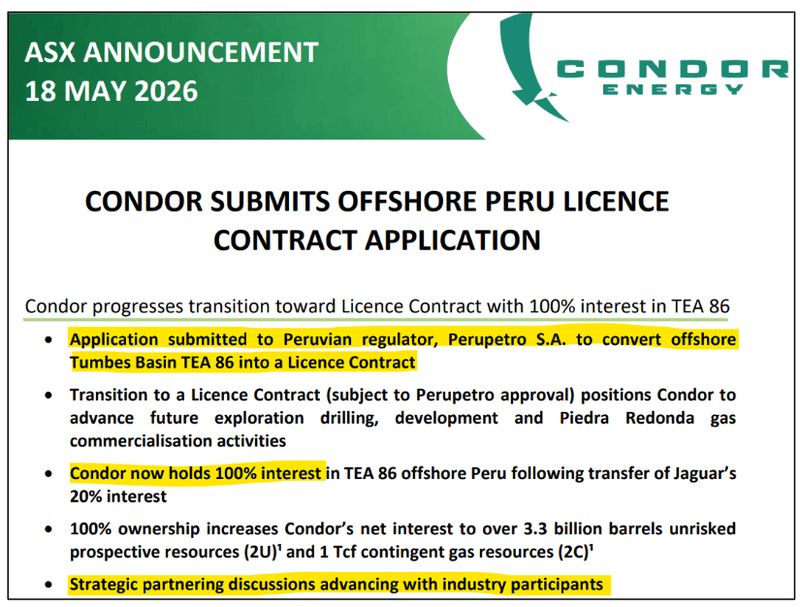
CND lodged its application with Peru's regulator back in May. (source)
That licence is what would give CND the right to actually drill and develop the block - to farm it out, to drill the oil prospects, to commercialise the gas.
And THAT is when we think the market re-rates CND on the merits of its existing gas discovery and its oil prospects.
(source)
A big part of why we like CND is because of where its asset sits.
CND's block sits in Peru's Tumbes Basin, right alongside the Talara Basin - which have combined historic oil production of more than 1.68 billion barrels. (source)
CND’s block actually holds a few existing discoveries in it already - so we know there is a working hydrocarbon system.
CND came into Peru back in August 2023. (source)
Since then all of the following have come in:
- ~US$283BN TotalEnergies in May 2024 - picking up all of the blocks surrounding CND.
- ~US$585BN Chevron in August 2025 - through a farm-in on Anadarko’s blocks to the south. (source)
- Then Westlawn, a Houston-based offshore group - took 30% of the Chevron/Anadarko blocks in September 2025. (source)
(Perupetro also said in late 2025 that Petrobras had come knocking about the Tumbes–Piura shelf) (source)
(source)
The majors aren’t messing about either.
TotalEnergies spent two years studying its ground, then exercised its option to negotiate a full licence.(source)
Warren Buffett-backed Anadarko shot 6,018km2 of 3D seismic over its blocks in 2024 at a cost of ~US$40M. (source)
(Anadarko is owned by ~US$61BN Occidental Petroleum. Berkshire Hathaway owns 26.5% of Occidental.)
And the latest news...
Anadarko has COMMITTED to drilling offshore Peru.
Four weeks ago Anadarko formally notified Perupetro that it is moving into the Third Exploratory Period on its blocks. (source)
That period comes with a drilling obligation - its first offshore exploration well, in 2027. (source)
After ~US$40M on seismic and two years of data work - Anadarko has decided the prize is worth a ~US$100M well. (source)
(source - article is originally in Spanish)
We think that IF CND has its permit converted from a TEA into a full exploration license.
And then next year Anadarko drills in Peru and finds anything, CND’s market cap could re-rate well above where it trades today.
Especially with 100% ownership of 3.3 billion barrels in oil prospects and an existing 1 Tcf gas discovery...
So... why is CND capped at just ~$15.5M?
It doesn't really make sense for an existing 1 TCF gas discovery + 3.3BN barrels of oil prospects to trade at a ~$15.5M market cap...
We think the reason it does comes down to the permitting status of CND’s block.
Up until now, CND hasn't actually "owned" the right to drill and develop its block.
It held something called a Technical Evaluation Agreement (TEA).
The TEA was basically a “look before you buy” agreement.
It allows a company to study an offshore area's seismic and geological data for a couple of years, with no obligation to drill.
CND spent the last ~2.5 years reprocessing seismic data, completing new geological modelling and updating the resource estimates over the project. (source)
And then in May CND made its submission to convert the TEA into a license contract:
(source)
Ultimately, the licence contract is what gives CND the right to drill and develop the block.
And we think IF successful - that grant alone could be a major catalyst for a re-rate in CND’s share price...
(No guarantees of course - Perupetro approval is not guaranteed, and timing can slip. More on that in the risks section.)
We also think the licence contract opens the door to deals being done on CND’s block.
(Understandably, anyone committing to a farm-in would have wanted to see CND have tenure over the block)
In April 2025 CND said it had “multiple parties in the dataroom” and that a farm out process had commenced. (source)
So hopefully a lot of the warming up of interested parties has already been done, AND IF/when the licence is granted things can start to happen quickly...
IF CND secures the licence contract we think CND could:
1. Do a deal on its 1 TCF existing gas discovery - Maybe CND gets a free-carried interest in an asset that could generate revenues in a reasonable timeframe? We note Promigas - the gas distributor for 94% of Peru's market - is already studying the asset under an MoU. (source)
OR
2. Do a deal on its 3.3BN barrel oil exploration assets - Maybe CND lands a free-carried interest in a well that's fully funded by a farm-in partner.
OR maybe it's a combination, a partner that wants BOTH the oil and the gas.
Ultimately we think that IF CND lands that licence contract it will have big enough targets and an existing discovery large enough, to farm-down to bigger parties BUT retain something company making... especially from the current $15.5M market cap.
We look at CND in two ways right now
Scenario A:
- We have exposure to an EXISTING 1 Tcf gas discovery - one that's flowed gas before and got close to development in the past.
In that scenario we get the 3.3 BN barrels of oil exploration upside as a “free option”.
Scenario B:
- Exposure to 3.3 billion barrels of oil exploration targets offshore Peru
In that scenario we get the 1 TCF existing gas discovery as a “free option”.
Either way we think the current $15.5M market cap is highly leveraged to a re-rate (IF that licence contract lands).
Our CND Big Bet
“CND defines a multi-billion barrel prospective resource and sees its market cap re-rate by 20x prior to drilling”
NOTE: our “Big Bet” is what we HOPE the ultimate success scenario looks like for this particular Investment over the long term (3+ years). There is a lot of work to be done, many risks involved - just some of which we list in our CND Investment Memo. Success will require a significant amount of luck. There is no guarantee that our Big Bet will ever come true.
Success will require a significant amount of luck. Past performance is not an indicator of future performance.
Deep dive into CND’s existing 1 TCF gas discovery
This is the "advanced-stage" half of CND’s block.
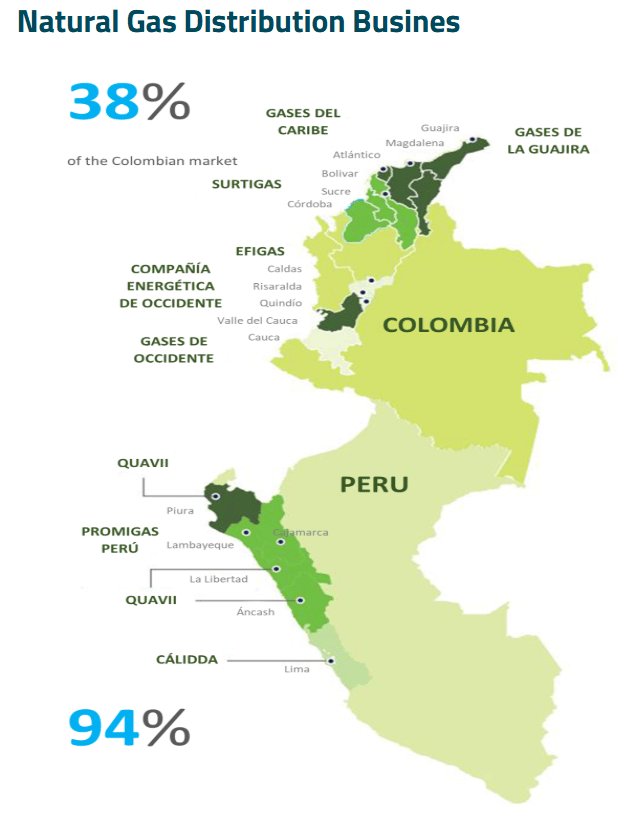
CND's Piedra Redonda gas field is a 1 Tcf discovery and CND has an MoU signed with Peru’s biggest gas distributor - Promigas Peru on the asset.
Promigas manages, maintains and builds gas infrastructure across northern Peru - supplying gas to homes, businesses and industrial facilities.
They supply natural gas to 94% of the Peruvian market and 38% of the Colombian market. (source)
(source)
The deal with CND is around a potential offtake from CND’s existing gas discovery at Piedra Redonda.
CND’s project has a 1 Trillion Cubic Feet (Tcf) discovered gas field and together with Promigas will do studies on:
- Evaluating gas production potential
- Assessing infrastructure and delivery options
- Defining integration and commercial pathways
Basically, CND’s MoU with Promigas is to work out how best to take gas from its existing gas field and bring it to market.
One thing that stood out to us was CND’s comment on “Promigas’ efforts to expand access to natural gas in Peru’s northern regions”.
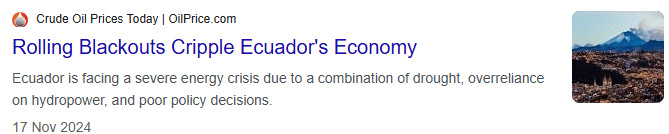
This region is key, because not only is the northern regions expanding rapidly, it opens up access to Colombia where Promigas already supplies gas and it borders Ecuador, which has had significant energy supply issues of late (source).
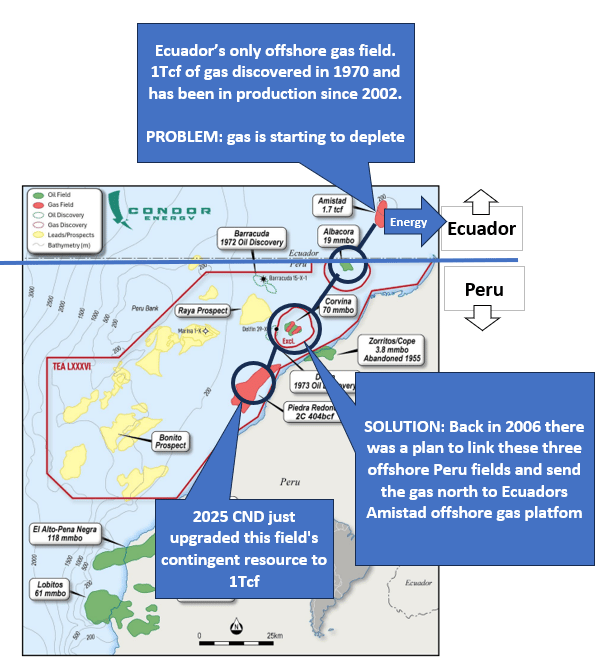
Ecuador only has one offshore gas field (Amistad) which has 1Tcf of gas and has been in production since 2002 - it’s right near the maritime border with Peru (and CND’s Peruvian acreage).
But the gas from Ecuador's field is starting to deplete and the Ecuadorian industrial sector is in need of more...
(source)
We think energy from Peru could be a part of the solution here.
Back in November 2024 the Ecuadorian Minister for Energy & Mines approved the import of 7.3 billion cubic feet of Liquefied Natural Gas (LNG) from Peru.
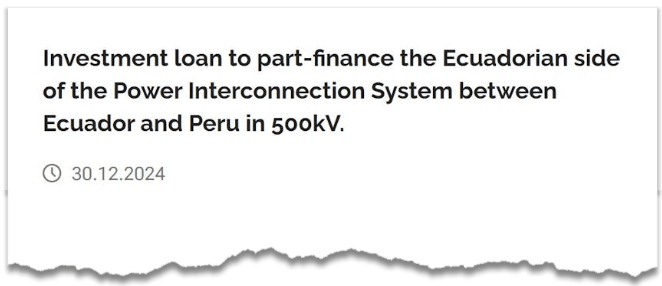
And the European Investment Bank said it would contribute US$125M to the construction of a power interconnector between Peru and Ecuador:
(source)
All of that activity is happening in and around CND’s block.
The really interesting takeaway for us from the MoU is that supplying gas from CND’s block, north into Ecuador has been explored in the past...
Back in 2006 CND’s project was almost developed as part of a plan to help solve Ecuador’s energy shortages.
The plan was to tie in CND’s gas discovery to the Amistad project to the north just over the border in Ecuador:
(source)
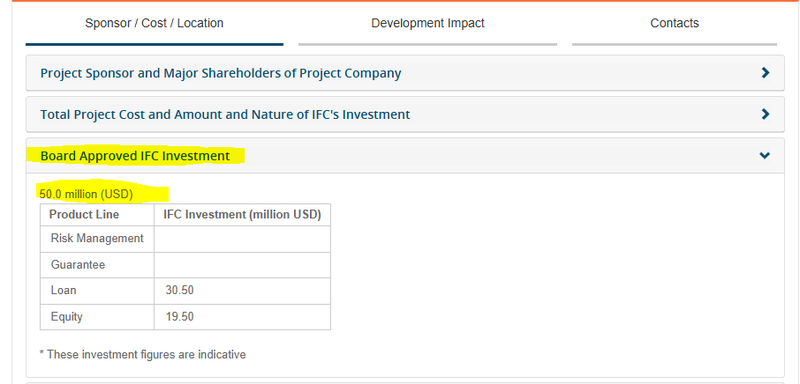
The project even had backing from the World Bank International Finance Corporation who was going to partially fund it.
(source)
THEN...
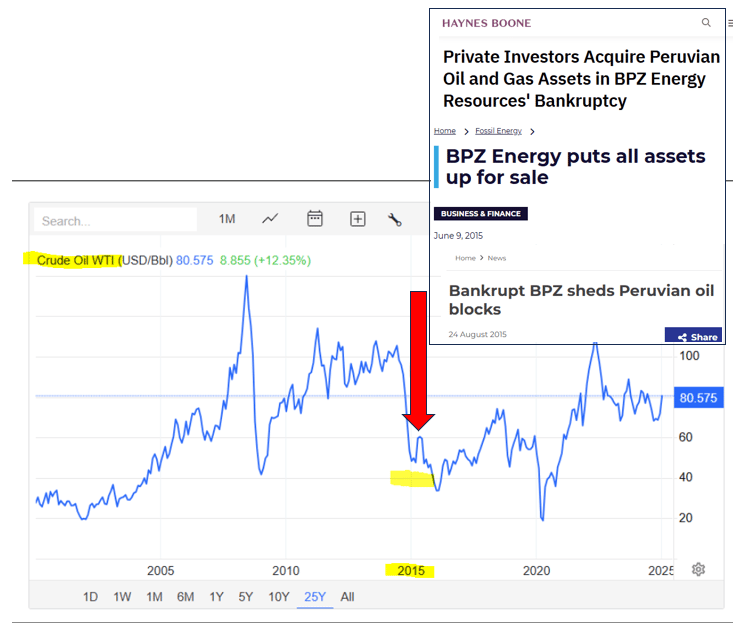
The previous owners at the time (a US company called BPZ) decided to also focus on oil and took on a huge amount of debt to develop their oil projects...
However a 2015 oil price crash eventually caused BPZ to declare bankruptcy - which led to a fire sale of their offshore Peru assets.
(source)
And now the block sits 100% controlled through a TEA by $15.5M capped CND.
We also note there is a commercialisation study that CND has completed recently which could be something Promigas take and run with too.
We covered the work from that in a recent Quick Take here: CND completes commercialisation study for 1 trillion cubic feet gas discovery
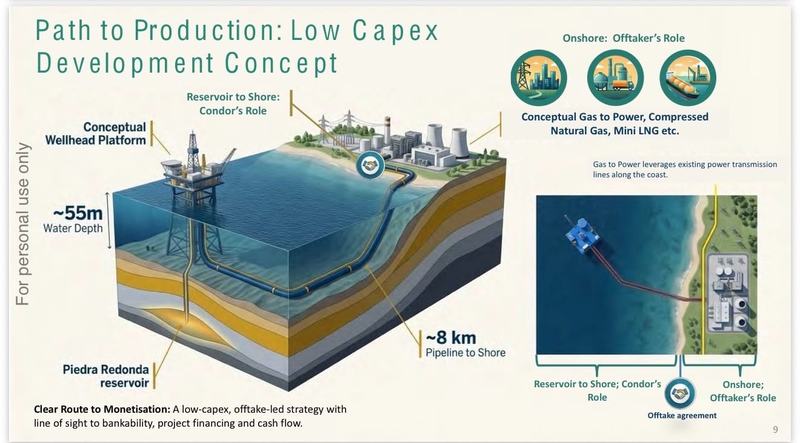
Here is a nice summary image from CND’s recent presentation showing how its gas project could be developed:
(source)
Deep dive into CND’s 3.3BN barrel oil exploration prospects
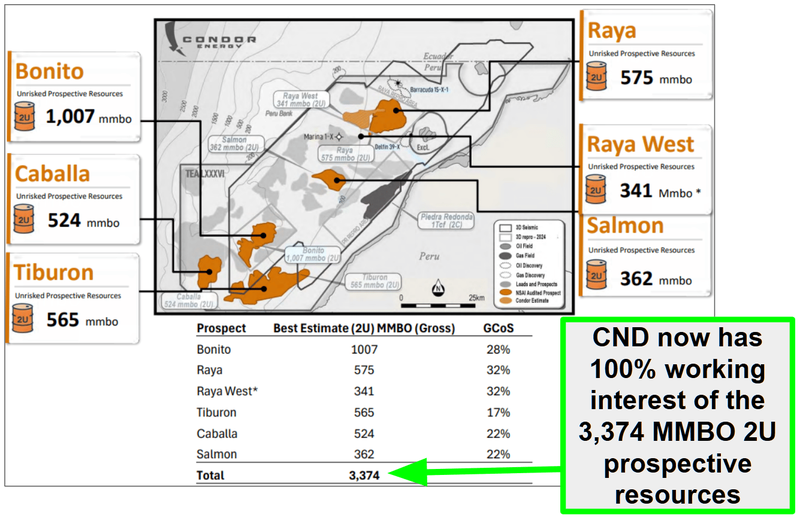
At the moment CND’s asset has a 3.3BN barrel prospective resource split across six main prospects:
(source)
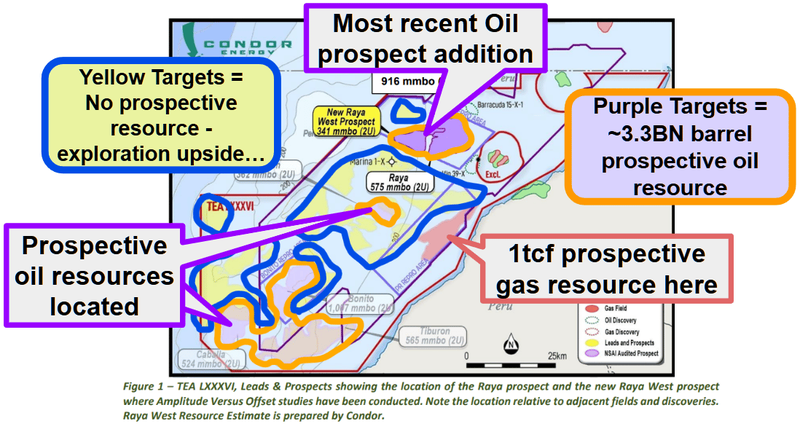
And there are a bunch of other leads that DO NOT have a resource estimate defined on them yet... so the exact upside could be a lot bigger than 3.3BN barrels:
(source)
A big part of why we like these prospects is because CND’s single biggest target is the ~1BN barrel Bonito prospect - more than big enough to be an interesting single well exploration roll of the dice.
And more than big enough to get a few interested parties into a data room and signed up to a farm-in deal.
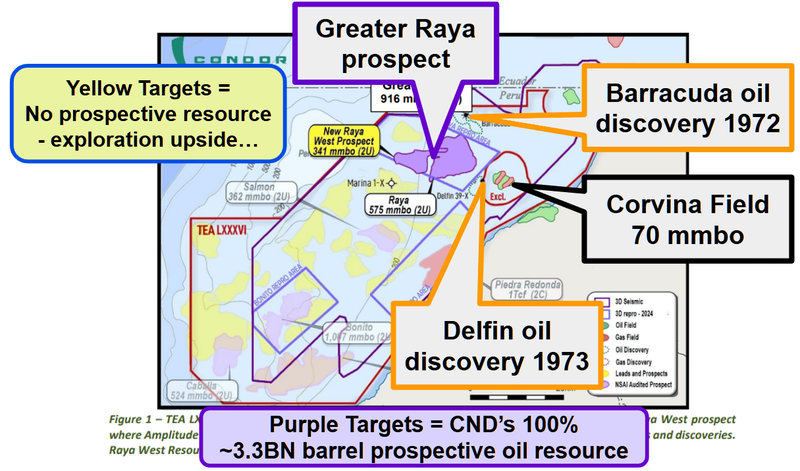
Another big reason we like these prospects is because they sit in the middle of a PROVEN hydrocarbon system.
There is the Barracuda oil discovery that was made in 1972 and the Delfin oil discovery made in 1973 (both of which sit inside CND’s acreage)...
AND there is the Corvina Field (excluded from CND’s block) which is currently producing oil.
As mentioned earlier, the two wider basins that CND’s block sits within have produced ~1.7BN Barrels of oil historically.
So CND’s 3.3BN barrels of prospects are in a part of the world where discoveries have been made and projects have been brought into production...
(source)
We think the oil exploration part of CND’s block is exactly what you want to see in an offshore up and coming basin.
BIG targets - with plenty of running room (follow up targets) IF discoveries get made which can help build scale to justify developing a new oil field...
(the big kicker is that it's a proven hydrocarbon system with all of that historical production - so it's technically de-risked to some extent).
What’s next for CND?
🔄 License application outcome
The single biggest catalyst for CND right now is the outcome of the licence contract application.
Up until now, CND operated the project under a Technical Evaluation Agreement (TEA).
Back in May CND made its submission to convert the TEA into a license contract:
Ultimately, the licence contract is what gives CND the right to drill and develop the block.
And we think IF successful - that grant alone could be a major catalyst for a re-rate in CND’s share price...
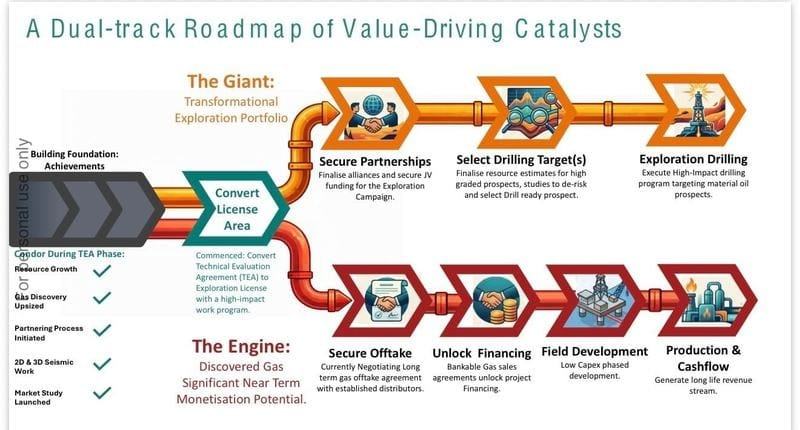
We think it will also put CND’s block in play and allow for deals to be done over the asset:
(source)
What are the risks?
The single biggest risk right now is, without a doubt, licensing / regulatory risk.
CND has APPLIED to convert its TEA into a Licence Contract - but there is no guarantee the licence is granted.
If the market starts to price in a "no" or a long delay, CND's share price could drift lower.
Permitting risk
CND’s project is currently permitted under a Technical Evaluation Agreement (TEA) for a period of two years. Eventually before any drilling work can happen CND will have to convert it into an exploration licence. There is always a risk that the licence doesn't get granted and CND is left with no claim over the asset.
Source: “What could go wrong” - CND Investment Memo 05 December 2023
Other risks for CND
Like any small cap O&G explorer, investing in CND carries a high degree of risk.
Even with good seismic indicators and proven discoveries in the region, offshore drilling is technically complex and expensive.
A well can miss or deliver smaller-than-expected results, which would likely hit market sentiment and future funding options.
CND is also exposed to country and geopolitical risk. Peru has a history of supporting energy development, but policy shifts, regulatory changes or political instability could affect permitting, commercial terms or project economics.
And while a tense global oil backdrop (like the current Strait of Hormuz situation) can lift sentiment toward oil & gas explorers, it can just as easily reverse - sentiment-driven moves can be short-lived, and a sudden easing in oil prices could remove a tailwind just as quickly as it appeared.
Rising industry costs can also bite. Offshore rigs, vessels and specialised crews move with global demand cycles, and cost inflation could blow out drilling budgets or make a development less attractive to a partner.
Investors should consider these risks carefully and seek professional advice tailored to their personal circumstances before investing.
Our CND Investment Memo
Our Investment Memo provides a short, high-level summary of our reasons for Investing.
We use this memo to track the progress of all our Investments over time.
Our CND Investment Memo covers:
- What does CND do?
- The macro theme for CND
- Our CND Big Bet
- What we want to see CND achieve
- Why we are Invested in CND
- The key risks to our Investment Thesis
- Our Investment Plan
General Information Only
This material has been prepared by StocksDigital. StocksDigital is an authorised representative (CAR 000433913) of 62 Consulting Pty Limited (ABN 88 664 809 303) (AFSL 548573).
This material is general advice only and is not an offer for the purchase or sale of any financial product or service. The material is not intended to provide you with personal financial or tax advice and does not take into account your personal objectives, financial situation or needs. Although we believe that the material is correct, no warranty of accuracy, reliability or completeness is given, except for liability under statute which cannot be excluded. Please note that past performance may not be indicative of future performance and that no guarantee of performance, the return of capital or a particular rate of return is given by 62C, StocksDigital, any of their related body corporates or any other person. To the maximum extent possible, 62C, StocksDigital, their related body corporates or any other person do not accept any liability for any statement in this material.
Conflicts of Interest Notice
S3 and its associated entities may hold investments in companies featured in its articles, including through being paid in the securities of the companies we provide commentary on. We disclose the securities held in relation to a particular company that we provide commentary on. Refer to our Disclosure Policy for information on our self-imposed trading blackouts, hold conditions and de-risking (sell conditions) which seek to mitigate against any potential conflicts of interest.
Publication Notice and Disclaimer
The information contained in this article is current as at the publication date. At the time of publishing, the information contained in this article is based on sources which are available in the public domain that we consider to be reliable, and our own analysis of those sources. The views of the author may not reflect the views of the AFSL holder. Any decision by you to purchase securities in the companies featured in this article should be done so after you have sought your own independent professional advice regarding this information and made your own inquiries as to the validity of any information in this article.
Any forward-looking statements contained in this article are not guarantees or predictions of future performance, and involve known and unknown risks, uncertainties and other factors, many of which are beyond our control, and which may cause actual results or performance of companies featured to differ materially from those expressed in the statements contained in this article. S3 cannot and does not give any assurance that the results or performance expressed or implied by any forward-looking statements contained in this article will actually occur and readers are cautioned not to put undue reliance on forward-looking statements.
This article may include references to our past investing performance. Past performance is not a reliable indicator of our future investing performance.