SGQ commences geophysical surveys at Brazilian niobium/REE project
Our Investment St George Mining (ASX: SGQ) just started geophysical surveys at its rare earth/niobium project in Brazil.
SGQ’s project currently has two resources:
- Rare earths - 40.6Mt of rare earths at grades of 4.13% TREO (total rare earths oxide)
- Niobium - 41.2Mt at niobium grades of 0.63%
Now SGQ is drilling to try and upgrade those resources with three rigs on site for a 10,000m drill program.
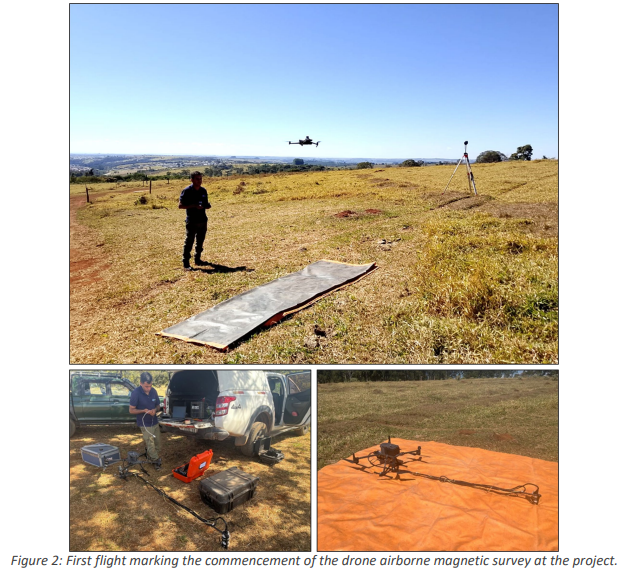
Today, SGQ announced that it is now running geophysical surveys in parallel to the drilling program.
SGQ plans to fly an airborne magnetic survey AND a passive seismic survey - both to try and get a better understanding of the structures that sit across its project area.
More data will help with where SGQ is putting its drillholes…
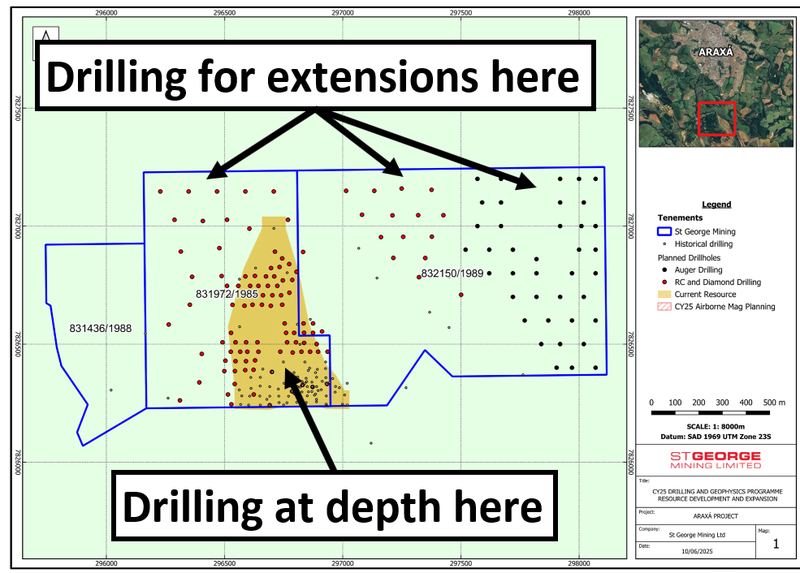
Here is a 2D view of where SGQ will be drilling (the yellow section is the current resource, the holes surrounding it are where SGQ will be drilling):
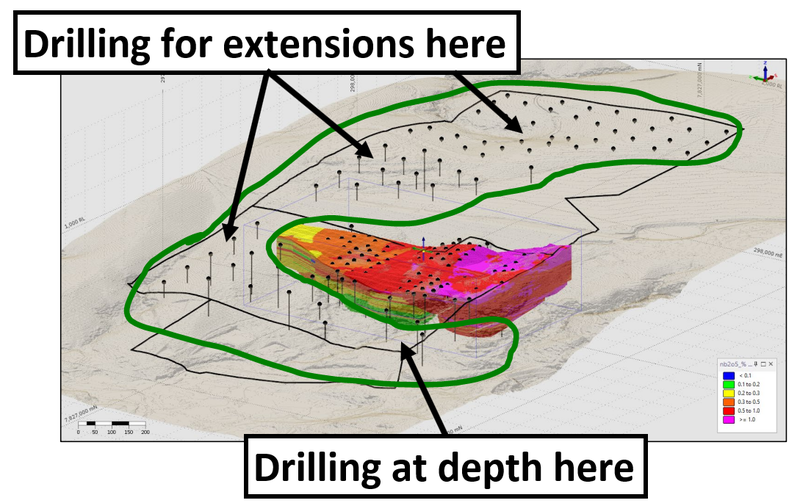
Here is a 3D overview of the drilling, which gives a good sense of what SGQ is going after:
SGQ’s current resources are already very big.
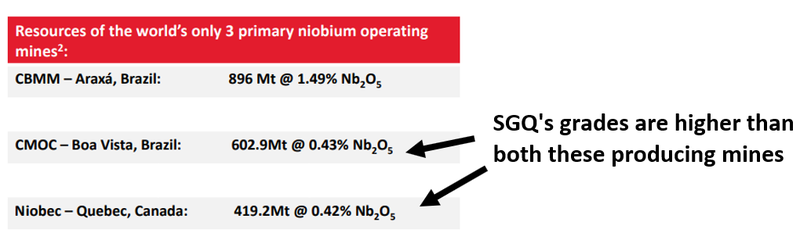
SGQ’s niobium resource has higher grades than 2/3 of the world’s biggest producing niobium mines.
As for SGQ’s rare earths project - it is one of the largest, highest grade hard-rock rare earth resources in the world.
SGQ’s resource is carbonatite hosted (hard rock) which is well understood.
SGQ’s resource has similar grades to A$7.9BN capped Lynas Rare Earths, who owns the producing Mount Weld project in WA.
And in terms of size, SGQ has the same tonnages as A$7.8BN MP Materials which is producing from its project in the USA.
Comparing it to a developer - SGQ has a higher grade relative to A$443M Arafura.
Here is how SGQ ranks side by side against Lynas, Arafura and MP Materials:
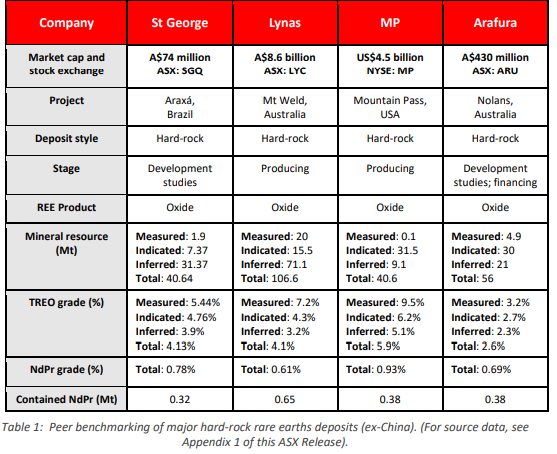
(Source - note the market caps are slightly out of date now)
SGQ’s project can get a lot bigger. What’s the exploration upside?
SGQ’s project hasn't been drilled for years and has had almost no work done on it during the current positive market sentiment for niobium.
Which is why we think SGQ can add a lot of value to the project with the drill bit.
At the moment, almost all of the JORC resource is limited to depths of ~100m and drilling has been on only ~10% of the project area:
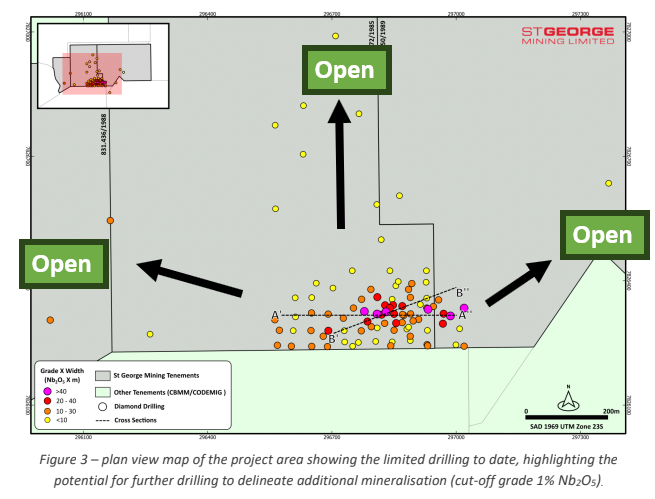
SGQ expects all of the current drilling to be completed, reported and the projects resources upgraded inside 2025.
What’s next for SGQ?
Drilling results + geophysics 🔄
In the short term the main thing we want to see are drill results.
Ideally we see big extensions at depth and to the North/East/West of SGQ’s current JORC resource.
We are also looking forward to seeing the results of the geophysical surveys.
Hopefully they can define clear high priority drill targets (that SGQ ends targets with this round of drilling).
Beyond the drilling 🔄
Over the next 12-18 months, a lot of the catalysts for SGQ could come at hard-to-forecast times:
- Progress on strategic investors/offtake partners - hopefully SGQ can follow up the $8M cornerstone investment it managed to get from Xinhai Group - a global mining services provider - as part of its last raise.
- Finalise the remaining vendor payments - (US$6M due before the end of the year and US$5M due next year).
- Start working on development studies - SGQ has mentioned some of these workstreams are already underway.
- Updates on downstream processing processing venture - SGQ is also working on a downstream processing process for niobium/rare earths products. This could be an additional upside if SGQ manages to make any material progress on this front.
- Pilot plant trials - SGQ has an agreement in place with Latin America’s only permanent magnet maker. SGQ is participating in the “MAGBRAS Initiative” - a program that has major automakers like Stellantis working toward building Brazil’s first permanent magnet-making facility.
- Permitting - Permitting targeted for full completion by Q4, 2026.