

Our Latest Investment: Pure Resources (ASX: PR1) - Thermal Management for AI data centres, Military and Robotics with Rice University
Disclosure: S3 Consortium Pty Ltd (the Company) and Associated Entities own 3,100,000 PR1 Shares at the time of publishing this article. The Company has been engaged by PR1 to share our commentary on the progress of our Investment in PR1 over time. This information is general in nature about a speculative investment and does not constitute personal advice. It does not consider your objectives, financial situation, or needs. Any forward-looking statements are uncertain and not a guaranteed outcome.
We think AI and robotics will be bigger for humanity than the internet and mobile phones were.
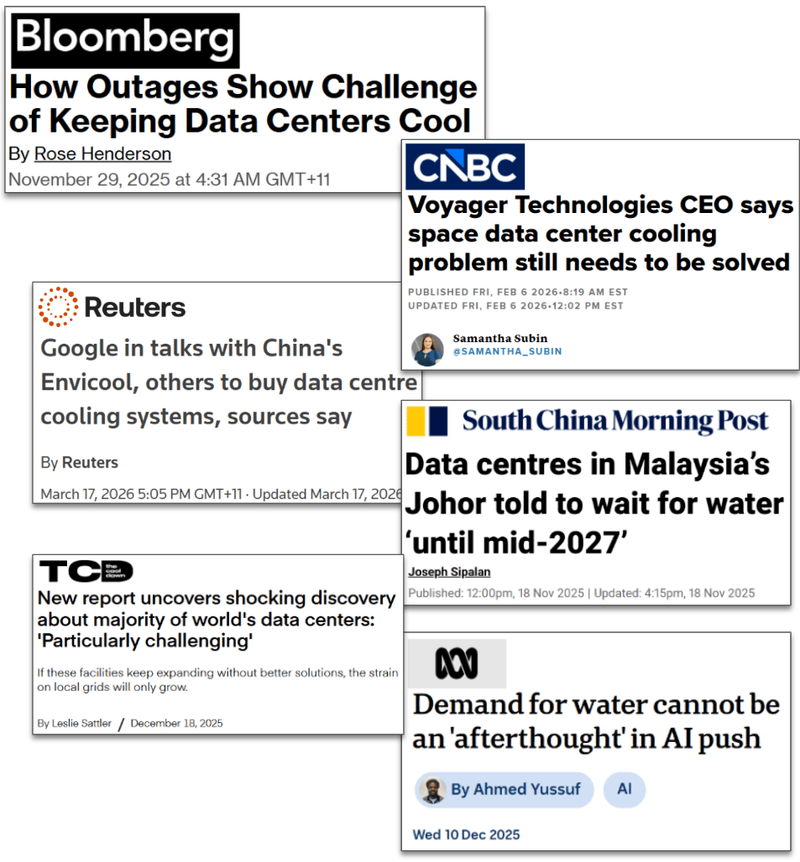
However managing the immense heat generated by these technologies is a critical and growing problem.
The specialized hardware used for Artificial Intelligence generates far more heat than traditional servers.
(The thermal management market is valued at over $100BN)
Current cooling solutions rely on copper and aluminium heat sinks - but they are approaching their physical and structural limits.
Power density is rising faster than conventional cooling architectures can scale.
Managing heat has become the bottleneck for AI computing and next generation defence technologies.
(source)(source)(source)(source)(source)
Carbon nanotubes represent one of the most advanced forms of engineered carbon, combining exceptional:
- thermal conductivity,
- mechanical strength, and
- lightweight structural properties.
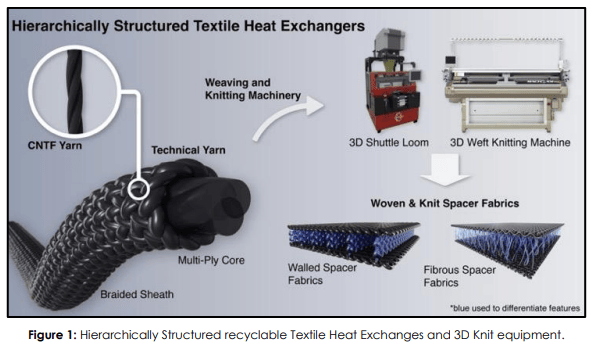
Carbon nanotube fibre (CNTF) thermal management is a high-performance cooling technology.
The technology uses microscopic, hair-like carbon threads to move heat away from sensitive components.
(source - PR1 announcement)
These carbon fibres act as "thermal superhighways" because they possess exceptional axial thermal conductivity (the ability to conduct heat along their length) - which can exceed that of copper by 15-20%, while being significantly lighter.
We have recently written a lot about AI taking our jobs...
Now carbon nanofibre tubes could be taking copper’s job in AI chips and data centre cooling.
(sorry, copper bulls)
Not even base metals’ jobs are safe...
The potential applications for this technology extend to anywhere where lightweight cooling is required in tight spaces - including robotics and military.
PR1 has just entered into an R&D collaboration agreement with Rice University to research carbon nanotube fibre thermal management systems for advanced electronics.
Rice University in Houston, Texas is known as “The Birthplace of Carbon Nanotechnology”. (source)
It is also the same University that has done four technology partnerships with ASX listed companies:
- ~$757M capped Weebit Nano (ASX: WBT): ReRAM semiconductor technology up ~700% at its peak.
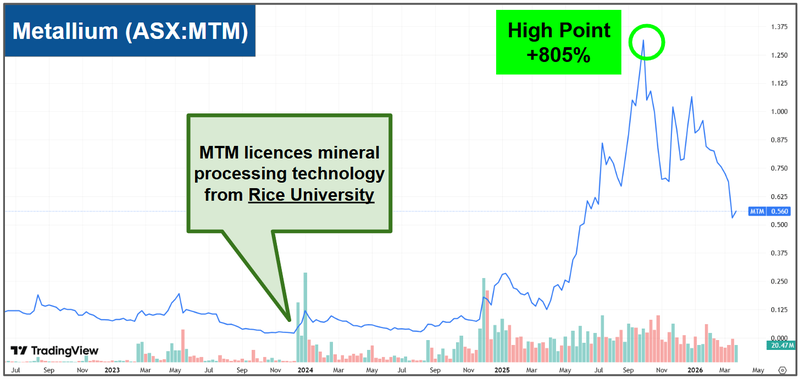
- $413M capped Metallium (ASX: MTM): Flash Joule Heating technology up at ~800% at its peak. ~
- ~$34M capped Environmental Clean Technologies (ASX: ECT): up 104% on the day it partnered with Rice Uni for Flash Joule Heating technology.
- Locksley Resources (ASX: LKY): signed a collaboration with Rice Uni - on that day alone, LKY’s share price was up over 40%. One of our best performers of 2025 -
The past performance is not and should not be taken as an indication of future performance. Caution should be exercised in assessing past performance. This product, like all other financial products, is subject to market forces and unpredictable events that may adversely affect future performance.
Today we added Pure Resources (ASX:PR1) to our Portfolio.
PR1 will provide Rice with up to US$500,000 in Research and Development funding (over a maximum 24 month period) to apply carbon nanotube fibre for thermal management (cooling) in:
- Hyperscale AI data centres
- directed-energy weapons (e.g. military lasers) and advanced RF platforms (e.g. radar and comms)
- and autonomous defence systems (e.g. automated drone swarms and robot dogs)
Both PR1 and Rice will have joint ownership of any intellectual property where there are inventors from both PR1 and Rice.
(read the full PR1 announcement here)
This Rice University R&D collaboration plus the markets PR1 intends to go after are the key reasons we Invested in PR1.
PR1 just raised $3M and is capped at ~$17.5M at the 25c placement price (post placement).
A big part of our Investment in PR1 is to back the team at Rice University.

(source: PR1 announcement)
Each professor brings a different piece of the puzzle (more on each of them later):
- Prof. Matteo Pasquali - a global pioneer in carbon nanotube fibre technology and leader in high performance carbon nanotube materials
- Prof. Daniel Preston pushes heat rejection to its extreme physical limits
- Prof. Vanessa Sanchez turns fibres into deployable, real-world structures
- Prof. Geoff Wehmeyer makes the thermal system intelligent and adaptive
Put them together and you have the full chain - from carbon nanotube fibres chemistry all the way to thermal management systems.
And now PR1 will be working with the Rice team to apply the carbon nanotube fibres to the thermal management problem.
PR1 said that the applications it is going after are “in Hyperscale AI data centres, directed-energy weapons, advanced RF platforms and autonomous defence systems”
(source: Today’s PR1 announcement)
Here’s what each of those mean:
AI Data Centres - next-gen AI chips will generate heat loads that copper simply can't handle.
Lightweight, flexible carbon nanotube fibres cooling could be the answer.
(A hyperscale AI data center is a massive, specialised facility engineered to train and deploy the world’s most advanced artificial intelligence models at an unprecedented scale. Yep, even more heat load at a hyperscale data centre)
Directed-Energy Weapons - military lasers and microwave weapons dump enormous heat in short bursts.
Carbon nanotube fibres may be able to handle the temperature extremes while being light enough to mount on vehicles and aircraft.
Advanced Radar & RF Systems - high-power electronics in phased-array radars need compact, corrosion-resistant cooling.
Carbon nanotube fibres do both - conduct heat AND shields electromagnetic interference in a single layer.
Autonomous Defence Systems - drones and unmanned vehicles can't afford the weight of heavy copper cooling.
Coming in at 80% lighter, carbon nanotube fibres let you cool the electronics without weighing down the platform.
We think the four professors listed above - all at Rice University, where carbon nanotube fibres technology was originally invented - have the combined skills to take carbon nanotube fibres from a proven material to a deployable thermal management solution across defence and AI.
No guarantees of a successful outcome here though. PR1 is an early stage company and the project is at R&D stage, this is high risk / high reward Investment.
The Rice University ASX track record
We like that the PR1’s IP collaboration in this space is with Rice University.
Again, Rice University has been behind some of the most successful materials technology projects on the ASX in the last few years.
Again, Rice is the same university that developed the:
- ~$757M capped Weebit Nano (ASX: WBT) ReRAM semiconductor technology and
- ~$413M capped Metallium (ASX: MTM) Flash Joule Heating technology.
- ~$34M capped Environmental Clean Technologies (ASX: ECT) Flash Joule Heating technology for PFAS.
- One of our best performers of 2025 - Locksley Resources (ASX: LKY), signed a collaboration with Rice Uni - on that day alone LKY’s share price was up over 40%.
The past performance of these companies is not indicative of future performance of PR1.
Here is how each stock traded in the years following Rice University licensing agreements or R&D partnerships:
It's worth noting, PR1 doesn’t have a licensing deal of its own yet; PR1 is a lot earlier stage and there is no guarantee PR1 and Rice will end up signing a licensing agreement either.
(source)
The past performance is not and should not be taken as an indication of future performance. Caution should be exercised in assessing past performance. This product, like all other financial products, is subject to market forces and unpredictable events that may adversely affect future performance.
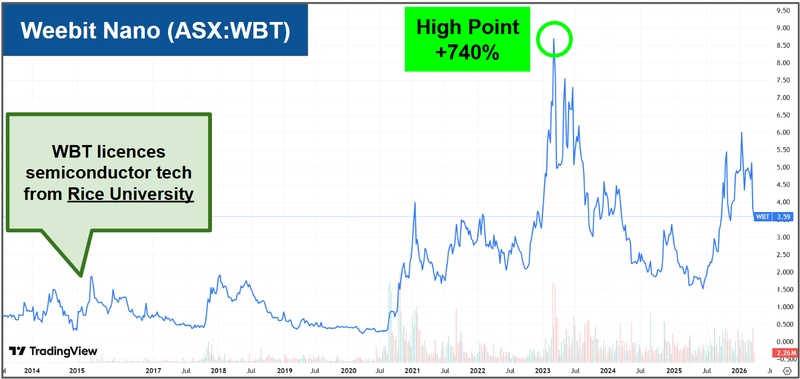
(source)
The past performance is not and should not be taken as an indication of future performance. Caution should be exercised in assessing past performance. This product, like all other financial products, is subject to market forces and unpredictable events that may adversely affect future performance.
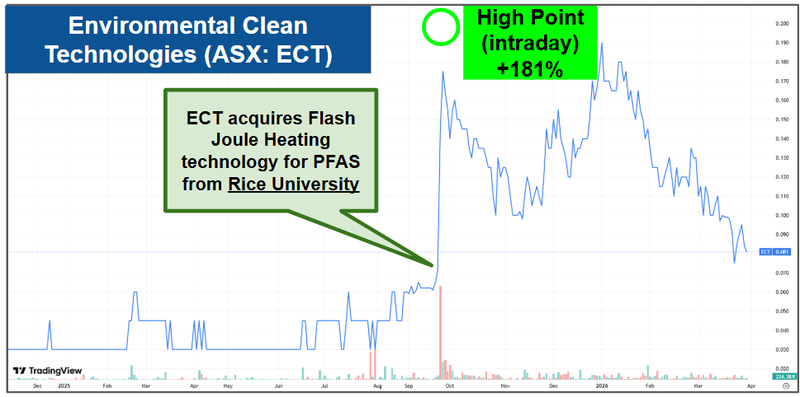
(source)
The past performance is not and should not be taken as an indication of future performance. Caution should be exercised in assessing past performance. This product, like all other financial products, is subject to market forces and unpredictable events that may adversely affect future performance.
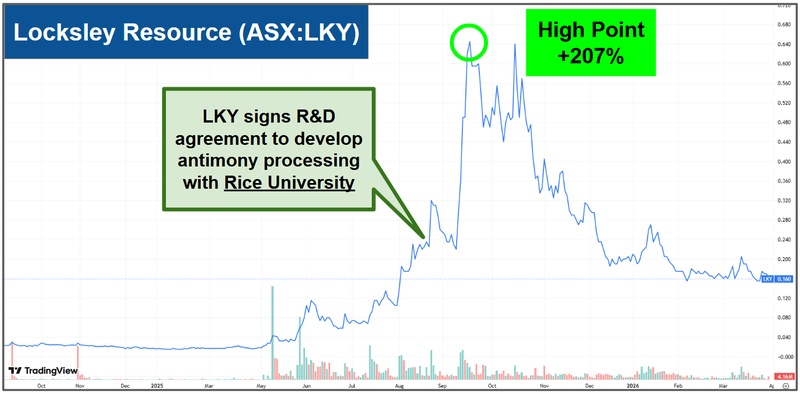
(source)
The past performance is not and should not be taken as an indication of future performance. Caution should be exercised in assessing past performance. This product, like all other financial products, is subject to market forces and unpredictable events that may adversely affect future performance.
Rice University is a leader in carbon nanotube fibre technology
PR1’s new R&D collaboration partner, Rice University, just so happens to be one of the world leaders in carbon nanotube fibre tech.
Rice University's Carbon Hub (led by Professor Matteo Pasquali) developed the technology behind a carbon nanotube fibre (called Galvorn).
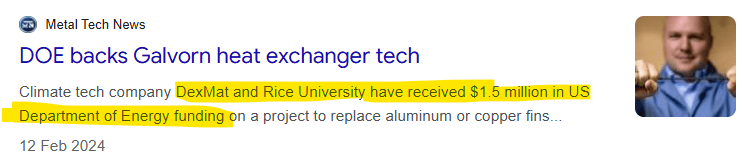
That tech is being commercialised by a company called Dexmat in aerospace, high‐end cables, wearables, and specialty industrial uses.
(so the carbon nano fibre tech is mature, PR1 collaboration with Rice is going after building on the mature technology to apply it to thermal cooling markets)
Dexmat is backed by Shell Ventures, the corporate venture capital arm of energy supermajor Shell plc.
It has also received funding from the US Department of Energy, NASA, the US Air Force, and ARPA-E.
AND NOW - Rice are partnering with PR1 to work out how to apply this same carbon nanotube fibres tech to thermal management.
(The co-founder of Dexmat - Professor Matteo Pasquali - is also the leading the collaboration deal with PR1)
And under the terms of the R&D collaboration agreement, any IP that gets developed would be jointly owned by PR1 and Rice.
“Both Pure and Rice will have joint ownership of any intellectual property where there are inventors from both Rice and Pure Resources.” (source)

(source: Today’s PR1 announcement)
OK, so what exactly is carbon nanotube fibre?
We have to admit, we didn't know much about carbon nanotubes until recently.
After going down a rabbit hole of research papers (thanks to AI) it started looking like this material may just “one shot” copper cabling and the whole AI datacentre copper bull case.
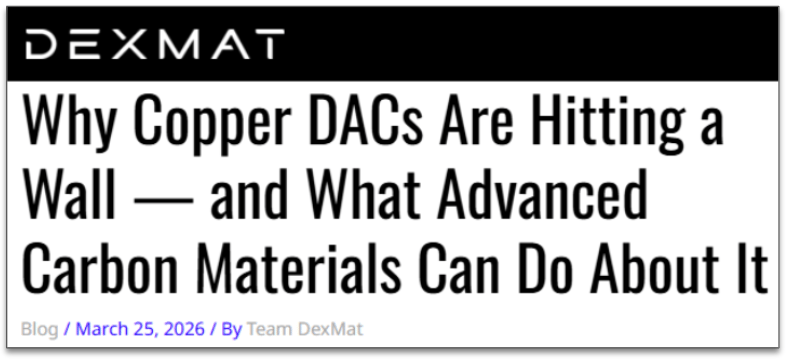
To that point, last week, DexMat (the company set up by the same Rice Uni team that is working with PR1) actually published a blog specifically addressing “Why copper cables in data centres are hitting a wall”.
(even copper’s job as a conductivity metal is at risk because, is anyone’s job safe?)
(source)
But for us, the more exciting parallel is all of the different applications that material could have - like a gateway material for new technologies to be developed on top of.
Which is where PR1 comes into play.
Professor Pasquali's lab at Rice University creates the carbon nanotube fibres - PR1’s Rice team takes those fibres and creates new market applications for it.
With the first market being “thermal management”.
So why PR1 and why thermal management?
The carbon nanotube fibres (think of them like wires) have thermal conductivity that is around ~10x copper (this is the individual nanotube strands) from Dexmat’s website.
When built into larger structures Dexmat’s product is still ~17% more conductive relative to copper. (source)
And 80% lighter.
(perfect for thermal management in tight compact places)
Higher thermal conductivity = higher cooling requirements.
That’s where thermal interface materials (TIMs) and heat sinks matter.
AND where PR1 is focusing with its collaboration deal.
Ever seen one of these inside a computer?
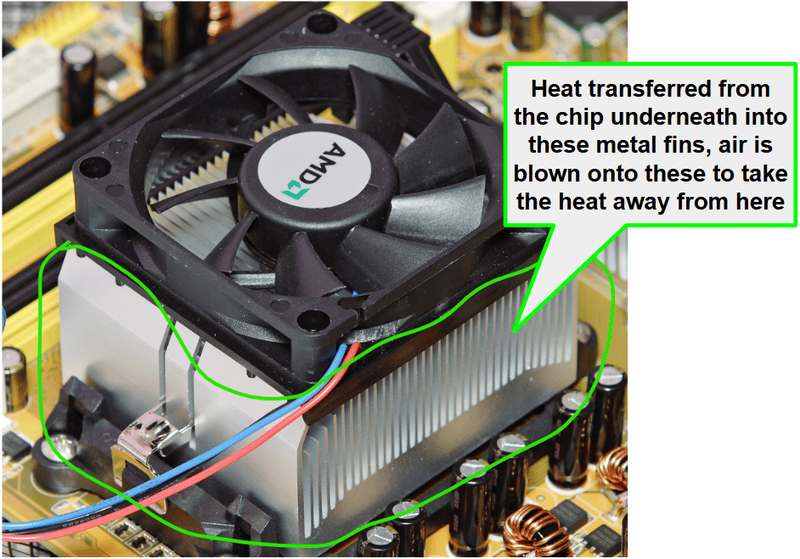
That's the heat sink that sits between the chip and the cooling equipment (in the above case a fan).
Then there is also liquid cooled chips - basically the same concept except they use a liquid instead of air to cool it (but both scenarios still need a copper/aluminium heat sink to sit between the cooling device and the chips below):
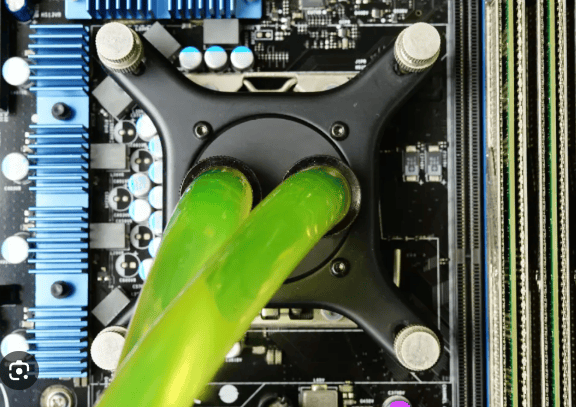
Here is where the carbon nanotubes would fit - replacing the (mostly aluminium or copper) heat sink materials - because carbon nanotube fibres are more conductive and can transfer heat away from the chip more effectively.
More efficient heat transfer = lower cooling requirements.
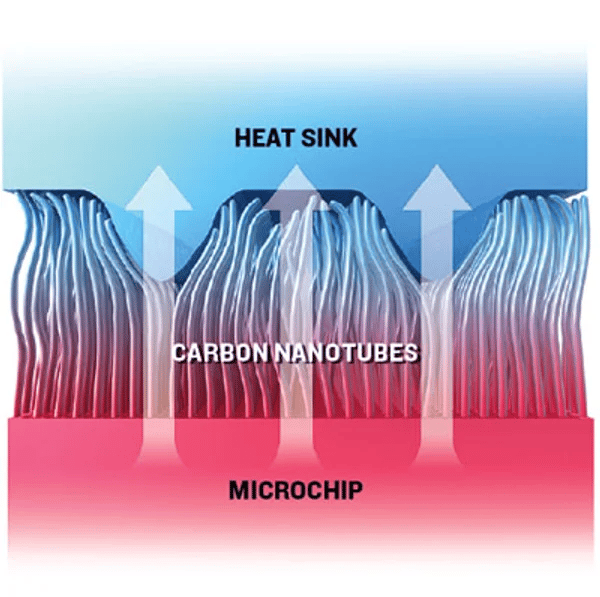
(Source)
A carbon nanomaterial made of extremely aligned and densely packed carbon nanotubes, processed into continuous fibres and thin films:
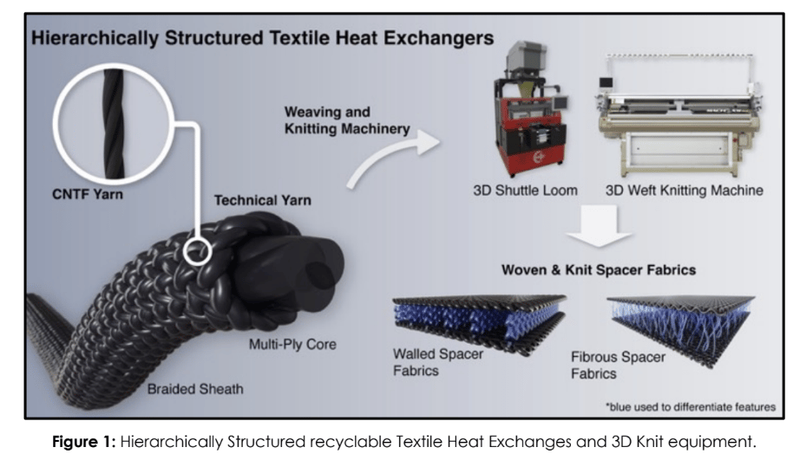
(source: PR1 announcement)
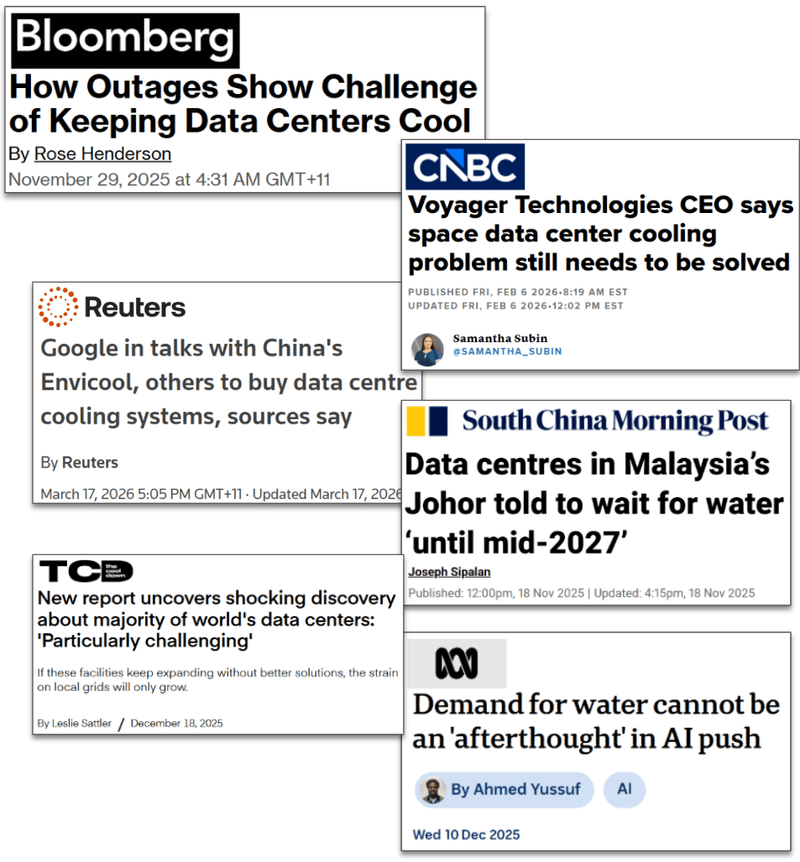
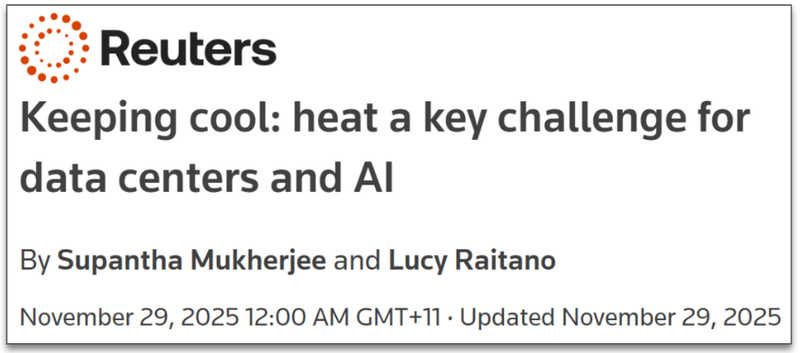
We think the cooling issue for AI data centres could be one that all of the big tech companies face (NVIDIA, Google, Meta, Amazon) - and a material/product that can solve that problem for them could become valuable and of interest to them.
We are already seeing it in the media (that google purchase of Envicool is especially of interest):
(source)(source)(source)(source)(source)(source)(source)
Of course, there is no guarantee PR1's research agreement leads to a commercial outcome. This is early-stage R&D and many research collaborations don't result in commercial products.
The markets PR1 is going after.
In today's announcement, PR1 specified the markets they plan to targeting for thermal management using carbon nanotube fibres:

(source: Today’s PR1 announcement)
Let’s unpack each now and why copper or aluminum heat sinks cooled with air or liquid are reaching their limits and how carbon nanotube fibres can help.
Hyperscale AI data centres
What is it
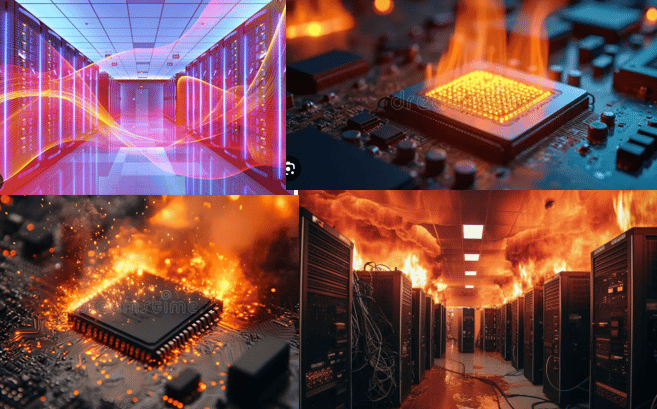
Giant “AI factories” full of powerful chips (GPUs/TPUs) that train and run AI models around the clock, using as much power as a small town.
Everytime you ask AI a question, a datacenter somewhere heats up a bit.
Times that by everyone using AI.
Why it needs cooling
Almost all of that power turns into heat inside the chips and racks. If the chips get too hot, they slow down (throttle), crash, or wear out faster, which directly reduces how much useful AI work each rack can do.
Why aluminium or copper fail
Traditional cooling uses aluminium or copper blocks with fins being cooled by air/liquids. With AI racks now at tens of kilowatts each, the heat is so concentrated that air or liquid plus simple metal heat sinks can’t pull it away fast enough.
You can’t just keep adding more metal and more fans – you run out of space, power and noise budget – so basic aluminium/copper heat sinks hit a wall and more advanced cooling is needed.
Carbon nanotube fibres are ~17% more thermally conductive than copper and nearly double the conductivity of aluminum (higher conductivity = more efficient heat transfer).
Directed‐energy weapons (lasers, high‐power microwaves)
What is it
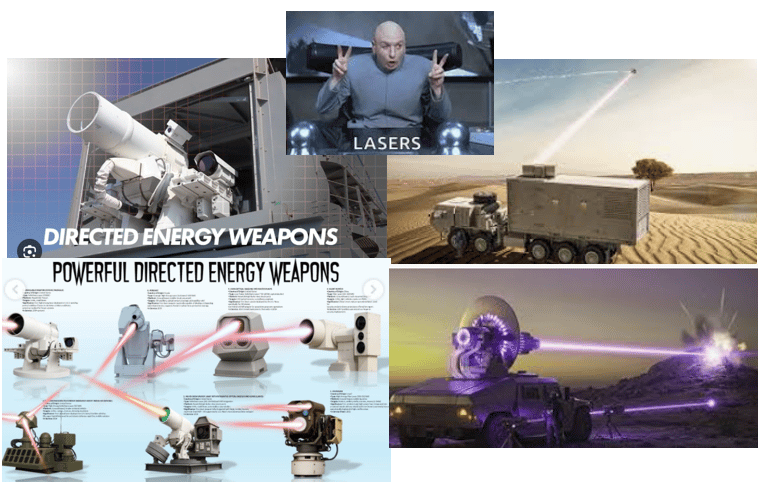
Weapons that fire energy (laser light or high‐power radio waves) instead of bullets, mounted on ships, vehicles or aircraft to knock out drones, missiles or electronics.
Why it needs cooling
Only part of the input power becomes the beam; a big chunk turns straight into heat inside the laser module and power electronics.
That heat builds up very quickly in a small, enclosed weapon. If you don’t remove it fast, optics and electronics overheat, so the weapon can only fire short bursts or has to stop to cool down.
Why aluminium or copper fail
A simple aluminium or copper heat sink can absorb the heat from one small shot, but repeated or long‐duration shots dump more heat than the metal can soak and get rid of.
The block heats up and stays hot, so temperatures still spike.
On top of that, copper is heavy and space/weight are strictly limited on vehicles and ships, so you can’t just bolt on a huge copper radiator.
That’s why passive chunks of aluminium or copper on their own are not enough.
Carbon nanotube fibres are ~50x stronger than copper by weight, 5.6x lighter than copper, and fully recyclable (unlike carbon fibre, which cannot be recycled at all).
Advanced RF (radio frequency) platforms (radars, jammers, high‐end comms)

What is it
Modern radars, electronic warfare pods and high‐power communications systems that pack thousands of tiny RF chips and power amplifiers into small panels and pods on aircraft, ships and vehicles.
Why it needs cooling
When these systems transmit, all those RF chips dump heat into a tight, often sealed space (like the nose of a jet or a pod on a wing).
If they run too hot, the signal gets weaker or noisier, range drops, and reliability suffers, which is unacceptable for mission‐critical sensing and jamming.
Why aluminium or copper fail
You can mount the RF modules on an aluminium or copper plate, but as power levels and duty cycles go up, the plate quickly heats up too.
There often isn’t enough airflow or space to add big fins and fans, and you can’t grow the plate indefinitely because of size and weight limits.
Plain metal alone can’t move the heat away fast enough from such dense, hot spots.
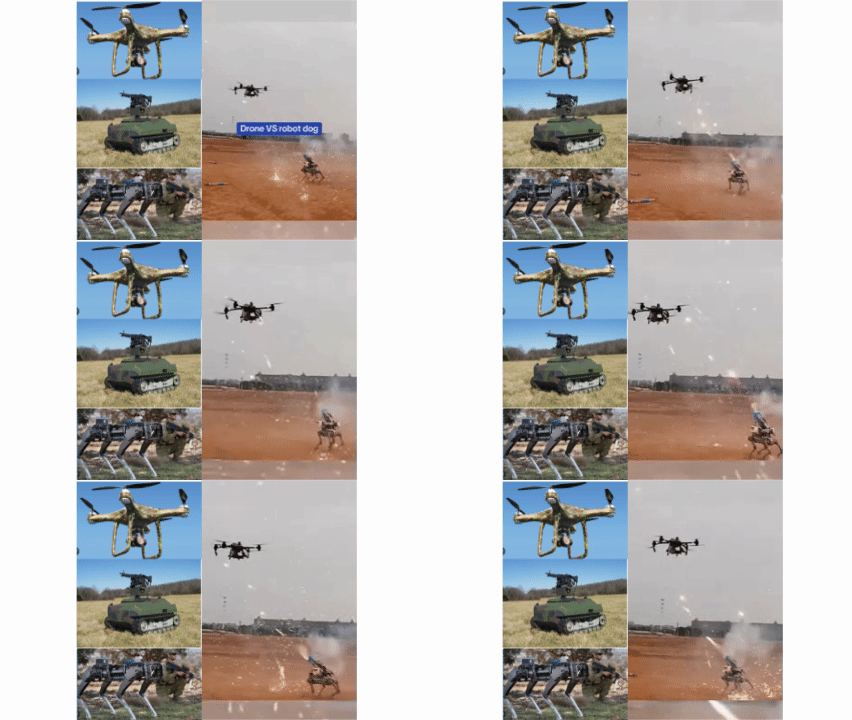
Autonomous defence systems (drones, robots, unmanned vehicles)
What is it
Drones, unmanned ground vehicles and other platforms carrying “AI brains” in rugged, sealed boxes that do onboard vision, navigation and targeting.
Why it needs cooling
These AI computers act like mini data centres in a box, generating a lot of heat in a small volume, often in very hot environments (desert sun, near engines) with little or no airflow.
If they overheat, the AI software slows, crashes or shuts down mid‐mission.
Why aluminium or copper fail
The usual trick is to use the aluminium enclosure as a big heat sink.
As you add more compute, that box fills with more heat than it can dump to the outside air, especially when the air is already hot.
Heavier copper helps a bit but adds weight (bad for drones) and still only moves heat to the surface of the box.
Again - carbon nanotube fibres are ~50x stronger than copper by weight, 5.6x lighter than copper, and fully recyclable (unlike carbon fibre, which cannot be recycled at all).
The Rice University research team on PR1’s project
Our Investment in PR1 is really an investment in the Rice University team collaborating with PR1.

(source: PR1 announcement)
Here’s some more details on them:
Prof. Matteo Pasquali - the inventor of Rice Uni’s carbon nanotube fibres technology alongside Nobel laureate Richard Smalley at Rice, starting in 2001.
Over 25 years of R&D, his lab laid the entire scientific foundation - from dissolving nanotubes in superacid to spinning them into continuous fibres.
He co-founded DexMat (the company producing the carbon nanotube fibre as a material (Galvorn) and remains its Chief Science Advisor.
He's the reason this material exists, and he's the one who knows how to optimise it for any specific application.
Prof. Daniel Preston - the extreme heat guy.
His PhD work at MIT achieved a 4x improvement in how fast surfaces can shed heat, and his boiling experiments toward the theoretical limits of cooling.
At Rice, he explicitly works on "thermal management for high-powered electronics, both military and civilian applications."
He's the one who can take a carbon nanotube fibre heat exchanger and make it perform at its absolute physical maximum.
Prof. Vanessa Sanchez - the textile engineer.
She knows how to take advanced fibres and weave, knit, and integrate them into functional structures - thermal blankets for server racks, cooling skins for drone airframes, conformal wraps for weapon systems.
She holds a Department of Defense fellowship and was named in Forbes 30 Under 30.
She's the bridge between "we have a great fibre" and "we have a product that fits on an actual platform."
Prof. Geoff Wehmeyer - the thermal switch guy.
He builds devices that can turn heat flow on and off, like a light switch, but for thermal energy.
Imagine a cooling system in a data centre that ramps up when the AI chips are working hard...
and dials back when they're idle. That's what his tech enables.
He makes the cooling system smart.
Why This Matters
Each of these people brings a different piece of the puzzle:
- Pasquali invented the material and knows how to optimise and scale it
- Preston pushes heat rejection to its extreme physical limits
- Sanchez turns fibres into deployable, real-world structures
- Wehmeyer makes the thermal system intelligent and adaptive
Put them together, and you have the full chain - from carbon nanotube fibres chemistry all the way to a fielded thermal management system.
And now that team is undertaking R&D collaboration with PR1.
And whatever tech the team develops with PR1 will be jointly owned by the two parties.
A little further down we will share our full PR1 Investment Memo which covers:
- Why we Invested,
- Our “Big Bet”,
- Outline our Investment Memo, and
- What we want to see PR1 execute on over the coming 12 months.
Before that, here are the 6 reasons why we Invested in PR1 and our Big Bet:
6 reasons why we Invested in PR1:
1. Our three favourite macro thematics - AI, Robotics and Defence
We have been looking for ways to get exposure to the "AI infrastructure buildout", "robotics" and “defence” thematic on the ASX for a while now.
PR1’s focus will be on a problem that combines a mix between materials science, AI and robotics - where the blue sky upside could be anything really...
(We literally don't know, it could also never eventuate into anything commercial).
PR1 is going after thermal management - a critical problem for two of our favourite macro thematics - AI data centres, autonomous robots/vehicles.
We think the two macro thematics are going to be the main character for the markets over the next decade at least.
2. First micro-cap on the ASX going after thermal management
We like first movers on the ASX - especially when it comes to advanced technologies across AI and robotics.
PR1 is working with Rice Uni to develop thermal management tech based on the work of Professor Matteo Pasquali - who leads Rice University's Carbon Hub.
Pasquali developed “carbon nanotube fibres” a material that is 17% more thermally conductive than copper, nearly double the thermal conductivity of aluminium, 50x stronger than copper by weight, 5.6x lighter than copper, and fully recyclable (unlike carbon fibre, which cannot be recycled at all).
Carbon nanotube fibres showed that for the first time you could get metal-level conductivity and carbon fibre-level strength in the same material.
Under the R&D collaboration agreement, PR1 is applying that material to thermal management.
3. Collaboration deal with Rice University who were involved in multiple ASX tech success stories.
PR1 is not the first ASX company to partner with Rice University.
Rice University has been associated with some of the most successful industrial materials projects on the ASX in the last few years.
Rice University is the same university that developed the:
- ~$757M capped Weebit Nano (ASX: WBT) ReRAM semiconductor technology and
- ~$413M capped Metallium (ASX: MTM) Flash Joule Heating technology.
- ~$34M capped Environmental Clean Technologies (ASX: ECT) Flash Joule Heating technology for PFAS.
- One of our best performers of 2025 - Locksley Resources (ASX: LKY) signed a collaboration with Rice Uni - on that day alone LKY’s share price was up over 40%.
The past performance of the above companies is not an indicator of future performance of PR1. Caution should be exercised in assessing past performance.
4. Proven technology that’s been funded by the US DoE and DoW
The tech that underpins PR1’s thermal management research isn't just a lab experiment.
Rice's carbon nanotube fibre technology that is being commercialised by a company called DexMat and has received funding from the US Department Of Energy, NASA and the US Air Force.
The DoE grant from 2024 was specifically targeting further improvements to thermal conductivity so there is a demand signal in the market too.
The US Department of War is also funding carbon nanotube fibre research.
(Team members of Dexmat are also part of the collaboration deal with PR1)
5. PR1 is collaborating with experts in carbon nanotube fibres and thermal management
PR1 will now be doing its R&D programs alongside:
- Prof. Matteo Pasquali - the inventor of Rice Uni’s carbon nanotube fibres technology. He's the reason the material exists and how to optimise it for any specific application.
- Prof. Daniel Preston - At Rice, he explicitly works on "thermal management for high-powered electronics, both military and civilian applications." He's the one who can take a carbon nanotube fibre heat exchanger and make it perform at its absolute physical maximum.
- Prof. Vanessa Sanchez - She knows how to take advanced fibres and weave, knit, and integrate them into functional structures. She's the bridge between "we have a great fibre" and "we have a product that fits on an actual platform."
- Prof. Geoff Wehmeyer - the thermal switch guy. He builds devices that can turn heat flow on and off, like a light switch, but for thermal energy.
Put them together and you have the full chain - from carbon nanotube fibres chemistry all the way to thermal management systems.
6. Tiny market cap and tight capital structure
PR1 has a market cap of just ~$17.5M and ~70 million shares on issue (after today’s capital raise).
The last annual report also showed that the top 20 held ~83% of the company's stock (source) - so we think the company could re-rate to multiples of where it is today IF the company can develop, license and commercialise its tech partnerships.
No guarantees this will eventuate of course. Commercialising technology is hard to do, and an investment in PR1 carries risk.
Ultimately, we are hoping a combination of the above reasons contribute to PR1 achieving our Big Bet as follows:
Our PR1 Big Bet:
"PR1 re-rates to a +$200M market cap by securing a pathway into the carbon nanotube fibre thermal management supply chain, attracting strategic partnerships with major data centre or defence customers, and/or being acquired at a multiple of our Initial Entry Price."
NOTE: our “Big Bet” is what we HOPE the ultimate success scenario looks like for this particular Investment over the long term (3+ years). There is no guarantee that our Big Bet will ever come true. There is a lot of work to be done, many risks involved, including development risk, country risk and commodity price risk - just some of which we list in our PR1 Investment Memo.
Success will require a significant amount of luck. Past performance is not an indicator of future performance.
Investment Memo 1: Pure Resources (ASX:PR1)
Memo Opened: 31st March 2026
Shares Held: 3,100,000
What does PR1 do?
Pure Resources (ASX:PR1) has partnered with Rice University to develop carbon nanotube fibre thermal management materials for AI data centres and defence applications.
What is the macro theme behind PR1?
We think AI and robotics will be as big a macro thematic across markets as the introduction of the internet was in the late 1990’s and early 2000’s.
AI data centres and AI humanoid robots are already pushing the boundaries of materials science technology.
(like the materials being used to make chips and data centre infrastructure)
Every single AI data centre and AI humanoid robot will need lightweight thermal management to stop motors, batteries, and chips from overheating.
We think carbon nanotube fibres have a role to play across both thematics as a lighter, higher conductivity and stronger material - and naturally, anything that utilises them as parts for advanced chips/robotics.
AI infrastructure buildouts from the likes of Alphabet, Meta, Amazon and more of the hyperscalers - all creates massive demand for better thermal management materials.
Our PR1 Big Bet:
"PR1 re-rates to a +$200M market cap by securing a pathway into the carbon nanotube fibre thermal management supply chain, attracting strategic partnerships with major data centre or defence customers, and/or being acquired at a multiple of our Initial Entry Price."
NOTE: our “Big Bet” is what we HOPE the ultimate success scenario looks like for this particular Investment over the long term (3+ years). There is no guarantee that our Big Bet will ever come true. There is a lot of work to be done, many risks involved, including development risk, country risk and commodity price risk - just some of which we list in our PR1 Investment Memo.
Success will require a significant amount of luck. Past performance is not an indicator of future performance.
The 6 Reasons We Invested in PR1
- Our three favourite macro thematics - AI, Robotics and Defence
- First micro-cap on the ASX going after thermal management
- Collaboration deal with Rice University who were involved in multiple ASX tech success stories.
- Proven technology that’s been funded by the US DoE and DoW
- PR1 is collaborating with experts in carbon nanotube fibres and thermal management
- Tiny market cap and tight capital structure
What do we want to see PR1 do next?
Objective #1: Formalise the Rice University research partnership
We want to see initial results from PR1’s R&D collaboration agreement with Rice University.
Then we want to see the collaboration agreement convert into licensing agreements for any tech developed through the partnership OR outside of the partnership - whether that is carbon nanotube fibre thermal prototypes, or co-development of tech through Rice’s Carbon Hub.
Here are the milestones we will be tracking:
- 🔲 Announce licensing agreement OR formal research agreement with Rice University
- 🔲 Deliver first research milestone / progress update
- 🔲 Announce co-development or pilot-scale testwork results for thermal management materials (or any other products developed through the relationship).
Objective #2: Demonstrate technology validation
We want to see PR1's involvement in the CNTF thermal management space validated through testing results, prototypes, or third-party endorsements.
- 🔲 Testing/prototype results from Rice collaboration
- 🔲 Pathway to qualification for data centre or defence applications
Objective #3: Secure US market entry - data centre or defence supply chain partnerships
We want to see PR1 take any tech it develops with Rice and sign partnerships or MoU’s with industrial users.
Here are the milestones we are tracking:
- 🔲 Announce partnership or MoU with a US data centre thermal management company
- 🔲 Announce partnership or MoU with a US defence contractor
- 🔲 Strategic partnership or co-development agreement signed
Objective #4 (Bonus): Attract strategic investment or JV partner
This one is probably more likely to happen a lot later but we think some sort of third party validation of any tech PR1 develops could be a major catalyst for the stock.
Similar to how an MTM signed a deal with US based Indium corp in August 2024 - that started the rally from 8c to a high of above $1.10 per share.
(past performance of MTM is not an indicator of future performance of PR1)
We think it is possible that PR1 could attract a strategic investor or joint venture partner from the data centre, defence, or advanced materials space.
Milestones
- 🔲 Secure strategic cornerstone investor
- 🔲 Announce JV with a major data centre or defence counterparty
- 🔲 Secure Department Of Energy, Department Of War or US Air Force funding
What are the risks?
Technology / R&D risk
PR1's research agreement with Rice University is early-stage R&D.
There is no guarantee that the collaboration leads to a commercial product.
Many research partnerships do not result in commercially viable outcomes.
Carbon nanotube fibre thermal management products are mostly in the “lab-demonstrated” but not yet commercially ready stage for PR1’s specific use case.
The gap between laboratory-scale and commercial-scale is real and has killed many promising technologies.
Funding risk / dilution risk
PR1 is a micro cap, pre revenue company meaning it will need to raise funds in the future for R&D work.
PR1 will likely need to raise capital multiples times, each of which may dilute existing shareholders.
There is no guarantee PR1 can access capital on favourable terms.
Long lead times to revenue
Even if PR1 formalises a research agreement with Rice University, commercial revenue from carbon nanotube fibre is likely years away.
Product qualification of new thermal materials can take 5-15 years under industry standard frameworks.
Investors need to be comfortable with a long runway before any revenue materialises.
Competition risk
The thermal management space is crowded with large, well-funded players.
There are companies with commercialised tech in the market already and the end users (Google, Meta, Amazon) all have internal R&D programs.
PR1 could face competition from larger, better-resourced players on multiple fronts.
Market risk
Broader market sentiment could deteriorate, particularly for micro-cap technology plays.
If the ASX small-cap market enters a period of weakness, PR1 could struggle to attract the capital and attention needed to advance its strategy.
Other risks
Like any early-stage technology and R&D company, PR1 carries significant risk, here we aim to identify a few more risks.
A major specific risk for PR1 lies in the Intellectual Property (IP) structure of its collaboration with Rice University.
The agreement states that IP will be jointly owned where there are co-inventors, which can create complex legal and commercial hurdles when attempting to exclusively license, sell, or protect the technology globally.
Even if the R&D successfully produces a highly conductive carbon nanotube fibre for thermal management, scaling the manufacturing process is incredibly difficult.
Moving from creating small batches of advanced materials in a university laboratory to producing commercial quantities cost-effectively has historically been a tough task for advanced materials companies.
PR1 also faces significant industry adoption risk.
Hyperscale data center operators like Amazon, Google, and Microsoft are highly risk-averse regarding their multi-billion dollar infrastructure. Convincing these tech giants to replace proven copper or liquid cooling systems with a novel carbon nanomaterial will require years of rigorous, expensive product qualification and testing.
The company is also reliant on its partnership with Rice University and key personnel like Professor Pasquali and his team. As an ASX-listed junior, PR1 lacks the internal scientific capacity to advance this highly specialised technology on its own if the university collaboration breaks down or key researchers depart.
Investors should consider these risks carefully and seek professional advice tailored to their personal circumstances before investing.
What is our Investment Strategy?
Our plan is to hold the majority of our position in PR1 for 3 to 5 years which we hope is enough time to see PR1 to move towards development (see “our long term bet” above).
After 12 months, we will apply our standard de-risking strategy.
We may also look to sell up to 20% of our holding if the company delivers on one or more of our Investment Memo objectives and/or the share price materially re-rates.
Any sell downs will be in accordance with our trading and hold policy disclosure.
General Information Only
This material has been prepared by StocksDigital. StocksDigital is an authorised representative (CAR 000433913) of 62 Consulting Pty Limited (ABN 88 664 809 303) (AFSL 548573).
This material is general advice only and is not an offer for the purchase or sale of any financial product or service. The material is not intended to provide you with personal financial or tax advice and does not take into account your personal objectives, financial situation or needs. Although we believe that the material is correct, no warranty of accuracy, reliability or completeness is given, except for liability under statute which cannot be excluded. Please note that past performance may not be indicative of future performance and that no guarantee of performance, the return of capital or a particular rate of return is given by 62C, StocksDigital, any of their related body corporates or any other person. To the maximum extent possible, 62C, StocksDigital, their related body corporates or any other person do not accept any liability for any statement in this material.
Conflicts of Interest Notice
S3 and its associated entities may hold investments in companies featured in its articles, including through being paid in the securities of the companies we provide commentary on. We disclose the securities held in relation to a particular company that we provide commentary on. Refer to our Disclosure Policy for information on our self-imposed trading blackouts, hold conditions and de-risking (sell conditions) which seek to mitigate against any potential conflicts of interest.
Publication Notice and Disclaimer
The information contained in this article is current as at the publication date. At the time of publishing, the information contained in this article is based on sources which are available in the public domain that we consider to be reliable, and our own analysis of those sources. The views of the author may not reflect the views of the AFSL holder. Any decision by you to purchase securities in the companies featured in this article should be done so after you have sought your own independent professional advice regarding this information and made your own inquiries as to the validity of any information in this article.
Any forward-looking statements contained in this article are not guarantees or predictions of future performance, and involve known and unknown risks, uncertainties and other factors, many of which are beyond our control, and which may cause actual results or performance of companies featured to differ materially from those expressed in the statements contained in this article. S3 cannot and does not give any assurance that the results or performance expressed or implied by any forward-looking statements contained in this article will actually occur and readers are cautioned not to put undue reliance on forward-looking statements.
This article may include references to our past investing performance. Past performance is not a reliable indicator of our future investing performance.