

LSR: Dysprosium, terbium and lutetium in xenotime... huh? The market liked it.
Disclosure: S3 Consortium Pty Ltd (the Company) and Associated Entities own 38,596,178 LSR Shares and 26,627,263 LSR Options at the time of publishing this article. The Company has been engaged by LSR to share our commentary on the progress of our Investment in LSR over time. This information is general in nature about a speculative investment and does not constitute personal advice. It does not consider your objectives, financial situation, or needs. Any forward-looking statements are uncertain and not a guaranteed outcome.
Why did our exploration Investment Lodestar Minerals (ASX:LSR)’s share price go up 46% yesterday on large volumes of shares traded?
Because LSR announced that its heavy rare earths project in Arizona, USA, contains high value, hard to find heavy rare earths dysprosium, terbium and lutetium.
AND mineralogy testing showed it is hosted in “Xenotime” - a well known host rock that the west knows how to process (and turn into important inputs for advanced technologies).
...and the market liked it.
(The past performance of LSR is not an indication of future performance)
Access to and control over HEAVY rare earths supply will help determine which nations can build, sustain, and upgrade next-generation:
- Artificial Intelligence (AI)
- AI-driven defence
- Autonomous war robots and drones
- Quantum computing, and
- Advanced energy technologies.
Nations that “win” these technologies will likely be the next global superpower.
And to build these technologies you need heavy rare earth minerals.
So it's kinda important to NOT be 100% sourcing the heavy rare earths you need to win this race (USA) from your main adversaries (China) who also want to win the race.
LSR owns a heavy rare earth project in the USA (Arizona).
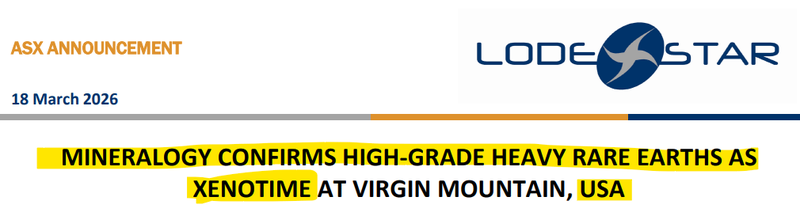
Yesterday LSR announced it had just completed mineralogy test work on rock samples from its project:
(source)
LSR announced that the mineralogy of its heavy rare earth project is one that’s well understood and one that the west can extract with conventional processing.
(unlike most rare earth projects, which are more so chemistry experiments)
Before we go to far here, it’s important to note is that LSR’s project is still at a very early stage. All of the results so far are based on rock chips only. There hasn’t been any drill testing yet, let alone a resource estimate, so we don't know (yet) if there is an economically viable quantity of rare earths in the project.
How do we know?
Because $248M capped ASX listed Northern Minerals built and operated a xenotime-based processing flowsheet and received $5.9M in government grant funding + letters of support from the US Export-Import bank for US$230M. (source) (source)
Oh, and it's also the type of rock that typically contains very high-grade heavy rare earths - the type of rare earth elements that the US needs the most (and has very little of).
We also found out that LSR’s project has three of the highest-value heavy rare earths, all on the US critical minerals list, and all export-controlled by China.
Dysprosium, terbium and lutetium:
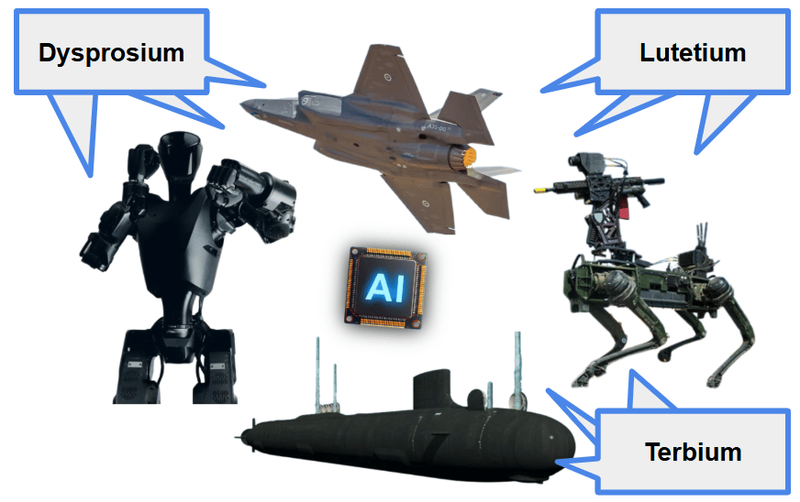
Dysprosium (Dy)
- Military: Stops magnets in missiles, jets, and drones from failing under extreme heat.
- Robotics: Every robot arm and joint motor needs Dy-doped magnets to work reliably.
- AI: Keeps hard drives spinning in the massive data centres that power AI systems.
- Quantum Computing: Used in cooling systems that keep quantum computers at near-absolute-zero temperatures.
Terbium (Tb)
- Military: Powers sonar on submarines, stabilises missile guidance systems, and lights up night-vision displays.
- Robotics: Hardens robot motor magnets so they don't weaken under heavy loads and high heat.
- AI: Improves the tiny transistor gates inside next-generation AI chips.
- Quantum Computing: Being developed for advanced memory systems that could store quantum data.
Lutetium (Lu)
- Military: Detects nuclear and chemical threats on the battlefield via gamma-ray scintillators and the M4 Joint Chemical Agent Detector
- Robotics: Lutetium-based radiation sensors enable robots to operate safely in nuclear or contaminated environments
- AI: Lutetium oxyorthosilicate crystals are used in advanced PET imaging systems being adapted for AI-guided inspection and detection
- Quantum Computing: Lutetium ions are being explored as ultra-stable qubit candidates due to their simple electronic structure and long coherence times
Here is a video of LSR’s “lead consultant geologist in the USA” Finn Hunter talking through LSR’s results:
Earlier this year the US Department of War put this statement out - outlining “securing rare earth elements a national security imperative” (source)
And then the day before the Iran conflict began the Pentagon issued a tender for 13 critical minerals - three of which were heavy rare earths. (source)
The US has some light rare earths - mostly produced from $14.5BN MP Materials Mountain Pass mine in California.
BUT that deposit produces very little heavy rare earths.
LSR's project sits around a 225km drive from MP Materials' who is currently building an expanded magnet production facility (which will be hungry for heavy rare earths feedstock).
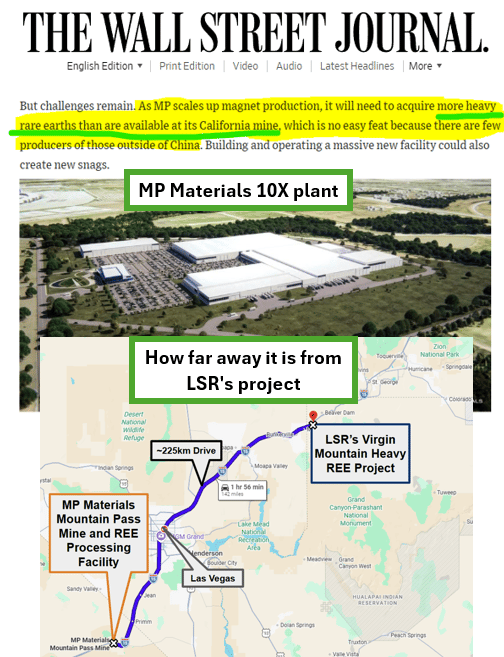
We listened in on MP's Q3 earnings call back in November where management specifically said they were: (source)
- Stockpiling heavy rare earth concentrates to ensure supply for magnet production
- Actively looking for third party supply - management confirmed they're "actively engaging new suppliers, planning to integrate several over time"
So the US Pentagon and the US rare earths national champion are both on the lookout for heavy rare earths right now.
We think that urgency inside the US just went up a notch (post the Iran war starting) and after yesterday’s announcement from LSR - its rare earths exploration project became a lot more interesting to us.
We already knew that LSR’s project had high grade rare earths from previous rock chip samples (source).
What we didn't know was whether or not those high grades were a simple “one-off” fluke from sampling - or if the broader structures over the project had the right type of rocks to host something with more scale.
So far, LSR has sampled two parts of its outcrop ~225M apart and found “xenotime” mineralogy in both locations - all sitting inside a ~5km long trend that could host a heavy rare earths deposit.
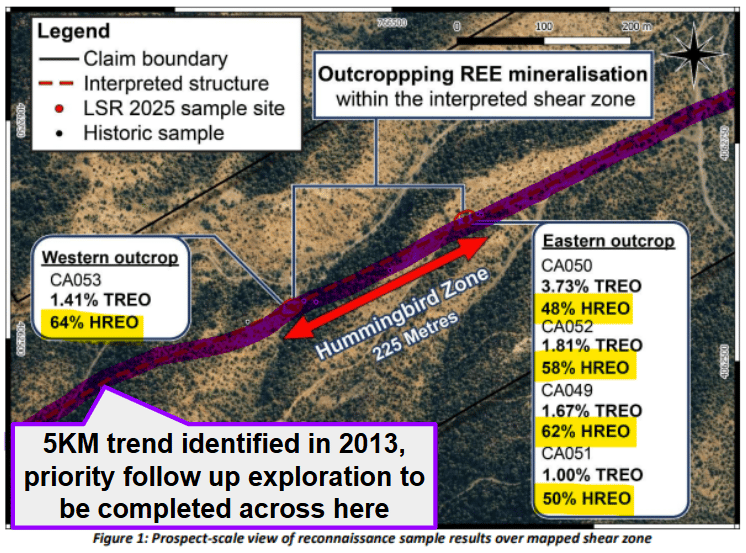
(source)
What we need to find out now is just how much of that trend is mineralised, and how far at depth it extends.
Next LSR is planning a follow up exploration program (sampling/mapping) scheduled for April - so we won't have to wait too long to find out.
LSR also has assays coming from its copper project in Chile
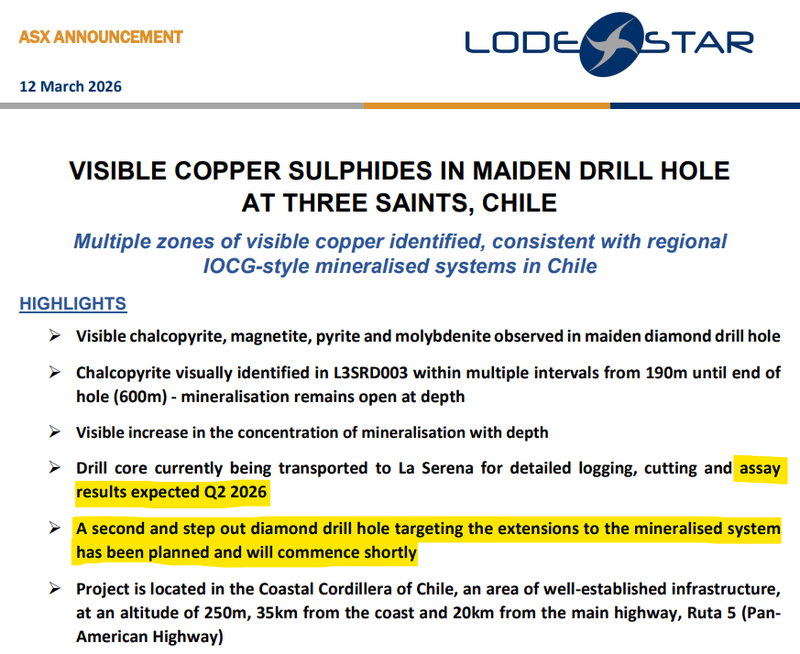
At the moment, we are waiting on copper assay results from Chile, where LSR hit ~410m of visible copper sulphides in its first ever drill hole - we covered that in our last note here.
That visuals announcement took LSR’s share price up from 1.4c to 1.7c (up ~33%).
So if assays come in from that hole (expected in Q2) - we think the market could show a lot more interest in LSR...
(source)
So we now have three catalysts to look forward to for LSR over the next 6-8 or so weeks:
- Chile copper - visible copper sulphides in the maiden hole, second hole to start any day now, assays due Q2 2026
- US heavy rare earths - follow up exploration works aimed to test the length and consistency of rare earth mineralisation and outcropping across the prior mapped 5km, LSR’s team will be back on site in April.
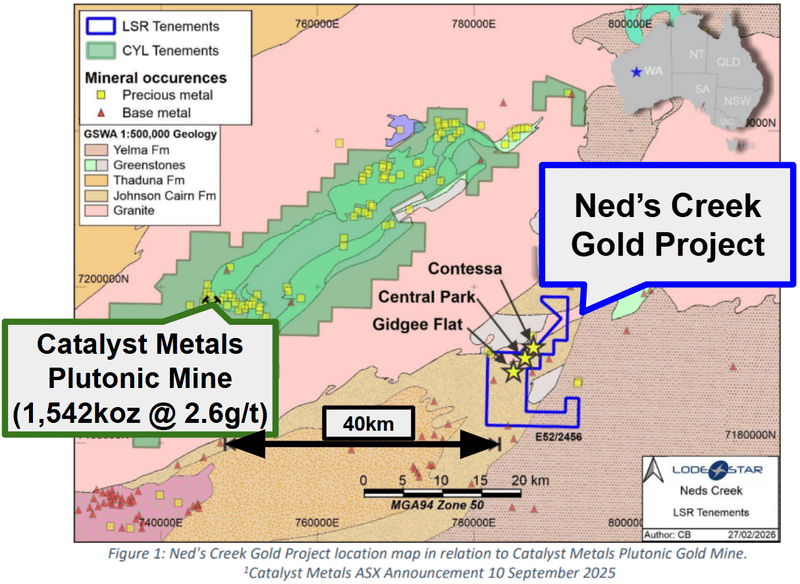
We haven’t really written about it much for LSR - but there is also a gold asset in WA that LSR has a 10,000m drill program planned on.
That project has an exploration target of 250,000 to 300,000 ounce of gold and LSR expects to be drilling the asset in “late March” building up to a maiden resource estimate later in the year.
That project sits in the same part of WA as $1.8BN Catalyst Metals’ core asset - so any major resource defined could also have corporate appeal too.
(source)
With LSR capped at ~$14M, we will take success on any of the three projects, but our Big Bet for the company written when we first Invested centres around the US heavy rare earths project as follows:
Our LSR Big Bet:
"LSR makes an economic discovery on its US heavy rare earths projects and re-rates 1,000% from our Initial Entry Price"
NOTE: our "Big Bet" is what we HOPE the ultimate success scenario looks like for this particular Investment over the long term (3+ years). There is no guarantee that our Big Bet will ever come true. There is a lot of work to be done, many risks involved, including development risk, country risk and commodity price risk - just some of which we list in our LSR Investment Memo.
Success will require a significant amount of luck. Past performance is not an indicator of future performance.
More on the copper assays coming from LSR’s project in Chile
See our deep dive on the visuals announcement here: LSR's “blind” moonshot copper drilling - 1st hole: visible copper sulphides from 190m to 600m, ending in mineralisation.
For anyone who missed that announcement, here were our key takeaways from the first hole:
- LSR has hit the right type of rocks
- from a “blind” target no one in the market really expected anything from
- the hole ended in mineralisation
- AND LSR has a second hole starting on the project within days.
- Assays from the first hole are due in Q2.
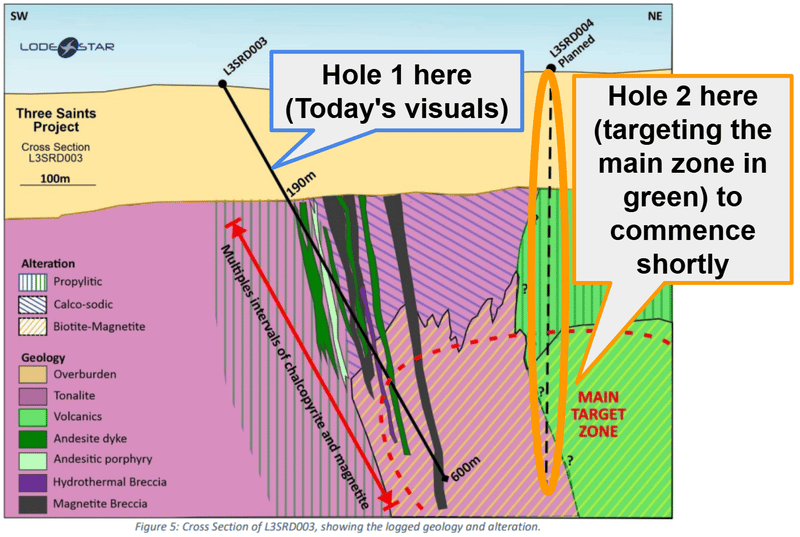
We should know exactly what LSR has found with the next hole - a 500m vertical hole directly into the “Main Target Zone”:
(source)
Assays from the first hole will tell us the types of grades sitting around the Main Target Zone and the second hole (being drilled right now) should confirm (or not) that the system extends into the Main Target Zone for the project.
The reason we think the market liked the news was because no one really expected anything from the drill program (including us).
LSR was, after all drilling a completely blind, never drilled before target in the middle of regional Chile.
“Blind” exploration means no mineral outcrop at surface, no obvious visual expressions, and very little target generation work to figure out the best place to drill - it was more drilling on a geologist's “hunch”.
(Drilling “blind” is a high risk manoeuvre, so our expectations were also pretty low going into the drill program)
The big result was LSR hitting “visible chalcopyrite (copper sulphide)” across multiple intervals from 190m all the way to the end of the hole at 600m.
That's zones of copper over ~410m - with the hole ending in mineralisation (where the intensity of visible sulphides looks to be getting stronger).
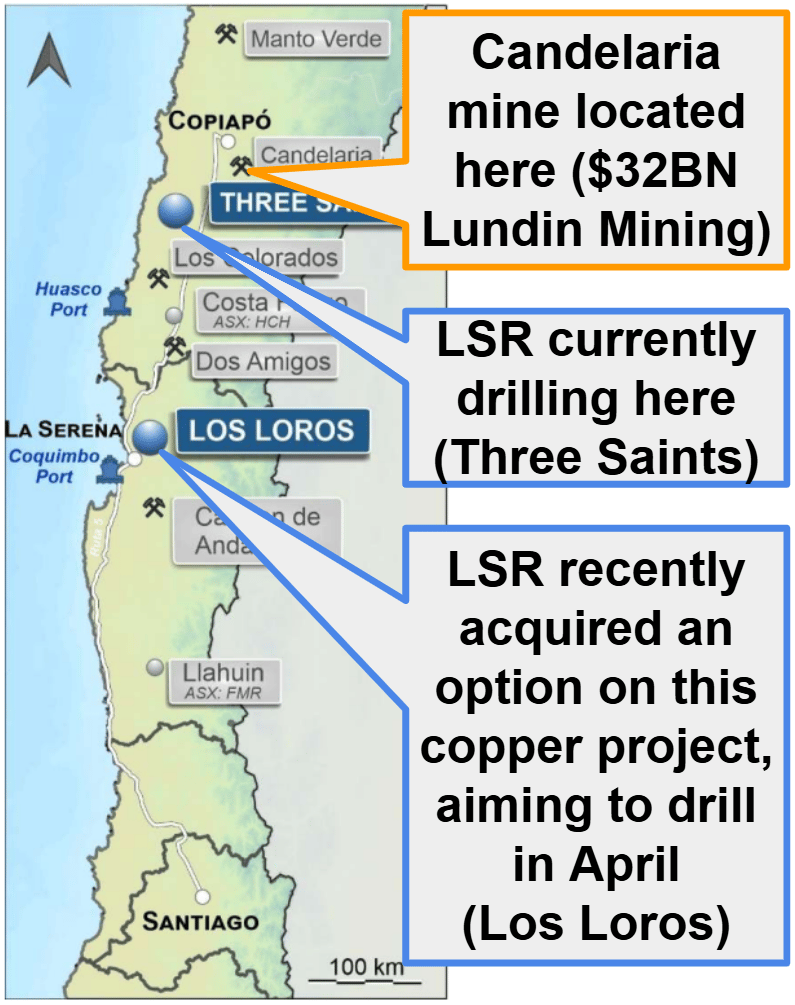
And the mineralisation styles LSR is seeing are consistent with IOCG-style (Iron Oxide Copper Gold) mineral systems.
The same style system as the Candelaria Mine (owned by the $32BN Lundin Mining), one of the biggest copper-gold mines in Chile, sitting in the same regional belt as LSR's project:
(source)
We think the style of mineralisation (IOCG deposit) is important, because when they come in, they tend to be fairly big.
For example, Candelaria’s resource contains over 5BN pounds of copper.
Obviously, it's very early days, and there is a massive gap between "visible copper sulphides in a first hole" and a world-class copper deposit.
But the geological style and setting look like the right ingredients...
Assay results are due next quarter - this is where we find out what specific copper grades are present (as opposed to a site geologist estimating by eyeball).
Now we wait for the assays (and the second hole to be drilled).
Lodestar Minerals
What's next for LSR?
🔄 Chile drilling - Three Saints Project
The first hole has come back with visible copper sulphides. Now we wait for:
- ✅ Maiden drill hole completed (600m)
- ✅ Visible copper mineralisation identified (chalcopyrite from 190m to 600m)
- 🔄 Second diamond drill hole underway (L3SRD004, planned 500m depth - expected ~3 weeks)
- 🔲 Second hole visual results
- 🔲 Assay results from hole 1 (expected Q2 2026)
- 🔲 Assay results from hole 2
🔄 Target generation on the US rare earths project
We want to see LSR continue to advance its US asset with mineralogical studies and then plan the next round of exploration.
- ✅ Mapping and sampling (soil and rock chips)
- ✅ Mineralogical studies (announced yesterday)
- 🔲 Geophysics/ follow up field work (starting in April)
- 🔲 Drill targets confirmed
🔄 10,000m drilling program on WA gold project
LSR expects to be drilling the asset in “late March” - we are hoping to see the 250,000 to 300,000 ounce exploration target converted into a maiden resource estimate post drilling.
Here are the milestones we are tracking on that project:
- 🔲 Drilling starts
- 🔲 Assay results
- 🔲 Resource estimate
🔲 LSR also has a second copper project in Chile (Los Loros)
Beyond Three Saints, LSR also has an option to acquire a second copper project that was previously drilled by the United Nations and supermajor $75BN Anglo American.
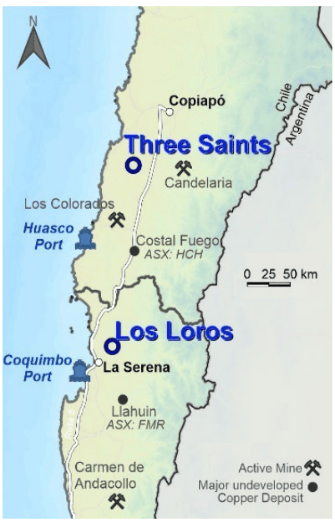
(source)
Since 1969 no one has done any modern geophysics on that project - so there could be more to come on this front too.
Back in early February when LSR acquired the option, it was aiming to be drilling here in April this year, so LSR is expecting there to be newsflow from here in the near term also. (source)
What could go wrong?
The key risk right now on LSR’s copper project in Chile is assay results.
There is no guarantee that the visuals today translate to anything considered economic.
Visual chalcopyrite in drill core looks encouraging, but visual estimates of mineral abundance should not be regarded as a proxy or substitute for laboratory analysis.
There is no guarantee the copper grades will be economic - the assays could come back with low grades that don't justify further drilling.
If that were to happen, it could negatively impact LSR's share price.
Another risk is “funding risk”.
LSR just drilled its first hole and has another deep vertical hole coming.
LSR is also planning a 10,000m drill program on its WA gold project.
All of this will mean LSR has committed to a fair bit of exploration spend this quarter and going into Q2-2026.
LSR had $2.9M cash at December 31, so the company may need to raise capital to fund future exploration programs. This could create some short-term weakness in the share price.
Funding risk/dilution risk
As a pre-revenue small cap company, LSR is reliant on capital markets to advance its projects. If something negative happens at a macro or company level, LSR could struggle to access capital on favourable terms. These capital raises may take place at a discount and result in the issuance of new shares which incur dilution to existing shareholders.
Source: “What could go wrong” - LSR Investment Memo 27 October 2025
Other risks
Like any early-stage exploration company, LSR carries significant risk, here we aim to identify a few more risks.
A major near-term risk for LSR centres around the visual copper sulphide hits at its project in Chile. Visual estimates of chalcopyrite do not guarantee economic copper grades. So the upcoming laboratory assays could disappoint the market, which would likely cause a sharp negative re-rating of the share price as exploration expectations are reset.
As for yesterday’s announcement, xenotime mineralogy at the US rare earths project is encouraging, but extracting heavy rare earths remains a highly complex and capital-intensive chemical process.
Even if a large deposit is delineated, there is no guarantee that the specific mineralogy at LSR's project can be processed economically at a commercial scale.
LSR’s valuation is also heavily leveraged to the "US critical minerals" macro thematic and elevated copper and gold prices.
If geopolitical tensions between the US and China ease, or if underlying commodity prices correct downwards, investor interest in LSR's early-stage projects could quickly fade.
Investors should consider these risks carefully and seek professional advice tailored to their personal circumstances before investing.
Our LSR Investment Memo
You can read our LSR Investment Memo in the link below.
We use this memo to track the progress of all our Investments over time.
Our LSR Investment Memo covers:
- What does LSR do?
- The macro theme for LSR
- Our LSR Big Bet
- What we want to see LSR achieve
- Why we are Invested in LSR
- The key risks to our Investment Thesis
- Our Investment Plan
General Information Only
This material has been prepared by StocksDigital. StocksDigital is an authorised representative (CAR 000433913) of 62 Consulting Pty Limited (ABN 88 664 809 303) (AFSL 548573).
This material is general advice only and is not an offer for the purchase or sale of any financial product or service. The material is not intended to provide you with personal financial or tax advice and does not take into account your personal objectives, financial situation or needs. Although we believe that the material is correct, no warranty of accuracy, reliability or completeness is given, except for liability under statute which cannot be excluded. Please note that past performance may not be indicative of future performance and that no guarantee of performance, the return of capital or a particular rate of return is given by 62C, StocksDigital, any of their related body corporates or any other person. To the maximum extent possible, 62C, StocksDigital, their related body corporates or any other person do not accept any liability for any statement in this material.
Conflicts of Interest Notice
S3 and its associated entities may hold investments in companies featured in its articles, including through being paid in the securities of the companies we provide commentary on. We disclose the securities held in relation to a particular company that we provide commentary on. Refer to our Disclosure Policy for information on our self-imposed trading blackouts, hold conditions and de-risking (sell conditions) which seek to mitigate against any potential conflicts of interest.
Publication Notice and Disclaimer
The information contained in this article is current as at the publication date. At the time of publishing, the information contained in this article is based on sources which are available in the public domain that we consider to be reliable, and our own analysis of those sources. The views of the author may not reflect the views of the AFSL holder. Any decision by you to purchase securities in the companies featured in this article should be done so after you have sought your own independent professional advice regarding this information and made your own inquiries as to the validity of any information in this article.
Any forward-looking statements contained in this article are not guarantees or predictions of future performance, and involve known and unknown risks, uncertainties and other factors, many of which are beyond our control, and which may cause actual results or performance of companies featured to differ materially from those expressed in the statements contained in this article. S3 cannot and does not give any assurance that the results or performance expressed or implied by any forward-looking statements contained in this article will actually occur and readers are cautioned not to put undue reliance on forward-looking statements.
This article may include references to our past investing performance. Past performance is not a reliable indicator of our future investing performance.