

LKY: Fast tracking USA antimony mining AND now antimony processing too?
The US government needs more critical minerals and onshore critical metals processing.
... like now.
It’s essential for national security, and core to the new American agenda.
Processing minerals is just as important to securing supply chains as finding them and digging them up...
Antimony is critical to the US defense sector, essential for producing ammunition, explosives, armoured vehicles and flame-retardant materials.
There’s a few big problems for the US though - China has banned exports to the US and there’s no antimony mines in operation in the US.
And currently no commercial scale antimony processing exists in the US.
Today, our Investment Locksley Resources (ASX:LKY | OTCQB: LKYRF), signed a legally binding R&D agreement with Texas based Rice University to develop an antimony processing technology.
(LKY has a historically producing antimony mine on its USA project - images of this in a second)
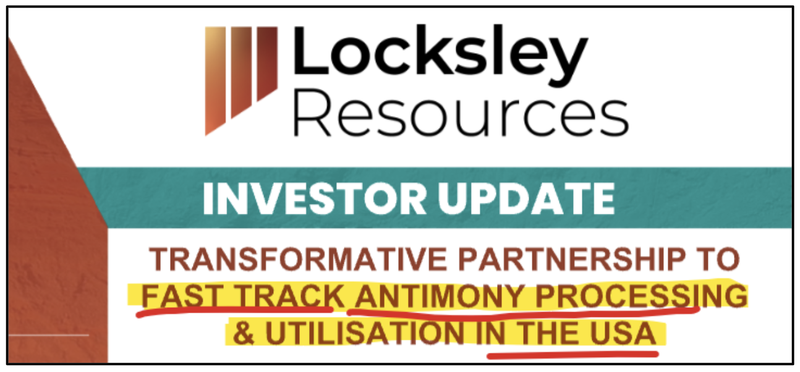
(source - LKY announcement)
LKY has been in a trading halt on the ASX for the past two trading days but we did notice it traded as high as ~US$0.44 per share on the US OTC markets during the halt period...
(closing the weekend at ~US$0.29 per share (A$0.45 per share) in the US).
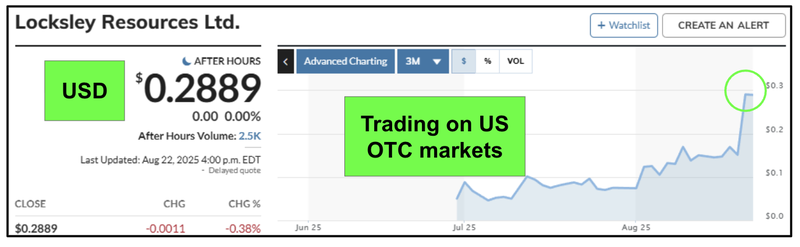
(Source)
The past performance is not and should not be taken as an indication of future performance. Caution should be exercised in assessing past performance. This product, like all other financial products, is subject to market forces and unpredictable events that may adversely affect future performance.
Rice University has been associated with some of the most successful industrial projects on the ASX in the last few years.
Rice University is the same university that developed the:
- ~$600M capped Weebit Nano ReRAM semiconductor technology and
- ~$400M capped Metallium Flash Joule Heating technology.
Prior to both companies’ transformative Rice University partnerships, Weebit Nano and Metallium were tiny ASX stocks.
Here is how each stock traded in the years following Rice University licencing agreements:
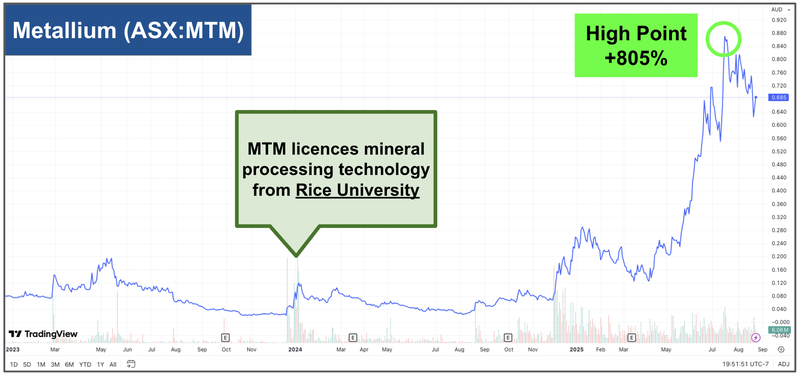
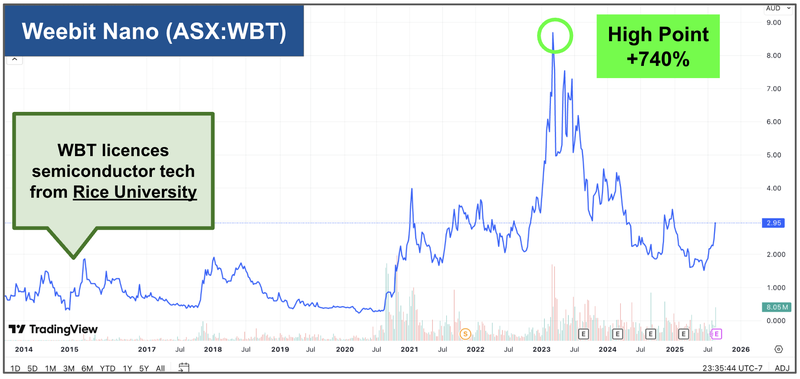
The past performance is not and should not be taken as an indication of future performance. Caution should be exercised in assessing past performance. This product, like all other financial products, is subject to market forces and unpredictable events that may adversely affect future performance.
And now LKY is partnering with Rice University on the development of antimony processing technology.
We do note that the technologies that went into Weebit Nano and Metallium were further developed. It is early days in the development of any technology for LKY. Similar success is no guarantee.
Rice University has a track record of transforming research into real-world solutions, and has collaborated with the U.S. Department of Energy, Department of Defense and other industry partners.
Given its experience and track record in turning lab experiments into commercial reality we are really looking forward to seeing what LKY’s partnership with them can deliver.
This new partnership also positions LKY to gain access to a wide range of government funding opportunities.
Two weeks ago the US Department of Energy announced US$1BN in funding for critical minerals projects.
At least half of the funds are allocated to “minerals recycling and processing applications”:
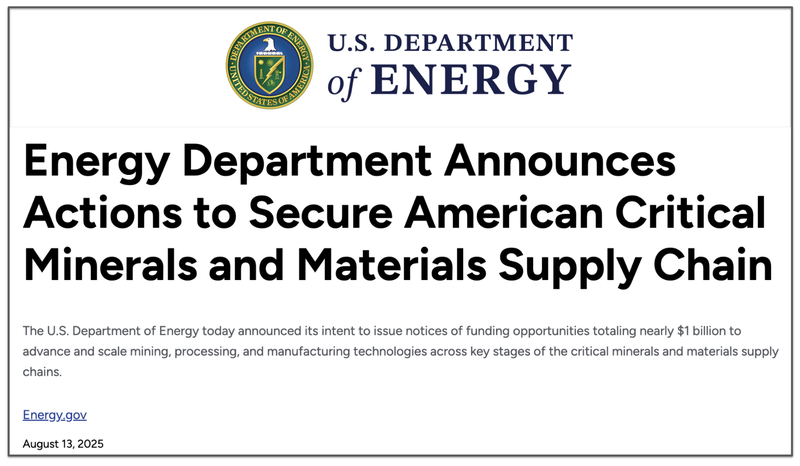
(Source, US Department of Energy)
LKY and Rice University are aiming to develop a processing technology for antimony using a low-energy, benign solvent process from ore over LKY’s own antimony project.
(and also applied to any antimony mine or project)
Here is a basic overview we whipped up to make sense of the strategy and how it fits into the geopolitical landscape:
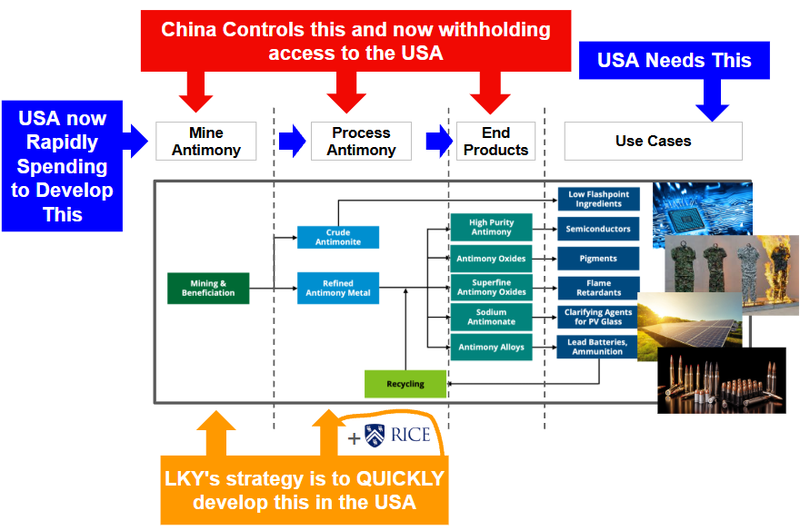
After today’s announcement, we think that LKY could re-rate higher off one of the three catalysts:
- Make an antimony discovery over its project (which was previously mined for antimony)
- Use innovative technology with Rice University to develop US-based, low cost antimony processing technology.
- Make a rare earths discovery right next door to MP Materials, the only rare earths mine in America.
At the same time, LKY is a pre revenue speculative small cap stock - a share price re-rate higher is no guarantee, its share price can also go down. Success is not a guarantee.
The US government needs more antimony - LKY wants to help... and quickly
Antimony is one of the most important critical minerals due to its uses in various military applications.
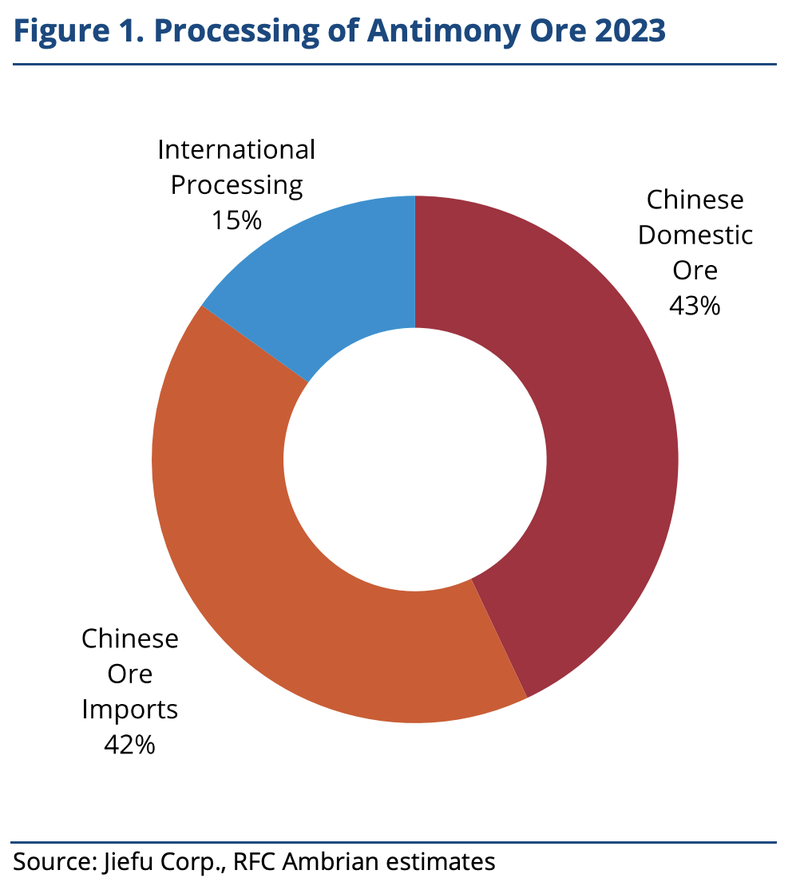
China controls 85% of the world’s antimony processing, and banned the export of antimony to the US in December last year for leverage in trade negotiations.
(‘trade negotiations’ is the reason for now... but what happens if an actual conflict flares up?)
The largest antimony resource in the US is owned by a company called Perpetua Resources, who has received millions of dollars in funding from the US Department of Defence.
Perpetua is currently capped at $3BN.
Perpetua is not in production yet, and it doesn't yet have a clear antimony processing solution.
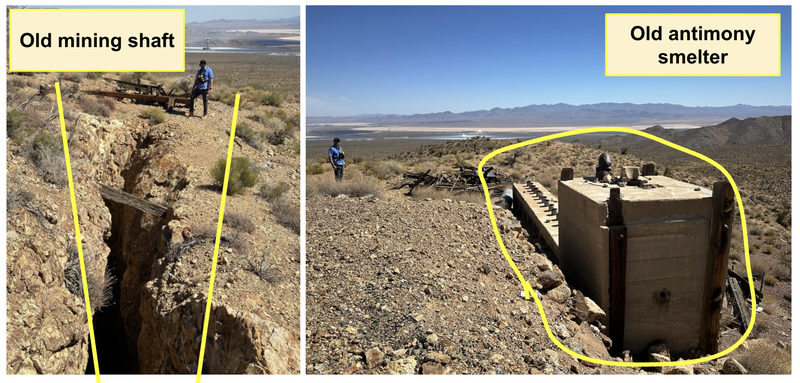
LKY’s project was once an antimony mine. There is even an old artisanal smelter on the property:
LKY’s ground sits right next door to MP Materials, the only rare earths mine in the USA.
LKY is set to drill its project next quarter, looking for both antimony AND rare earths.
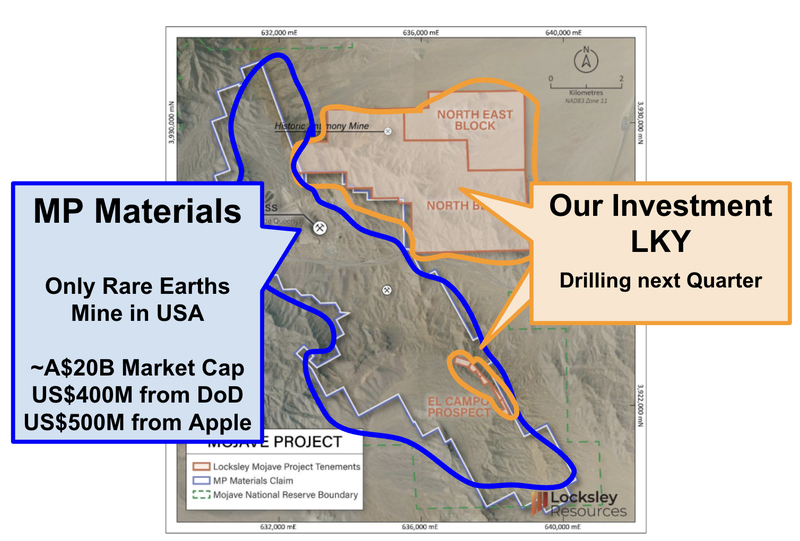
MP Materials is one of the most talked about mines in the western world right now.
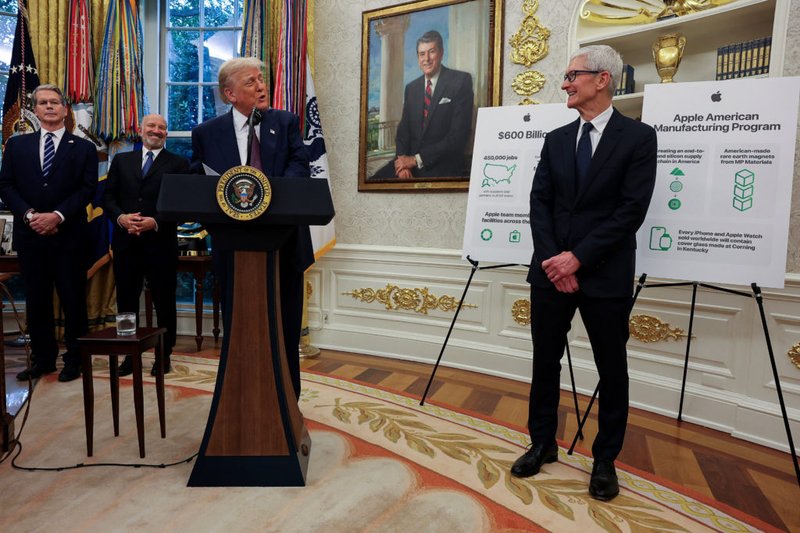
The company recently secured US$400M in funding from the US Department of Defence and signed a $600M offtake agreement with Apple.
Here is President Trump and Apple’s CEO Tim Cook at the White House discussing the deal with MP Materials:
We like that LKY is supporting the US critical minerals agenda both through exploration and extraction of valuable minerals AND now also through advancing processing technologies.
Recently LKY has been increasing engagement with the US government through:
- A lodged an application for a membership with the US Critical Materials Institute (CMI)
- Discussions have started with the US Export, Import bank (EXIM) and the Department of Interior.
By engaging relationships with the US government early, LKY is positioning itself as a company that can support the US critical minerals demands.
How China dominates the minerals processing industry
85% of the world's antimony is processed in China:
(Source)
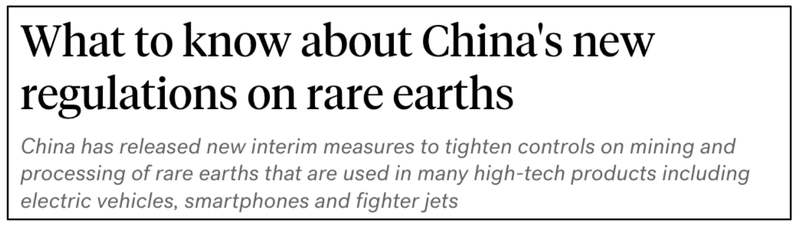
Over the weekend it was reported that China would implement event tighter controls on mining and processing of critical minerals:
(Source)
So even if the US finds more antimony, there is very limited capacity to process the ore and turn it into something valuable within the US.
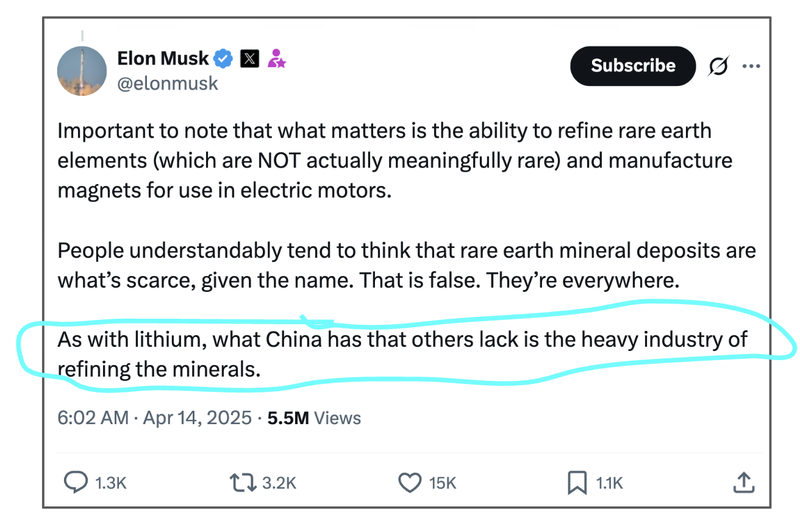
Here is Elon Musk’s tweet back in April talking about how the US should focus on “the heavy industry of refining the minerals”:
(We think that the US government is now starting to catch on)
(Source)
Before the export ban, the United States obtained 79% of its antimony supply from China.
The map below is a good illustration of how concentrated the antimony supply chain is concentrated outside of the US:
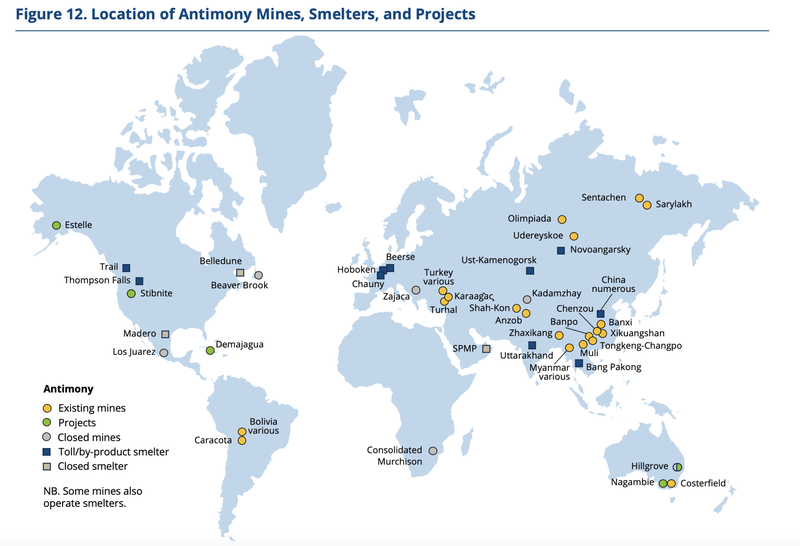
(Source)
The United State Antimony Corp, the company that owns the only active antimony smelter in this US has almost 10-bagged in the last 18 months, and the company is now capped at ~US$600M:
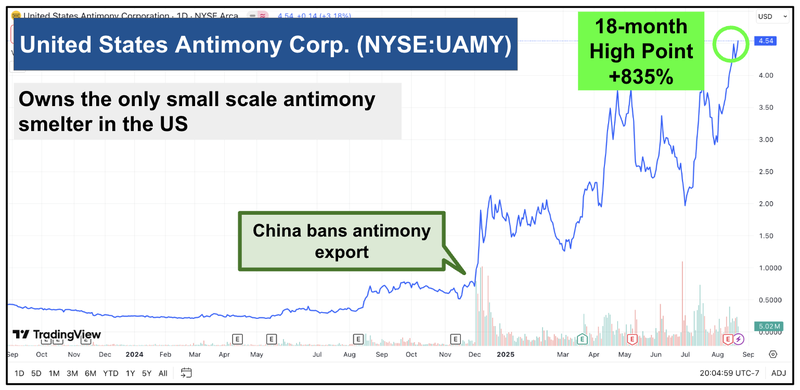
The past performance is not and should not be taken as an indication of future performance. Caution should be exercised in assessing past performance. This product, like all other financial products, is subject to market forces and unpredictable events that may adversely affect future performance.
If LKY can create a novel technology with Rice University that can better process US antimony, it could solve a key challenge for the US government and defence industry.
We think that LKY can re-rate on one of:
- Make an antimony discovery over its project (which was previously mined for antimony)
- Use innovative technology with Rice University to develop US-based, low cost antimony processing technology.
- Make a rare earths discovery right next door to MP Materials, the only rare earths mine in America.
Of course, this is small cap stock investing, there’s no guarantee LKY will re-rate - it's a speculative stock and things can go wrong.
The strategy is clear.
LKY is tackling the biggest challenges faced by the US government right now...
The US needs more rare earths and antimony and LKY is trying to make that happen as quickly as possible.
Our LKY Big Bet
“LKY to re-rate to $200M market cap on the back of strong drill results and maiden resource, plus continued interest and capital flows into the USA critical metals thematic”
NOTE: our “Big Bet” is what we HOPE the ultimate success scenario looks like for this particular Investment over the long term (3+ years). There is no guarantee that our Big Bet will ever come true. There is a lot of work to be done, many risks involved, including exploration risk, funding risk, permitting risk - just some of which we list in our LKY Investment Memo.
What technology is LKY aiming to develop?
The Rice University partnership will focus on two key value streams:
- Low energy processing of antimony using solvent extraction
- Use of antimony in energy storage applications (like batteries)
Solvent extraction technologies are much less energy intensive, and much better for the environment than typical smelting techniques.
LKY will partner with Professor Pulickel M. Ajyan and the Rice University faculty of Department of Material Science and Nano Engineering to develop this technology.
Professor Pulickel has more than 1,200 publications on energy storage batteries, solid electrolytes, nanocomposites and green extraction.
At the moment most antimony processing is done using pyrometallurgical smelting, which is energy intensive and environmentally harmful.
Together, LKY and Rice intend to develop a hydrometallurgical process, which uses a solution-based chemistry at much lower temperatures to extract the antimony from the ore.
The way we think about it is:
- Pyromet = cooking rocks in a super-hot oven until the desired metal inside melts out and the junk gets left behind.
- Hydromet = washing rocks with special liquids to dissolve the valuable metal
Using solvents to extract valuable minerals from ore is not a new process...
It is a proven technology that works with minerals like cobalt, nickel, copper and lithium.
We are actually Invested in another company in our Portfolio (IonDrive - ASX:ION) which is developing a bio-degradable, non-toxic chemical solution.
ION’s tech is based around Deep Eutectic Solvents (DES) - which have been shown to work on antimony:
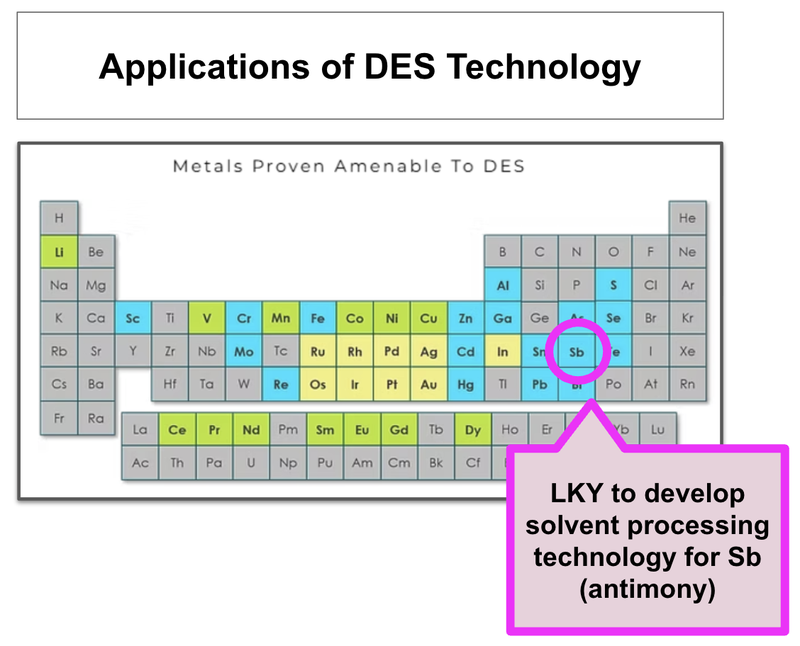
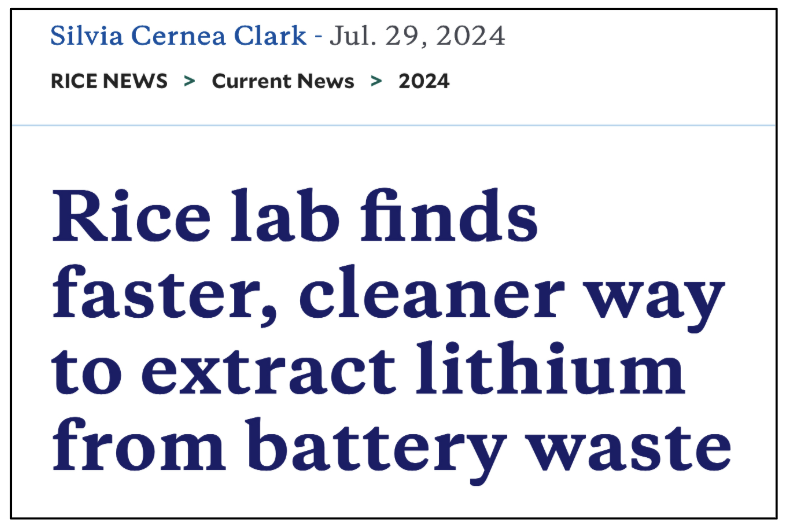
We don't know for sure if LKY and Rice University will be working on a similar chemical process BUT we do know that Professor Pulickel M. Ajyan and Rice have worked with DES tech for batteries in the past.
(Source)
LKY is drilling for rare earths and antimony next quarter - right next door to USA rare earths “national champion” MP Materials
LKY is planning to drill test its projects next quarter.
With all the attention on its neighbor MP Materials, we think that any whiff of exploration success could re-rate the stock. No guarantees of course.
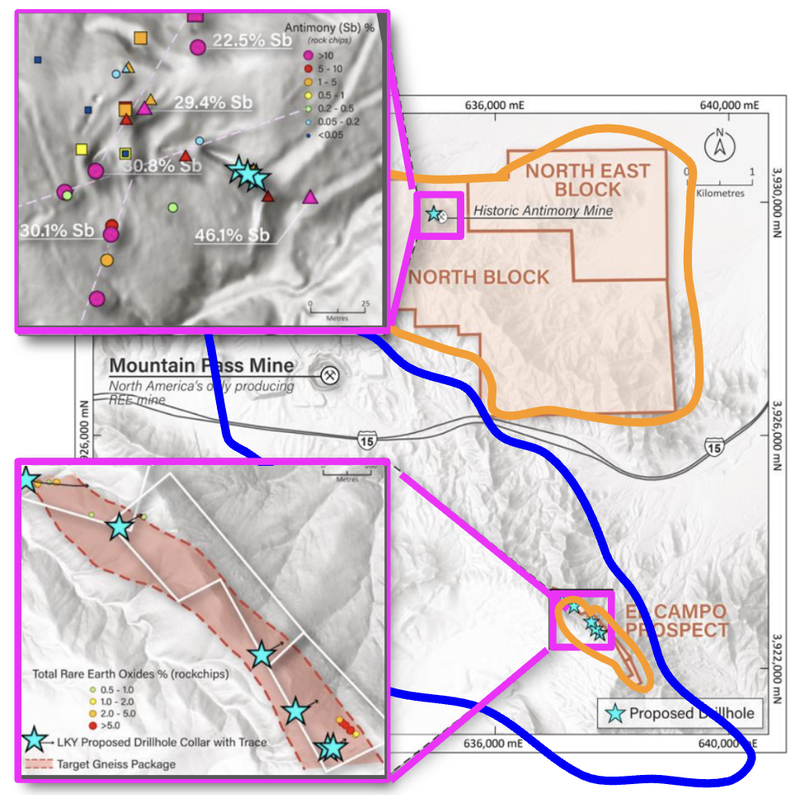
Here is where LKY’s initial drilling program is scheduled:
(Source)
With the rare earths drill program, LKY plans to test areas where a number of high grade rock chip samples were found, grading 1.20% to 6.87% TREO (rare earths).
With the antimony drill program, LKY plans to test for the extent of mineralisation near the historical antimony mine.
Over 24 surface samples 8 had over 17% antimony and 18 had over 1.4% antimony - these are very high grades for antimony projects.
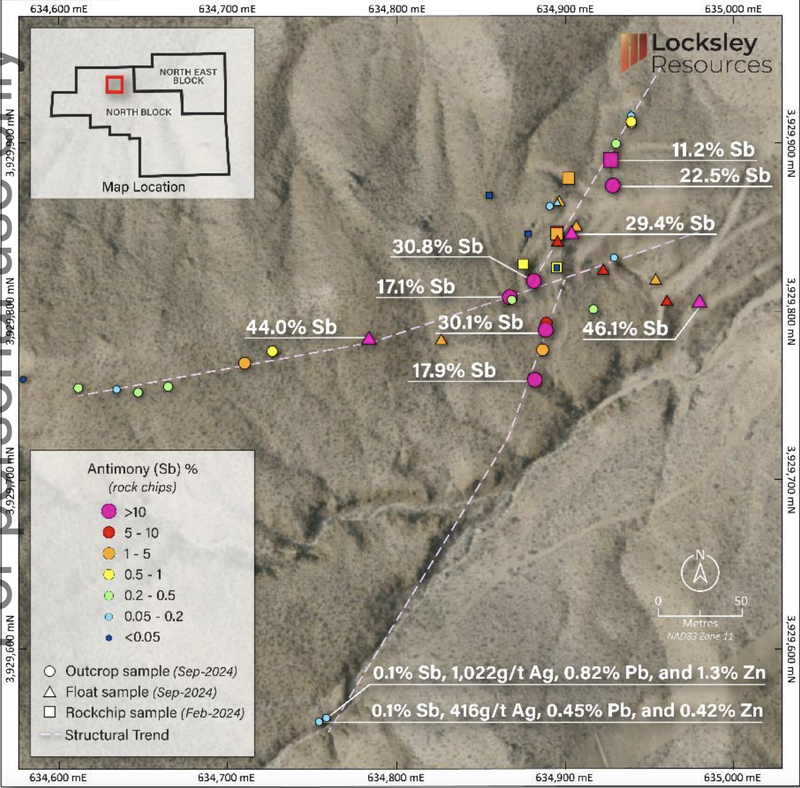
Here are pictures of the old mining shaft and the antimony smelter from where the old timers were mining antimony on LKY’s ground.
Here is a video of Julian Woodcock, Technical Director of LKY talking through LKY’s upcoming drilling plans:
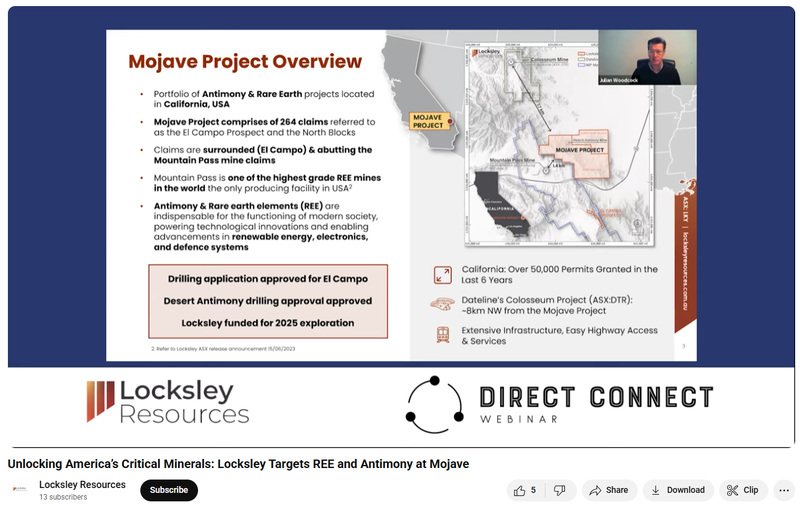
Like all exploration investors, we are hoping with this upcoming drill program that LKY makes a new mineral discovery.
Obviously, there is no guarantee LKY finds anything, mineral exploration is risky and there is a high likelihood that LKY finds nothing.
We have identified and accepted the risks of our Investment in LKY which include risks around early stage exploration, commodity pricing, tenure risk and market risk - more on these risks here in our Investment Memo or further below) - our LKY position is only a small % of our overall Portfolio.
LKY has lodged permits for an expanded Phase 2 drilling program on the Northern Block.
In the map below:
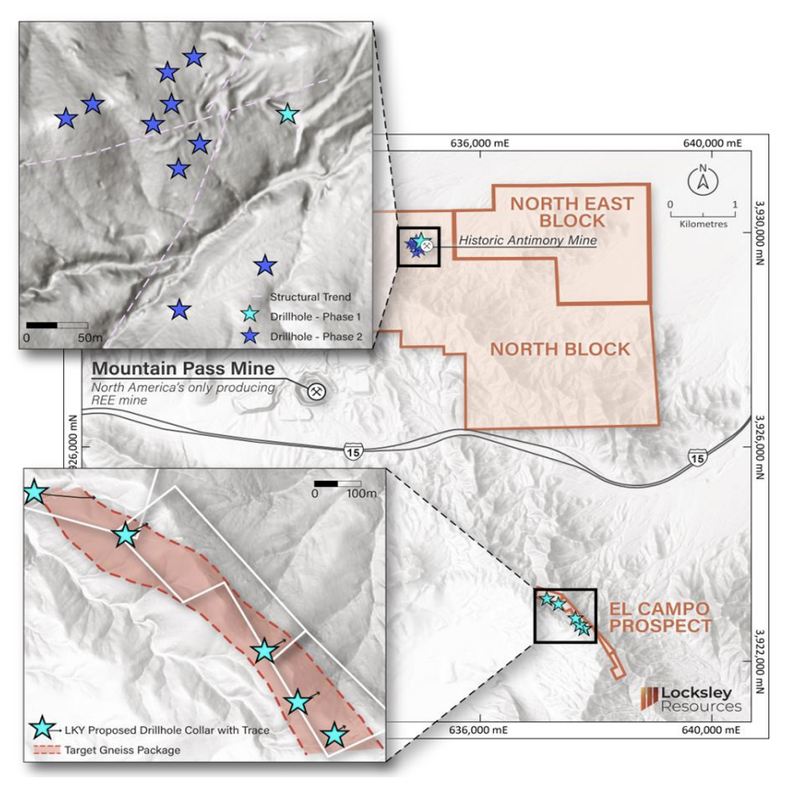
- Light blue stars = phase 1 drill program (fully permitted)
- Dark blue stars = phase 2 drill holes (permit pending)
All of the future permitted drill program appears to be around the historic antimony mine - so we should get a clear idea of LKY’s antimony potential within these next two drill programs.
Before the drilling we should expect to see the results of the sampling program on the northern block.
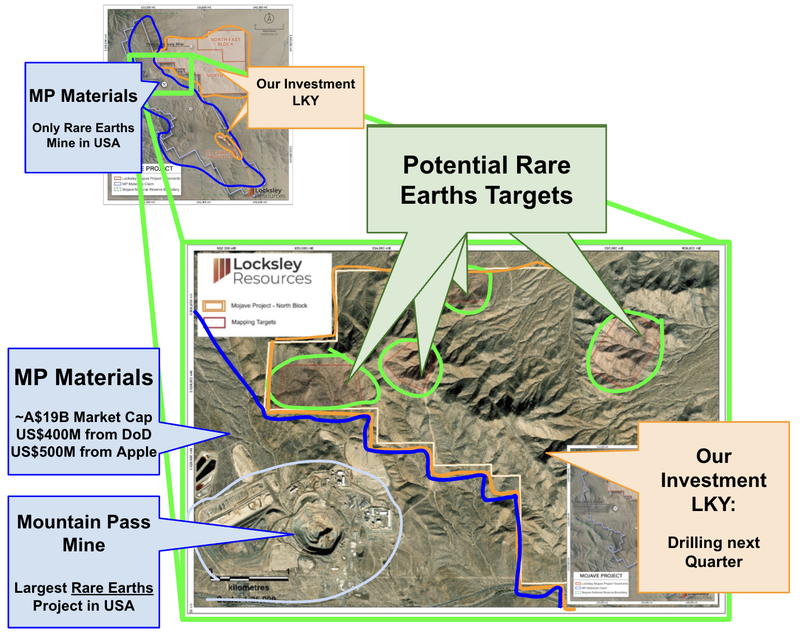
LKY is also looking to work up some rare earth targets in this area.
Here is some more detail in our previous article: LKY chasing new rare earths target areas - as close as possible to MP Materials rare earths mine ...
What’s next for LKY?
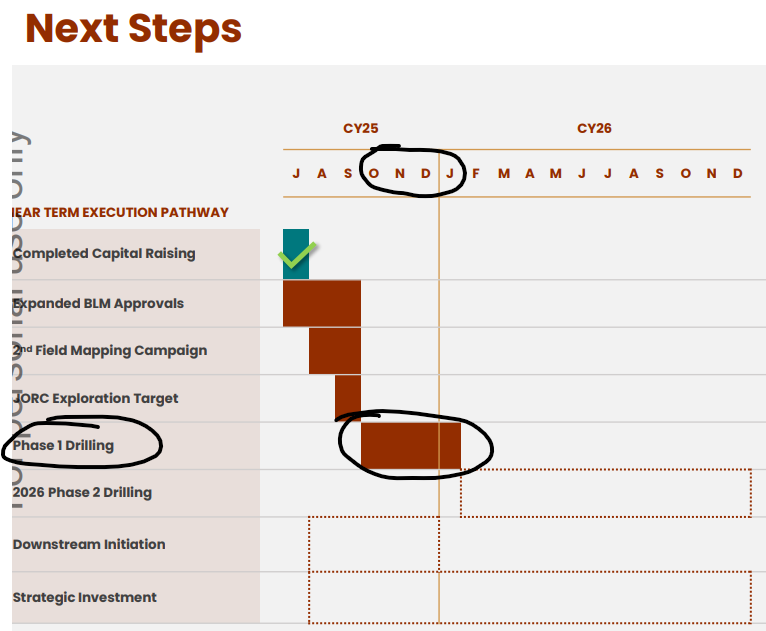
Drilling (next quarter) 🔄
LKY expects drilling to start next quarter, with first results expected before the end of this year.
Right now LKY is waiting for its expanded Plan of Operations (“POO” hehehe) to be approved (which is LKY expanding the size of its currently permitted drill program).
(Source)
Permitting for Phase 2 Drilling 🔄
LKY has lodged permits for an expanded Phase 2 drilling program on the North Block.
In the map below:
- Light blue stars = phase 1 drill program (fully permitted)
- Dark blue stars = phase 2 drill holes (permit pending)
Secure Licence Agreement with Rice University 🔄
Now that LKY has signed a partnership agreement with Rice University, the next stage will be to secure a larger licence deal over whatever technology is developed from the R&D agreement.
This will take some time to work out the IP sharing and mutual development of the technology.
Identify Rare Earth targets on Northern Block 🔄
LKY is now trying to work up some rare earth targets on the much larger blocks to the north, two of them as close as possible to MP Materials’ mine.
LKY will run structural and geological mapping, plus geophysics programmes on the areas shown above (we circled them in green).
Hopefully we get to see some nice looking rock chip samples as part of this field work too.
Read our full take on this news here: LKY chasing new rare earths target areas - as close as possible to MP Materials rare earths mine ...
What are the risks?
LKY hasn’t started drilling yet and just raised capital so the main risk here is “permitting risk”.
LKY just lodged an “expanded plan of operations” to increase the size of its already permitted drill program.
There is no guarantee that this expanded program is approved.
Now with mapping and sampling work starting, there is an element of “exploration risk” too.
It is possible that LKY finds nothing worth following up on the upcoming exploration programs.
Exploration risk
There is no guarantee that LKY’s upcoming drill programs are successful. LKY may fail to find economic deposits of rare earths or antimony in which case we would expect the share price to re-rate lower.
Source: “What could go wrong with LKY?” - LKY Investment Memo 1 August 2025
For the full set of risks we have identified and accepted in making our Investment in LKY, see our LKY Investment Memo below.
Other Risks
The company's primary asset is a pre-discovery antimony and rare earth elements exploration project in California, and it is possible that LKY makes no economic discovery despite the proximity to the producing Mountain Pass mine.
LKY is highly sensitive to fluctuations in antimony and rare earth element prices.
While current geopolitical tensions have supported these prices, any easing of US-China trade restrictions or alternative supply sources could materially impact the project's economic viability and the market’s interest in exploring the project.
While LKY does have current drilling approvals in place, there is no guarantee the expanded plan of operations the company recently submitted is approved. There is also no guarantee of timely regulatory approvals which could mean delays for the planned drilling program.
Finally, despite high-grade surface samples (up to 12.1% TREO and 46% antimony), these results may not be representative of broader mineralisation at depth, and the company has yet to conduct any drilling to verify continuity.
Investors should consider these risks carefully and seek professional advice tailored to their personal circumstances before investing.
Our LKY Investment Memo
You can read our LKY Investment Memo in the link below.
We use this memo to track the progress of all our Investments over time.
Our LKY Investment Memo covers:
- What does LKY do?
- The macro theme for LKY
- Our LKY Big Bet
- What we want to see LKY achieve
- Why we are Invested in LKY
- The key risks to our Investment Thesis
- Our Investment Plan
General Information Only
This material has been prepared by StocksDigital. StocksDigital is an authorised representative (CAR 000433913) of 62 Consulting Pty Limited (ABN 88 664 809 303) (AFSL 548573).
This material is general advice only and is not an offer for the purchase or sale of any financial product or service. The material is not intended to provide you with personal financial or tax advice and does not take into account your personal objectives, financial situation or needs. Although we believe that the material is correct, no warranty of accuracy, reliability or completeness is given, except for liability under statute which cannot be excluded. Please note that past performance may not be indicative of future performance and that no guarantee of performance, the return of capital or a particular rate of return is given by 62C, StocksDigital, any of their related body corporates or any other person. To the maximum extent possible, 62C, StocksDigital, their related body corporates or any other person do not accept any liability for any statement in this material.
Conflicts of Interest Notice
S3 and its associated entities may hold investments in companies featured in its articles, including through being paid in the securities of the companies we provide commentary on. We disclose the securities held in relation to a particular company that we provide commentary on. Refer to our Disclosure Policy for information on our self-imposed trading blackouts, hold conditions and de-risking (sell conditions) which seek to mitigate against any potential conflicts of interest.
Publication Notice and Disclaimer
The information contained in this article is current as at the publication date. At the time of publishing, the information contained in this article is based on sources which are available in the public domain that we consider to be reliable, and our own analysis of those sources. The views of the author may not reflect the views of the AFSL holder. Any decision by you to purchase securities in the companies featured in this article should be done so after you have sought your own independent professional advice regarding this information and made your own inquiries as to the validity of any information in this article.
Any forward-looking statements contained in this article are not guarantees or predictions of future performance, and involve known and unknown risks, uncertainties and other factors, many of which are beyond our control, and which may cause actual results or performance of companies featured to differ materially from those expressed in the statements contained in this article. S3 cannot and does not give any assurance that the results or performance expressed or implied by any forward-looking statements contained in this article will actually occur and readers are cautioned not to put undue reliance on forward-looking statements.
This article may include references to our past investing performance. Past performance is not a reliable indicator of our future investing performance.
