HVY: Key shipbuilding material production to come online as US and China race to outbuild each other?
Disclosure: S3 Consortium Pty Ltd (the Company) and Associated Entities own 3,745,000 HVY Shares at the time of publishing this article. The Company has been engaged by HVY to share our commentary on the progress of our Investment in HVY over time. This information is general in nature about a speculative investment and does not constitute personal advice. It does not consider your objectives, financial situation, or needs. Any forward-looking statements are uncertain and not a guaranteed outcome.
When global building and heavy manufacturing surges - so does the demand for “garnet”.
Garnet is an important industrial mineral used in high-precision manufacturing, shipbuilding, defence infrastructure, and heavy engineering.
The global shipbuilding orderbook is at a 17-year high.
China and the US are locked in a once in a generation shipbuilding race.
Whoever controls the shipyards controls the global supply chains, economic choke points, and the future of maritime warfare.
China is rapidly outbuilding the US, with an estimated 232x more shipbuilding capacity - but the US has now started running hard to catch up.
The US Navy has committed to dramatically increasing from 291 vessels to 450+ in the next 5 years.
(for context, until now they only build on average 2 new vessels per year).
So the world is going to need a lot more garnet.

Our Investment Heavy Minerals (ASX:HVY) is progressing two advanced stage garnet projects towards production in Australia.
- Port Gregory, WA - flagship pre-production MINING asset - generating ~A$56 million in EBITDA per year for 24 years when built.
- Kanmantoo, SA - fast tracked garnet production (within ~6 months) by processing tailings from an operating copper mine. HVY does no mining here. Our rough calcs show it could generate up to ~$31.1M in gross revenue for the first 3 years, followed by up to ~$62.2M per year after that.
And the unique thing about the $28.5M capped HVY?
They are the most vigorous defenders of capital structure we have EVER seen in the small end of the market...
... where heavily dilutive cap raises, 1:1 oppies, broker options, convertible death notes run rampant.
HVY has two advanced stage projects with just 72 million shares on issue and some options mostly above today’s share price (no share consolidations) - usually getting to this stage comes with dilutive capital raises at least once a year - diluting your shareholding.
In the three years since we first Invested, HVY has progressed its projects via largely non-dilutive royalty funding (even during tough market times when aggressively priced, highly dilutive cap raises can be the easy way out).
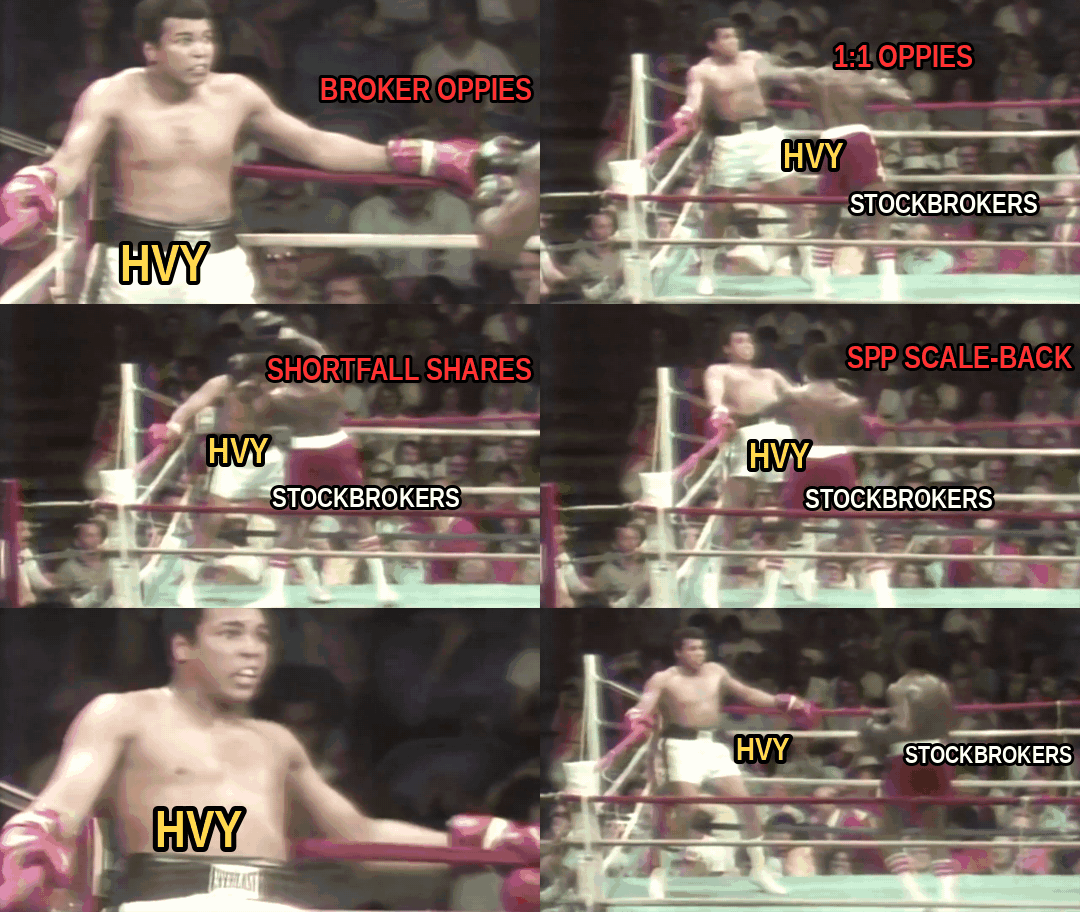
Pristinely kept capital structures mean share prices have little overhang or resistance to going up.
This morning the $28.5M capped HVY released the results of its Pre Feasibility Study for its WA asset (read it here), which demonstrated the asset can deliver:
- Net Present Value (NPV) of $322.8M.
- EBITDA of $1.34BN over 24 years.
- Internal Rate of Return of 47.6%.
- A 3.1 year payback,
- Based on $122.1M CAPEX
Right next door to the world’s biggest operating garnet mine.
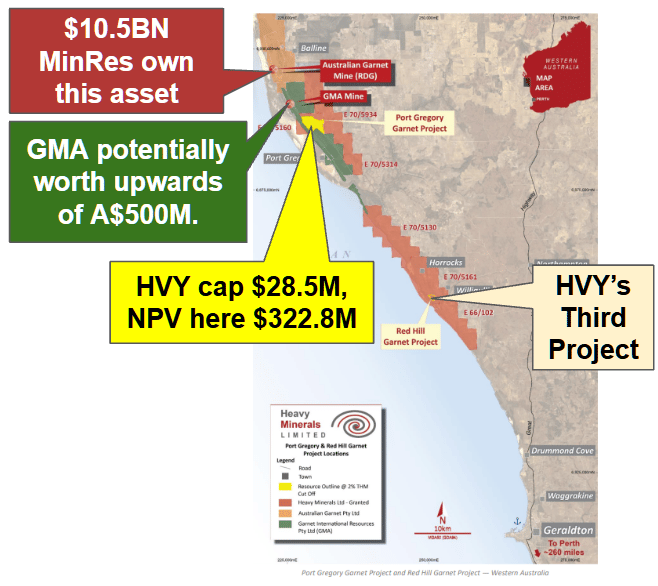
(source)
The all important NPV to CAPEX ratio is 2.64x.
This is well above the ~2x "rule of thumb" that the market (and project financiers) like to see when determining IF a project is fundable or not.
While we wait for HVY to secure the funding to build this project...
HVY’s second project (with the potential for fast tracked revenue) we mentioned earlier is a lot closer to “first garnet production”.
Back in January, HVY signed a binding deal signed with ASX listed South Australian copper miner Hillgrove Resources to:
- Take the garnet rich tailings (waste) from its producing copper-gold mine,
- process the tailings,
- Extract valuable industrial use Hardrock Almandine Garnet, and;
- Sell that garnet for cash.
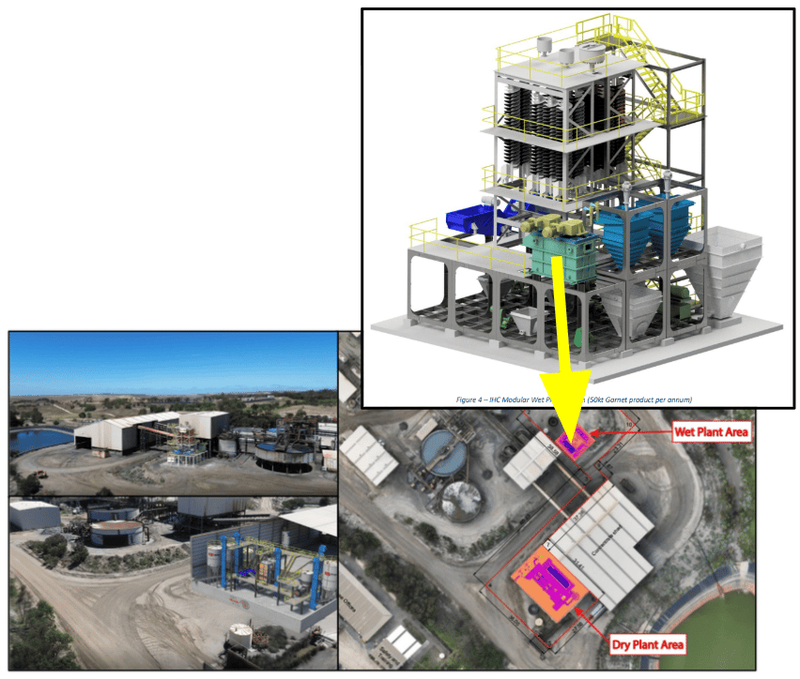
(source - HVY announcement)
Our rough calcs show that HVY’s South Australian project could generate up to ~$31.1M in gross revenue for the first 3 years, followed by up to ~$62.2M per year after that.
(more on these rough calcs in a second, including all assumptions and caveats)
First production on that SA project is targeted for before the end of THIS year.
HVY says it's already “progressing discussions with multiple funders” for the $25M to $30M needed to build this plant. (source)
HVY has previously said production would be 8-10 months after the build starts, so there is a chance that “end of year” production timeline could slip.
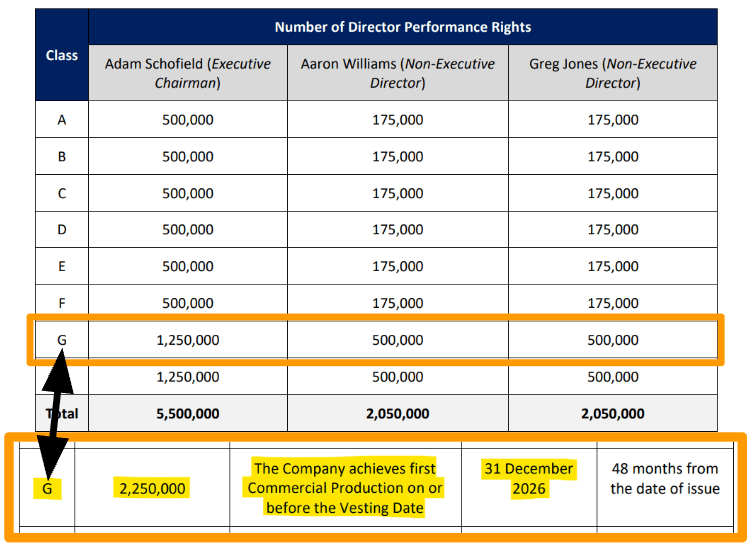
BUT we do know HVY's board is incentivised (via performance rights) for "commercial production" before 31 December 2026:
(source)
The one big thing standing in the way of production on that project is financing.
So how will HVY get to first production - the same way it got to where it is today?
We don't know how HVY’s done it.
It has managed to avoid the micro cap death spiral financing rollercoaster - where a company does down round after down round trying to get to major catalysts (and into a position where its project can be financed by bigger investors).
HVY has:
- One asset that is finance ready and could be in production in a few months.
- Another that is at the PFS stage on a $322.8M NPV project.
With only ~72M shares on issue, and 7.785 options on issue.
Usually, a company has issued a few billion shares, consolidated and then issued a few billion more by the time a single asset is “build/finance ready”.
HVY has been able to get here with no grotesque capital raises and no soul destroying 1:1 free oppie round.
By completing “Australia's first syndicated non-dilutive pre-paid royalty”. (source)
As mentioned earlier, HVY says it's already “progressing discussions with multiple funders” for the $25M to $30M needed to build its plant in South Australia.
And in today’s PFS announcement, HVY said that $122.1M CAPEX is required for its WA asset.
We have stopped doubting HVY when it comes to financing rounds.
We participated in that royalty financing deal which seems to have worked out pretty well for HVY as a short term funding strategy.
Props to MD Adam Schofield and his team, they got it done.
Now it feels a lot clearer to us how HVY becomes a big ASX listed garnet producer:
- First, financing its South Australian project (processing only, no mining).
- Getting into production (processing only, no mining).
- Producing and selling Garnet.
- Using that cashflow to finance its WA asset. (mining and processing).
No guarantees of course, the above is just a pathway of how things could work in HVY’s favour. HVY is a microcap stock, and it won't be easy.
Get into production quickly relatively cheaply and figure out financing for its mine with the cashflows from that production - a big change from where HVY was ~12 months ago.
The next big thing we want to see from HVY is an offtake deal that forms the basis for funding that plant in South Australia.
In the rest of today’s note, we will cover:
- Why we like HVY’s deal in South Australia.
- How we think HVY could become a near-term garnet producer.
- How HVY could generate $31.1M to $62.2M in revenues per annum
- More on HVY’s WA project and our key takeaways from today’s Pre Feasibility Study (PFS) for the WA project
- What is garnet & what it’s used for
- An update on the current state of the garnet market
Heavy Minerals
More on HVY’s ‘production by year’s end’ (hopefully) asset
Here is a quick overview of why we like HVY’s deal with Hillgrove:
- HVY is partnering with an established copper producer capped at ~$188M - this producing company is letting HVY onto their mine site and to plug into their processing plant - a strong show of confidence in HVY’s ability to execute.
- HVY has already done most of the technical work - Bulk sampling, metallurgy and flowsheet work is all done. The process plant is designed. End-product testwork is complete and distribution, financing discussions are underway.
- HVY could produce $31.1M to $62.2M per year gross revenue from just $25M to $30M CAPEX (our rough gross revenue calcs, full details in a second)
- Simple, predictable permitting process - HVY is plugging into Hillgrove’s existing processing circuit, so there shouldn’t be any major permitting issues getting HVY’s plant built.
- Quick timeline to production subject to funding - HVY expects to be in production ~8-10 months after making a Final Investment Decision on the project.
- HVY’s board is incentivised for “commercial production” before 31 December 2026. (source) So they better get moving with a FID.
- HVY can scale up to meet demand - HVY is planning to produce up to ~50ktpa of waterjet garnet (~10% of global demand) and eventually aim to increase capacity to 100ktpa. This means, HVY can scale up/scale down based on market demand for its product.
🎓 We covered the Hillgrove deal in detail when it was announced - read: HVY: Transformational new deal just announced? Producing by end of this year?
How HVY can become a near term garnet producer
HVY’s deal is with copper producer Hillgrove Resources in South Australia.
🎓 check out the full deal terms here - source
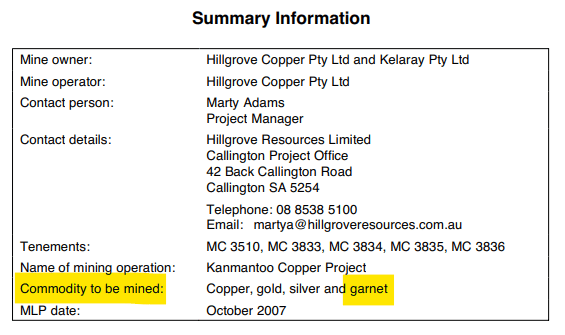
Back in 2007 when Hillgrove was going through permitting on its project garnet was actually listed as one of the commodities that would be mined from the project.
(source)
Surprise surprise, it turns out the tailings (waste material) from Hillgrove's copper mine is full of garnet.
According to the South Australian government, some of Hillgrove’s host rock had >12% garnet grades. (source)

(Source)
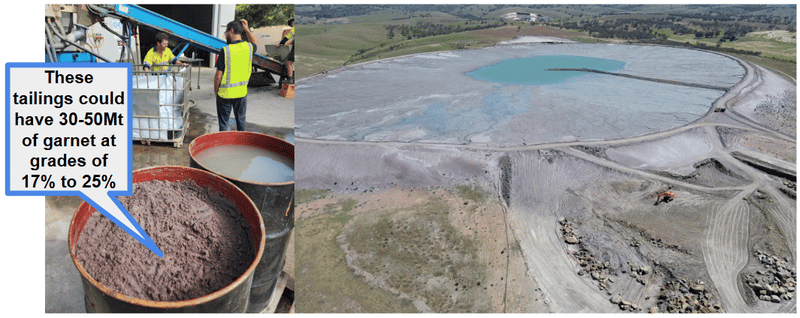
According to HVY its ~30mt to 50mt of garnet with an average grade of 17-25%. (source)
Despite all of that, no one has had a crack at recovering the garnet (not even Hillgrove).
Enter HVY.
While Hillgrove is focused on copper, HVY is fully focused on garnet, has garnet knowledge and would know the industry inside and out having worked on its garnet asset for years.
HVY is the natural partner to extract and sell the valuable garnet from Hillgrove’s mine tailings.
HVY’s deal with Hillgrove means HVY pays ~$200k to Hillgrove, plus 15% of gross revenue (from garnet sales) made while the copper mine is still operating, then 5% of revenue (from garnet sales) after the mine shuts down.
Wait... HVY keeps producing even when the mine shuts down?
Yes, from all of the already processed material sitting in Hillgrove’s tailings storage facility.
(source)
It's a win-win for both companies.
HVY becomes a revenue generating garnet producer without all of the CAPEX and mining operating costs associated with building a resources project completely from scratch.
Hillgrove gets to monetise a resource that was going untouched until HVY entered the picture.
And it looks like HVY may have done the deal at the right time too...
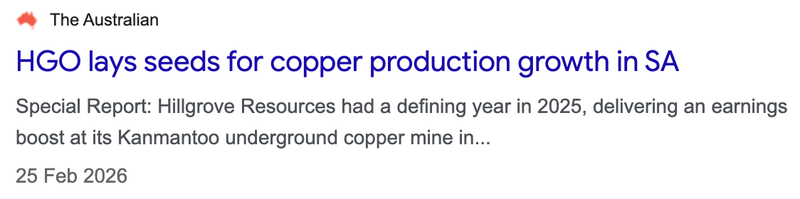
In mid-July, Hillgrove approved the development of a third underground mine to expand production at its project.
(source)
Why does a copper mine's expansion matter to a garnet company?
Because every extra tonne of rock Hillgrove mines and processes = more garnet-rich feedstock for HVY’s proposed plant.
More copper mining = more garnet for HVY (for longer).
How HVY could generate $31.1M to $62.2M in revenues per annum
What does the “fast to production” strategy mean in terms of numbers for HVY?
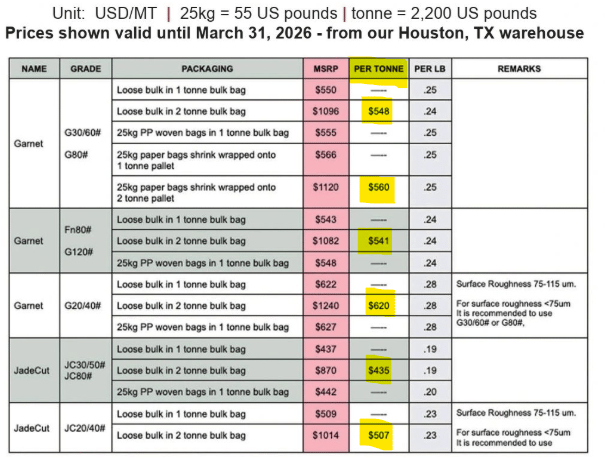
According to this (now deleted) post, garnet prices range between US$435 to US$620 per tonne:
(source)
Even taking the LOWEST price per tonne of US$435 = ~$630 AUD per tonne.
(for the simplicity of this basic calc just to show simple total gross revenue, let’s assume full capacity to 50,000tpa from day 1. In reality, it will likely take time to get the plant humming smoothly and up to this capacity)
50,000 tonnes per annum x $630 per tonne = $31.1M gross revenue for the first 3 years.
Then after 3 years, 100,000 tonnes per annum x $630 = $62.2M gross revenue per year after that for the life of mine.
Even taking out Hillgrove’s 5% to 15% cut, the rough numbers look very good for a $28.5M capped company like HVY.
Caution - this is a VERY rough calc, net revenue to HVY will need to take into consideration either 15% or 5% gross revenue payment to Hillgrove, the cost to produce, plus any fees paid to distributors - also garnet prices may go up OR down over life of mine - this rough calculation is for illustration purposes of the general scale of the project and should not be relied on.
The big variable will be the “cost to produce” which could be minimal given HVY doesn't have to actually mine anything.
However, processing tailings can be notoriously tricky - so it's not completely without risk.
Coming back to HVY’s WA asset - here are our key takeaways from today’s Pre Feasibility Study (PFS)
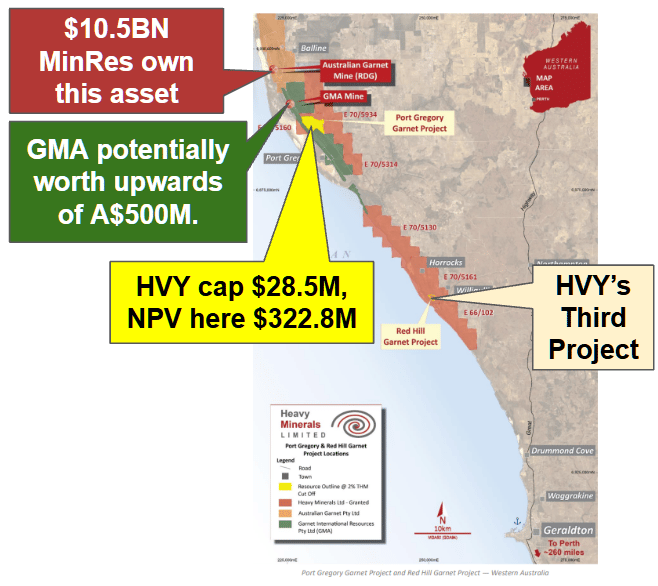
HVY’s WA project sits right next to two major garnet projects.
One owned by the world’s biggest garnet producer - GMA Garnet responsible for ~35% of global production.
The other is a mine owned by $10.5BN Mineral Resources that is currently on care and maintenance.
(source)
We think that as HVY progresses its project closer toward development (from a permitting and feasibility study perspective) AND in the right garnet market, HVY will trade at less of a discount to the NPV of its project.
Today’s PFS showed an NPV of $322.8M, HVY’s current market cap is ~$28.5M.
Speaking of the PFS, here are some of our key takeaways from the study:
- Post-tax NPV of A$322.8M on just A$122.1M of development capital
- Maiden Ore Reserve - 3.3Mt of contained garnet with the ore reserve underpinning ~94% of mill feed
- 24-year mine life - A$1.34BN life-of-mine EBITDA from A$3.07BN gross revenue
- Quick payback - ~3.1 years from first production, with cash flow cumulative positive during year four
- Simple free-digging mining with no drilling and blasting, no crushing or grinding, and no permanent tailings facility...
- Front-loaded cash flow - the schedule sequences the higher-grade panels first (5.7% THM in year one vs the 4.4% LOM average), driving ~143ktpa of garnet over the first nine years right when capital is being repaid
- Ultra-low strip ratio - 0.22:1, holding mining costs to just A$2.17/t of ore. Mining is one of the smallest lines in the cost stack
- Conservative pricing - the US$555/t year-one basket price comes from an independent assessment, with nil escalation applied to the 120 grade and ilmenite by-product
- Even a 20% fall in product price still leaves a post-tax NPV of A$137.3 million, while a 20% move in capital cost shifts NPV by only ~5%
- Infrastructure already in place - export through existing Berth 4 at Geraldton (which already handles garnet), no new port infrastructure required, and no mine camp needed thanks to the residential workforce in Geraldton, Kalbarri and Northampton
What is garnet again?
Garnet is an industrial mineral used in high-precision manufacturing, global shipbuilding, defence infrastructure, and heavy engineering.

Being an industrial mineral, garnet doesn’t really get much mainstream attention - but it also means there are very few companies on the ASX looking to build a business in that space - a big part of where the opportunity is for HVY.
Garnet’s two big applications are:
- Waterjet cutting - garnet + high pressure water jet to precision-cut steel, titanium, glass and composites (think aerospace parts, defence manufacturing).
- Abrasive blasting - garnet used to strip rust and old coatings off ship hulls, bridges, pipelines and tanks before they're re-coated.
Basically - the more the world builds ships, maintains navies, and patches up old steel infrastructure, the more garnet gets used.
And there is a LOT of that going on right now.
The US budgeted ~US$40BN for bridge repair, replacement and rehabilitation - including ~US$2BN to fix rusting steel bridges. (source)
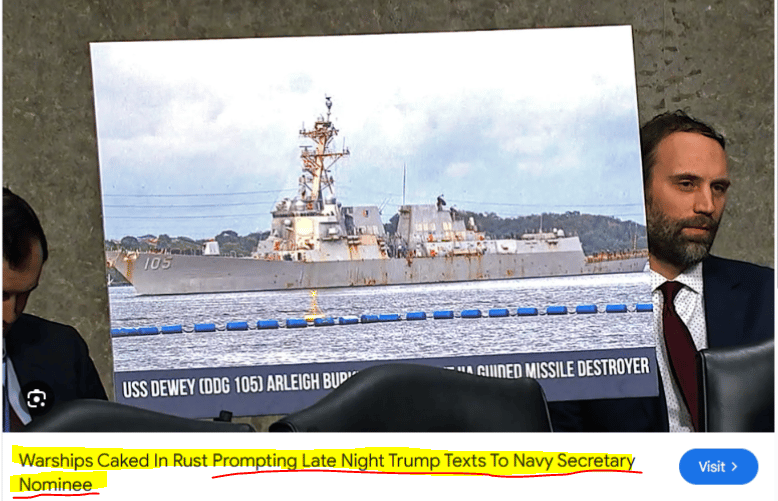
The Trump Administration has singled out the rusting US Navy fleet as a national embarrassment - and rust removal is exactly what garnet does.
(source)
Major shipbuilding companies and infrastructure maintenance companies use garnet to safely reduce corrosion and extend the life of surfaces that are prone to rust.
A lot is happening on the demand side, but admittedly, it's a lot harder to forecast.
What’s easier to understand and model is what’s happening on the supply side.
The garnet market is getting squeezed - hard
Here is what’s been happening on the supply side over the last 12 months:
- Australian Garnet (next door to HVY, owned by $10.5BN Mineral Resources) is now on care and maintenance.
This was the newest garnet mine in Australia and got put on care and maintenance by its owner MinRes, effective 1 July 2026, after a strategic review.
That's a mine that was supposed to be a meaningful new source of global supply.
And we can’t see MinRes diverting attention away from its multi billion dollar iron ore and lithium mines to focus on this.
So it's hard to see it being switched back online and ramped up any time soon.
- Nordic Mining (Norway) is still not ramped up.
Europe's great garnet hope has struggled to get to nameplate capacity - producing just ~5,587 tonnes of garnet in the March 2026 quarter, with bottlenecks in its dry plant and design capacity now targeted for late 2026.
- And India - once a major garnet exporter - has had beach sand garnet production effectively banned for years. (source)(source)
So is the price responding?
US warehouse pricing had garnet at US$435 to US$620 per tonne earlier this year - which was already a significant step up on prior years.
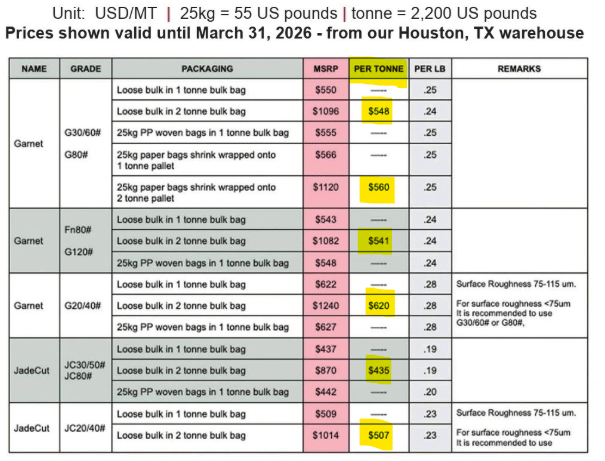
(This was from a LinkedIn post, which has since been deleted - source )
The biggest garnet name in North America (Barton International) also went to Norway to lock up distribution rights over Nordic Minings garnet. (source)
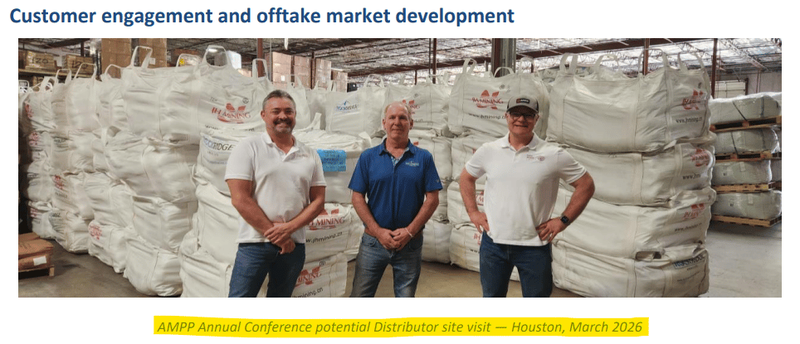
Hopefully, HVY was able to land a few meets and get in front of the big garnet buyers at this year’s AMPP conference in Houston (which HVY attended back in March). (source)
(The AMPP conference in Houston is a trade show for the coatings, surface-prep and abrasives industry) meeting US garnet distributors and end-users about potential offtake.
(source)
Maybe they will be one of the few people who actually read every single page of today’s PFS to see if HVY’s project is one they can secure early distribution rights on too.
Or maybe while they are reading the PFS they stumble across the South Australian deal and try to lock up that supply...
We will take either/OR on this one, as offtake/distribution deals will backstop any funding deal to get into production - which is a big part of our HVY Big Bet as follows:
Our "Big Bet" for HVY
"We want to see 20x return (from our Initial Entry Price of 11.3c) as HVY moves into production by 2026 and become a profitable garnet mine"
NOTE: our "Big Bet" is what we HOPE the ultimate success scenario looks like for this particular Investment over the long term (3+ years). There is a lot of work to be done and many risks involved - some of which we list below. Success will require a significant amount of luck. There is no guarantee that our Big Bet will ever come true.
What's next for HVY?
🔄 South Australian garnet project (deal with Hillgrove)
This is in our minds the closest project HVY has to first garnet production.
Next we want to see HVY raise the A$25-30M for its plant.
HVY has said it’s progressing discussions across project debt, royalty financing, prepay/offtake structures, government grants and equity. (source)
Here are the milestones we are tracking for this project:
- 🔲 Secure CAPEX funding for the project
- 🔲 Distribution/offtake deals
- 🔲 Final Investment Decision
- 🔲 Plant build
- 🔲 First production
🔄 Port Gregory (garnet development project in WA)
This is the asset today’s PFS relates to.
Here are the milestones we are tracking for this project:
- 🔲 Mining Lease application progress
- 🔲 Offtake and project financing conversations off the back of the PFS.
🔄 Red Hill - maiden resource
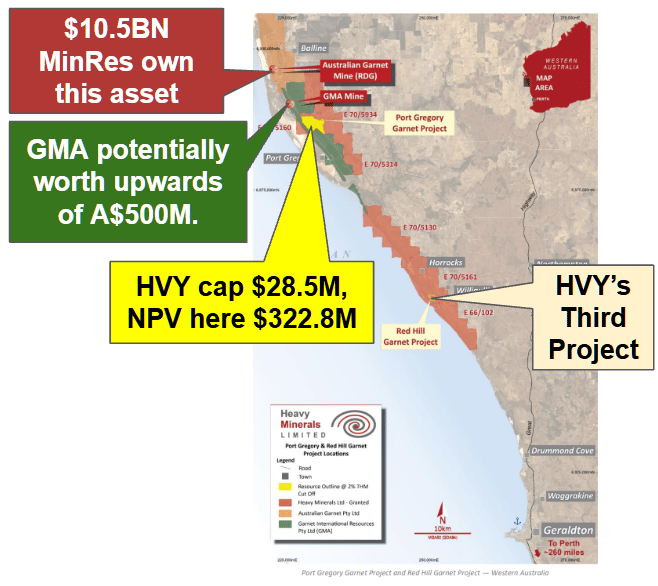
This is HVY’s third asset - an earlier stage exploration asset also in WA, ~37km away from its more advanced Port Gregory asset:
(source)
Here are the milestones we are tracking for this project:
- 🔲 Assay results (due this quarter)
- 🔲 Maiden JORC Resource
What could go wrong?
The single biggest risk right now is "funding risk".
HVY closed the March quarter with ~$46k in cash, and is funding working capital through its At-the-Market facility (~$1.8M undrawn) and tranche 2 of its royalty deal.
HVY needs to find $25-30M for the Kanmantoo plant, and multiples of that for Port Gregory.
The company wants to do this via debt, pre-sales and royalties - but there is no guarantee these funds are secured, and if they are, the terms could dictate how much dilution existing shareholders wear.
If HVY can't secure non-dilutive funding, a traditional discounted equity raise becomes more likely - which would run against the tight capital structure story that has underpinned the share price.
Financing risk
Due to a combination of any or all of the above risks, financing for the project is hard to come by or unavailable, and the project does not become operational.
Source: “What could go wrong” - HVY Investment Memo 14 July 2023
Other risks
Like any early-stage industrial minerals company, HVY carries significant risk, here we aim to identify a few more risks.
Processing historical and fresh mine tailings carries operational complexities, meaning plant recovery rates and mineral throughput could fall short of initial projections.
The South Australian operation depends heavily on Hillgrove Resources for site access, shared infrastructure, and ongoing tailings feedstock, creating direct reliance on a third-party operator.
HVY's funding strategy hinges on securing binding offtake or distribution agreements, and any delays in locking in commercial buyers could stall project financing.
While management is incentivised to hit commercial production before the end of 2026, standard plant construction or equipment commissioning delays could easily push out target timelines.
Industrial garnet pricing remains tied to broader economic cycles in shipbuilding and infrastructure manufacturing, exposing future revenue estimates to broader market fluctuations.
Investors should consider these risks carefully and seek professional advice tailored to their personal circumstances before investing.
Our HVY Investment Memo
Our Investment Memo provides a short, high-level summary of our reasons for Investing. We use this memo to track the progress of all our Investments over time.
Click here to read our HVY Investment Memo where you will find:
- What does HVY do?
- The macro theme for HVY
- Our HVY Big Bet
- What we want to see HVY achieve
- Why we are Invested in HVY
- The key risks to our Investment Thesis
- Our Investment Plan
General Information Only
This material has been prepared by StocksDigital. StocksDigital is an authorised representative (CAR 000433913) of 62 Consulting Pty Limited (ABN 88 664 809 303) (AFSL 548573).
This material is general advice only and is not an offer for the purchase or sale of any financial product or service. The material is not intended to provide you with personal financial or tax advice and does not take into account your personal objectives, financial situation or needs. Although we believe that the material is correct, no warranty of accuracy, reliability or completeness is given, except for liability under statute which cannot be excluded. Please note that past performance may not be indicative of future performance and that no guarantee of performance, the return of capital or a particular rate of return is given by 62C, StocksDigital, any of their related body corporates or any other person. To the maximum extent possible, 62C, StocksDigital, their related body corporates or any other person do not accept any liability for any statement in this material.
Conflicts of Interest Notice
S3 and its associated entities may hold investments in companies featured in its articles, including through being paid in the securities of the companies we provide commentary on. We disclose the securities held in relation to a particular company that we provide commentary on. Refer to our Disclosure Policy for information on our self-imposed trading blackouts, hold conditions and de-risking (sell conditions) which seek to mitigate against any potential conflicts of interest.
Publication Notice and Disclaimer
The information contained in this article is current as at the publication date. At the time of publishing, the information contained in this article is based on sources which are available in the public domain that we consider to be reliable, and our own analysis of those sources. The views of the author may not reflect the views of the AFSL holder. Any decision by you to purchase securities in the companies featured in this article should be done so after you have sought your own independent professional advice regarding this information and made your own inquiries as to the validity of any information in this article.
Any forward-looking statements contained in this article are not guarantees or predictions of future performance, and involve known and unknown risks, uncertainties and other factors, many of which are beyond our control, and which may cause actual results or performance of companies featured to differ materially from those expressed in the statements contained in this article. S3 cannot and does not give any assurance that the results or performance expressed or implied by any forward-looking statements contained in this article will actually occur and readers are cautioned not to put undue reliance on forward-looking statements.
This article may include references to our past investing performance. Past performance is not a reliable indicator of our future investing performance.